
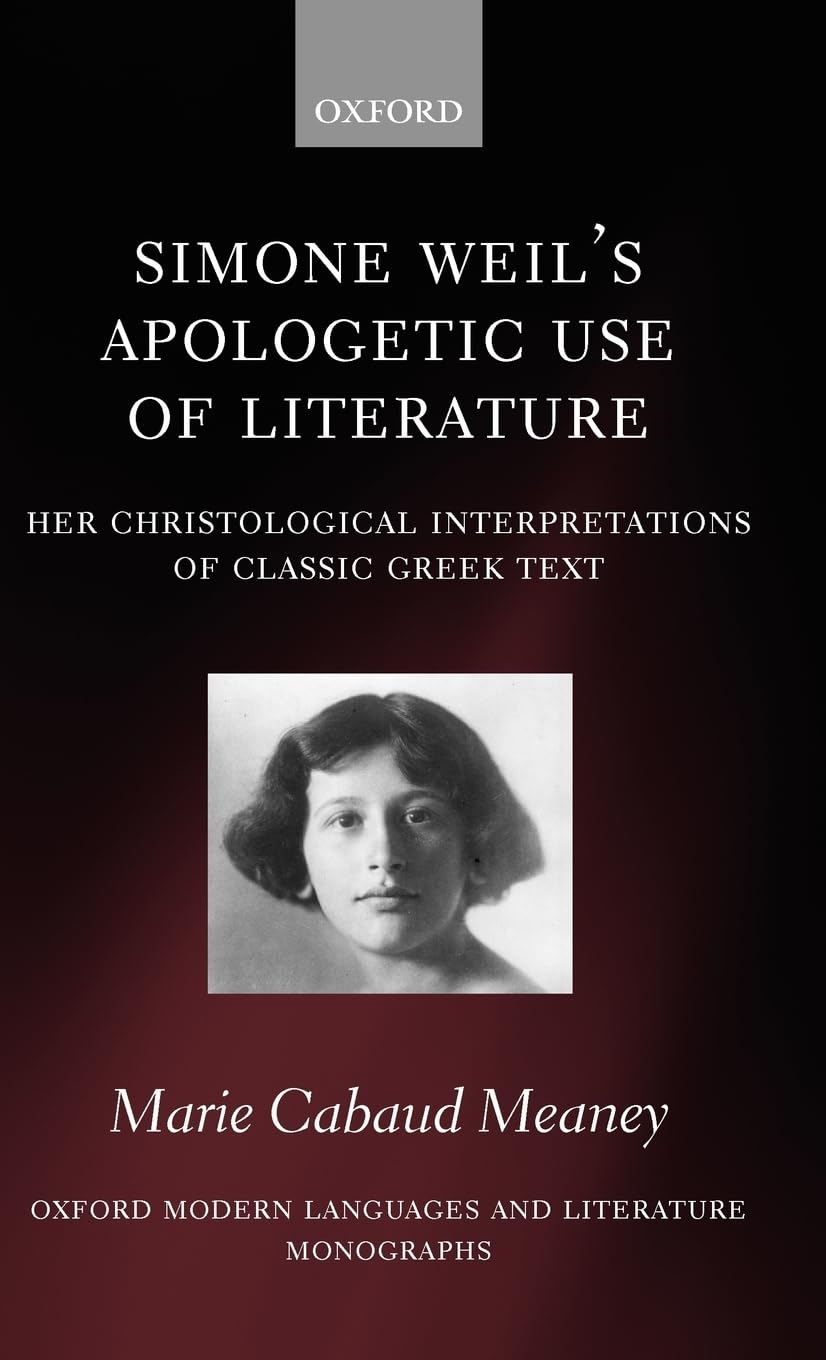
Simone Weil's Apologetic Use of Literature: Her Christological Interpretation of Classic Greek Texts by Marie Cabaud Mea
Inclusive of all applicable taxes. FREE shipping on all orders.
Available Offers
- 🚚Free Delivery — Free shipping on all orders
- 💵Cash on Delivery — Pay when your order arrives
- ↩️15-Day Easy Returns — Hassle-free return policy
- 🔒Cash on Delivery — Pay safely when your order arrives
Check Delivery
Product Description
Introduction
Simone Weil’s Apologetic Use of Literature: Her Christological Interpretation of Classic Greek Texts by Marie Cabaud Meaney is a profound exploration of how one of the twentieth century’s most original thinkers turned to ancient Greek literature to articulate a deeply Christian vision. Published by OUP Oxford, this hardcover volume offers a rigorous yet accessible analysis of Weil’s fragmentary writings on Sophocles, Homer, and Aeschylus. For Indian readers and students of literature, philosophy, or theology, this book opens a window into the intersection of classical heritage and spiritual renewal—a conversation that resonates across cultures and eras.
Book Overview
Meaney focuses on Simone Weil’s Christological readings of key Greek texts: Sophocles’ Antigone and Electra, Homer’s Iliad, and Aeschylus’ Prometheus Bound. Weil, a French philosopher and mystic who died in 1943, never formally joined the Catholic Church but immersed herself in Christian symbolism and doctrine. Her interpretations of these classics are often fragmentary, sometimes boldly twisting their literal meanings. Meaney argues that Weil’s purpose was apologetic—she sought to offer a spiritual antidote to the ideological fanaticism of World War II by re-Christianizing Europe. Through her readings, Weil aimed to show agnostic intellectuals that Greek texts could only be fully understood in light of Christ, while also revealing to Catholics that their faith was more universal than they imagined, as Greek culture already embodied the Christian spirit.
Key Highlights
- Original Analysis: Meaney provides the first sustained study of Weil’s interpretations of Antigone, Electra, and Prometheus Bound, which are rarely examined in scholarship.
- Apologetic Framework: The book demonstrates how Weil used literature as a tool for spiritual persuasion, addressing both secular intellectuals and Catholic believers.
- Historical Context: Weil’s writings are situated against the backdrop of World War II, showing her response to totalitarianism through a return to classical and Christian roots.
- Christological Lens: Meaney unpacks how Weil saw Christ’s presence in Greek myths and tragedies, from the suffering of Prometheus to the sacrificial love of Antigone.
- Scholarly Rigor: The book draws on unpublished notes and letters, offering fresh insights into Weil’s intellectual development.
Story Themes
The central theme is the redemptive power of suffering and love, which Weil perceived as the core of both Greek tragedy and Christian theology. In Antigone, she saw a figure of Christ-like defiance against unjust authority; in Electra, a soul consumed by grief yet yearning for divine justice. The Iliad revealed to Weil the brute force of war and the possibility of grace within violence, while Prometheus Bound embodied the crucified creator who bears the weight of human darkness. Meaney shows how these themes converge in Weil’s vision of a universal Christianity, one that transcends institutional boundaries and speaks to the deepest human longings for meaning and salvation.
Reader Benefits
- Deepen Literary Understanding: Gain a fresh perspective on classic Greek texts through the lens of a major philosopher and mystic.
- Explore Interdisciplinary Thought: The book bridges literature, theology, philosophy, and history, enriching your critical thinking.
- Engage with Apologetics: Understand how literature can serve as a medium for spiritual dialogue, relevant for students of religion and ethics.
- Enhance Academic Writing: Meaney’s clear, well-structured arguments provide a model for scholarly analysis.
- Cultural Relevance: For Indian readers, the book invites reflection on how ancient texts from any tradition can be reinterpreted to address contemporary crises.
Who Should Read
This book is ideal for advanced undergraduate and postgraduate students of English literature, comparative literature, philosophy, and religious studies. It will also appeal to scholars working on Simone Weil, Christian apologetics, or classical reception. General readers with an interest in the intersection of spirituality and literature will find it rewarding, provided they have some familiarity with Greek tragedies. Teachers looking for a text that challenges conventional readings of classics will appreciate its fresh approach. For those in India exploring the dialogue between Eastern and Western thought, Weil’s universalism offers a compelling case study.
About the Author
Marie Cabaud Meaney is a scholar of French literature and philosophy, with a specialization in Simone Weil’s thought. She has taught at universities in Europe and the United States, and her research focuses on the religious dimensions of modern literature. Meaney’s meticulous work on Weil’s unpublished manuscripts brings to light a lesser-known aspect of the philosopher’s legacy, establishing her as a leading voice in Weil studies. Her writing combines academic precision with a clear, engaging style that makes complex ideas accessible.
About the Publisher
OUP Oxford, part of the University of Oxford, is one of the world’s oldest and most respected academic publishers. Known for its rigorous peer-review process and high editorial standards, OUP produces works that shape scholarship across disciplines. This hardcover edition reflects the publisher’s commitment to durable, beautifully produced books that stand the test of time—perfect for libraries, research collections, and serious readers.
Conclusion
Simone Weil’s Apologetic Use of Literature is a vital contribution to understanding how a modern thinker used ancient texts to address the spiritual crises of her age. Marie Cabaud Meaney’s insightful analysis not only illuminates Weil’s Christological readings but also invites readers to reconsider the enduring power of Greek literature. For anyone passionate about the dialogue between faith, art, and history, this book is a treasure. Order your hardcover copy from Bookshops.in today and add a thought-provoking volume to your collection.
Quick Summary
Simone Weil's Apologetic Use of Literature by Marie Cabaud Meaney is a scholarly exploration of how the French philosopher Simone Weil employed Christological interpretations of classic Greek texts to advance a Christian apologetic agenda. Focusing on Sophocles' Antigone and Electra, Homer's Iliad, and Aeschylus' Prometheus Bound, Meaney reveals that Weil deliberately twisted these ancient works—sometimes contradicting their literal meaning—to address the spiritual crises of ideology and fanaticism during World War II. The book argues that Weil, though not baptized, sought to re-Christianize Europe by showing agnostic intellectuals that their cherished classics could only be fully understood through a Christian lens. This study is ideal for students and scholars of theology, literature, philosophy, and intellectual history. Readers will gain a deeper understanding of Weil's unique method, her wartime context, and the enduring power of classical literature to convey spiritual truths. By purchasing from Bookshops.in, Indian readers receive a premium hardcover edition from OUP Oxford, ensuring reliable academic quality and fast delivery.
Book Highlights
Book Specifications
| ISBN-13 | 9780199212453 |
| ISBN-10 | 0199212457 |
| Publisher | Clarendon Pr |
| Language | English |
| Dimensions | 21.59 x 2.29 x 14.22 cm |
| Weight | 454 g |
| Country | India |
| Category | Region & Countries › Europe |
| Genre | Literary Criticism |
| Original Language | English |
Frequently Asked Questions
What is the main argument of Simone Weil's Apologetic Use of Literature?
Which Greek texts does Simone Weil interpret in this study?
Who is the author of this book?
Is this book suitable for undergraduate students?
Does the book cover all of Weil's literary criticism?
Why did Simone Weil use Greek classics for Christian apologetics?
How does this book relate to World War II?
Is this book only for religious readers?
What makes this book unique?
Does the book include Weil's original texts?
Is this book available in paperback?
Can Indian readers benefit from this book?
Readers Also Search For
Related Products
View All
History
The Information Revolution: Transforming the World Through Technology (World History)
History
Human Nature and the French Revolution: From the Enlightenment to the Napoleonic Code: 3 (Polygons: Cultural Diversities and Intersections, 3)
History
The Unmaking of Home in Contemporary Art (Cultural Spaces)

History
Handbook to Life in Medieval and Early Modern Japan | by William E. Deal | Oxford University Press | by William E. Deal | Oxford University Press | by William E. Deal | Oxford University Press | by William E. Deal | Oxford University Press | by William E. Deal | Oxford University Press | by William E. Deal | Oxford University Press | by William E. Deal | Oxford University Press | by William E. Deal | Oxford University Press | by William E. Deal | Oxford University Press | by William E. Deal | Ox

History
The Narrators of Barbarian History (A.D. 550-800) | by Walter Goffart | University of Notre Dame Press | by Walter Goffart | University of Notre Dame Press | by Walter Goffart | University of Notre Dame Press | by Walter Goffart | University of Notre Dame Press | by Walter Goffart | University of Notre Dame Press | by Walter Goffart | University of Notre Dame Press | by Walter Goffart | University of Notre Dame Press | by Walter Goffart | University of Notre Dame Press | by Walter Goffart | Univ
History