
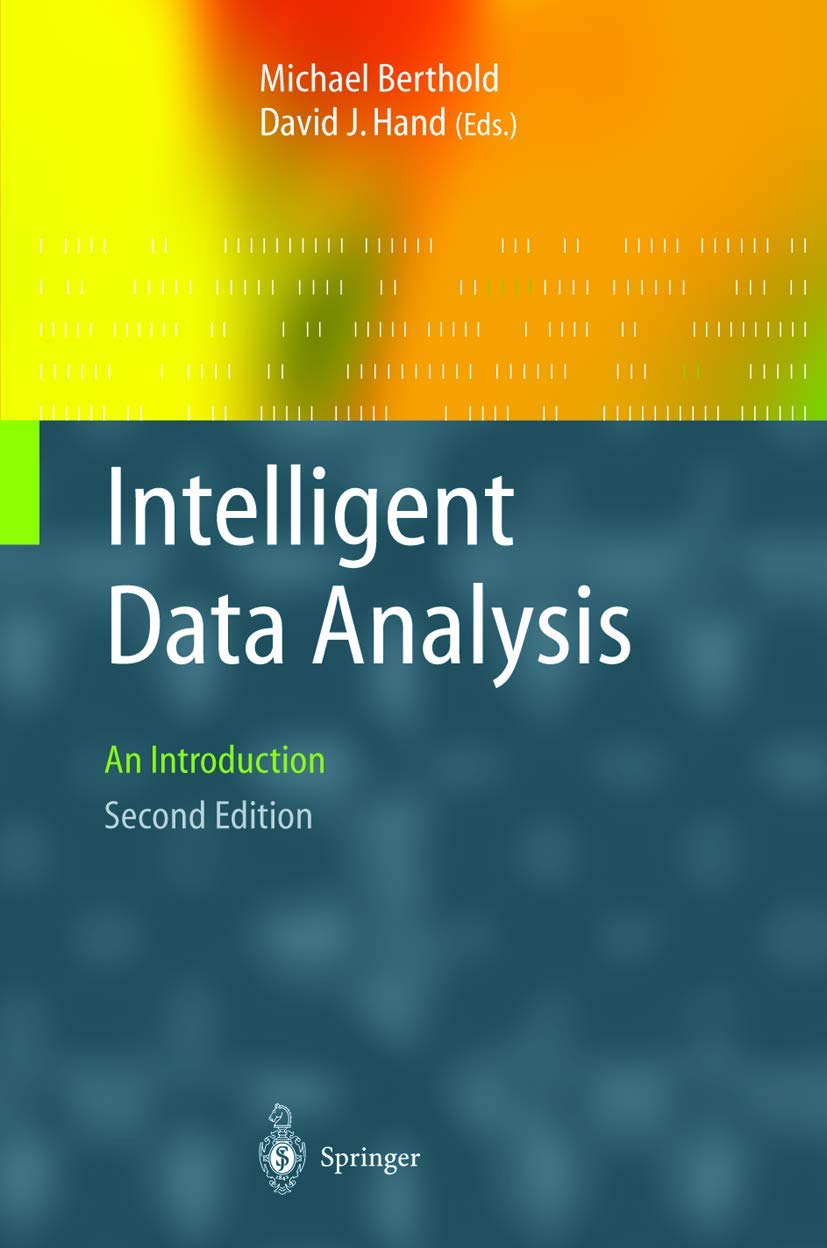
Intelligent Data Analysis: An Introduction – A Comprehensive Data Science Textbook by Michael R. Berthold
Inclusive of all applicable taxes. FREE shipping on all orders.
Available Offers
- 🚚Free Delivery — Free shipping on all orders
- 💵Cash on Delivery — Pay when your order arrives
- ↩️15-Day Easy Returns — Hassle-free return policy
- 🔒Cash on Delivery — Pay safely when your order arrives
Check Delivery
Product Description
Introduction
Intelligent Data Analysis: An Introduction by Michael R. Berthold is a definitive resource for students, researchers, and professionals seeking a comprehensive understanding of modern data analysis techniques. Published by Springer, this hardcover edition serves as a bridge between classical statistical methods and cutting-edge artificial intelligence approaches. Whether you are a postgraduate student in India pursuing data science or a working professional looking to deepen your analytical skills, this book offers a structured and rigorous introduction to the field. The revised second edition ensures that readers are equipped with both foundational knowledge and advanced methodologies, making it an essential addition to any data enthusiast's library.
Book Overview
This second and revised edition of Intelligent Data Analysis: An Introduction provides a detailed exploration of the key classes of intelligent data analysis methods. The book is divided into twelve coherently written chapters, each contributed by leading experts in the field. The first half of the volume focuses on classical statistical issues, offering a solid grounding in probability, hypothesis testing, and data modeling. The latter half delves into machine learning and artificial intelligence, covering rule induction, neural networks, fuzzy logic, and stochastic search methods. The book concludes with a chapter on visualization techniques and an advanced overview of the IDA process, ensuring readers can apply these concepts to real-world problems. This balanced approach makes it suitable for both academic coursework and self-study.
Key Highlights
- Comprehensive Coverage: Bridges classical statistics with modern AI and machine learning techniques.
- Expert Contributions: Twelve chapters written by leading international researchers in data science.
- Revised Edition: Updated content reflecting the latest advances in intelligent data analysis.
- Practical Focus: Includes real-world examples and case studies to illustrate key concepts.
- Visualization Emphasis: Dedicated chapter on data visualization for effective communication of insights.
- Hardbound Quality: Durable hardcover format ideal for libraries and long-term reference.
Inside the Book
The book opens with a thorough introduction to statistical foundations, including exploratory data analysis, probability distributions, and inferential statistics. Subsequent chapters explore machine learning paradigms such as supervised and unsupervised learning, decision trees, and ensemble methods. A dedicated section on neural networks covers both feedforward and recurrent architectures, while the fuzzy logic chapter explains how to handle uncertainty in data. Stochastic search methods, including genetic algorithms and simulated annealing, are presented with clear pseudocode and applications. The final chapters address data visualization principles and the complete IDA workflow, from data preprocessing to model evaluation. Each chapter includes exercises and references for further reading, making it an excellent textbook for Indian university courses in data science and analytics.
Key Topics
- Statistical Foundations: Probability theory, hypothesis testing, regression analysis, and multivariate statistics.
- Machine Learning: Decision trees, support vector machines, clustering algorithms, and dimensionality reduction.
- Artificial Intelligence: Rule induction, expert systems, and knowledge representation.
- Neural Networks: Perceptrons, backpropagation, deep learning basics, and network optimization.
- Fuzzy Logic: Membership functions, fuzzy inference systems, and applications in control and classification.
- Stochastic Methods: Genetic algorithms, particle swarm optimization, and Monte Carlo techniques.
- Data Visualization: Graphs, charts, interactive dashboards, and visual analytics for big data.
- IDA Process: Data cleaning, feature selection, model validation, and deployment strategies.
Reader Benefits
By studying this book, readers will gain a holistic understanding of how to extract meaningful insights from complex datasets. The blend of theory and practice ensures that you can immediately apply techniques to real-world problems in business, healthcare, finance, and engineering. The expert-written chapters provide multiple perspectives, helping you develop a versatile toolkit for data analysis. The inclusion of stochastic and fuzzy methods prepares you for handling noisy and incomplete data, which is common in Indian contexts such as agricultural data, urban planning, and public health. Additionally, the visualization chapter equips you with skills to present findings to non-technical stakeholders, a crucial ability for data scientists in any organization.
Learning Outcomes
- Master Statistical Techniques: Perform exploratory data analysis, hypothesis testing, and regression modeling with confidence.
- Implement Machine Learning Algorithms: Build and evaluate decision trees, neural networks, and clustering models using standard frameworks.
- Apply Fuzzy Logic and Stochastic Methods: Solve optimization and classification problems under uncertainty.
- Create Effective Visualizations: Design data dashboards and charts that communicate insights clearly.
- Understand the IDA Workflow: Manage end-to-end data analysis projects from raw data to actionable insights.
- Critically Evaluate Models: Use cross-validation, bias-variance tradeoff, and performance metrics to select robust solutions.
Who Should Read
This book is ideal for postgraduate students in data science, computer science, statistics, and related fields at Indian universities. It is also highly recommended for researchers in academia and industry who need a solid reference on intelligent data analysis methods. Professionals working as data analysts, business intelligence experts, and AI engineers will find the practical examples and advanced topics invaluable for upskilling. Additionally, faculty members teaching courses on data mining, machine learning, or statistical computing can use this book as a primary or supplementary textbook. The clear writing style and structured chapters make it accessible even to those with a basic background in mathematics and programming.
About the Author
Michael R. Berthold is a renowned researcher and educator in the field of data science and artificial intelligence. He has contributed extensively to the development of intelligent data analysis methods, with a particular focus on machine learning, fuzzy systems, and knowledge discovery. Berthold has authored numerous peer-reviewed papers and edited several influential books. His expertise spans both theoretical foundations and practical applications, making him an authoritative voice in the discipline. As a professor and leader of research groups, he has mentored generations of data scientists, and his work continues to shape the evolution of intelligent data analysis worldwide.
About the Publisher
Springer is a globally respected academic publisher known for its high-quality scientific, technical, and medical books and journals. With a history spanning over 180 years, Springer has been at the forefront of disseminating cutting-edge research and educational content. The publisher is particularly renowned for its series in computer science, engineering, and data analytics, offering rigorous peer-reviewed content that meets the needs of students, researchers, and professionals. This hardcover edition of Intelligent Data Analysis: An Introduction reflects Springer's commitment to excellence, featuring durable binding and clear typesetting suitable for long-term use in libraries and personal collections.
Conclusion
Intelligent Data Analysis: An Introduction is more than a textbook—it is a comprehensive guide to the art and science of extracting knowledge from data. With its balanced coverage of statistics, machine learning, AI, and visualization, this book prepares readers for the challenges of modern data-driven decision-making. The revised second edition ensures that content remains relevant in a rapidly evolving field. For Indian students and professionals seeking to build a strong foundation in data science, this hardcover edition from Springer is a wise investment. Add it to your library today and take a decisive step toward mastering intelligent data analysis.
Quick Summary
Intelligent Data Analysis: An Introduction by Michael R. Berthold is a comprehensive textbook that bridges classical statistics and modern artificial intelligence for data analysis. Designed for Indian students and professionals, the book covers statistical methods, machine learning, rule induction, neural networks, fuzzy logic, stochastic search, and data visualization. Each chapter is written by a domain expert, providing deep yet accessible insights. Readers will learn to apply these techniques to real-world problems, from pattern recognition to predictive modeling. The book concludes with a detailed look at the Intelligent Data Analysis (IDA) process, offering a complete framework for data projects. Published by Springer, this hardcover edition is a durable reference for academic courses and professional practice. By purchasing from Bookshops.in, Indian readers get authentic imported copies with fast delivery and reliable customer service, making it the preferred choice for serious learners.
Book Highlights
Book Specifications
| ISBN-13 | 9783540430605 |
| ISBN-10 | 3540430601 |
| Publisher | Springer Nature |
| Language | English |
| Dimensions | 16.51 x 3.18 x 24.77 cm |
| Weight | 871 g |
| Category | Mathematics › Statistics |
| Genre | Non-fiction |
| Original Language | English |
Frequently Asked Questions
Is this book suitable for beginners in data science?
Does the book cover Python or R programming?
Is this book used in Indian university curricula?
What is the difference between this book and other data analysis books?
Does the book include exercises or problems?
Who are the contributing authors?
Can I use this book for self-study?
Is there a focus on Indian datasets or examples?
What is the ISBN-13 of this book?
Is the book available in hardcover?
What topics are covered in the second half of the book?
Does the book include a chapter on data visualization?
How is the book priced in Indian rupees?
Readers Also Search For
Customers Also Bought
Mathematics
Stereotype Spaces and Algebras: 73 (De Gruyter Expositions in Mathematics, 73)

Mathematics
Semigroups in Algebra, Geometry and Analysis: 20 (De Gruyter Expositions in Mathematics, 20)

Mathematics
Geometry from the Pacific Rim: Proceedings of the Pacific Rim Geometry Conference held at National University of Singapore, Republic of Singapore, ... 1994 (De Gruyter Proceedings in Mathematics)

Mathematics
First International Tainan-Moscow Algebra Workshop: Proceedings of the International Conference held at National Cheng Kung University Tainan, Taiwan, ... 1994 (De Gruyter Proceedings in Mathematics)

Mathematics
Differential Geometry - Proceedings of the VIII International Colloquium (English, Jesus A. Alvarez Lopez | Eduardo Garcia-Rio)
Mathematics
Mathematical Theory of Optimal Processes (Classics of Soviet Mathematics)
Related Products
View All
Statistics
Asymptotics in Statistics and Probability: Papers in Honor of George Gregory Roussas
Statistics
Inequalities in Analysis and Probability: 3rd Edition
Statistics
Random Graphs, Geometry and Asymptotic Structure
Statistics
Inference for Functional Data With Applications: 200 (Springer Series in Statistics, 692)
Statistics
High-Dimensional Probability: An Introduction with Applications in Data Science (Cambridge Series in Statistical and Probabilistic Mathematics)
Statistics