
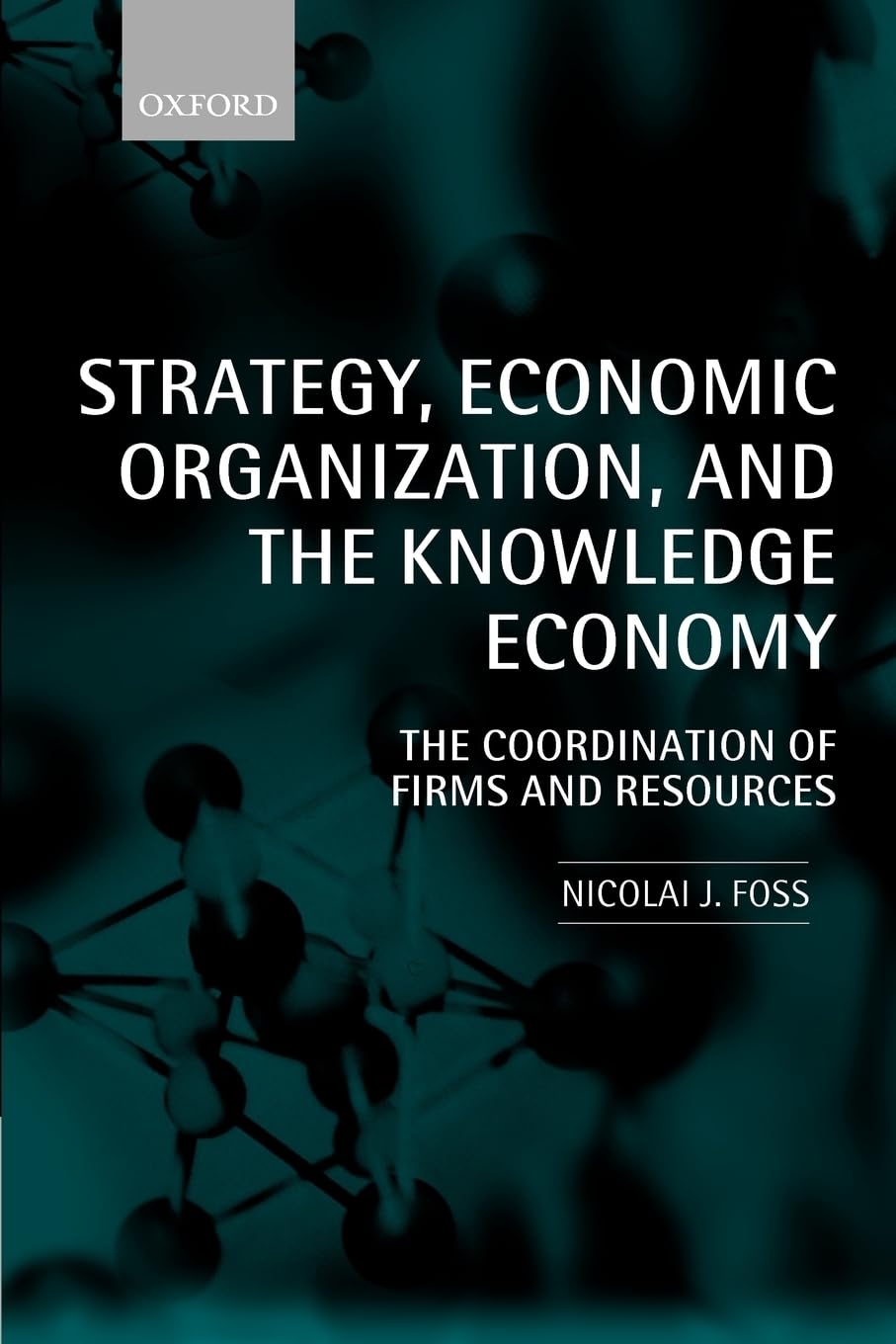
Strategy, Economic Organization, And the Knowledge Economy: The Coordination of Firms And Resources by Nicolai J. Foss –
Inclusive of all applicable taxes. FREE shipping on all orders.
Available Offers
- 🚚Free Delivery — Free shipping on all orders
- 💵Cash on Delivery — Pay when your order arrives
- ↩️15-Day Easy Returns — Hassle-free return policy
- 🔒Cash on Delivery — Pay safely when your order arrives
Check Delivery
Product Description
Introduction
In an era where information and intangible assets drive economic growth, understanding the intricate relationship between strategy, organizational design, and the knowledge economy is more critical than ever. Nicolai J. Foss’s seminal work, Strategy, Economic Organization, And the Knowledge Economy: The Coordination of Firms And Resources, bridges the gap between management theory and economic analysis, offering a nuanced framework for navigating modern business complexities. This hardcover edition, published by OUP Oxford, is an essential resource for Indian scholars, corporate strategists, and students seeking to decode how firms coordinate resources in a knowledge-driven world.
Book Overview
This book systematically explores the complementarity between knowledge-based approaches—popular in strategic management—and organizational economics, particularly transaction cost economics and agency theory. Foss argues that rather than being opposing schools of thought, these perspectives can enrich each other to explain how firms efficiently organize production, innovation, and resource allocation. The text delves into theoretical foundations and empirical evidence, examining how firms adapt their internal structures, boundaries, and strategies in response to the rise of the knowledge economy. It challenges simplistic dichotomies and provides a robust analytical toolkit for understanding coordination problems in modern enterprises.
Key Highlights
- Integrative Framework: Merges knowledge-based views with organizational economics to offer a holistic understanding of firm behavior.
- Theoretical Rigour: Builds on foundational concepts from Ronald Coase, Oliver Williamson, and modern capability theorists.
- Empirical Insights: Draws on real-world case studies and data to illustrate how firms manage knowledge assets and organizational boundaries.
- Contemporary Relevance: Directly addresses challenges posed by digitization, innovation, and intangible resource coordination.
- Authoritative Scholarship: Written by Nicolai J. Foss, a leading figure in strategic management and organizational economics.
Inside the Book
The book is structured into several thematic sections. Early chapters lay the groundwork by contrasting knowledge-based and transaction cost perspectives. Subsequent chapters explore how firms design incentive systems, governance structures, and internal labor markets to foster knowledge creation and sharing. Foss critically examines the concept of ‘organizational capabilities’ and how they interact with contractual and hierarchical arrangements. Later sections apply the framework to topics like outsourcing, innovation networks, and multinational enterprise strategy. Each chapter concludes with thought-provoking questions and references for further study, making it ideal for classroom use or self-directed learning.
Key Topics
- Coordination of resources in knowledge-intensive firms
- Transaction cost economics versus capabilities-based strategy
- Organizational design and incentive alignment
- Knowledge governance and property rights
- Firm boundaries in the knowledge economy
- Strategic implications of intangible assets
- Empirical methods for studying economic organization
Reader Benefits
- Deepened Analytical Skills: Learn to critically evaluate different theoretical approaches to firm strategy and organization.
- Practical Frameworks: Gain actionable insights for designing organizational structures that promote innovation and efficiency.
- Academic Excellence: Perfect for postgraduate courses in economics, business strategy, and organizational behaviour in Indian universities.
- Career Advancement: Equip yourself with concepts valued in consulting, corporate strategy, and policy-making roles.
- Cross-Disciplinary Understanding: Develop a nuanced perspective that bridges economics and management.
Learning Outcomes
After reading this book, you will be able to: explain why firms exist and how they differ from markets; analyse the role of knowledge as a strategic resource; evaluate trade-offs between hierarchical and market-based coordination; design governance mechanisms that align individual incentives with organizational goals; and apply economic reasoning to real-world strategic dilemmas in Indian and global contexts.
Who Should Read
- MBA and postgraduate students in strategy, economics, or organizational theory
- Corporate strategists and business consultants seeking theoretical grounding
- Academics and researchers exploring economic organization and knowledge management
- Policy analysts interested in firm behaviour and industrial dynamics
- Senior managers in knowledge-intensive sectors like IT, consulting, and R&D
About the Author
Nicolai J. Foss is a distinguished professor of strategy and organization at the Copenhagen Business School and a leading voice in the fields of strategic management and organizational economics. His research has been published in top-tier journals such as the Strategic Management Journal and the Journal of Management Studies. Foss is known for his ability to synthesize diverse theoretical traditions, making complex ideas accessible without sacrificing depth. His work has influenced both academic thought and managerial practice worldwide.
About the Publisher
OUP Oxford (Oxford University Press) is a globally respected academic publisher known for its rigorous peer-review process and high-quality scholarly output. With a history spanning over five centuries, OUP publishes authoritative works across disciplines, including economics, management, and social sciences. This hardcover edition reflects the publisher’s commitment to durable, beautifully bound books that stand the test of time—ideal for libraries, personal collections, and academic institutions in India.
Conclusion
Strategy, Economic Organization, And the Knowledge Economy is not just a textbook; it is a thought-provoking journey into the heart of modern economic organization. By reconciling knowledge-based and economic approaches, Nicolai J. Foss provides a roadmap for firms operating in an increasingly intangible economy. For Indian readers—whether students at IIMs, researchers at Delhi School of Economics, or professionals in Bengaluru’s tech hubs—this book offers enduring value. Add this hardcover to your library today and elevate your understanding of strategy in the knowledge age.
Quick Summary
Strategy, Economic Organization, And the Knowledge Economy: The Coordination of Firms And Resources by Nicolai J. Foss is a groundbreaking academic work that bridges two influential yet often divided streams of thought: knowledge-based or capabilities-based approaches in management, and the economics of organization. The book argues convincingly that these perspectives are not rivals but complementary lenses for understanding how firms coordinate resources and formulate strategy in today's knowledge-driven economy. Readers will gain a deep theoretical understanding of firm boundaries, transaction costs, resource allocation, and the role of knowledge in competitive advantage. This book is ideal for postgraduate students in management and economics in India, as well as researchers and professionals who want a rigorous yet accessible framework for analyzing organizational design and strategic decision-making. By integrating insights from both strategy and economics, Foss provides a holistic view that is rare in the literature. Purchasing from Bookshops.in ensures you receive an authentic, high-quality hardcover edition from a trusted Indian bookstore, with reliable delivery and customer service.
Book Highlights
Book Specifications
| ISBN-13 | 9780199205325 |
| ISBN-10 | 0199205329 |
| Publisher | Oxford Univ Pr on Demand |
| Language | English |
| Dimensions | 15.88 x 1.73 x 23.5 cm |
| Weight | 499 g |
| Category | Business & Economics › Economics |
| Genre | Non-fiction |
| Original Language | English |
Frequently Asked Questions
What is the main argument of this book?
Who is the author of this book?
Is this book suitable for Indian students?
What topics are covered in the book?
Does the book include case studies?
What is the ISBN-13 of this book?
Is this a hardcover or paperback edition?
What is the price of this book in India?
Can I use this book for a PhD research?
Does the book address Indian business contexts?
What is the reading level of this book?
Where can I buy this book in India?
Readers Also Search For
Customers Also Bought

Entrepreneurship
Chinese Economic Revolution (English, Linda Grove)
Entrepreneurship
Engines of Innovation: The Entrepreneurial University in the Twenty-First Century by Holden Thorp
Entrepreneurship
Invention to Innovation (English, PhD Marshall Larry | Jenna Daroczy)

Entrepreneurship
Database Management Systems by Raghu Ramakrishnan – DBMS Textbook

Entrepreneurship
Decision-making for Technology Executives by Harold A. Linstone
Entrepreneurship
The Business Innovation Audit (English, William Tate)
Related Products
View All
Economics
Political Economy from Pufendorf to Marx (English, István Hont | Lasse S. Andersen | Béla Kapossy)
Economics
Women's Entrepreneurship and Economics (English, Miguel-Angel Galindo | Domingo Ribeiro)
Economics
Trade Policy and Industrialization in Turbulent Times | by Gerry Helleiner | Routledge | by Gerry Helleiner | Routledge | by Gerry Helleiner | Routledge | by Gerry Helleiner | Routledge | by Gerry Helleiner | Routledge | by Gerry Helleiner | Routledge | by Gerry Helleiner | Routledge | by Gerry Helleiner | Routledge | by Gerry Helleiner | Routledge | by Gerry Helleiner | Routledge | by Gerry Helleiner | Routledge | by Gerry Helleiner | Routledge | by Gerry Helleiner | Routledge | by Gerry Hellei
Economics
History of Economic Analysis | by Schumpeter Joseph A. | Taylor & Francis Ltd | by Schumpeter Joseph A. | Taylor & Francis Ltd | by Schumpeter Joseph A. | Taylor & Francis Ltd | by Schumpeter Joseph A. | Taylor & Francis Ltd | by Schumpeter Joseph A. | Taylor & Francis Ltd | by Schumpeter Joseph A. | Taylor & Francis Ltd | by Schumpeter Joseph A. | Taylor & Francis Ltd | by Schumpeter Joseph A. | Taylor & Francis Ltd | by Schumpeter Joseph A. | Taylor & Franci

Economics
OECD Compendium of Productivity Indicators 2015 | by Organization for Economic Cooperation an | Organization for Economic Co-Operation & Deve | by Organization for Economic Cooperation an | Organization for Economic Co-Operation & Deve | by Organization for Economic Cooperation an | Organization for Economic Co-Operation & Deve | by Organization for Economic Cooperation an | Organization for Economic Co-Operation & Deve | by Organization for Economic Cooperation an | Organization

Economics