
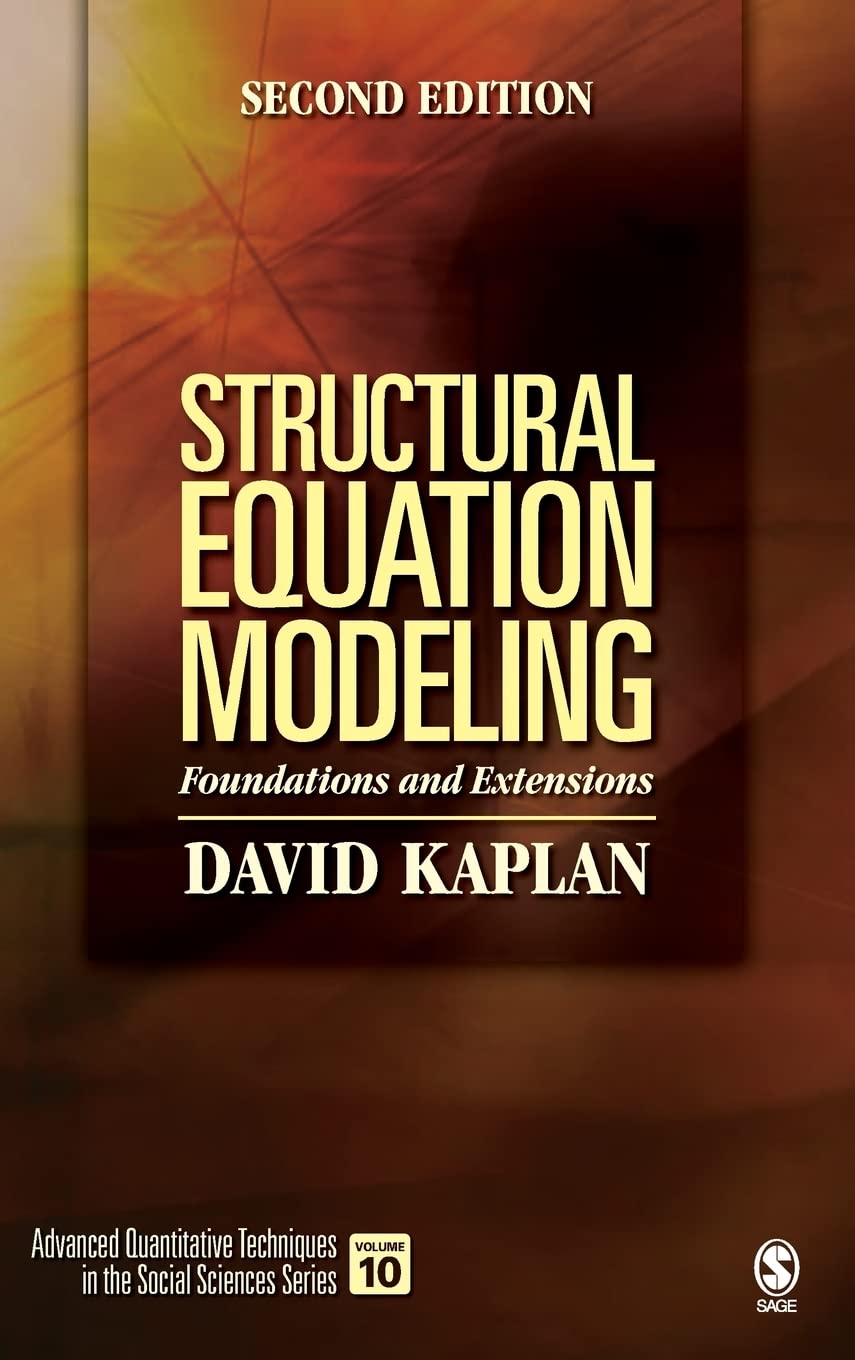
Structural Equation Modeling: Foundations and Extensions – A Comprehensive Guide to SEM Methods and Applications by Davi
Inclusive of all applicable taxes. FREE shipping on all orders.
Available Offers
- 🚚Free Delivery — Free shipping on all orders
- 💵Cash on Delivery — Pay when your order arrives
- ↩️15-Day Easy Returns — Hassle-free return policy
- 🔒Cash on Delivery — Pay safely when your order arrives
Check Delivery
Product Description
Introduction
Structural Equation Modeling (SEM) stands as one of the most powerful statistical techniques in the social and behavioural sciences, enabling researchers to test complex theoretical frameworks with empirical data. David Kaplan’s Structural Equation Modeling: Foundations and Extensions, published by Sage Publications, Inc, offers a rigorous yet accessible gateway into this sophisticated methodology. Designed for graduate students and practising researchers in India and worldwide, this hardcover edition provides a comprehensive treatment of SEM’s core principles, advanced extensions, and practical applications. Whether you are exploring causal pathways, latent variable models, or measurement invariance, this book equips you with the conceptual clarity and technical skills needed to conduct robust SEM analyses.
Book Overview
Now in its second edition, this volume builds on the strengths of the first by integrating updated examples, new extensions, and deeper coverage of foundational assumptions. Kaplan’s approach is distinctly empirical: each chapter grounds theoretical discussion in real-world data from the social and behavioural sciences, making abstract concepts tangible. The book bridges the gap between introductory statistics and advanced SEM topics, ensuring readers can move from understanding basic regression to designing and evaluating complex structural models. With a focus on critical assumptions—normality, sample size, model identification, and fit indices—the text prepares readers to apply SEM responsibly and interpret results with confidence.
Key Highlights
- Empirical focus: Detailed real-data examples from psychology, education, and sociology illustrate each technique.
- Foundations first: Thorough coverage of path analysis, confirmatory factor analysis, and latent variable modelling before moving to extensions.
- Critical assumptions: In-depth discussion of normality, missing data, and model identification to avoid common pitfalls.
- Advanced extensions: Chapters on multilevel SEM, latent growth curves, mixture models, and Bayesian SEM.
- Software-agnostic: Concepts are explained independently, though references to popular SEM software (e.g., LISREL, Mplus) are included.
- Updated second edition: New material on effect sizes, power analysis, and handling non-normal and categorical data.
Inside the Book
The book is structured to guide readers from foundational concepts to cutting-edge extensions. Part I covers the logic of SEM, including covariance structure analysis, model specification, identification, estimation, and fit evaluation. Part II delves into confirmatory factor analysis and structural regression models, with emphasis on measurement theory. Part III introduces advanced topics such as multiple-group SEM, latent growth modelling, and mixture models for unobserved heterogeneity. Each chapter includes worked examples, annotated output, and exercises that reinforce learning. Kaplan’s writing is clear and methodical, avoiding unnecessary jargon while maintaining statistical rigour.
Key Topics
- Path analysis and covariance structure modelling
- Confirmatory factor analysis (CFA) and measurement invariance
- Structural regression models with latent variables
- Model fit assessment: chi-square, RMSEA, CFI, TLI, SRMR
- Handling non-normal and categorical data
- Multilevel SEM (clustered data)
- Latent growth curve modelling for longitudinal data
- Mixture models and finite mixture SEM
- Bayesian approaches to SEM
- Power analysis and sample size planning
Reader Benefits
By studying this book, you will develop a deep understanding of SEM’s logic and limitations. You will learn to specify, estimate, and evaluate models that reflect your substantive theories. The empirical examples help you see how SEM illuminates research questions—from testing mediation hypotheses to examining developmental trajectories. The focus on assumptions ensures you avoid common errors, such as misinterpreting fit indices or ignoring measurement error. Indian students and researchers will find the content directly applicable to fields like educational psychology, marketing, public health, and organisational behaviour, where SEM is increasingly used for thesis work and journal publications.
Learning Outcomes
- Understand the mathematical and conceptual foundations of SEM
- Specify and identify structural equation models correctly
- Conduct confirmatory factor analysis and assess measurement models
- Evaluate model fit using appropriate indices and guidelines
- Handle missing data, non-normality, and categorical variables
- Apply advanced extensions like multilevel SEM and latent growth curves
- Interpret SEM results for academic papers and dissertations
- Critically evaluate published SEM studies
Who Should Read
This book is ideal for postgraduate students in psychology, sociology, education, economics, and business who have completed introductory courses in multivariate statistics. Researchers in Indian universities, research institutes, and market research firms will find it a valuable reference for conducting SEM-based studies. Faculty members teaching advanced quantitative methods will appreciate the balanced blend of theory and application. Professionals in data analytics and survey research who wish to move beyond regression to causal modelling will also benefit. The book assumes basic knowledge of regression and factor analysis, but no prior SEM experience is required.
About the Author
David Kaplan is a professor of quantitative methods in the School of Education at the University of Wisconsin–Madison. He has published extensively on SEM, Bayesian statistics, and educational measurement. His research focuses on the integration of statistical modelling with policy analysis, and he has served on editorial boards of leading journals. Kaplan’s teaching experience informs the clarity and pedagogical structure of this book, making it a trusted resource for students and researchers worldwide.
About the Publisher
Sage Publications, Inc is a renowned academic and professional publisher with a strong presence in India. Known for its rigorous editorial standards and commitment to advancing social science research, Sage publishes influential textbooks, reference works, and journals. This hardcover edition reflects Sage’s dedication to producing durable, high-quality academic books that support learning and scholarship across disciplines.
Conclusion
Structural Equation Modeling: Foundations and Extensions is more than a textbook—it is a mentor guiding you through one of statistics’ most powerful frameworks. With its empirical grounding, clear exposition, and coverage of both classic and modern extensions, this book deserves a place on the shelf of every serious quantitative researcher. For Indian students and academics aiming to produce rigorous, publishable SEM work, this second edition is an indispensable companion. Order your copy from Bookshops.in today and take your analytical skills to the next level.
Quick Summary
Structural Equation Modeling: Foundations and Extensions by David Kaplan is a definitive guide for researchers and graduate students seeking a thorough understanding of SEM. The book begins with the core principles—model specification, identification, estimation, and fit evaluation—using clear empirical examples from the social and behavioral sciences. It then moves into advanced topics such as multilevel SEM, longitudinal modeling, handling missing data, and nonnormal distributions, equipping readers with modern analytical tools. Kaplan’s accessible writing style demystifies complex statistical concepts without sacrificing rigor, making the book suitable for both newcomers and experienced analysts. Readers will learn not only how to run SEM analyses but also how to interpret results critically and avoid common pitfalls. By purchasing from Bookshops.in, Indian customers receive a genuine hardcover edition published by Sage Publications, ensuring high-quality print and binding. Whether you are preparing a dissertation, publishing research, or advancing your statistical skills, this book provides the foundation and extensions you need to excel in SEM.
Book Highlights
Book Specifications
| ISBN-13 | 9781412916240 |
| ISBN-10 | 1412916240 |
| Publisher | SAGE Publications Inc |
| Language | English |
| Dimensions | 15.24 x 1.91 x 22.86 cm |
| Weight | 480 g |
| Country | India |
| Category | Society & Social Sciences › Society & Culture |
| Genre | Non-fiction |
| Original Language | English |
Frequently Asked Questions
What is Structural Equation Modeling?
Who is David Kaplan?
Is this book suitable for beginners?
What topics are covered in this edition?
Does the book include software guidance?
What is the difference between this and other SEM books?
Is this book used in Indian universities?
What is the ISBN for this book?
Can I use this book for self-study?
Does the book cover confirmatory factor analysis?
What is the price of this book?
Is this book available in hardcover?
Why should I buy from Bookshops.in?
Readers Also Search For
Customers Also Bought

Sociology
Imagination Beyond Nation: Latin American Popular Culture: 349 (Pitt Latin American Series)

Sociology
Boomer Volunteer Engagement: Facilitator's Tool Kit

Sociology
Making a Success of Marriage: Planning for Happily Ever After

Sociology
Causal Mediation Analysis (Analytical Methods for Social Research)

Sociology
Marriage and the Moral Imagination (New Departures in Anthropology)

Sociology
Social Change, Resistance and Social Practices: 19 (Studies in Critical Social Sciences, 19)
Related Products
View All
Society & Social Sciences
Oxford Studies in Epistemology, Volume 3 | by Tamar Szabo Gendler | John Hawthorne | OUP UK | by Tamar Szabo Gendler | John Hawthorne | OUP UK | by Tamar Szabo Gendler | John Hawthorne | OUP UK | by Tamar Szabo Gendler | John Hawthorne | OUP UK | by Tamar Szabo Gendler | John Hawthorne | OUP UK | by Tamar Szabo Gendler | John Hawthorne | OUP UK | by Tamar Szabo Gendler | John Hawthorne | OUP UK | by Tamar Szabo Gendler | John Hawthorne | OUP UK | by Tamar Szabo Gendler | John Hawthorne | OUP UK

Society & Social Sciences
Sidgwick's Ethics and Victorian Moral Philosophy | by J. B. Schneewind | Jerome B. Schneewind | OUP Oxford | by J. B. Schneewind | Jerome B. Schneewind | OUP Oxford | by J. B. Schneewind | Jerome B. Schneewind | OUP Oxford | by J. B. Schneewind | Jerome B. Schneewind | OUP Oxford | by J. B. Schneewind | Jerome B. Schneewind | OUP Oxford | by J. B. Schneewind | Jerome B. Schneewind | OUP Oxford | by J. B. Schneewind | Jerome B. Schneewind | OUP Oxford | by J. B. Schneewind | Jerome B. Schneewind

Society & Social Sciences
Cognitive Phenomenology | by Tim Bayne | Michelle Montague | OUP UK | by Tim Bayne | Michelle Montague | OUP UK | by Tim Bayne | Michelle Montague | OUP UK | by Tim Bayne | Michelle Montague | OUP UK | by Tim Bayne | Michelle Montague | OUP UK | by Tim Bayne | Michelle Montague | OUP UK | by Tim Bayne | Michelle Montague | OUP UK | by Tim Bayne | Michelle Montague | OUP UK | by Tim Bayne | Michelle Montague | OUP UK | by Tim Bayne | Michelle Montague | OUP UK | by Tim Bayne | Michelle Montague |

Society & Social Sciences
Alasdair MacIntyre on Practical Philosophy | by Kelvin Knight | Peter Wicks | University of Notre Dame Press | by Kelvin Knight | Peter Wicks | University of Notre Dame Press | by Kelvin Knight | Peter Wicks | University of Notre Dame Press | by Kelvin Knight | Peter Wicks | University of Notre Dame Press | by Kelvin Knight | Peter Wicks | University of Notre Dame Press | by Kelvin Knight | Peter Wicks | University of Notre Dame Press | by Kelvin Knight | Peter Wicks | University of Notre Dame P

Society & Social Sciences
Philosophical Historicism and the Betrayal of First Philosophy | by Carl Page | Penn State University Press | by Carl Page | Penn State University Press | by Carl Page | Penn State University Press | by Carl Page | Penn State University Press | by Carl Page | Penn State University Press | by Carl Page | Penn State University Press | by Carl Page | Penn State University Press | by Carl Page | Penn State University Press | by Carl Page | Penn State University Press | by Carl Page | Penn State Univ

Society & Social Sciences