
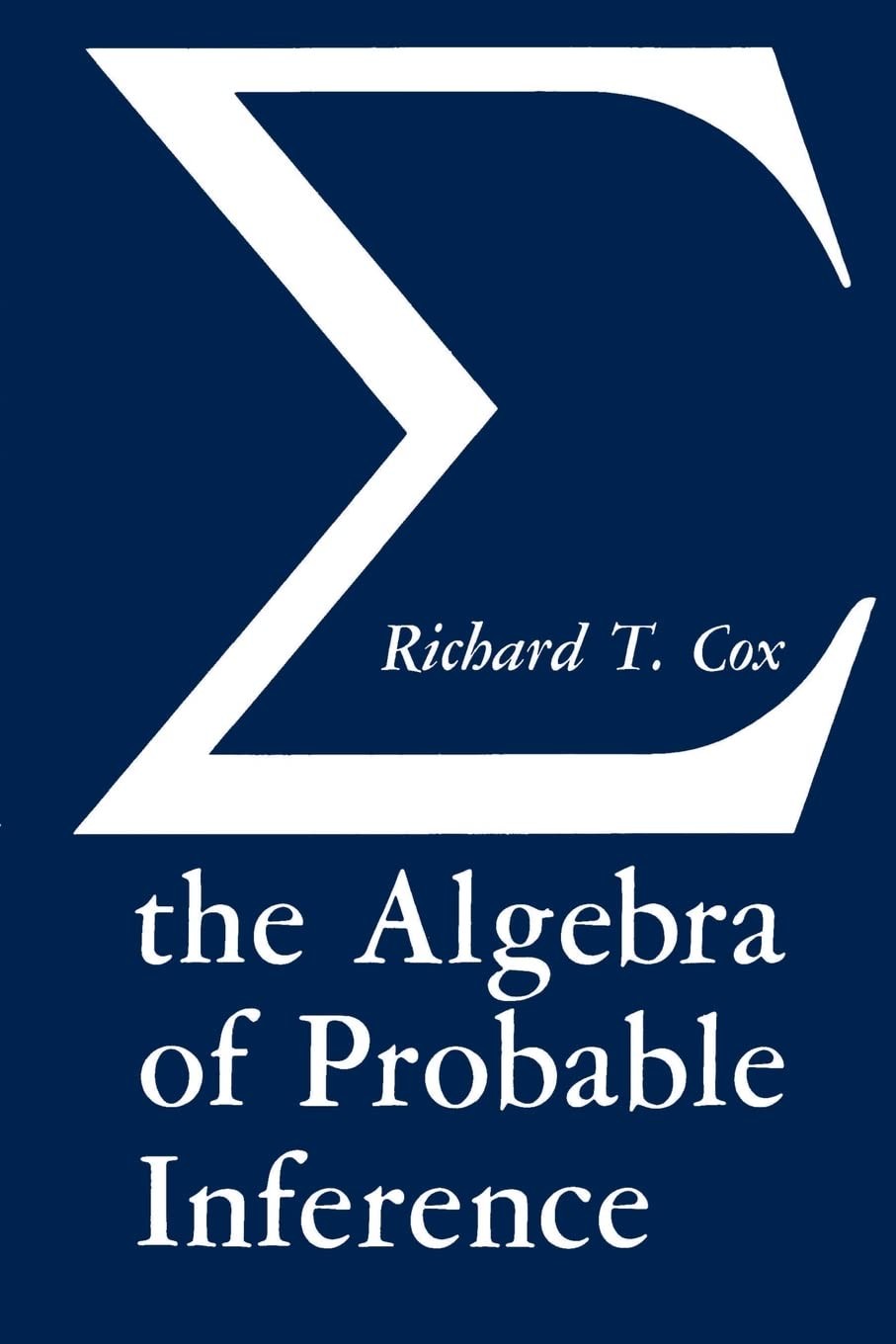
Algebra of Probable Inference by Richard T. Cox – A Groundbreaking Treatise on Probability Theory and Logical Reasoning
Inclusive of all applicable taxes. FREE shipping on all orders.
Available Offers
- 🚚Free Delivery — Free shipping on all orders
- 💵Cash on Delivery — Pay when your order arrives
- ↩️15-Day Easy Returns — Hassle-free return policy
- 🔒Cash on Delivery — Pay safely when your order arrives
Check Delivery
Product Description
Introduction
In the vast landscape of scientific reasoning, few works have reshaped the philosophical foundations of probability as profoundly as Richard T. Cox's landmark treatise. For Indian students and researchers navigating the intricate worlds of mathematics, physics, and data science, understanding the logical underpinnings of inference is essential. This hardcover edition of Algebra of Probable Inference offers a rigorous yet accessible journey into the very axioms that govern how we reason under uncertainty. Published by Johns Hopkins University Press, this classic text bridges Boolean algebra and probability theory, presenting a timeless framework for logical consistency in inductive reasoning.
Book Overview
Originally published in the mid-20th century, this book stands as a cornerstone of modern probability theory. Cox masterfully demonstrates that probability is not merely a statistical tool but the only logical extension of Boolean algebra when dealing with incomplete knowledge. The work systematically derives the laws of probability from simple, undeniable principles of consistency, establishing that subjective degrees of belief can be treated with the same rigor as mathematical truths. For Indian readers pursuing advanced studies in statistics, artificial intelligence, or philosophy of science, this volume provides the conceptual bedrock upon which modern Bayesian inference is built.
Key Highlights
- Foundational Derivation: A functional derivation showing probability as the unique extension of Boolean algebra, legitimizing Laplace's formalization.
- Logical Consistency: Demonstrates that any system of inductive inference that violates probability laws is inherently inconsistent.
- Subjective Objectivity: Clarifies how probability represents a subjective degree of belief while remaining universally applicable across all systems of inference.
- Pioneering Framework: Introduces a theory of logical questions through systems of assertions, a concept later expanded by Cox himself.
- Enduring Relevance: Remains a critical reference for Bayesian statistics, machine learning, and decision theory.
Inside the Book
The text unfolds with a careful exposition of the algebra of propositions, moving seamlessly into the functional equations that define plausible reasoning. Cox avoids heavy reliance on measure theory, making the logical structure transparent. Each chapter builds upon the last, from the basic rules of combination for assertions to the derivation of the sum and product rules of probability. The later sections explore the nature of logical questions and the algebra of systems of assertions, offering insights that anticipate modern developments in quantum logic and computational inference. The hardcover binding ensures durability for years of scholarly reference.
Key Topics
- Boolean algebra and its role in logical inference
- Functional derivation of probability axioms
- Consistency conditions for plausible reasoning
- Algebra of assertions and logical questions
- Relationship between probability and degree of belief
- Foundations of inductive logic
Reader Benefits
Engaging with this book equips readers with a deep, philosophical understanding of why probability works. Instead of memorizing formulas, you will grasp the logical necessity behind every rule. This clarity is invaluable for researchers designing inference algorithms, students preparing for competitive examinations in mathematics and statistics, and professionals working in data science or artificial intelligence. The book also sharpens critical thinking by forcing readers to question the very basis of reasoning under uncertainty, a skill highly prized in academic and professional circles across India.
Learning Outcomes
- Understand the logical foundation of probability as an extension of Boolean algebra.
- Derive the sum and product rules of probability from first principles.
- Analyze the consistency requirements for any system of inductive inference.
- Apply Cox's framework to evaluate arguments involving incomplete information.
- Recognize the philosophical implications of subjective versus objective probability.
Who Should Read
This book is ideal for postgraduate students and researchers in mathematics, statistics, physics, computer science, and philosophy. It is particularly valuable for those in Indian universities exploring Bayesian methods, artificial intelligence, or the foundations of quantum mechanics. Educators teaching advanced probability or logic will find it an excellent reference. Professionals in data analytics and machine learning who wish to deepen their theoretical grounding will also benefit immensely. The material assumes familiarity with basic algebra and logic but is accessible to determined readers at the senior undergraduate level.
About the Author
Richard T. Cox was an American physicist and mathematician whose work bridged the gap between logic and probability. His contributions, though published decades ago, have gained renewed recognition in the age of Bayesian statistics and machine learning. Cox's elegant derivations continue to inspire researchers seeking a unified framework for reasoning under uncertainty. His legacy endures in the foundational literature of probability theory.
About the Publisher
Johns Hopkins University Press, established in 1878, is one of the oldest and most prestigious academic publishers in the United States. Known for its rigorous editorial standards and commitment to scholarly excellence, the press has published seminal works across the sciences and humanities. This hardcover edition reflects the publisher's tradition of producing durable, high-quality academic books that stand the test of time.
Conclusion
Algebra of Probable Inference is more than a textbook; it is a philosophical treatise that redefines how we think about uncertainty. For the Indian academic community, where rigorous logical training is highly valued, this book offers a unique opportunity to engage with the deepest foundations of probability. Whether you are a student, researcher, or professional, owning this hardcover edition means possessing a timeless key to the logic of inductive reasoning. Add it to your library and transform your understanding of inference forever.
Quick Summary
Algebra of Probable Inference by Richard T. Cox is a seminal work that establishes probability theory as the only logically consistent framework for inductive reasoning. Cox derives probability as a unique extension of Boolean algebra, showing that any system of plausible inference must follow the rules of probability to avoid logical inconsistency. This book is essential for advanced students and researchers in mathematics, statistics, philosophy, and the sciences who seek a deep understanding of the foundations of probability and Bayesian reasoning. Readers will learn how probability represents a subjective degree of belief based on incomplete knowledge, yet applies objectively across all domains. The hardcover edition from Johns Hopkins University Press is a durable addition to any academic library. By purchasing from Bookshops.in, Indian readers get access to authentic imported editions with fast shipping and excellent customer service, making it the ideal choice for serious scholars.
Book Highlights
Book Specifications
| ISBN-13 | 9780801869822 |
| ISBN-10 | 080186982X |
| Publisher | Johns Hopkins University Press |
| Language | English |
| Dimensions | 15.24 x 0.74 x 22.86 cm |
| Weight | 227 g |
| Country | India |
| Category | Mathematics › Algebra & Trigonometry |
| Genre | Nonfiction |
| Original Language | English |
Frequently Asked Questions
What is the main thesis of Algebra of Probable Inference?
Who is the author of this book?
Is this book suitable for beginners in probability?
What is Cox's theorem?
Does this book cover Bayesian statistics?
What is the ISBN of this book?
Is this book available in paperback?
Can this book help with machine learning?
What is the price of this book in India?
Is this book part of a series?
What language is the book in?
Who should buy this book?
Why buy from Bookshops.in?
Readers Also Search For
Customers Also Bought
Mathematics
Stereotype Spaces and Algebras: 73 (De Gruyter Expositions in Mathematics, 73)
Mathematics
Semigroups in Algebra, Geometry and Analysis: 20 (De Gruyter Expositions in Mathematics, 20)
Mathematics
Geometry from the Pacific Rim: Proceedings of the Pacific Rim Geometry Conference held at National University of Singapore, Republic of Singapore, ... 1994 (De Gruyter Proceedings in Mathematics)
Mathematics
First International Tainan-Moscow Algebra Workshop: Proceedings of the International Conference held at National Cheng Kung University Tainan, Taiwan, ... 1994 (De Gruyter Proceedings in Mathematics)
Mathematics
Differential Geometry - Proceedings of the VIII International Colloquium (English, Jesus A. Alvarez Lopez | Eduardo Garcia-Rio)
Mathematics
Mathematical Theory of Optimal Processes (Classics of Soviet Mathematics)
Related Products
View AllMathematics
Mathematical Theory of Optimal Processes (Classics of Soviet Mathematics)
Mathematics
Stereotype Spaces and Algebras: 73 (De Gruyter Expositions in Mathematics, 73)
Mathematics
Semigroups in Algebra, Geometry and Analysis: 20 (De Gruyter Expositions in Mathematics, 20)
Mathematics
Geometry from the Pacific Rim: Proceedings of the Pacific Rim Geometry Conference held at National University of Singapore, Republic of Singapore, ... 1994 (De Gruyter Proceedings in Mathematics)
Mathematics
First International Tainan-Moscow Algebra Workshop: Proceedings of the International Conference held at National Cheng Kung University Tainan, Taiwan, ... 1994 (De Gruyter Proceedings in Mathematics)
Mathematics