
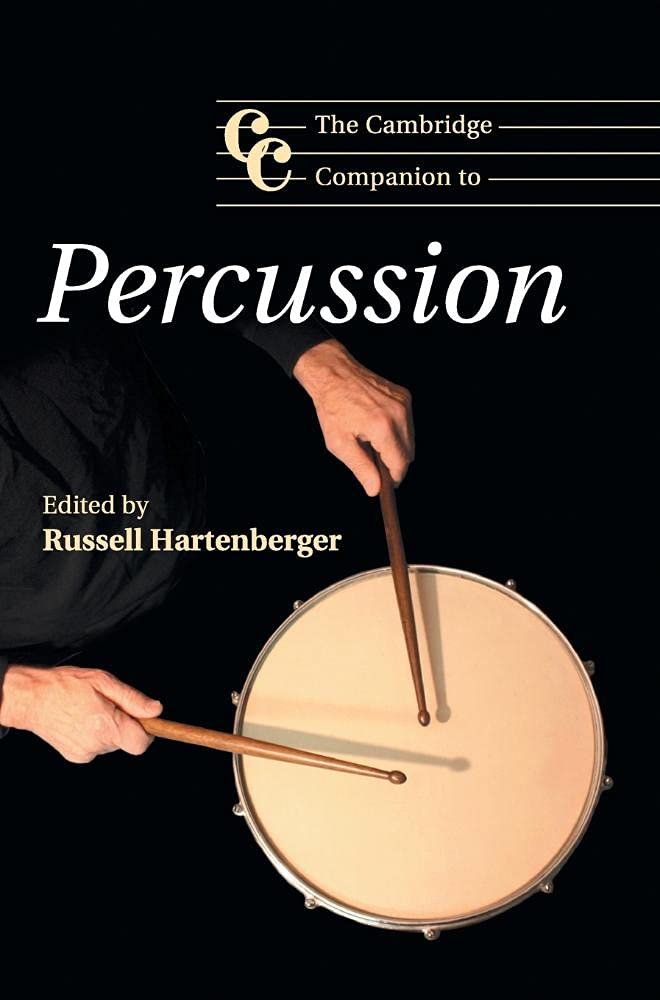
The Cambridge Companion to Percussion by Russell Hartenberger – A Deep Dive into Rhythm, Instruments, and Global Percuss
Inclusive of all applicable taxes. FREE shipping on all orders.
Available Offers
- 🚚Free Delivery — Free shipping on all orders
- 💵Cash on Delivery — Pay when your order arrives
- ↩️15-Day Easy Returns — Hassle-free return policy
- 🔒Cash on Delivery — Pay safely when your order arrives
Check Delivery
Product Description
Introduction
Percussion is the heartbeat of music—primal, universal, and endlessly evolving. The Cambridge Companion to Percussion, edited by renowned percussionist Russell Hartenberger, offers an authoritative and engaging exploration of this dynamic world. Published by Cambridge University Press, this hardcover volume is an essential resource for Indian students, educators, and music enthusiasts who wish to understand the art, science, and culture of percussion instruments and rhythm. Whether you are a budding tabla player, a Western classical drummer, or a curious listener, this book opens up a rich panorama of percussive traditions and innovations.
Book Overview
This companion is a comprehensive collection of essays written by leading performers, composers, conductors, instrument builders, scholars, and cognitive scientists. It traces the journey of percussion from its ancient origins to its cutting-edge applications in contemporary music. The book covers the role of percussion in symphony orchestras from the 19th century to today, the evolution of key instruments like the marimba, the impact of drum machines, and the acoustical principles that shape sound. It also delves into drum set techniques, the cross-pollination of world music with Western percussion, and the multifaceted roles of percussionists as soloists, chamber musicians, and theatrical performers. Scientific perspectives on sound perception and the evolution of rhythm add a fascinating layer of depth.
Key Highlights
- Comprehensive Scope: Covers orchestral, world, electronic, and experimental percussion in one volume.
- Expert Contributors: Insights from top percussionists, scientists, and instrument makers worldwide.
- Multidisciplinary Approach: Blends performance practice, history, acoustics, and cognitive science.
- Practical and Theoretical: Balances technical knowledge with artistic and cultural perspectives.
- Authoritative Publisher: Cambridge University Press ensures scholarly rigor and accessibility.
Inside the Book
The book is structured into thematic chapters that guide the reader through different facets of percussion. Early chapters examine the historical development of percussion instruments in Western classical music, including the rise of the percussion section in orchestras. Later sections explore the marimba revolution, the percussion instrument industry, and the influence of drum machines on modern music. Dedicated chapters investigate drum set playing, the integration of Indian, African, and Latin American rhythms, and the role of percussionists as conductors and composers. The final chapters offer scientific insights into how humans perceive rhythm and how musical rhythm has evolved over millennia. Each essay is self-contained yet interconnected, making the book suitable for both sequential reading and targeted reference.
Key Topics
- Percussion in the symphony orchestra: 19th century to the present
- The marimba revolution and the rise of keyboard percussion
- Drum machines, electronic percussion, and the music industry
- Acoustics and the science of sound production
- Drum set techniques and stylistic evolution
- World music influences on Western percussion (including Indian, African, and Latin traditions)
- The percussionist as soloist, chamber musician, conductor, and theatrical performer
- Cognitive science: perception of sound and the evolution of rhythm
Reader Benefits
- Deepen Musical Knowledge: Gain a thorough understanding of percussion history, technique, and theory.
- Enhance Performance Skills: Practical insights from master performers that can be applied to practice and teaching.
- Broaden Cultural Awareness: Explore how global rhythms enrich Western music and vice versa.
- Stay Current: Learn about modern developments like drum machines and electronic percussion.
- Academic Support: Ideal for research, coursework, and curriculum development in music programs.
Learning Outcomes
By engaging with this book, readers will be able to articulate the historical trajectory of percussion instruments, identify key technological and artistic innovations, and analyze the role of rhythm in music across cultures. They will develop a nuanced appreciation for the percussionist’s craft, from technical execution to creative expression. Students will gain the vocabulary and conceptual tools needed for advanced study in musicology, performance, or sound studies. Additionally, they will understand the scientific principles behind sound perception and rhythmic cognition, bridging the gap between art and science.
Who Should Read
- Music Students: Undergraduate and postgraduate students in music, especially those focusing on percussion or ethnomusicology.
- Professional Percussionists: Performers seeking to deepen their historical and theoretical knowledge.
- Music Educators: Teachers looking for a reliable resource for curriculum planning and classroom instruction.
- Composers and Conductors: Those who work with percussion and want to understand its full potential.
- Enthusiasts and Collectors: Anyone passionate about rhythm, drumming, or world music traditions.
About the Author
Russell Hartenberger is a distinguished percussionist, educator, and scholar. A longtime member of the internationally acclaimed percussion group Nexus, he has performed and recorded extensively, collaborating with composers such as Steve Reich and John Cage. Hartenberger has taught at the University of Toronto and the Glenn Gould School, and his research interests span performance practice, percussion history, and rhythm cognition. His hands-on experience as a performer and his academic rigor make him the ideal editor for this companion.
About the Publisher
Cambridge University Press is one of the world's oldest and most prestigious academic publishers, known for its rigorous peer review and high-quality publications in the humanities, sciences, and social sciences. The Cambridge Companions series is celebrated for bringing together leading experts to create accessible yet authoritative introductions to major topics. This volume upholds that tradition, offering Indian readers a reliable and enriching guide to the world of percussion.
Conclusion
The Cambridge Companion to Percussion is more than a reference book—it is a gateway to understanding the universal language of rhythm. With its blend of history, practice, science, and culture, it speaks to the head, heart, and hands of every percussionist. For Indian readers, it offers a unique opportunity to connect global percussive traditions with our own rich rhythmic heritage. Add this hardcover edition to your library and let the beat guide your learning journey.
Quick Summary
The Cambridge Companion to Percussion, edited by Russell Hartenberger, is an authoritative and wide-ranging exploration of percussion music and rhythm. It brings together perspectives from performers, composers, conductors, instrument makers, scholars, and cognitive scientists to create a rich tapestry of knowledge. The book covers everything from the role of percussion in symphony orchestras to the marimba revolution, the percussion industry, drum machines, and the acoustics of instruments. It also delves into drum set techniques, the impact of world music on Western percussion, and the multifaceted roles of percussionists as composers, soloists, chamber musicians, and theatrical performers. Scientific research on rhythm and perception adds a modern dimension. This companion is ideal for Indian students of music, aspiring percussionists, educators, and anyone fascinated by rhythm. It bridges historical traditions with contemporary innovations, making it a valuable resource for academic courses and personal study. By purchasing from Bookshops.in, readers get a genuine hardcover edition delivered across India with trusted service.
Book Highlights
Book Specifications
| ISBN-13 | 9781107093454 |
| ISBN-10 | 1107093457 |
| Publisher | Cambridge University Press |
| Language | English |
| Dimensions | 17.78 x 1.91 x 24.77 cm |
| Weight | 790 g |
| Country | India |
| Category | Arts, Film & Photography › Music |
| Series | Cambridge Companions to Music |
| Genre | Music |
| Original Language | English |
Frequently Asked Questions
What is The Cambridge Companion to Percussion about?
Who edited this book?
Is this book suitable for beginners?
Does it cover Indian percussion instruments?
Can I use this book for a university course?
What topics are included?
Who are the contributors?
Does it include practical exercises?
Is it only about Western percussion?
Is this book available in India?
What is the price in INR?
Does it cover electronic percussion?
Why should I buy from Bookshops.in?
Readers Also Search For
Customers Also Bought
Art History
The Italian Renaissance in Art

Art History
Photovoltaic Design & Installation For Dummies | by Mayfield | ForDummies | by Mayfield | ForDummies | by Mayfield | ForDummies | by Mayfield | ForDummies | by Mayfield | ForDummies | by Mayfield | ForDummies | by Mayfield | ForDummies | by Mayfield | ForDummies | by Mayfield | ForDummies | by Mayfield | ForDummies | by Mayfield | ForDummies | by Mayfield | ForDummies | by Mayfield | ForDummies | by Mayfield | ForDummies | by Mayfield | ForDummies | by Mayfield | ForDummies | by Mayfield | ForDu
Art History
Designing School Systems for All Students (English, Robert J. Manley | Richard J. Hawkins)
Art History
Routledge Library Editions: Art and Culture in the Nineteenth Century
Art History
An Errant Design (English, S. H. Long)
Art History
Distributed System Design | by Jie Wu | CRC Press | by Jie Wu | CRC Press | by Jie Wu | CRC Press | by Jie Wu | CRC Press | by Jie Wu | CRC Press | by Jie Wu | CRC Press | by Jie Wu | CRC Press | by Jie Wu | CRC Press | by Jie Wu | CRC Press | by Jie Wu | CRC Press | by Jie Wu | CRC Press | by Jie Wu | CRC Press | by Jie Wu | CRC Press | by Jie Wu | CRC Press | by Jie Wu | CRC Press | by Jie Wu | CRC Press | by Jie Wu | CRC Press | by Jie Wu | CRC Press | by Jie Wu | CRC Press | by Jie Wu | CRC
Related Products
View All
Music
The Cambridge Companion to Michael Tippett by Kenneth Gloag – Music Analysis
Music
Making Light: Haydn, Musical Camp, and the Long Shadow of German Idealism
Music
Music and the Crises of the Modern Subject by Michael L. Klein – Music Theory & Criticism
Music
Opera and Drama in Eighteenth-Century London: The King's Theatre, Garrick and the Business of Perfor
Music
Music in Theory and Practice Volume 1 | by Bruce Benward | Marilyn Saker | McGraw-Hill Companies | by Bruce Benward | Marilyn Saker | McGraw-Hill Companies | by Bruce Benward | Marilyn Saker | McGraw-Hill Companies | by Bruce Benward | Marilyn Saker | McGraw-Hill Companies | by Bruce Benward | Marilyn Saker | McGraw-Hill Companies | by Bruce Benward | Marilyn Saker | McGraw-Hill Companies | by Bruce Benward | Marilyn Saker | McGraw-Hill Companies | by Bruce Benward | Marilyn Saker | McGraw-Hill
Music