
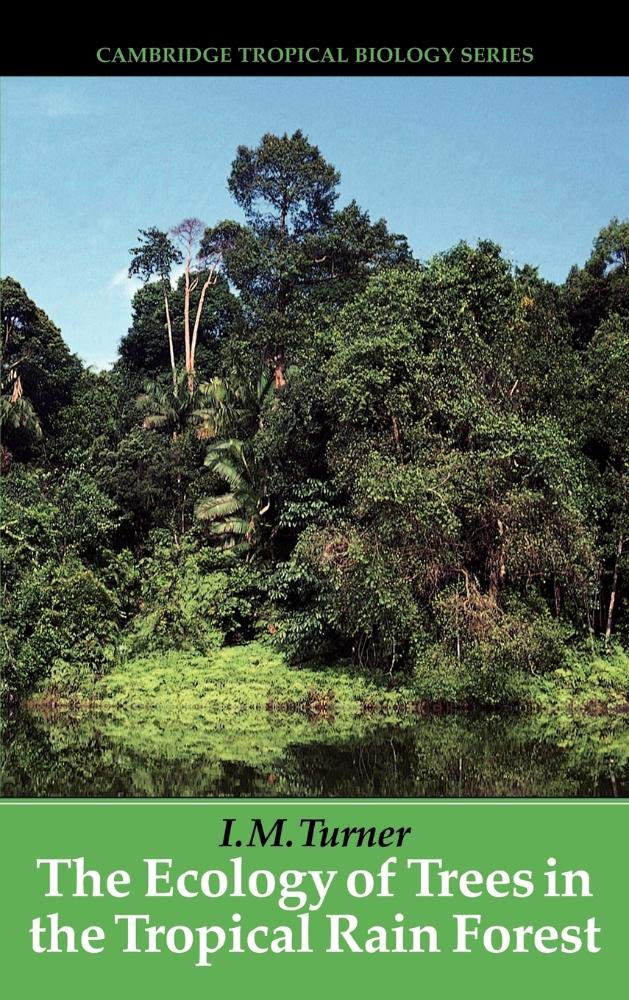
The Ecology of Trees in the Tropical Rain Forest by I. M. Turner – A Detailed Study of Tropical Tree Biology, Forest Eco
Inclusive of all applicable taxes. FREE shipping on all orders.
Available Offers
- 🚚Free Delivery — Free shipping on all orders
- 💵Cash on Delivery — Pay when your order arrives
- ↩️15-Day Easy Returns — Hassle-free return policy
- 🔒Cash on Delivery — Pay safely when your order arrives
Check Delivery
Product Description
Introduction
Tropical rain forests are among the most complex and biodiverse ecosystems on Earth, and at their heart stand the trees that shape them. The Ecology of Trees in the Tropical Rain Forest by I. M. Turner offers a comprehensive and insightful exploration into the lives of these remarkable organisms. Published by Cambridge University Press, this hardbound volume is an essential reference for students, researchers, and anyone fascinated by the natural world. It bridges the gap between scattered field studies and a cohesive understanding of how tropical trees function, adapt, and interact within their environment.
Book Overview
This book presents a detailed synthesis of the ecological knowledge available for tropical rain-forest trees, focusing on comparative ecology as a tool to uncover adaptive trends and evolutionary constraints. Rather than simply cataloguing species, Turner examines the underlying patterns that govern tree life—from seed germination to canopy dominance. The text is rooted in field observations and scientific data, making it a rigorous yet accessible resource for Indian readers studying botany, forestry, or environmental science. It challenges readers to think beyond individual species and consider the forest as a dynamic, interconnected system.
Key Highlights
- Comparative approach: Emphasises ecological classification to simplify the complexity of rain-forest communities.
- Evidence-based insights: Draws from decades of research on tree physiology, reproduction, and growth.
- Global perspective: Covers examples from tropical forests across Asia, Africa, and the Americas, including Indian contexts.
- Authoritative source: Written by a leading ecologist with deep expertise in tropical botany.
- Durable hardcover edition: Perfect for academic libraries and long-term reference.
Inside the Book
The book is structured to guide readers through the fundamental aspects of tree ecology. Early chapters introduce the physical environment of the tropical rain forest, including climate, soil, and light dynamics. Subsequent sections delve into tree architecture, leaf and root systems, and the strategies trees use to compete for resources. Reproduction—flowering, pollination, seed dispersal, and seedling establishment—receives detailed treatment. Turner also discusses tree growth patterns, longevity, and the role of disturbances such as storms and logging. Each chapter builds a layered understanding of how trees survive and thrive in one of the most challenging habitats on the planet.
Key Topics
- Tree morphology and functional traits in tropical forests
- Reproductive biology: from flowers to seedlings
- Resource acquisition: light, water, and nutrients
- Competition and coexistence among tree species
- Responses to environmental stress and disturbances
- Ecological classification and life-history strategies
Reader Benefits
This book empowers readers with a structured framework for understanding tropical forest ecosystems. Students will gain clarity on complex ecological concepts through clear explanations and real-world examples. Researchers will find a valuable synthesis of scattered literature, saving hours of study. For Indian readers, the comparative ecology approach is especially useful for studying native forests like the Western Ghats or the rainforests of Northeast India. The book also enhances critical thinking by encouraging readers to identify patterns and apply them to conservation and management.
Learning Outcomes
By the end of this book, readers will be able to: describe the key ecological processes shaping tropical tree communities; identify major adaptive strategies of trees in relation to light, water, and nutrients; analyse the role of reproduction and dispersal in forest dynamics; evaluate how disturbances influence tree population structure; and apply comparative ecological concepts to classify tree species for research or fieldwork. These outcomes make the book an excellent companion for advanced undergraduate and postgraduate courses in ecology and forestry.
Who Should Read
This book is ideal for students of botany, ecology, forestry, and environmental science at Indian universities. It is equally valuable for researchers, conservationists, and wildlife biologists working in tropical regions. Nature enthusiasts with a serious interest in understanding forest ecosystems will also find it enriching. Teachers and professors can use it as a core text for courses on tropical ecology or tree biology. The content assumes some basic knowledge of biology, making it suitable for advanced learners.
About the Author
I. M. Turner is a distinguished ecologist with extensive experience studying tropical forests. He has contributed to numerous scientific publications on tree ecology and has held academic positions at institutions in Asia and the UK. His work is known for blending rigorous fieldwork with thoughtful synthesis, and this book reflects his deep commitment to understanding the natural world. Turner’s writing is clear and authoritative, making complex ideas accessible without oversimplification.
About the Publisher
Cambridge University Press is one of the world’s oldest and most respected academic publishers. With a history spanning over four centuries, it is renowned for producing high-quality scholarly works in science, humanities, and education. This hardcover edition is a testament to their commitment to academic excellence, featuring durable binding and clear print—perfect for repeated reference in libraries and classrooms across India.
Conclusion
The Ecology of Trees in the Tropical Rain Forest is a masterful work that deepens our appreciation for the trees that define these vital ecosystems. Whether you are a student preparing for exams, a researcher building your knowledge, or a curious reader wanting to understand the forest better, this book offers lasting value. It is not just a collection of facts—it is a lens through which to see the intricate dance of life in the tropical canopy. Add this essential volume to your collection and embark on a journey into the heart of the rain forest.
Quick Summary
The Ecology of Trees in the Tropical Rain Forest by I. M. Turner is a definitive academic work that synthesizes current knowledge on the ecology of tropical rain-forest trees. The book adopts a comparative ecological perspective, examining how different tree species adapt to their environment, interact with fauna, and contribute to forest dynamics. It covers key topics such as seed dispersal, pollination, gap regeneration, growth strategies, and mortality patterns, drawing on research from major tropical regions including Asia, Africa, and the Americas. This volume is particularly valuable for Indian students and researchers because it provides a conceptual framework to classify tree species ecologically, simplifying the complexity of rainforest communities. Readers will gain a deep understanding of the evolutionary and ecological forces that shape tropical forests. By purchasing from Bookshops.in, customers receive a high-quality physical hardcover edition, ensuring durability for years of study. The book is an essential addition to any ecology or forestry library, supporting both academic learning and practical conservation efforts.
Book Highlights
Book Specifications
| ISBN-13 | 9780521801836 |
| ISBN-10 | 0521801834 |
| Publisher | Cambridge University Press |
| Language | English |
| Dimensions | 15.88 x 1.91 x 22.86 cm |
| Weight | 640 g |
| Country | India |
| Category | Biology & Life Sciences › Biology |
| Genre | Science & Mathematics |
| Original Language | English |
Frequently Asked Questions
What is the main focus of this book?
Who is the author of The Ecology of Trees in the Tropical Rain Forest?
Is this book suitable for Indian students?
What topics are covered in the book?
Does the book include case studies from Indian forests?
Is this book a hardcover edition?
What is the ISBN of this book?
Can I use this book for my research on tropical trees?
Does the book discuss climate change impacts?
What makes this book different from other ecology textbooks?
Is the book written in technical language?
Does Bookshops.in offer discounts on this book?
Can I order this book for my university library?
Readers Also Search For
Related Products
View All
Science & Mathematics
Elements of Pelagos Biology: With Focus on the Mediterranean Sea

Science & Mathematics
Mathematical Theory of Optimal Processes (Classics of Soviet Mathematics)
Science & Mathematics
Cambridge IGCSE and O Level Additional Mathematics by Val Hanrahan – Textbook for 0606/4037

Science & Mathematics
Squid - Superconducting Quantum Interference Devices and Their Applications: Proceedings of the International Conference on Superconducting Quantum Devices, Berlin-west, October 4-8, 1976

Science & Mathematics
Concise Encyclopedia of Biochemistry
Science & Mathematics