
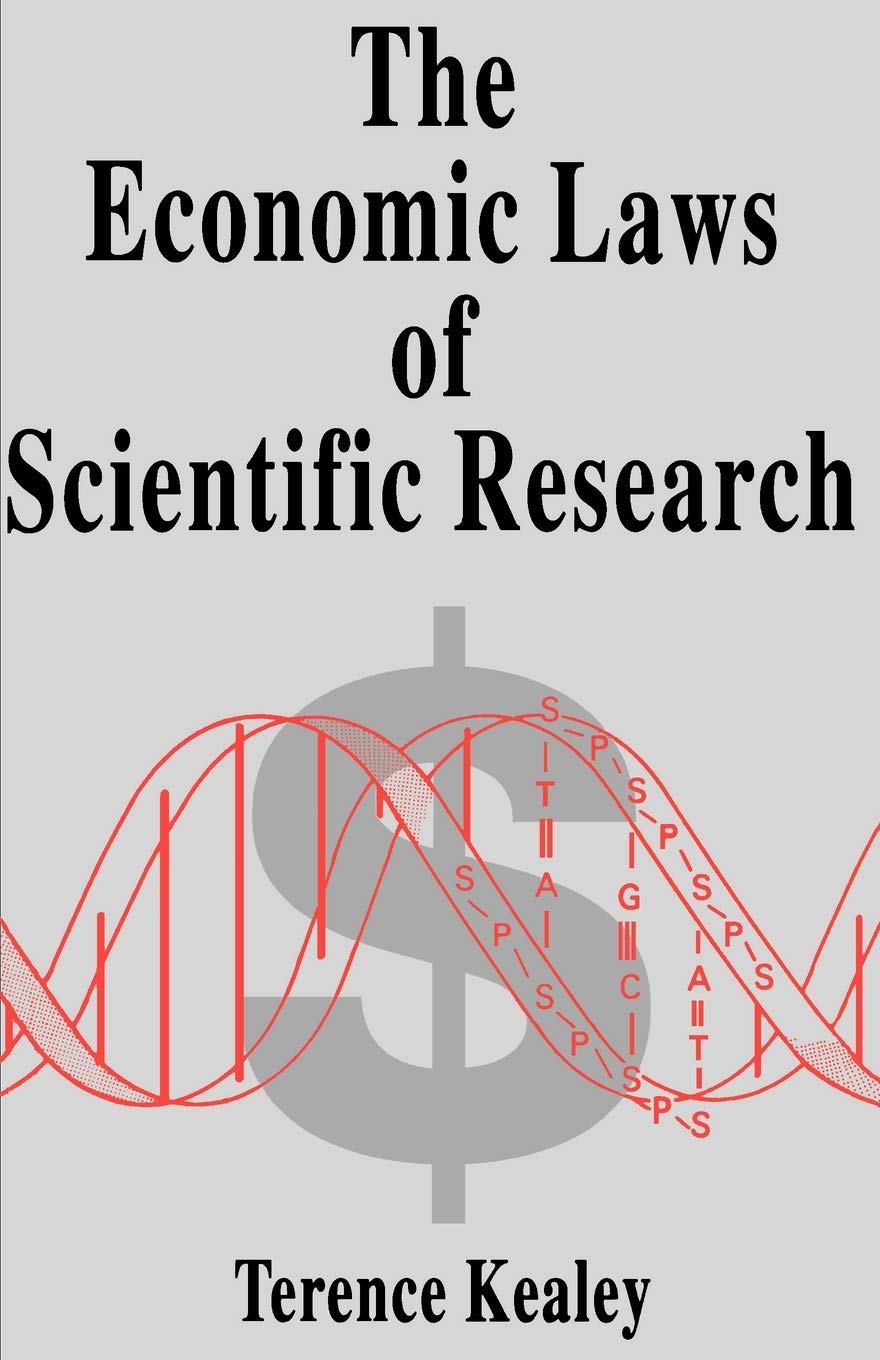
The Economic Laws of Scientific Research: A Critical Examination of Government Funding and Economic Growth by Terence Ke
Inclusive of all applicable taxes. FREE shipping on all orders.
Available Offers
- 🚚Free Delivery — Free shipping on all orders
- 💵Cash on Delivery — Pay when your order arrives
- ↩️15-Day Easy Returns — Hassle-free return policy
- 🔒Cash on Delivery — Pay safely when your order arrives
Check Delivery
Product Description
Introduction
In an era where government spending on scientific research is often taken for granted, Terence Kealey’s The Economic Laws of Scientific Research offers a bold and provocative counterargument. This hardcover edition, published by Palgrave MacMillan, challenges the long-held belief that state funding is essential for scientific progress and economic growth. For Indian students, policymakers, and economists, this book provides a fresh lens to examine the relationship between science, innovation, and market forces. Kealey’s work is not just a critique—it is a rigorous historical and comparative analysis that questions the very foundations of science policy.
Book Overview
The Economic Laws of Scientific Research is a comprehensive examination of how scientific research is funded and whether government intervention truly benefits society. Kealey argues that free markets, rather than state subsidies, have historically driven the most significant scientific breakthroughs and economic prosperity. Drawing on examples from Japan, the USSR, India, and Western nations, the book presents a compelling case that government-funded science often leads to inefficiency, stagnation, and even decline. This hardcover edition is essential reading for anyone interested in the economics of innovation, public policy, or the future of research in India and beyond.
Key Highlights
- Challenges the conventional wisdom that government funding is necessary for scientific advancement.
- Uses historical evidence from Japan, the USSR, India, and the UK to support its arguments.
- Explores the economic laws that govern research productivity and innovation.
- Offers a free-market alternative to state-driven science policy.
- Written by a practising scientist with deep expertise in biochemistry and science policy.
Inside the Book
The book is structured around a series of historical and contemporary case studies. Kealey begins by debunking the myth that government-funded science was responsible for the Industrial Revolution or modern technological marvels. He then examines the Soviet Union’s collapse in the context of its massive state-funded research apparatus, contrasting it with Japan’s post-war economic miracle achieved with minimal government investment in basic science. Special attention is given to India, where state-funded science has not translated into proportional economic growth. Kealey also discusses the role of private philanthropy, corporate R&D, and market incentives in fostering genuine innovation.
Key Topics
- Science and economic growth: the real relationship between research funding and national prosperity.
- Market versus state: comparing free-market and government-funded models of science.
- Historical case studies: Japan, USSR, India, and the United Kingdom.
- Philanthropy and private research: the role of non-government actors in scientific progress.
- Policy implications: what India can learn from global examples.
Reader Benefits
- Critical thinking: develop a nuanced understanding of science funding debates.
- Policy insight: gain tools to evaluate government schemes and budgets.
- Historical perspective: learn from the successes and failures of different nations.
- Economic literacy: understand basic principles of incentives, productivity, and market failure.
Learning Outcomes
- Understand the economic laws that determine the effectiveness of scientific research.
- Analyse the impact of government funding on innovation and growth.
- Compare different national science policies and their outcomes.
- Critically assess arguments for and against state intervention in research.
- Apply these insights to real-world policy discussions in India.
Who Should Read
- Students of economics, public policy, and science studies.
- Researchers and academics interested in the sociology and economics of science.
- Policymakers in government and funding agencies.
- Entrepreneurs and innovators who want to understand the market forces behind R&D.
- General readers curious about how science truly works in society.
About the Author
Terence Kealey is a British biochemist and a former clinical lecturer at the University of Oxford. He has published extensively on the economics of science and is known for his contrarian views on government funding. His background as a practising scientist gives him unique credibility when analysing the incentives and realities of research. Kealey’s work has been praised by leading economists and historians for its originality and rigour.
About the Publisher
Palgrave MacMillan is a leading academic publisher known for its authoritative titles in economics, politics, and social sciences. With a global reputation for scholarly excellence, Palgrave MacMillan ensures that books like The Economic Laws of Scientific Research reach a wide audience of students, researchers, and professionals. This hardcover edition is built to last, making it a valuable addition to any library.
Conclusion
The Economic Laws of Scientific Research is a must-read for anyone who wants to think differently about science, money, and progress. Terence Kealey’s arguments are as relevant today as when the book was first published—especially in India, where debates about research funding and economic growth continue. Whether you are a student, a policymaker, or simply a curious reader, this book will challenge your assumptions and broaden your perspective. Order your hardcover copy from Bookshops.in today and join the conversation about the true drivers of scientific discovery.
Quick Summary
The Economic Laws of Scientific Research by Terence Kealey is a provocative and rigorously argued book that challenges the long-held belief that government funding of scientific research is essential for economic growth. Kealey, a practising scientist turned economist, uses historical evidence from Japan, the USSR, and India to show that state-supported science often fails to deliver promised economic benefits. Japan, for instance, flourished economically while neglecting government-funded science, whereas the USSR and India declined despite heavy investment. The book critiques the Bernalist model of science policy and advocates for market-based approaches to research funding. This hardcover edition from Palgrave MacMillan is ideal for policy makers, economists, students, and anyone interested in science policy and economic history. Readers will gain a deeper understanding of the real relationship between science and wealth, and develop critical perspectives on public spending priorities. By purchasing from Bookshops.in, Indian readers get a premium physical copy with reliable delivery and customer service.
Book Highlights
Book Specifications
| ISBN-13 | 9780312173067 |
| ISBN-10 | 0312173067 |
| Publisher | Palgrave Macmillan |
| Language | English |
| Dimensions | 15.24 x 2.29 x 22.86 cm |
| Weight | 513 g |
| Category | Economics › Economic Theory |
| Genre | Non-Fiction |
| Reading Age | Adult |
| Original Language | English |
Frequently Asked Questions
What is the main argument of The Economic Laws of Scientific Research?
Who is the author Terence Kealey?
Is this book relevant to Indian readers?
What is the Bernalist model mentioned in the book?
Does the book oppose all science funding?
What evidence does Kealey use to support his argument?
Who praised this book?
Is this book suitable for students?
What format is this book available in?
Does the book discuss India specifically?
What is the ISBN of this book?
Is the book still in print?
Where can I buy this book in India?
Readers Also Search For
Customers Also Bought

Entrepreneurship
Chinese Economic Revolution (English, Linda Grove)
Entrepreneurship
Engines of Innovation: The Entrepreneurial University in the Twenty-First Century by Holden Thorp
Entrepreneurship
Invention to Innovation (English, PhD Marshall Larry | Jenna Daroczy)
Entrepreneurship
Database Management Systems by Raghu Ramakrishnan – DBMS Textbook

Entrepreneurship
Decision-making for Technology Executives by Harold A. Linstone
Entrepreneurship
The Business Innovation Audit (English, William Tate)
Related Products
View All
Economics
Political Economy from Pufendorf to Marx (English, István Hont | Lasse S. Andersen | Béla Kapossy)
Economics
Women's Entrepreneurship and Economics (English, Miguel-Angel Galindo | Domingo Ribeiro)
Economics
Trade Policy and Industrialization in Turbulent Times | by Gerry Helleiner | Routledge | by Gerry Helleiner | Routledge | by Gerry Helleiner | Routledge | by Gerry Helleiner | Routledge | by Gerry Helleiner | Routledge | by Gerry Helleiner | Routledge | by Gerry Helleiner | Routledge | by Gerry Helleiner | Routledge | by Gerry Helleiner | Routledge | by Gerry Helleiner | Routledge | by Gerry Helleiner | Routledge | by Gerry Helleiner | Routledge | by Gerry Helleiner | Routledge | by Gerry Hellei
Economics
History of Economic Analysis | by Schumpeter Joseph A. | Taylor & Francis Ltd | by Schumpeter Joseph A. | Taylor & Francis Ltd | by Schumpeter Joseph A. | Taylor & Francis Ltd | by Schumpeter Joseph A. | Taylor & Francis Ltd | by Schumpeter Joseph A. | Taylor & Francis Ltd | by Schumpeter Joseph A. | Taylor & Francis Ltd | by Schumpeter Joseph A. | Taylor & Francis Ltd | by Schumpeter Joseph A. | Taylor & Francis Ltd | by Schumpeter Joseph A. | Taylor & Franci
Economics
OECD Compendium of Productivity Indicators 2015 | by Organization for Economic Cooperation an | Organization for Economic Co-Operation & Deve | by Organization for Economic Cooperation an | Organization for Economic Co-Operation & Deve | by Organization for Economic Cooperation an | Organization for Economic Co-Operation & Deve | by Organization for Economic Cooperation an | Organization for Economic Co-Operation & Deve | by Organization for Economic Cooperation an | Organization

Economics