
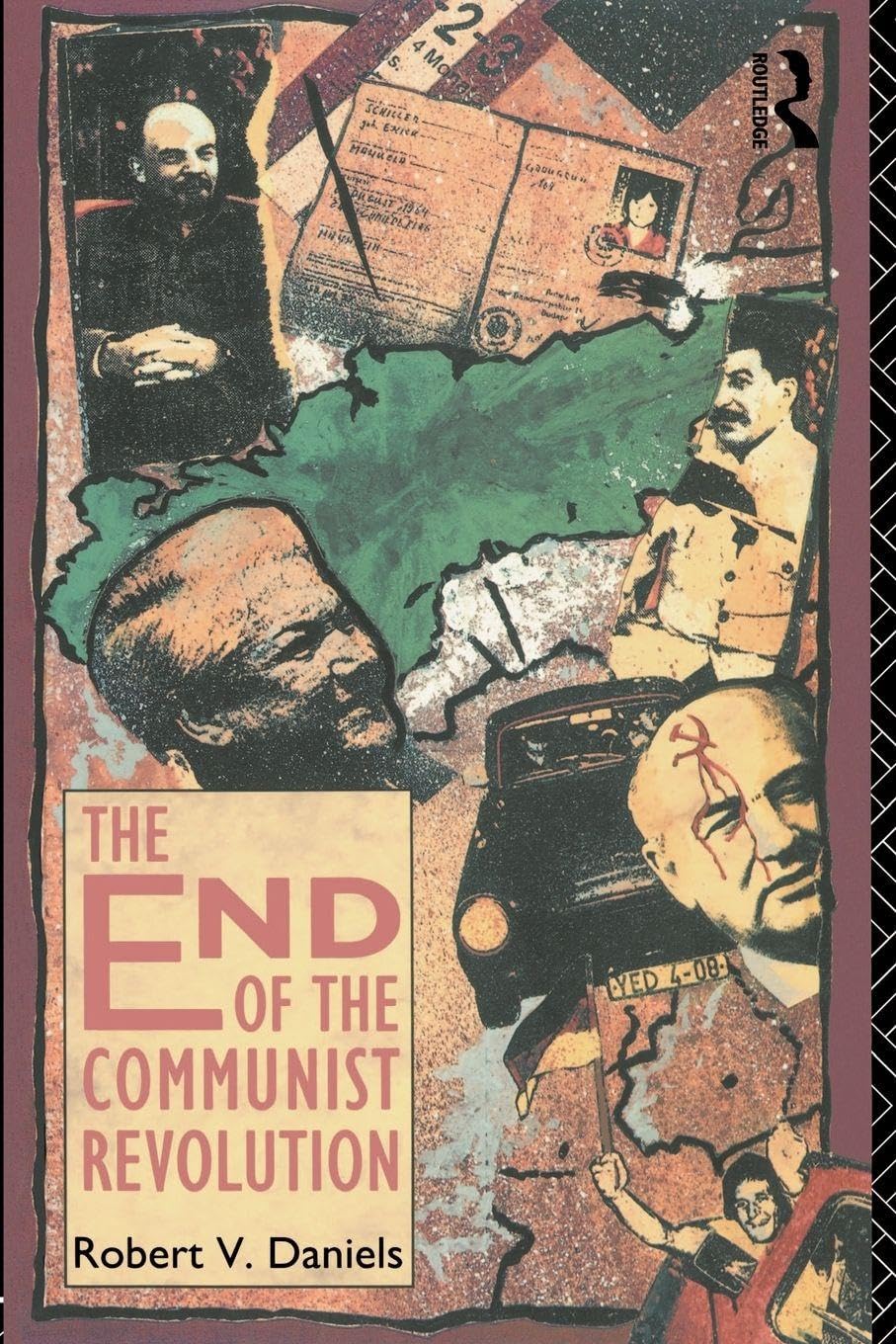
The End of the Communist Revolution: A Historical Perspective on Perestroika and Soviet Politics by Robert V. Daniels
Inclusive of all applicable taxes. FREE shipping on all orders.
Available Offers
- 🚚Free Delivery — Free shipping on all orders
- 💵Cash on Delivery — Pay when your order arrives
- ↩️15-Day Easy Returns — Hassle-free return policy
- 🔒Cash on Delivery — Pay safely when your order arrives
Check Delivery
Product Description
Introduction
Understanding the trajectory of the Soviet Union and its eventual dissolution is essential for students of political science, history, and revolutionary theory. Robert V. Daniels’ The End of the Communist Revolution offers a rigorous and insightful analysis of the forces that shaped the Soviet system from Lenin to Gorbachev. This hardcover edition, published by Routledge, is a vital resource for Indian readers seeking a deep, scholarly perspective on one of the most significant political transformations of the twentieth century.
Book Overview
In this compelling work, Daniels moves beyond simplistic narratives to examine the Communist revolution as an ongoing, evolving process. He situates perestroika—the restructuring initiated by Mikhail Gorbachev—within the broader arc of revolutionary development, tracing its roots through Leninism, Stalinism, and the stagnation of the Brezhnev era. The book argues that the Soviet experiment was not a single event but a cycle of revolutionary phases, each marked by distinct ideological and institutional challenges. By the end, Daniels provides a framework for understanding why the system ultimately collapsed, offering lessons that resonate far beyond Russia’s borders.
Key Highlights
- Original theoretical framework: Proposes a cyclical model of revolution, from radical inception to bureaucratic consolidation and eventual decay.
- Historical depth: Covers the entire Soviet period, from the 1917 Revolution to the late 1980s, with special focus on the Brezhnev stagnation.
- Perestroika in context: Interprets Gorbachev’s reforms not as a break from the past but as a logical outcome of the revolutionary cycle.
- Comparative perspective: Draws parallels with other revolutionary movements, making the analysis relevant for students of global politics.
- Scholarly yet accessible: Written in clear, academic prose suitable for both advanced undergraduates and researchers.
Inside the Book
The book is structured around the idea of revolution as a multi-stage process. Daniels begins by defining the revolutionary cycle—radical seizure of power, consolidation through terror, institutionalization, and eventual crisis. He then applies this model to the Soviet experience, devoting chapters to Lenin’s revolutionary vanguard, Stalin’s totalitarian state, Khrushchev’s thaw, and Brezhnev’s era of stagnation. The final chapters analyze Gorbachev’s perestroika as an attempt to break the cycle, ultimately leading to the system’s collapse. Throughout, Daniels uses primary sources and comparative data to support his arguments, avoiding jargon while maintaining intellectual rigor.
Key Topics
- The theory of revolutionary cycles and its application to Soviet history
- Leninism as a revolutionary ideology and its transformation under Stalin
- Stalinism: totalitarianism, purges, and the command economy
- The Brezhnev era: stagnation, corruption, and ideological decay
- Gorbachev’s perestroika and glasnost as responses to systemic crisis
- The collapse of the Soviet Union and the end of the communist revolution
- Comparative revolutions: China, Cuba, and other Marxist states
Reader Benefits
This book equips readers with a nuanced understanding of why revolutions often devour their own ideals. Indian students of political science will find the cyclical model useful for analyzing other revolutionary movements, including those in South Asia. History enthusiasts gain a fresh perspective on the Cold War era, moving beyond simple East-West binaries. For researchers, Daniels’ theoretical framework offers a tool for examining state decay and reform in any authoritarian context. The hardcover format ensures durability for repeated reference, making it a valuable addition to any academic library.
Learning Outcomes
- Analyze the Soviet Union’s political evolution using a cyclical revolutionary model.
- Evaluate the role of ideology, leadership, and bureaucracy in shaping revolutionary outcomes.
- Understand the historical roots of perestroika and its unintended consequences.
- Compare the Soviet experience with other communist and post-communist states.
- Critically assess the concept of revolution as a closed or open-ended process.
Who Should Read
This book is ideal for postgraduate and advanced undergraduate students in political science, history, and sociology. It is also highly recommended for scholars specializing in Soviet studies, comparative politics, and revolutionary theory. General readers with a serious interest in the Cold War, Marxism, or the collapse of the USSR will find it intellectually rewarding. Indian readers, in particular, will benefit from the book’s theoretical insights, which can be applied to understanding political change in diverse contexts.
About the Author
Robert V. Daniels is a distinguished historian of Soviet Russia and a professor emeritus at the University of Vermont. He is renowned for his works on the Russian Revolution, including Red October and Russia: The Roots of Confrontation. Daniels brings decades of research and a balanced, analytical perspective to this study, making him one of the most respected voices in the field.
About the Publisher
Routledge is a leading global academic publisher, known for its extensive catalog in the social sciences and humanities. With a reputation for scholarly excellence, Routledge ensures that works like The End of the Communist Revolution meet the highest standards of research and editorial quality. This hardcover edition is produced to last, with durable binding and clear print.
Conclusion
The End of the Communist Revolution is more than a historical account—it is a masterful theoretical exploration of how revolutions begin, evolve, and ultimately conclude. Robert V. Daniels provides readers with the tools to understand not just the Soviet past, but the dynamics of political change everywhere. For Indian students and scholars seeking a deeper grasp of revolutionary theory and Soviet history, this book is an indispensable resource. Order your copy today from Bookshops.in and add this classic to your collection.
Quick Summary
The End of the Communist Revolution by Robert V. Daniels is a seminal historical analysis that places perestroika within the long-term revolutionary process of the Soviet Union. The book systematically examines Leninism, Stalinism, and Brezhnevism, offering a theoretical framework to understand the cyclical nature of communist revolutions. Daniels argues that perestroika was not an isolated reform but a continuation of earlier revolutionary dynamics. This work is essential for Indian students and researchers in political science, history, and Soviet studies, providing deep insights into the ideological and political forces that shaped the USSR. Readers will gain a nuanced understanding of how revolutionary phases evolve and culminate. By purchasing from Bookshops.in, you receive a genuine hardcover edition, ensuring durability for academic reference. The book's scholarly rigor and comprehensive scope make it a valuable addition to any library focusing on modern political history.
Book Highlights
Book Specifications
| ISBN-13 | 9780415061506 |
| ISBN-10 | 0415061504 |
| Publisher | Routledge |
| Language | English |
| Dimensions | 15.6 x 1.32 x 23.39 cm |
| Weight | 408 g |
| Country | India |
| Category | World › History of Ideas |
| Genre | Non-fiction |
| Original Language | English |
Frequently Asked Questions
What is The End of the Communist Revolution about?
Who is the author of this book?
Is this book suitable for Indian students?
What is the binding of this book?
Who is the publisher?
What is the ISBN-13?
What language is the book in?
Is this book part of a series?
What is the price in INR?
What category does this book belong to?
Does the book cover Stalinism?
Why should I buy from Bookshops.in?
Can I use this book for research?
Readers Also Search For
Related Products
View All
History
The Information Revolution: Transforming the World Through Technology (World History)
History
Human Nature and the French Revolution: From the Enlightenment to the Napoleonic Code: 3 (Polygons: Cultural Diversities and Intersections, 3)
History
The Unmaking of Home in Contemporary Art (Cultural Spaces)

History
Handbook to Life in Medieval and Early Modern Japan | by William E. Deal | Oxford University Press | by William E. Deal | Oxford University Press | by William E. Deal | Oxford University Press | by William E. Deal | Oxford University Press | by William E. Deal | Oxford University Press | by William E. Deal | Oxford University Press | by William E. Deal | Oxford University Press | by William E. Deal | Oxford University Press | by William E. Deal | Oxford University Press | by William E. Deal | Ox

History
The Narrators of Barbarian History (A.D. 550-800) | by Walter Goffart | University of Notre Dame Press | by Walter Goffart | University of Notre Dame Press | by Walter Goffart | University of Notre Dame Press | by Walter Goffart | University of Notre Dame Press | by Walter Goffart | University of Notre Dame Press | by Walter Goffart | University of Notre Dame Press | by Walter Goffart | University of Notre Dame Press | by Walter Goffart | University of Notre Dame Press | by Walter Goffart | Univ
History