
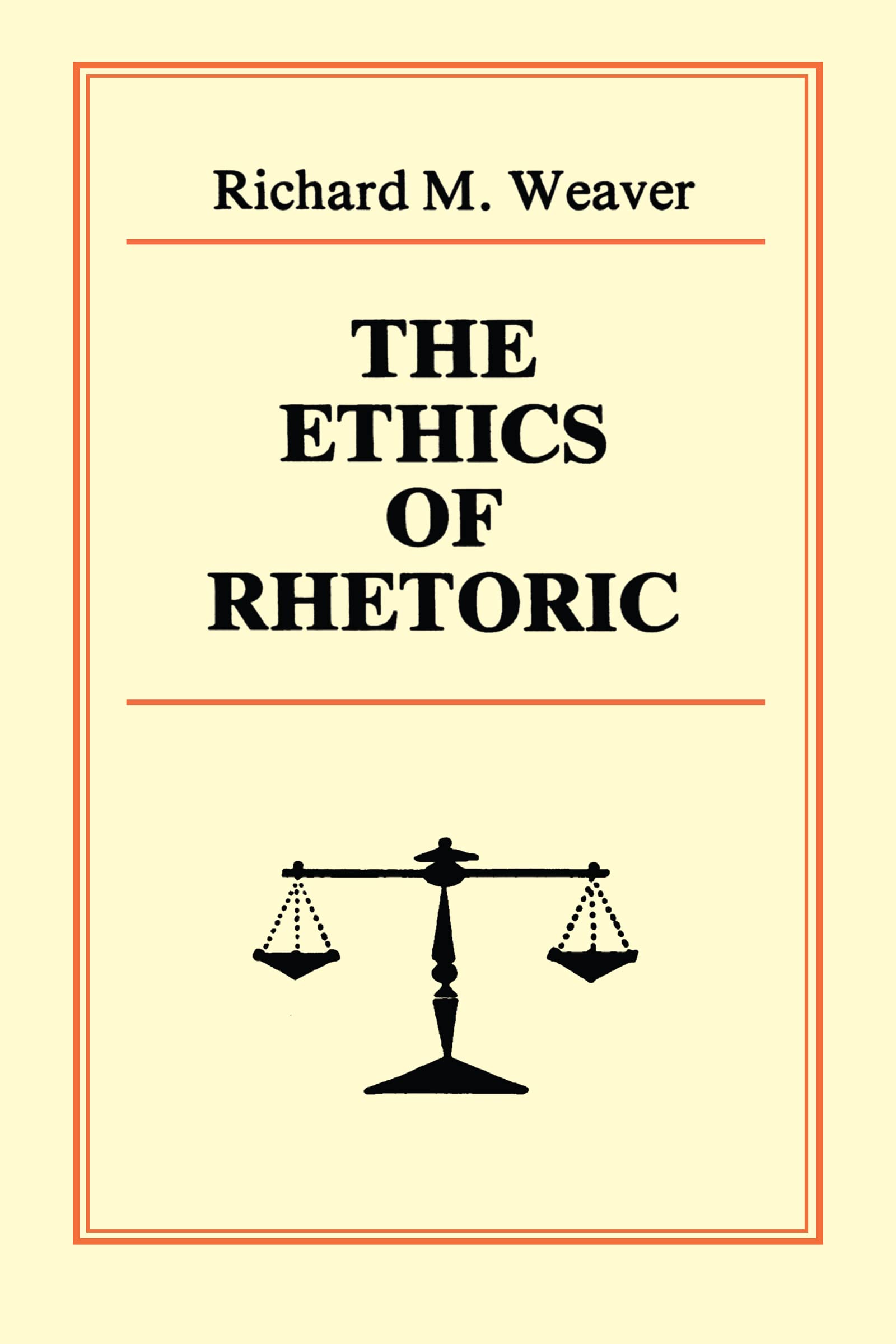
The Ethics of Rhetoric
Inclusive of all applicable taxes. FREE shipping on all orders.
Available Offers
- 🚚Free Delivery — Free shipping on all orders
- 💵Cash on Delivery — Pay when your order arrives
- ↩️15-Day Easy Returns — Hassle-free return policy
- 🔒Cash on Delivery — Pay safely when your order arrives
Check Delivery
Product Description
Introduction
In an age where words are wielded as weapons and persuasion often overshadows truth, The Ethics of Rhetoric by Richard M. Weaver stands as a timeless exploration of the moral dimensions of language. First published in 1953, this hardcover edition from Routledge brings Weaver’s profound insights to a new generation of Indian readers, students, and scholars. A landmark work in the field of rhetoric, it challenges us to consider not just how we speak, but why—and at what cost.
Book Overview
This volume collects eight incisive essays that examine the ethical responsibilities of the rhetorician. Drawing on classical philosophy, especially Plato’s Phaedrus, Weaver argues that rhetoric is never neutral; it always carries a cultural and moral charge. From the courtroom drama of the Scopes “Monkey Trial” to the statesmanship of Abraham Lincoln, each essay dissects the interplay between language, ideology, and society. The book remains a vital resource for anyone seeking to understand the power of persuasive speech in shaping human affairs.
Key Highlights
- Classic philosophical approach: Weaver anchors modern rhetoric in Platonic ideals, offering a rigorous ethical framework.
- Relevant case studies: Analyses of Lincoln, Burke, and Milton bring theory to life through historical examples.
- Cultural critique: A sharp examination of the encroachment of scientific and sociological thinking on humane letters.
- Enduring relevance: Issues of truth, persuasion, and social responsibility remain central to contemporary discourse.
Inside the Book
The essays progress from foundational theory to applied critique. Weaver begins with a close reading of Plato’s Phaedrus, establishing rhetoric as a means of leading souls toward truth. He then turns to the 1925 Scopes trial, revealing how evolutionary theory was used rhetorically to reshape public morality. Later chapters examine the conservative rhetoric of Edmund Burke, the poetic justice in Milton’s prose, and the rhetorical strategies of Lincoln’s speeches. The final essays critique sociology’s pretensions and propose a renewed rhetoric for modern times.
Key Topics
- The ethical dimensions of persuasive language
- Platonic rhetoric and the pursuit of truth
- Rhetoric in legal and political contexts
- Evolution, science, and public discourse
- Conservatism and cultural continuity
- The role of liberal studies in education
Reader Benefits
This book equips readers with a deeper understanding of how arguments are constructed and evaluated. It sharpens critical thinking by exposing the moral assumptions behind everyday language. For Indian students of literature, philosophy, political science, and communication studies, it offers a bridge between ancient wisdom and modern dilemmas. Professionals in law, journalism, and public speaking will find practical insights into the art of ethical persuasion.
Learning Outcomes
- Analyze the ethical implications of rhetorical choices in historical and contemporary texts.
- Identify the philosophical foundations of argumentation from Plato to the present.
- Critique the influence of scientific and sociological frameworks on public debate.
- Apply Weaver’s principles to evaluate political speeches, legal arguments, and media narratives.
- Develop a personal ethical stance toward the use of language in professional and civic life.
Who Should Read
The Ethics of Rhetoric is essential reading for undergraduate and postgraduate students of English, philosophy, political science, and communication studies. It will also appeal to teachers, lawyers, journalists, and anyone interested in the moral dimensions of public discourse. Readers who value intellectual history and the tradition of liberal education will find this book a rewarding challenge.
About the Author
Richard M. Weaver (1910–1963) was an American scholar of English and a prominent cultural conservative. A professor at the University of Chicago, he wrote extensively on rhetoric, education, and the decline of Western civilization. His works, including Ideas Have Consequences, have influenced generations of thinkers. Weaver believed that language shapes reality, and that the study of rhetoric is essential to preserving humane values in a technological age.
About the Publisher
Routledge is a world-leading academic publisher, known for its extensive catalog in the humanities and social sciences. With a legacy spanning over 180 years, Routledge brings rigorous scholarship to readers across the globe. This hardcover edition ensures that Weaver’s ideas are preserved in a durable format suitable for libraries, classrooms, and personal collections.
Conclusion
In an era of information overload and polarized debate, The Ethics of Rhetoric offers a much-needed compass. Richard M. Weaver’s essays remind us that every speech act carries a moral weight, and that the pursuit of truth must guide our words. Whether you are a student, a teacher, or a lifelong learner, this book will deepen your appreciation of the spoken and written word. Order your copy from Bookshops.in today and add a classic of rhetorical thought to your library.
Quick Summary
In 'The Ethics of Rhetoric', Richard M. Weaver delivers a profound exploration of the moral dimensions of persuasive language, arguing that rhetoric is far more than a set of techniques—it is a fundamental expression of cultural values and ethical responsibility. Drawing on Plato's Phaedrus, the book sets the stage for a series of incisive analyses of historical figures such as Abraham Lincoln, Edmund Burke, and John Milton, as well as a penetrating discussion of the Scopes 'Monkey Trial' as a rhetorical event. Weaver, a staunch cultural conservative, critiques the rise of scientific and sociological thinking that he believes undermines the liberal arts and the ethical use of language. This book is ideal for Indian students and scholars in philosophy, communication studies, political theory, and cultural studies who seek to understand how rhetoric shapes society and how it can be wielded responsibly. Readers will gain a deeper appreciation for the ethical stakes of public discourse and learn to evaluate arguments not just for their effectiveness but for their moral grounding. By purchasing this hardcover edition from Bookshops.in, you secure a premium, durable copy of a timeless academic work, delivered reliably across India.
Book Highlights
Book Specifications
| ISBN-13 | 9780961180027 |
| ISBN-10 | 0961180021 |
| Publisher | Routledge |
| Language | English |
| Dimensions | 13.79 x 1.4 x 21.59 cm |
| Weight | 340 g |
| Country | India |
| Category | Literature › Creative Writing & Composition |
| Genre | Nonfiction |
| Original Language | English |
Frequently Asked Questions
What is 'The Ethics of Rhetoric' about?
Who is the author of this book?
Is this book suitable for Indian students?
Does the book include analysis of specific speakers?
Is this book about modern rhetoric?
What is the primary argument of the book?
Does the book discuss the Scopes trial?
Is this book difficult to read?
Can I use this book for my research?
Is the book available in hardcover?
What is the ISBN?
Why should I buy from Bookshops.in?
Does the book include a bibliography?
Readers Also Search For
Customers Also Bought

Sociology
Imagination Beyond Nation: Latin American Popular Culture: 349 (Pitt Latin American Series)

Sociology
Boomer Volunteer Engagement: Facilitator's Tool Kit

Sociology
Making a Success of Marriage: Planning for Happily Ever After

Sociology
Causal Mediation Analysis (Analytical Methods for Social Research)

Sociology
Marriage and the Moral Imagination (New Departures in Anthropology)

Sociology
Social Change, Resistance and Social Practices: 19 (Studies in Critical Social Sciences, 19)
Related Products
View All
Society & Social Sciences
Oxford Studies in Epistemology, Volume 3 | by Tamar Szabo Gendler | John Hawthorne | OUP UK | by Tamar Szabo Gendler | John Hawthorne | OUP UK | by Tamar Szabo Gendler | John Hawthorne | OUP UK | by Tamar Szabo Gendler | John Hawthorne | OUP UK | by Tamar Szabo Gendler | John Hawthorne | OUP UK | by Tamar Szabo Gendler | John Hawthorne | OUP UK | by Tamar Szabo Gendler | John Hawthorne | OUP UK | by Tamar Szabo Gendler | John Hawthorne | OUP UK | by Tamar Szabo Gendler | John Hawthorne | OUP UK
Society & Social Sciences
Sidgwick's Ethics and Victorian Moral Philosophy | by J. B. Schneewind | Jerome B. Schneewind | OUP Oxford | by J. B. Schneewind | Jerome B. Schneewind | OUP Oxford | by J. B. Schneewind | Jerome B. Schneewind | OUP Oxford | by J. B. Schneewind | Jerome B. Schneewind | OUP Oxford | by J. B. Schneewind | Jerome B. Schneewind | OUP Oxford | by J. B. Schneewind | Jerome B. Schneewind | OUP Oxford | by J. B. Schneewind | Jerome B. Schneewind | OUP Oxford | by J. B. Schneewind | Jerome B. Schneewind

Society & Social Sciences
Cognitive Phenomenology | by Tim Bayne | Michelle Montague | OUP UK | by Tim Bayne | Michelle Montague | OUP UK | by Tim Bayne | Michelle Montague | OUP UK | by Tim Bayne | Michelle Montague | OUP UK | by Tim Bayne | Michelle Montague | OUP UK | by Tim Bayne | Michelle Montague | OUP UK | by Tim Bayne | Michelle Montague | OUP UK | by Tim Bayne | Michelle Montague | OUP UK | by Tim Bayne | Michelle Montague | OUP UK | by Tim Bayne | Michelle Montague | OUP UK | by Tim Bayne | Michelle Montague |

Society & Social Sciences
Alasdair MacIntyre on Practical Philosophy | by Kelvin Knight | Peter Wicks | University of Notre Dame Press | by Kelvin Knight | Peter Wicks | University of Notre Dame Press | by Kelvin Knight | Peter Wicks | University of Notre Dame Press | by Kelvin Knight | Peter Wicks | University of Notre Dame Press | by Kelvin Knight | Peter Wicks | University of Notre Dame Press | by Kelvin Knight | Peter Wicks | University of Notre Dame Press | by Kelvin Knight | Peter Wicks | University of Notre Dame P
Society & Social Sciences
Philosophical Historicism and the Betrayal of First Philosophy | by Carl Page | Penn State University Press | by Carl Page | Penn State University Press | by Carl Page | Penn State University Press | by Carl Page | Penn State University Press | by Carl Page | Penn State University Press | by Carl Page | Penn State University Press | by Carl Page | Penn State University Press | by Carl Page | Penn State University Press | by Carl Page | Penn State University Press | by Carl Page | Penn State Univ

Society & Social Sciences