
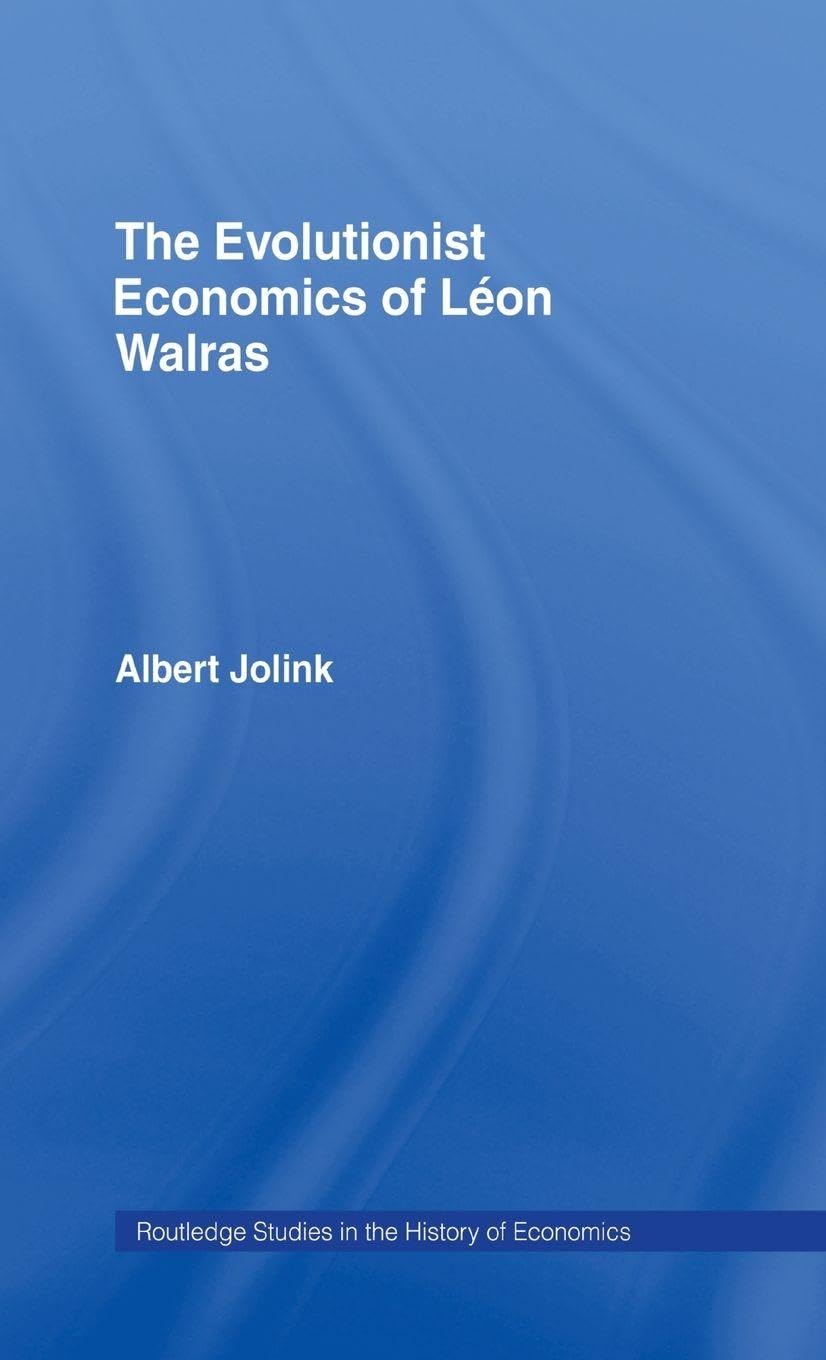
The Evolutionist Economics of Leon Walras by Jolink Albert – A Deep Dive into Walras' Pure, Applied & Social Economics i
Inclusive of all applicable taxes. FREE shipping on all orders.
Available Offers
- 🚚Free Delivery — Free shipping on all orders
- 💵Cash on Delivery — Pay when your order arrives
- ↩️15-Day Easy Returns — Hassle-free return policy
- 🔒Cash on Delivery — Pay safely when your order arrives
Check Delivery
Product Description
Introduction
The Evolutionist Economics of Leon Walras by Jolink Albert offers a groundbreaking exploration of one of the most influential yet misunderstood figures in economic thought. This hardcover volume, published by Taylor & Francis Ltd, repositions Walras not merely as a mathematical economist but as a thinker deeply engaged with the philosophical currents of his time. For Indian students and scholars of economics, this book provides a rare opportunity to understand the intellectual foundations of modern economic theory through a fresh, historically grounded lens.
Book Overview
In this meticulously researched work, Jolink Albert revisits the entire corpus of Leon Walras—his pure, applied, and social economics—through a newly constructed taxonomy based on extensive archival research at the University of Lausanne. The book challenges conventional readings by placing Walras within the broader cultural and historical context of nineteenth-century Europe. It reveals how Walras’ thought evolved from early romantic influences toward a systematic, evolutionary framework that anticipated later developments in logical positivism. This is not a dry recitation of equations but a vivid intellectual biography that connects Walras’ ideas to philosophy, science, and the social upheavals of his era.
Key Highlights
- Original Archival Research: Based on unpublished materials from the University of Lausanne archives, offering new insights into Walras’ intellectual development.
- Interdisciplinary Approach: Bridges economics, philosophy, and the history of science to show Walras as a product of his time.
- Evolutionary Perspective: Presents Walras’ economics as a dynamic, evolving system rather than a static mathematical model.
- Nineteenth-Century Context: Explores the tension between romanticism and positivism that shaped Walras’ thinking.
- Comprehensive Taxonomy: Offers a novel classification of Walras’ pure, applied, and social economics for clearer understanding.
Inside the Book
The volume is structured to guide readers through Walras’ intellectual journey. Early chapters delve into his philosophical foundations, including his engagement with Auguste Comte’s positivism and the romantic idealism of the early 1800s. Subsequent sections examine his pure economics—the general equilibrium theory for which he is famous—but reinterpret it as part of a larger evolutionary project. Applied economics chapters explore Walras’ ideas on production, exchange, and market dynamics, while social economics sections investigate his utopian vision of social justice and state intervention. The final chapters synthesize these strands, showing how Walras’ system anticipated modern evolutionary and institutional economics.
Key Topics
- Walras’ concept of general equilibrium and its philosophical underpinnings
- The role of romanticism in shaping nineteenth-century economic thought
- Logical positivism and its influence on economic methodology
- The relationship between pure, applied, and social economics in Walras’ framework
- Evolutionary ideas in Walras’ theories of value, capital, and distribution
- Walras’ critique of classical political economy and his vision for a just society
- The cultural and historical context of the University of Lausanne school
Reader Benefits
Indian readers will gain a deeper appreciation for how economic theories are shaped by their historical and philosophical environments. This book helps students move beyond rote memorization of models to understand the why behind economic ideas. It equips scholars with a nuanced perspective on the origins of neoclassical economics, making it easier to critically engage with contemporary debates. For those interested in the history of economic thought, it offers a model of how archival research can transform our understanding of canonical figures. The accessible prose and clear structure also make it suitable for self-study, whether you are preparing for competitive exams or writing a research paper.
Learning Outcomes
- Understand the evolution of Walras’ economic system from early romanticism to mature positivism
- Analyze the philosophical assumptions underlying general equilibrium theory
- Evaluate the connections between pure, applied, and social economics in a unified framework
- Critically assess the influence of nineteenth-century culture on economic methodology
- Apply historical insights to modern economic issues such as market design and social welfare
- Develop skills in interpreting archival materials and reconstructing intellectual histories
Who Should Read
This book is ideal for postgraduate students and researchers in economics, especially those specializing in the history of economic thought, economic methodology, or philosophy of science. Undergraduate students with a strong interest in the foundations of modern economics will also find it rewarding. Additionally, scholars in intellectual history, sociology, and political theory who explore the intersection of ideas and social change will appreciate the interdisciplinary depth. Indian readers preparing for UGC-NET, JRF, or PhD coursework in economics will find this volume a valuable resource for understanding the roots of neoclassical economics.
About the Author
Jolink Albert is a distinguished scholar known for his work on the history of economic thought and the philosophy of economics. His research has focused on unearthing archival materials that shed new light on classical and neoclassical economists. With a deep commitment to contextual analysis, Albert has contributed significantly to reinterpreting the intellectual heritage of the Lausanne School. His meticulous scholarship combines historical rigor with philosophical insight, making him a respected voice in the field.
About the Publisher
Taylor & Francis Ltd is a leading academic publisher with a global reputation for producing high-quality works in the social sciences, humanities, and sciences. Their economics list includes seminal texts that have shaped the discipline. This hardcover edition is produced to the highest standards of binding and print quality, ensuring durability for years of study. As a trusted name in scholarly publishing, Taylor & Francis continues to support innovative research that pushes the boundaries of knowledge.
Conclusion
The Evolutionist Economics of Leon Walras is an essential addition to any serious economics library in India. By revealing the philosophical and historical dimensions of Walras’ work, Jolink Albert invites readers to rethink the origins of modern economic theory. Whether you are a student grappling with equilibrium models or a researcher tracing the lineage of economic ideas, this book offers a rich, rewarding journey into the mind of one of the nineteenth century’s most original thinkers. Order your hardcover copy today from Bookshops.in and deepen your understanding of the evolution of economic thought.
Quick Summary
The Evolutionist Economics of Leon Walras by Jolink Albert is a scholarly work that reinterprets the economic theories of Leon Walras through an evolutionary lens. Drawing on archival research at the University of Lausanne, the book examines Walras' pure, applied, and social economics, revealing how his philosophy of science and the nineteenth century cultural context—from romanticism to logical positivism—shaped his ideas. This book is intended for postgraduate students, academic researchers, and faculty specializing in the history of economic thought, economic methodology, and Walrasian economics. Readers will gain a nuanced understanding of Walras' intellectual development and the philosophical foundations of his general equilibrium theory. The work stands out for its original taxonomy and deep contextual analysis, making it a valuable addition to any academic library. By purchasing from Bookshops.in, Indian readers get access to a premium hardcover edition with reliable delivery and customer service.
Book Highlights
Book Specifications
| ISBN-13 | 9780415098243 |
| ISBN-10 | 0415098246 |
| Publisher | Routledge |
| Language | English |
| Dimensions | 14.78 x 1.88 x 22.23 cm |
| Weight | 340 g |
| Country | India |
| Category | Economics › Economic Theory |
| Genre | Non-fiction |
| Original Language | English |
Frequently Asked Questions
What is the main argument of The Evolutionist Economics of Leon Walras?
Who is the author of this book?
Is this book suitable for undergraduate students?
What kind of research is this book based on?
Does the book cover Walras' general equilibrium theory?
How does this book differ from other works on Walras?
Who is the publisher?
Is this book available in hardcover?
What is the ISBN-13 of this book?
Can Indian students benefit from this book?
Does the book include any mathematical modeling?
What topics are covered in the book?
Is this book part of a series?
Where can I buy this book in India?
Readers Also Search For
Customers Also Bought
Entrepreneurship
Chinese Economic Revolution (English, Linda Grove)
Entrepreneurship
Engines of Innovation: The Entrepreneurial University in the Twenty-First Century by Holden Thorp
Entrepreneurship
Invention to Innovation (English, PhD Marshall Larry | Jenna Daroczy)
Entrepreneurship
Database Management Systems by Raghu Ramakrishnan – DBMS Textbook

Entrepreneurship
Decision-making for Technology Executives by Harold A. Linstone
Entrepreneurship
The Business Innovation Audit (English, William Tate)
Related Products
View All
Economics
Political Economy from Pufendorf to Marx (English, István Hont | Lasse S. Andersen | Béla Kapossy)
Economics
Women's Entrepreneurship and Economics (English, Miguel-Angel Galindo | Domingo Ribeiro)
Economics
Trade Policy and Industrialization in Turbulent Times | by Gerry Helleiner | Routledge | by Gerry Helleiner | Routledge | by Gerry Helleiner | Routledge | by Gerry Helleiner | Routledge | by Gerry Helleiner | Routledge | by Gerry Helleiner | Routledge | by Gerry Helleiner | Routledge | by Gerry Helleiner | Routledge | by Gerry Helleiner | Routledge | by Gerry Helleiner | Routledge | by Gerry Helleiner | Routledge | by Gerry Helleiner | Routledge | by Gerry Helleiner | Routledge | by Gerry Hellei
Economics
History of Economic Analysis | by Schumpeter Joseph A. | Taylor & Francis Ltd | by Schumpeter Joseph A. | Taylor & Francis Ltd | by Schumpeter Joseph A. | Taylor & Francis Ltd | by Schumpeter Joseph A. | Taylor & Francis Ltd | by Schumpeter Joseph A. | Taylor & Francis Ltd | by Schumpeter Joseph A. | Taylor & Francis Ltd | by Schumpeter Joseph A. | Taylor & Francis Ltd | by Schumpeter Joseph A. | Taylor & Francis Ltd | by Schumpeter Joseph A. | Taylor & Franci
Economics
OECD Compendium of Productivity Indicators 2015 | by Organization for Economic Cooperation an | Organization for Economic Co-Operation & Deve | by Organization for Economic Cooperation an | Organization for Economic Co-Operation & Deve | by Organization for Economic Cooperation an | Organization for Economic Co-Operation & Deve | by Organization for Economic Cooperation an | Organization for Economic Co-Operation & Deve | by Organization for Economic Cooperation an | Organization

Economics