
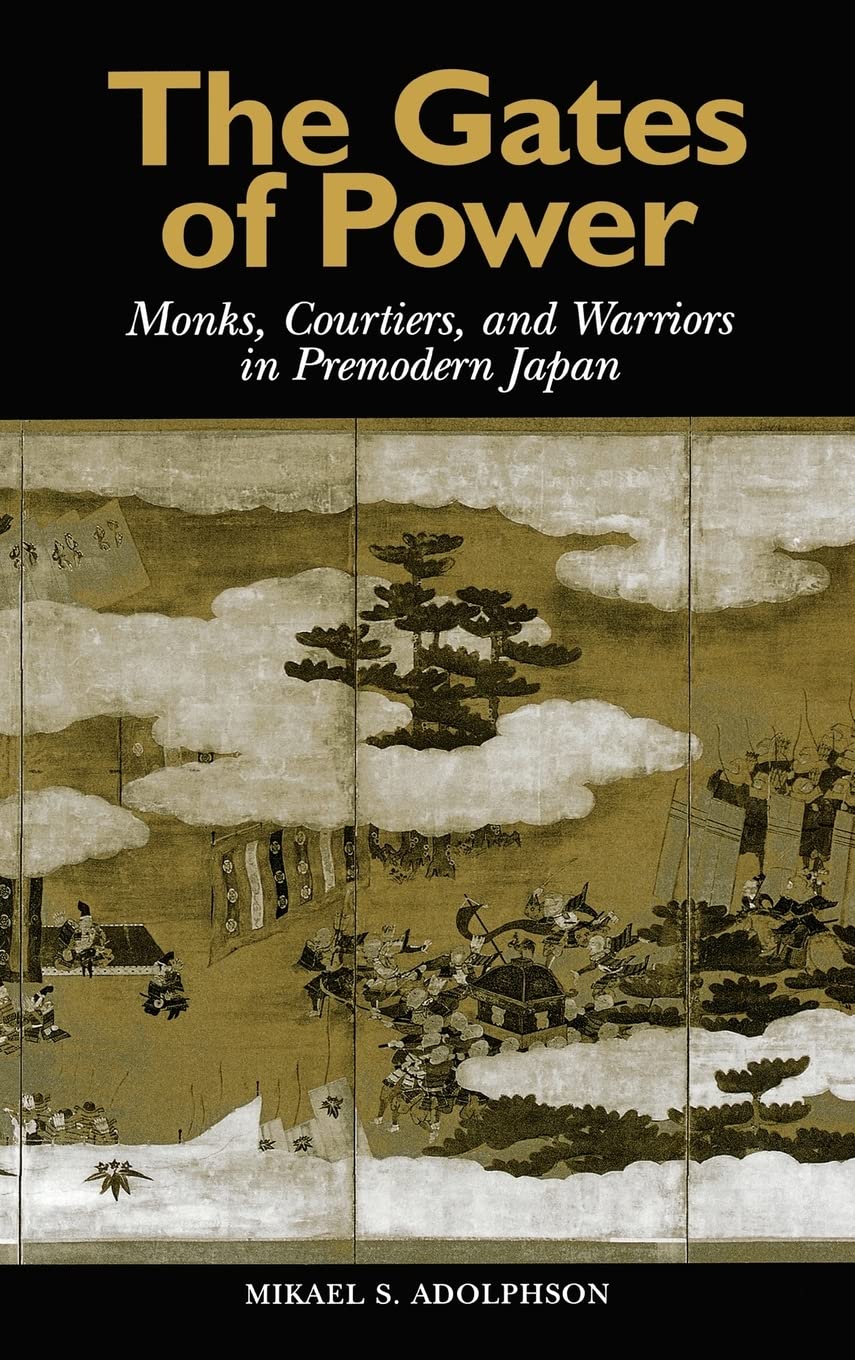
The Gates of Power: Monks, Courtiers, and Warriors in Premodern Japan by Mikael S. Adolphson – Understanding Religious a
Inclusive of all applicable taxes. FREE shipping on all orders.
Available Offers
- 🚚Free Delivery — Free shipping on all orders
- 💵Cash on Delivery — Pay when your order arrives
- ↩️15-Day Easy Returns — Hassle-free return policy
- 🔒Cash on Delivery — Pay safely when your order arrives
Check Delivery
Product Description
Introduction
In the vast tapestry of premodern Japanese history, few threads are as misunderstood as the political role of Buddhist temples and their warrior-monks. Mikael S. Adolphson’s The Gates of Power: Monks, Courtiers, and Warriors in Premodern Japan offers a groundbreaking reassessment of this turbulent era. For Indian readers and students of Asian history, this book provides a fascinating window into how religious institutions wielded real political influence—not through piety, but through strategic alliances, protests, and even armed demonstrations. It challenges long-held assumptions and reveals a complex world where monks, court nobles, and samurai were locked in a constant struggle for power.
Book Overview
This meticulously researched hardcover volume, published by the University of Hawaii Press, re-examines the phenomenon of ‘divine demonstrations’—a practice where monks from elite temples would carry sacred symbols to the imperial capital, demanding concessions from the court. Traditional scholarship has often dismissed these acts as mere religious violence or mob rule. Adolphson, however, uses a wide range of previously neglected sources to argue that such protests were not the cause of political turmoil but rather a symptom of deeper factionalism among secular leaders. The book demonstrates that powerful temples were not fringe actors but central players in the political landscape, using their religious prestige as leverage in a game of shifting alliances and rivalries.
Key Highlights
- Original Thesis: Challenges the conventional view of religious violence as irrational, presenting it instead as a calculated political tool used by both temples and secular factions.
- Rich Source Material: Draws on diaries, court records, and temple documents that have been largely ignored by earlier historians, offering new perspectives on well-known events.
- Focus on Three Centers: Examines the interplay between the imperial court, the warrior class (bushi), and major monastic complexes like Enryakuji on Mount Hiei.
- Three Centuries of Insight: Covers the late Heian through the Kamakura periods (roughly 900–1300 CE), a formative age in Japanese history.
- Equilibrium of Power: Explains how temples maintained a delicate balance of influence, using divine demonstrations as a negotiating tool to protect their rights and status.
Inside the Book
The book is divided into thematic chapters that build a coherent argument. It begins by setting the stage: the political structure of the Heian court and the rise of powerful monastic estates. Adolphson then delves into specific case studies of divine demonstrations, analyzing the actors involved—from abbots and warrior-monks to regents and retired emperors. A key section explores how secular leaders sometimes instigated temple protests to weaken their rivals, turning religious institutions into proxies for political battles. The final chapters examine the gradual shift in power dynamics as the samurai class grew stronger, leading to the eventual suppression of monastic militancy. Throughout, the writing is academic yet accessible, with clear explanations of Japanese terms and concepts.
Key Topics
- Divine Demonstrations: The ritualized protests where sacred mikoshi (portable shrines) were carried to the capital to pressure the court.
- Monastic Militancy: The organization and tactics of warrior-monks (sōhei) from temples like Enryakuji, Kōfukuji, and Onjōji.
- Court Factionalism: The rivalry between the Fujiwara regents, retired emperors (insei), and rising military houses.
- Land and Estates: The economic foundations of temple power through tax-exempt estates (shōen).
- Religious Legitimacy: How temples used Buddhist doctrine and sacred objects to justify their political demands.
- Kamakura Shift: The transition from courtly to warrior rule and its impact on religious institutions.
Reader Benefits
- Deeper Historical Understanding: Gain a nuanced view of medieval Japan beyond the familiar samurai narratives.
- Critical Thinking Skills: Learn to question simplistic explanations of religious violence and political conflict.
- Academic Rigor: Access a well-documented study that can serve as a reference for research papers, theses, or classroom discussions.
- Cultural Context: Appreciate the intertwined nature of religion and politics in premodern societies, with parallels to Indian history.
- Premium Edition: Own a durable hardcover copy from a respected academic publisher, ideal for building a personal library.
Learning Outcomes
After reading this book, you will be able to: identify the major monastic complexes and their political strategies; explain the role of divine demonstrations in medieval Japanese politics; analyze the relationship between temple power and secular factionalism; trace the evolution of temple-state interactions from the Heian to the Kamakura period; and critically evaluate primary sources related to religious and political history. These skills are valuable for students of history, religious studies, political science, and Asian studies.
Who Should Read
- History Students: Undergraduates and postgraduates specializing in Japanese, East Asian, or comparative medieval history.
- Scholars of Religion: Those interested in the political dimensions of Buddhism and religious institutions.
- General Readers: Anyone fascinated by samurai culture, Japanese temples, or the hidden dynamics of power.
- Indian Readers: Students and academics looking for a rigorous yet engaging study of how religion and state interacted in another great Asian civilization.
About the Author
Mikael S. Adolphson is a distinguished historian of premodern Japan. He is a professor at the University of Cambridge, where he teaches Japanese studies and East Asian history. His research focuses on the intersection of religion, politics, and military power, and he has published extensively on Buddhist institutions and court culture. Adolphson’s work is known for its careful use of primary sources and its ability to challenge established narratives, making him a leading voice in the field.
About the Publisher
The University of Hawaii Press is a premier academic publisher with a strong focus on Asian and Pacific studies. Established in 1947, it is renowned for publishing authoritative works on Japanese history, culture, and religion. This hardcover edition reflects the press’s commitment to high-quality scholarship, with durable binding and clear typography—perfect for serious readers and libraries.
Conclusion
The Gates of Power is an essential read for anyone seeking to understand the real forces that shaped premodern Japan. By placing monks, courtiers, and warriors on an equal footing, Mikael S. Adolphson reveals a world where sacred symbols were as potent as swords, and where temples were not just places of worship but formidable political players. For Indian readers, this book offers a valuable comparative perspective on the relationship between religion and state—a theme that resonates deeply in our own subcontinental history. Add this meticulously researched volume to your collection and unlock the gates to a richer understanding of Japan’s medieval past.
Quick Summary
'The Gates of Power: Monks, Courtiers, and Warriors in Premodern Japan' by Mikael S. Adolphson is a groundbreaking academic work that reexamines the political influence of Buddhist temples in medieval Japan. The book challenges conventional views that religious protests and divine demonstrations were spontaneous acts of faith. Instead, Adolphson argues that these events were orchestrated by secular leaders to manipulate political hierarchies and advance their own interests. Drawing on a wealth of previously neglected primary sources, the author reveals how court factionalism, warrior ambitions, and temple rivalries intertwined to shape the political landscape of the Heian and Kamakura periods. Readers will gain a nuanced understanding of the complex relationships between monks, courtiers, and warriors, and how disfavored religious institutions fought to protect their rights and status. This book is ideal for advanced students, scholars, and history enthusiasts who want to delve deeper into the political dynamics of premodern Japan. By purchasing from Bookshops.in, you support a premium Indian bookstore that offers authentic imported editions with fast delivery and excellent customer service.
Book Highlights
Book Specifications
| ISBN-13 | 9780824822637 |
| ISBN-10 | 0824822633 |
| Publisher | University of Hawai'i Press |
| Language | English |
| Dimensions | 15.24 x 2.69 x 22.86 cm |
| Weight | 816 g |
| Category | History Textbooks › Asia |
| Genre | History |
| Original Language | English |
Frequently Asked Questions
What is 'The Gates of Power' about?
Who is the author of this book?
Is this book suitable for beginners in Japanese history?
What time period does the book cover?
Does the book include primary sources?
What is the binding of this book?
Is this book available in paperback?
What is the price of the book?
Does the book challenge existing views?
What are 'divine demonstrations'?
What language is the book in?
Is there a digital edition?
How is this book different from other works on Japanese history?
Readers Also Search For
Customers Also Bought

McFarland & Company
Playing with the Guys | by Marc A. Ouellette | Matthew Wilhelm Kapell | McFarland & Company | by Marc A. Ouellette | Matthew Wilhelm Kapell | McFarland & Company | by Marc A. Ouellette | Matthew Wilhelm Kapell | McFarland & Company | by Marc A. Ouellette | Matthew Wilhelm Kapell | McFarland & Company | by Marc A. Ouellette | Matthew Wilhelm Kapell | McFarland & Company | by Marc A. Ouellette | Matthew Wilhelm Kapell | McFarland & Company | by Marc A. Ouellette | Matthew W

Rowman & Littlefield Publishers
Joss Whedon's Dollhouse: Confounding Purpose, Confusing Identity (Science Fiction Television)

State University of New York Press
Mexico Unmanned: The Cultural Politics of Masculinity in Mexican Cinema (SUNY series in Latin American Cinema)

McFarland & Company
Valley Forge to Monmouth | by Jim Stempel | McFarland & Company | by Jim Stempel | McFarland & Company | by Jim Stempel | McFarland & Company | by Jim Stempel | McFarland & Company | by Jim Stempel | McFarland & Company | by Jim Stempel | McFarland & Company | by Jim Stempel | McFarland & Company | by Jim Stempel | McFarland & Company | by Jim Stempel | McFarland & Company | by Jim Stempel | McFarland & Company | by Jim Stempel | McFarland & Company |
University of Toronto Press
Structures of Feeling in Seventeenth-Century Cultural Expression (UCLA Center Clark Library)

McFarland & Company
Welcome to Arkham Asylum | by Sharon Packer | Daniel R. Fredrick | McFarland & Company | by Sharon Packer | Daniel R. Fredrick | McFarland & Company | by Sharon Packer | Daniel R. Fredrick | McFarland & Company | by Sharon Packer | Daniel R. Fredrick | McFarland & Company | by Sharon Packer | Daniel R. Fredrick | McFarland & Company | by Sharon Packer | Daniel R. Fredrick | McFarland & Company | by Sharon Packer | Daniel R. Fredrick | McFarland & Company | by Sharon P
Related Products
View All
University of Hawaii Press
Japanese Inn | by Oliver Statler | University of Hawaii Press | by Oliver Statler | University of Hawaii Press | by Oliver Statler | University of Hawaii Press | by Oliver Statler | University of Hawaii Press | by Oliver Statler | University of Hawaii Press | by Oliver Statler | University of Hawaii Press | by Oliver Statler | University of Hawaii Press | by Oliver Statler | University of Hawaii Press | by Oliver Statler | University of Hawaii Press | by Oliver Statler | University of Hawaii Pre

University of Hawaii Press
Krauss - Conflict in Japan Paper | by Ellis S. Krauss | Thomas P. Rohlen | Patricia G. Steinhoff | University of Hawaii Press | by Ellis S. Krauss | Thomas P. Rohlen | Patricia G. Steinhoff | University of Hawaii Press | by Ellis S. Krauss | Thomas P. Rohlen | Patricia G. Steinhoff | University of Hawaii Press | by Ellis S. Krauss | Thomas P. Rohlen | Patricia G. Steinhoff | University of Hawaii Press | by Ellis S. Krauss | Thomas P. Rohlen | Patricia G. Steinhoff | University of Hawaii Press |

University of Hawaii Press
Lives of the Nuns | by Kathryn Ann Tsai | Kathryn Ann Tsai | Shih Pao-Ch'ang | University of Hawaii Press | by Kathryn Ann Tsai | Kathryn Ann Tsai | Shih Pao-Ch'ang | University of Hawaii Press | by Kathryn Ann Tsai | Kathryn Ann Tsai | Shih Pao-Ch'ang | University of Hawaii Press | by Kathryn Ann Tsai | Kathryn Ann Tsai | Shih Pao-Ch'ang | University of Hawaii Press | by Kathryn Ann Tsai | Kathryn Ann Tsai | Shih Pao-Ch'ang | University of Hawaii Press | by Kathryn Ann Tsai | Kathryn Ann Tsai |

University of Hawaii Press
Hawaii Islands Under the Influence | by Noel J. Kent | Dan Boylan | University of Hawaii Press | by Noel J. Kent | Dan Boylan | University of Hawaii Press | by Noel J. Kent | Dan Boylan | University of Hawaii Press | by Noel J. Kent | Dan Boylan | University of Hawaii Press | by Noel J. Kent | Dan Boylan | University of Hawaii Press | by Noel J. Kent | Dan Boylan | University of Hawaii Press | by Noel J. Kent | Dan Boylan | University of Hawaii Press | by Noel J. Kent | Dan Boylan | University o
University of Hawaii Press
Beginning of Heaven and Earth | by Christal Whelan | Christal Whelan | University of Hawaii Press | by Christal Whelan | Christal Whelan | University of Hawaii Press | by Christal Whelan | Christal Whelan | University of Hawaii Press | by Christal Whelan | Christal Whelan | University of Hawaii Press | by Christal Whelan | Christal Whelan | University of Hawaii Press | by Christal Whelan | Christal Whelan | University of Hawaii Press | by Christal Whelan | Christal Whelan | University of Hawaii

University of Hawaii Press