
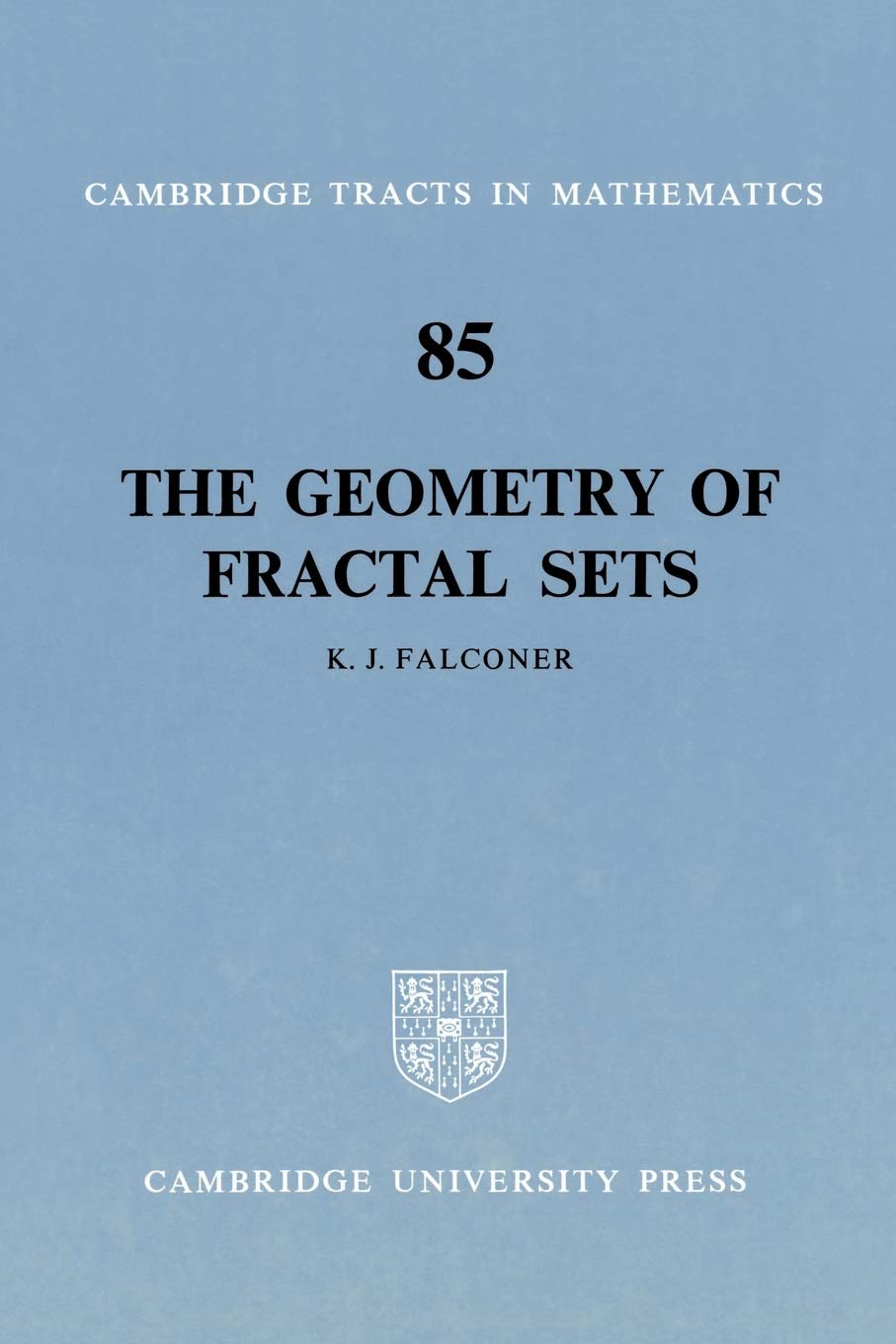
The Geometry of Fractal Sets: A Rigorous Mathematical Study by Kenneth Falconer for Graduate Students and Researchers
Inclusive of all applicable taxes. FREE shipping on all orders.
Available Offers
- 🚚Free Delivery — Free shipping on all orders
- 💵Cash on Delivery — Pay when your order arrives
- ↩️15-Day Easy Returns — Hassle-free return policy
- 🔒Cash on Delivery — Pay safely when your order arrives
Check Delivery
Product Description
Introduction
Fractal geometry has reshaped the way we perceive irregular, fragmented, and infinitely complex shapes in nature and mathematics. For serious students and researchers in pure and applied mathematics, The Geometry of Fractal Sets by Kenneth Falconer offers a profound and rigorous exploration into the mathematical foundations of fractal structures. Published by Cambridge University Press, this hardbound volume is an essential reference for anyone seeking to understand the geometric properties of sets with non-integer dimensions, from local density to tangents and projections. This book is not a casual read but a deep dive into the analytical tools that define modern geometric measure theory.
Book Overview
This classic text provides a systematic and advanced treatment of the geometrical aspects of sets of both integral and fractional Hausdorff dimension. Falconer masterfully navigates the reader through the subtle differences between regular, curve-like sets and irregular, dust-like sets, using the powerful language of measure theory. The book connects abstract theory to concrete examples, including self-similar sets, strange attractors, and number-theoretic constructs, making it a bridge between pure mathematics and its applications. With a strong emphasis on foundational tools such as the Vitali covering lemma, net measures, and Fourier transform methods, this work remains a cornerstone for postgraduate students and mathematicians.
Key Highlights
- Rigorous Treatment of Hausdorff Dimension: Develops a thorough understanding of both integral and fractional dimension concepts.
- Duality with Kakeya Sets: Explores the fascinating relationship between fractal sets and sets of zero area containing lines in every direction.
- Diverse Examples: Includes discussions on curves of fractional dimension, self-similar sets, strange attractors, and applications from number theory and convexity.
- Foundational Tools: Emphasizes the Vitali covering lemma, net measures, Fourier transform methods, and local density theory.
Inside the Book
Within these pages, readers will find a meticulously structured journey through the geometry of irregular sets. The book begins by establishing the necessary background in measure theory and dimension, then moves into the study of local properties such as density and tangents. Subsequent chapters delve into the dimensional properties of projections and intersections, leading to the intriguing duality with Kakeya sets. The final chapter is a treasure trove of applications, showcasing how the general theory applies to fractals arising in dynamics, number theory, and geometry. Each theorem is presented with clear proof, and the exercises reinforce the conceptual understanding.
Key Topics
- Hausdorff measure and dimension
- Local density and tangents of fractal sets
- Projections and intersections of sets
- Kakeya sets and Besicovitch sets
- Self-similar and self-affine sets
- Strange attractors and dynamical systems
- Fourier transform methods in geometric measure theory
Reader Benefits
This book equips serious readers with the analytical skills needed to tackle advanced problems in fractal geometry and related fields. By mastering the concepts presented, readers will gain the ability to compute and interpret Hausdorff dimensions, understand the geometric structure of irregular sets, and apply these ideas to real-world phenomena such as turbulence, signal processing, and chaos theory. The rigorous approach builds a strong foundation for further research in pure mathematics or interdisciplinary applications.
Learning Outcomes
- Develop a deep working knowledge of Hausdorff dimension and its properties.
- Learn to analyze local density and tangency conditions for both regular and irregular sets.
- Understand the dimensional behaviour of sets under projections and intersections.
- Grasp the duality between fractal sets and Kakeya sets.
- Apply the theory to concrete examples like self-similar sets and strange attractors.
Who Should Read
This book is ideal for postgraduate students, research scholars, and professional mathematicians specializing in real analysis, geometric measure theory, or fractal geometry. It is also highly relevant for physicists and engineers working with complex systems, chaos, or signal analysis, provided they have a strong background in advanced calculus and measure theory. Indian students preparing for competitive research examinations or pursuing a PhD in mathematics will find this text invaluable for building a rigorous mathematical foundation.
About the Author
Kenneth Falconer is a renowned British mathematician and a leading authority on fractal geometry and geometric measure theory. He is a professor at the University of St Andrews, where he has contributed extensively to the understanding of fractals, dimension theory, and their applications. His other influential works include Fractal Geometry: Mathematical Foundations and Applications, which is widely used as a textbook worldwide. Falconer's clear and precise writing style makes complex topics accessible to advanced students.
About the Publisher
Cambridge University Press is one of the oldest and most prestigious academic publishers in the world. With a history spanning over four centuries, CUP is known for publishing high-quality scholarly works in mathematics, science, and humanities. This hardcover edition reflects their commitment to academic excellence, featuring durable binding and crisp typesetting that ensures longevity for reference use in libraries and personal collections.
Conclusion
The Geometry of Fractal Sets is an indispensable resource for anyone serious about understanding the mathematics behind fractals. Whether you are a researcher exploring the frontiers of geometric measure theory or a postgraduate student seeking a thorough grounding in the subject, this book provides the depth and clarity you need. Its combination of rigorous theory and illustrative examples makes it a lasting reference that will enrich your mathematical journey. Add this classic to your collection and unlock the elegant geometry of the irregular.
Quick Summary
The Geometry of Fractal Sets by Kenneth Falconer is a foundational mathematical text that provides a rigorous treatment of sets with integral and fractional Hausdorff dimension. Aimed at graduate students and researchers, the book delves into the local density and existence of tangents of such sets, as well as the dimensional properties of their projections in various directions. It distinguishes between regular 'curve-like' sets and irregular 'dust-like' sets, and connects the theory to Kakeya sets—sets of zero area containing lines in every direction. The final chapter offers diverse examples, including curves of fractional dimension, self-similar sets, strange attractors, and applications in number theory and convexity. Readers will gain a deep understanding of geometric measure theory and fractal geometry. This hardcover edition from Cambridge University Press is a valuable resource for Indian mathematics students and academics, and purchasing from Bookshops.in ensures a reliable, high-quality copy for your library.
Book Highlights
Book Specifications
| ISBN-13 | 9780521337052 |
| ISBN-10 | 0521337054 |
| Publisher | Cambridge University Press |
| Language | English |
| Dimensions | 15.24 x 1.14 x 22.86 cm |
| Weight | 270 g |
| Country | India |
| Category | Mathematics › Calculus |
| Genre | Nonfiction |
| Original Language | English |
Frequently Asked Questions
What is The Geometry of Fractal Sets about?
Who is the author of this book?
Is this book suitable for beginners?
What topics are covered in the book?
Does the book include examples?
Is this book available in hardcover?
What is the ISBN-13?
Can I use this book for self-study?
Does the book cover fractional dimension?
What are Kakeya sets?
Is this book relevant for Indian students?
What is the price of this book?
Does the book include exercises?
Readers Also Search For
Customers Also Bought
Mathematics
Stereotype Spaces and Algebras: 73 (De Gruyter Expositions in Mathematics, 73)
Mathematics
Semigroups in Algebra, Geometry and Analysis: 20 (De Gruyter Expositions in Mathematics, 20)
Mathematics
Geometry from the Pacific Rim: Proceedings of the Pacific Rim Geometry Conference held at National University of Singapore, Republic of Singapore, ... 1994 (De Gruyter Proceedings in Mathematics)

Mathematics
First International Tainan-Moscow Algebra Workshop: Proceedings of the International Conference held at National Cheng Kung University Tainan, Taiwan, ... 1994 (De Gruyter Proceedings in Mathematics)

Mathematics
Differential Geometry - Proceedings of the VIII International Colloquium (English, Jesus A. Alvarez Lopez | Eduardo Garcia-Rio)
Mathematics
Mathematical Theory of Optimal Processes (Classics of Soviet Mathematics)
Related Products
View AllMathematics
Stereotype Spaces and Algebras: 73 (De Gruyter Expositions in Mathematics, 73)
Mathematics
Semigroups in Algebra, Geometry and Analysis: 20 (De Gruyter Expositions in Mathematics, 20)
Mathematics
Geometry from the Pacific Rim: Proceedings of the Pacific Rim Geometry Conference held at National University of Singapore, Republic of Singapore, ... 1994 (De Gruyter Proceedings in Mathematics)
Mathematics
First International Tainan-Moscow Algebra Workshop: Proceedings of the International Conference held at National Cheng Kung University Tainan, Taiwan, ... 1994 (De Gruyter Proceedings in Mathematics)
Mathematics
Differential Geometry - Proceedings of the VIII International Colloquium (English, Jesus A. Alvarez Lopez | Eduardo Garcia-Rio)
Mathematics