
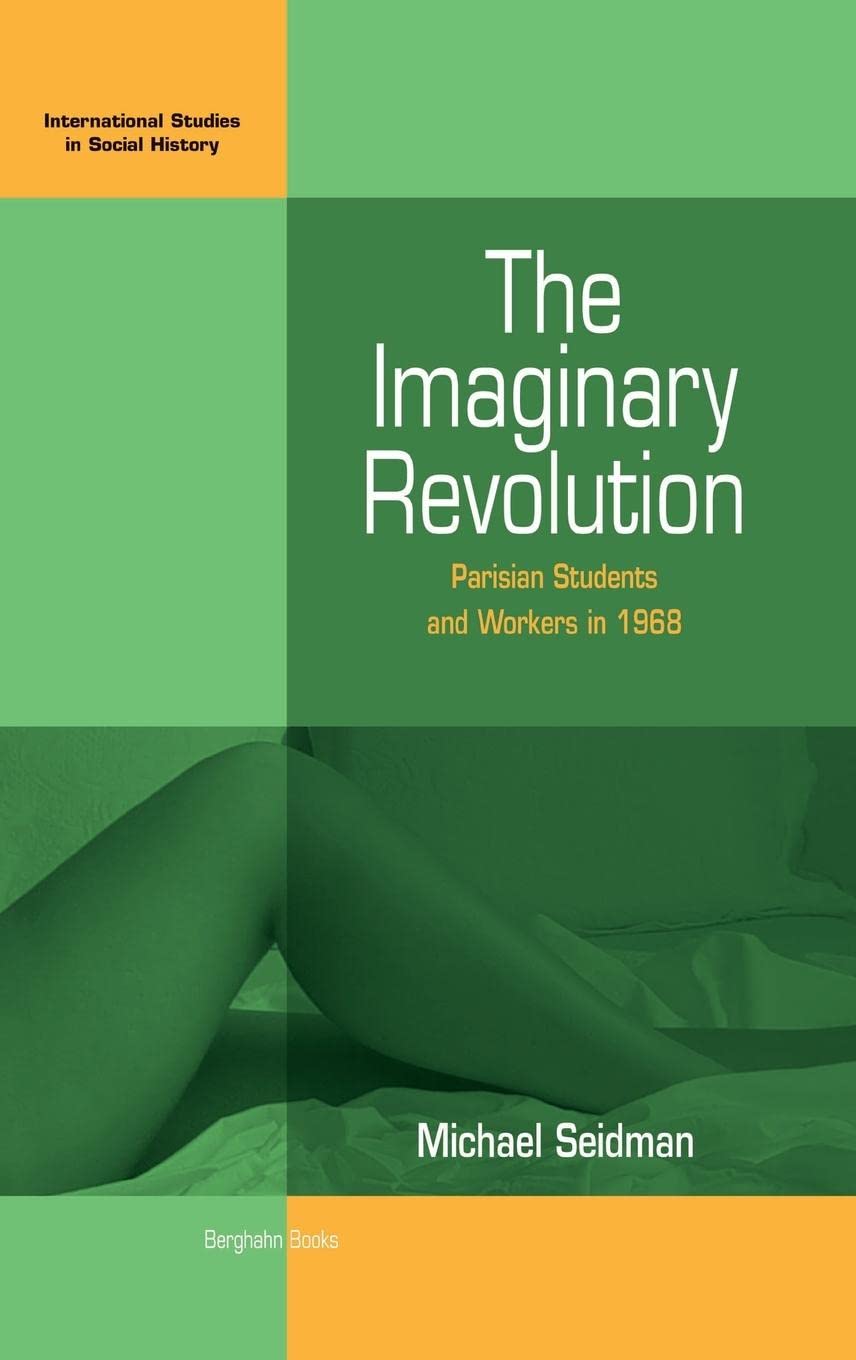
The Imaginary Revolution: Parisian Students and Workers in 1968 by Michael Seidman – A Critical Reassessment of the May
Inclusive of all applicable taxes. FREE shipping on all orders.
Available Offers
- 🚚Free Delivery — Free shipping on all orders
- 💵Cash on Delivery — Pay when your order arrives
- ↩️15-Day Easy Returns — Hassle-free return policy
- 🔒Cash on Delivery — Pay safely when your order arrives
Check Delivery
Product Description
Introduction
The year 1968 remains etched in global memory as a time of upheaval, idealism, and radical change. In France, the events of May 1968—where students and workers briefly united in protest—have been romanticised as a revolutionary watershed. But was it truly a revolution that reshaped society, or a dramatic moment that accelerated changes already underway? Michael Seidman’s The Imaginary Revolution: Parisian Students and Workers in 1968 offers a bold, meticulously researched re-examination of this iconic episode. For Indian students and scholars of history, sociology, and political science, this book provides a critical lens to understand how movements are remembered, mythologised, and analysed.
Book Overview
This hardcover volume from Berghahn Books presents a challenging perspective on the events of May 1968 in Paris. Seidman argues that the student protests and worker strikes, while dramatic, did not fundamentally transform French society. Instead, he contends that most of the social, cultural, and economic shifts attributed to 1968 had already begun in the late 1950s and early 1960s. The workers’ gains—such as higher wages and reduced working hours—were extensions of long-standing labour demands, not revolutionary breakthroughs. The book dissects the gap between the myth of a revolutionary moment and the reality of gradual, pre-existing change. It is an essential read for anyone interested in the dynamics of protest, memory, and historical interpretation.
Key Highlights
- Critical Reassessment: Challenges the dominant narrative that 1968 was a revolutionary turning point.
- Comparative Analysis: Contrasts student and worker movements, showing their distinct goals and outcomes.
- Media and Memory: Explores how media and scholars amplified the revolutionary symbolism of the events.
- Historical Context: Places 1968 within the broader trajectory of French post-war social and economic change.
- Rigorous Scholarship: Based on extensive archival research and primary sources.
Inside the Book
The book is structured to guide readers through the complex interplay of student radicalism, labour activism, and political reaction. Seidman begins by setting the stage of France in the 1960s—a period of economic growth, cultural shifts, and generational tension. He then delves into the student uprising at the University of Nanterre and the Sorbonne, examining the motivations and limitations of the student leaders. The narrative moves to the massive general strike that paralysed France, analysing the workers’ demands and the government’s response. Crucially, Seidman traces the aftermath: how the events were remembered, commemorated, and transformed into a global symbol of youthful rebellion. The final chapters offer a sobering conclusion: the revolution was largely imaginary, but the myth itself has had real consequences for how we think about protest and change.
Key Topics
- May 1968 in Paris: events and chronology
- Student radicalism and the New Left
- Labour movements and trade unionism in France
- The role of media in shaping historical narratives
- Cultural change in post-war Europe
- Historical memory and mythmaking
- Comparative revolutions and social movements
- French political history (1958–1970s)
Reader Benefits
- Deepen Historical Understanding: Move beyond popular myths to grasp the nuanced reality of 1968.
- Develop Critical Thinking: Learn to question dominant narratives and evaluate evidence.
- Enhance Academic Research: Gain insights for essays, dissertations, and papers on social movements.
- Contextualise Modern Protests: Understand how past uprisings inform contemporary activism in India and globally.
- Accessible Scholarship: Written in clear, engaging prose suitable for both students and general readers.
Learning Outcomes
After reading this book, you will be able to: analyse the difference between revolutionary rhetoric and actual social change; evaluate the role of media in constructing historical events; compare the French student and worker movements with other global protests; understand the long-term evolution of French society from the 1950s to the 1970s; and critically assess how historical memory shapes political identity. The book equips you with tools to deconstruct similar myths in other contexts, including Indian movements.
Who Should Read
- History and political science students at Indian universities
- Scholars of social movements and protest studies
- Readers interested in European history and the 1960s
- Journalists and writers covering contemporary activism
- Anyone curious about how revolutions are remembered and misremembered
About the Author
Michael Seidman is a distinguished historian specialising in modern European history, with a focus on France, war, and social movements. He has taught at several universities and is known for his rigorous, revisionist approach to historical events. His work often challenges conventional wisdom, urging readers to re-examine accepted narratives with fresh eyes. Seidman’s scholarship is respected for its depth of research and clarity of argument.
About the Publisher
Berghahn Books is an independent academic publisher based in New York and Oxford, renowned for its high-quality titles in history, anthropology, and the social sciences. They are committed to publishing works that push boundaries and offer new perspectives, making them a trusted name in scholarly publishing worldwide.
Conclusion
The Imaginary Revolution is not just a book about 1968; it is a masterclass in how to think critically about history. For Indian readers, it offers a valuable framework to examine our own narratives of protest and change—from the Naxalite movement to contemporary student agitations. By stripping away the myth, Seidman reveals a more complex, and ultimately more instructive, story. Add this hardcover to your library and challenge what you thought you knew about one of the most talked-about moments of the twentieth century.
Quick Summary
The Imaginary Revolution: Parisian Students and Workers in 1968 by Michael Seidman is a provocative historical work that challenges the widely accepted narrative of May 1968 as a transformative revolutionary moment. Seidman meticulously argues that the student protests did not bring about fundamental change but rather reflected shifts already underway in the late 1950s and early 1960s. The worker strikes, while significant, achieved only modest wage increases and reduced working hours—goals long pursued by the French labor movement. The book highlights how media and scholars inflated the events into a symbol of youthful rebellion and societal renewal, masking the limited actual reforms. This critical reassessment is ideal for Indian students of history, political science, and sociology who want to understand how historical myths are constructed. By reading this book, learners will develop a more nuanced perspective on protest movements and the gap between perception and reality. Purchasing from Bookshops.in ensures you receive a genuine hardcover edition, supporting a trusted Indian bookstore that values academic rigor.
Book Highlights
Book Specifications
| ISBN-13 | 9781571816757 |
| ISBN-10 | 1571816755 |
| Publisher | Berghahn Books, Incorporated |
| Language | English |
| Dimensions | 15.6 x 1.91 x 23.39 cm |
| Weight | 544 g |
| Country | India |
| Category | World › Revolutionary |
| Genre | History |
| Original Language | English |
Frequently Asked Questions
What is The Imaginary Revolution about?
Who is the author of this book?
Is this book suitable for Indian students?
What is the main argument of the book?
Does the book cover worker strikes?
How does this book differ from other accounts of 1968?
What type of readers will enjoy this book?
Is the book based on primary sources?
What language is the book in?
What is the ISBN-13?
What is the price in India?
Can I buy this from Bookshops.in?
Readers Also Search For
Related Products
View All
History
The Information Revolution: Transforming the World Through Technology (World History)
History
Human Nature and the French Revolution: From the Enlightenment to the Napoleonic Code: 3 (Polygons: Cultural Diversities and Intersections, 3)
History
The Unmaking of Home in Contemporary Art (Cultural Spaces)

History
Handbook to Life in Medieval and Early Modern Japan | by William E. Deal | Oxford University Press | by William E. Deal | Oxford University Press | by William E. Deal | Oxford University Press | by William E. Deal | Oxford University Press | by William E. Deal | Oxford University Press | by William E. Deal | Oxford University Press | by William E. Deal | Oxford University Press | by William E. Deal | Oxford University Press | by William E. Deal | Oxford University Press | by William E. Deal | Ox

History
The Narrators of Barbarian History (A.D. 550-800) | by Walter Goffart | University of Notre Dame Press | by Walter Goffart | University of Notre Dame Press | by Walter Goffart | University of Notre Dame Press | by Walter Goffart | University of Notre Dame Press | by Walter Goffart | University of Notre Dame Press | by Walter Goffart | University of Notre Dame Press | by Walter Goffart | University of Notre Dame Press | by Walter Goffart | University of Notre Dame Press | by Walter Goffart | Univ

History