
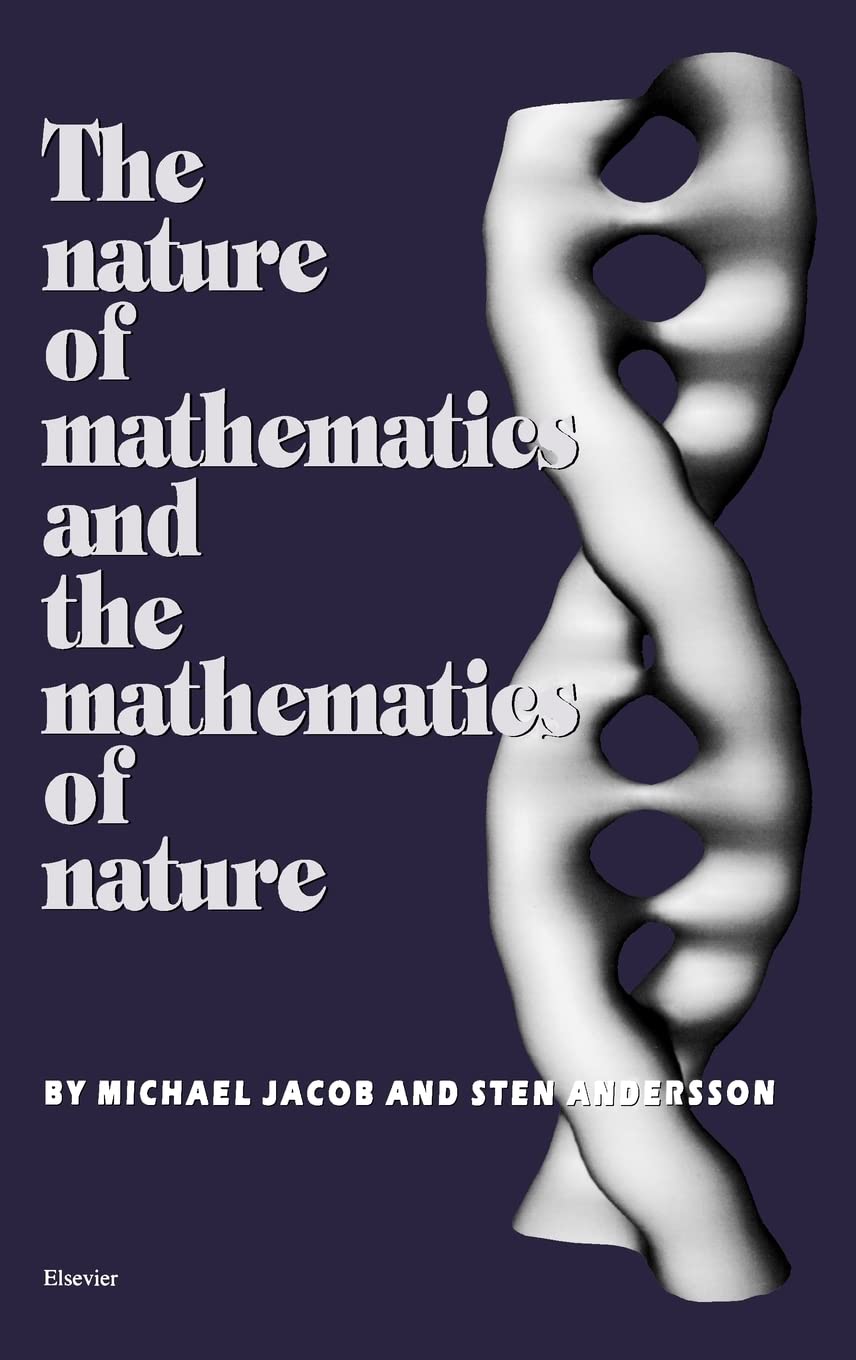
The Nature of Mathematics and the Mathematics of Nature by S. Andersson – A Deep Dive into Mathematical Structures and N
Inclusive of all applicable taxes. FREE shipping on all orders.
Available Offers
- 🚚Free Delivery — Free shipping on all orders
- 💵Cash on Delivery — Pay when your order arrives
- ↩️15-Day Easy Returns — Hassle-free return policy
- 🔒Cash on Delivery — Pay safely when your order arrives
Check Delivery
Product Description
Introduction
Mathematics is often perceived as an abstract discipline, yet it is the silent architect behind the patterns we observe in nature. The Nature of Mathematics and the Mathematics of Nature by S. Andersson is a thought-provoking hardcover that bridges the gap between human-made mathematical structures and the intricate designs found in chemistry, physics, and biology. Published by Elsevier Science, this book invites Indian students, researchers, and curious minds to explore a unified vision where geometry and natural sciences converge.
Book Overview
This volume challenges the conventional separation between pure mathematics and natural sciences. The authors argue that while chemistry, physics, and biology are inherently complex, mathematics—being a human creation—offers a simpler, more elegant lens to decode the universe. The book is built on two foundational ideas: first, using ordinary mathematics to reveal the simplicity within mathematical structures themselves, and second, developing new mathematical branches to describe natural phenomena. From the addition and subtraction of planes to the emergence of polyhedra, saddles, and multispirals, the narrative unfolds layer by layer, showing how symmetry and exponential scales govern both abstract concepts and physical reality.
Key Highlights
- Original Approach: Demonstrates how basic operations like addition, subtraction, and multiplication of planes generate complex geometric forms such as polyhedra, saddles, and multispirals.
- Exponential Scale Mastery: Introduces the exponential scale as a unifying tool to describe solids, nodal surfaces, and periodic structures.
- Symmetry Equation: Derives a fundamental equation of symmetry that ties together the exponential scale, complex exponentials, and Gauss Distribution mathematics with finite periodicity.
- Interdisciplinary Relevance: Connects mathematical functions directly to chemical structures, offering a fresh perspective for students of science and mathematics alike.
Inside the Book
The journey begins with the simplest of mathematical actions—adding planes—to construct polyhedra and solids. Then, subtracting planes reveals saddle shapes, while multiplying planes leads to general saddle equations and multispirals. The authors systematically build a framework where the equation of symmetry emerges naturally, encompassing the exponential scale for solids, complex exponentials for nodal surfaces, and Gauss Distribution mathematics for finite periodicity. Each chapter pieces together functions that geometrically describe chemical systems, making abstract equations tangible. The book is richly illustrated with diagrams and examples that aid visual learners, a boon for Indian students accustomed to rigorous visual teaching methods.
Key Topics
- Addition, subtraction, and multiplication of planes in geometric construction
- Exponential scale and its applications to polyhedra and solids
- Saddle equations and multispiral formations
- Symmetry equation and its components: complex exponentials and nodal surfaces
- Gauss Distribution mathematics with finite periodicity
- Mathematical modelling of chemical structures and natural forms
Reader Benefits
Readers will gain a deeper appreciation for how mathematics is not separate from nature but woven into its fabric. The book demystifies complex geometric concepts by grounding them in everyday operations like addition and subtraction. Indian students preparing for competitive exams or pursuing research in mathematics, chemistry, or physics will find a new way to visualize symmetry and structure. The clear, step-by-step progression from basic plane operations to advanced equations ensures that even those new to higher mathematics can follow along with patience. Moreover, the hardcover format makes it a durable addition to any library, ideal for repeated reference.
Learning Outcomes
- Understand how elementary geometric operations give rise to complex natural forms
- Apply the exponential scale to model solids and periodic structures
- Derive and interpret the equation of symmetry in multiple contexts
- Connect Gauss Distribution mathematics to finite periodicity in natural systems
- Develop new mathematical perspectives for describing chemical and physical phenomena
Who Should Read
This book is ideal for undergraduate and postgraduate students in mathematics, physics, chemistry, and materials science. Researchers in crystallography, geometry, and theoretical chemistry will find it a valuable resource. Teachers and educators looking for unconventional ways to explain symmetry and structure will also benefit. Indian readers who enjoy the works of authors like C. V. Raman or S. Chandrasekhar will appreciate this book's blend of rigorous theory and natural observation. It is equally suited for self-learners with a curiosity about the mathematical underpinnings of the world around us.
About the Author
S. Andersson is a distinguished researcher with a deep interest in the intersection of mathematics and natural sciences. With years of experience in theoretical chemistry and crystallography, Andersson brings a unique perspective that combines rigorous mathematical formalism with practical insights into chemical structures. The author’s work reflects a lifelong quest to show that mathematics is not an alien language but a natural tool for describing the universe. This book is a culmination of that vision, offering readers a window into a unified mathematical framework.
About the Publisher
Elsevier Science is a globally respected academic publisher known for its high-quality scientific, technical, and medical content. With a legacy of supporting cutting-edge research, Elsevier ensures that books like this one meet the highest standards of accuracy, clarity, and presentation. For Indian readers, Elsevier's publications are widely available through Bookshops.in, offering a trusted source for premium academic literature.
Conclusion
The Nature of Mathematics and the Mathematics of Nature is more than a textbook—it is an invitation to see the world through a mathematical lens. By showing how simple operations give rise to the complexity of natural forms, S. Andersson has created a work that will inspire students and researchers alike. Whether you are a mathematician seeking new applications or a scientist looking for deeper theoretical foundations, this hardcover volume promises to enrich your understanding. Order your copy today from Bookshops.in and embark on a journey where mathematics and nature speak the same language.
Quick Summary
The Nature of Mathematics and the Mathematics of Nature by S. Andersson is a unique work that reimagines mathematics through the lens of plane operations. The author demonstrates that addition, subtraction, and multiplication of planes can generate polyhedra, saddles, and complex surfaces, ultimately leading to the equation of symmetry. This book is written for advanced students, researchers, and professionals in mathematics, physics, chemistry, and biology who seek to understand the deep connections between mathematical structures and natural phenomena. Readers will learn how the exponential scale unifies solids and complex exponentials, and how symmetry emerges from simple geometric operations. The book challenges conventional views by showing that mathematics, being man-made, can be surprisingly simple and elegant. By purchasing from Bookshops.in, customers receive a premium hardcover edition with fast delivery across India, ensuring a valuable addition to any academic library.
Book Highlights
Book Specifications
| ISBN-13 | 9780444829948 |
| ISBN-10 | 0444829946 |
| Publisher | Elsevier Science Ltd |
| Language | English |
| Dimensions | 15.6 x 2.06 x 23.39 cm |
| Weight | 794 g |
| Category | Engineering Textbooks › Chemical Engineering |
| Genre | Non-fiction |
| Original Language | English |
Frequently Asked Questions
What is the main theme of this book?
Who is the author of this book?
What topics are covered in the book?
Is this book suitable for beginners?
How is this book different from other math books?
Does the book include practical applications?
What is the ISBN of this book?
Is this book available in hardcover?
Which publisher released this book?
What language is the book in?
Can I find this book at Bookshops.in?
What is the price of this book?
Does the book contain illustrations?
Why should I buy this book from Bookshops.in?
Readers Also Search For
Customers Also Bought
Mathematics
Stereotype Spaces and Algebras: 73 (De Gruyter Expositions in Mathematics, 73)

Mathematics
Semigroups in Algebra, Geometry and Analysis: 20 (De Gruyter Expositions in Mathematics, 20)
Mathematics
Geometry from the Pacific Rim: Proceedings of the Pacific Rim Geometry Conference held at National University of Singapore, Republic of Singapore, ... 1994 (De Gruyter Proceedings in Mathematics)

Mathematics
First International Tainan-Moscow Algebra Workshop: Proceedings of the International Conference held at National Cheng Kung University Tainan, Taiwan, ... 1994 (De Gruyter Proceedings in Mathematics)
Mathematics
Differential Geometry - Proceedings of the VIII International Colloquium (English, Jesus A. Alvarez Lopez | Eduardo Garcia-Rio)
Mathematics
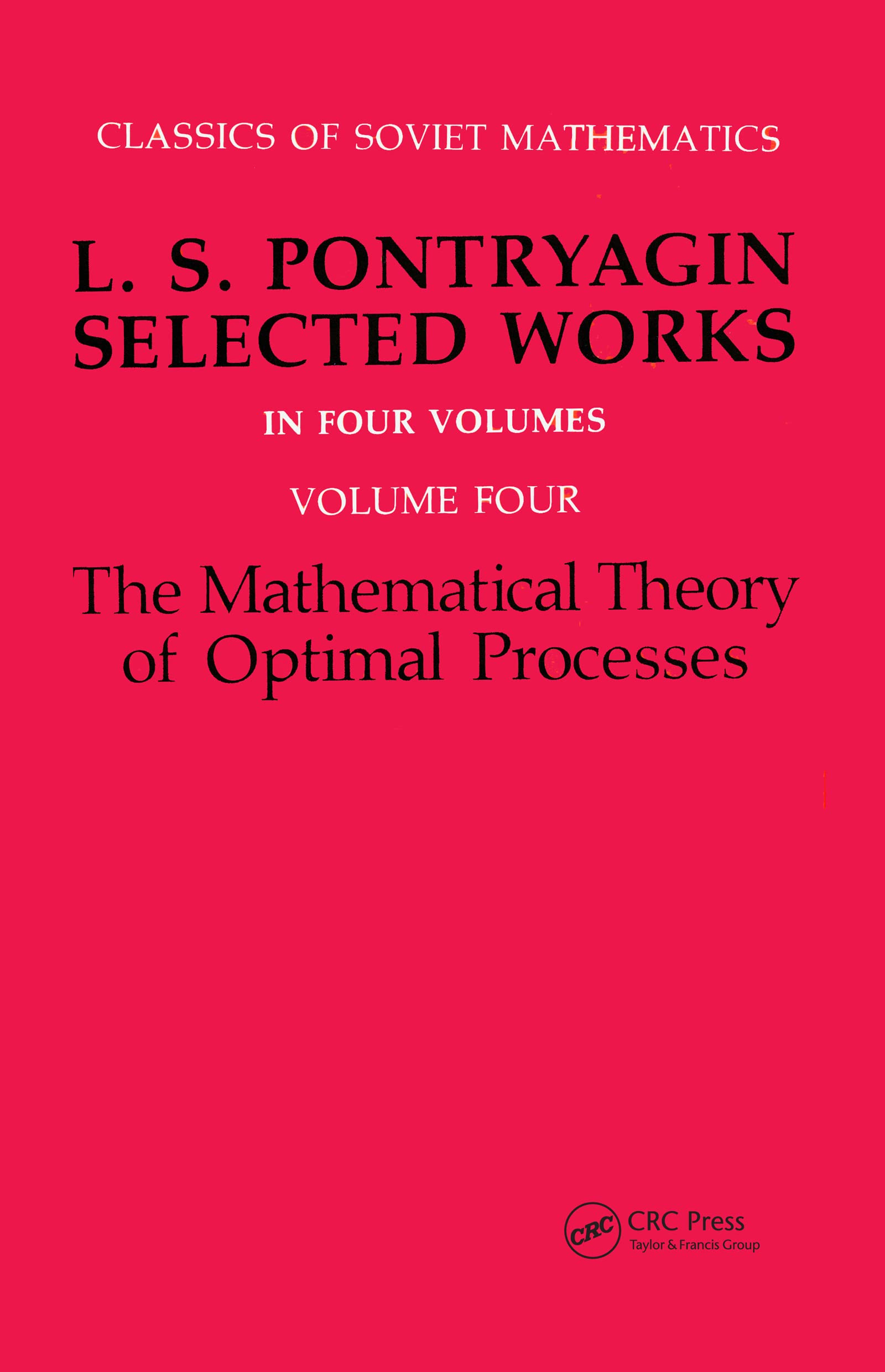
Mathematical Theory of Optimal Processes (Classics of Soviet Mathematics)
Related Products
View All
Science & Mathematics
Squid - Superconducting Quantum Interference Devices and Their Applications: Proceedings of the International Conference on Superconducting Quantum Devices, Berlin-west, October 4-8, 1976

Science & Mathematics
Thermodynamics and Pattern Formation in Biology

Science & Mathematics
Linear Algebra | by Stephen Friedberg | Arnold Insel | Lawrence Spence | Pearson | by Stephen Friedberg | Arnold Insel | Lawrence Spence | Pearson | by Stephen Friedberg | Arnold Insel | Lawrence Spence | Pearson | by Stephen Friedberg | Arnold Insel | Lawrence Spence | Pearson | by Stephen Friedberg | Arnold Insel | Lawrence Spence | Pearson | by Stephen Friedberg | Arnold Insel | Lawrence Spence | Pearson | by Stephen Friedberg | Arnold Insel | Lawrence Spence | Pearson | by Stephen Friedberg

Science & Mathematics
University Calculus | by Joel Hass | Christopher Heil | Maurice Weir | Pearson | by Joel Hass | Christopher Heil | Maurice Weir | Pearson | by Joel Hass | Christopher Heil | Maurice Weir | Pearson | by Joel Hass | Christopher Heil | Maurice Weir | Pearson | by Joel Hass | Christopher Heil | Maurice Weir | Pearson | by Joel Hass | Christopher Heil | Maurice Weir | Pearson | by Joel Hass | Christopher Heil | Maurice Weir | Pearson | by Joel Hass | Christopher Heil | Maurice Weir | Pearson | by Joe

Science & Mathematics
Sears and Zemansky's University Physics | by Hugh Young | Roger Freedman | Pearson | by Hugh Young | Roger Freedman | Pearson | by Hugh Young | Roger Freedman | Pearson | by Hugh Young | Roger Freedman | Pearson | by Hugh Young | Roger Freedman | Pearson | by Hugh Young | Roger Freedman | Pearson | by Hugh Young | Roger Freedman | Pearson | by Hugh Young | Roger Freedman | Pearson | by Hugh Young | Roger Freedman | Pearson | by Hugh Young | Roger Freedman | Pearson | by Hugh Young | Roger Freedm

Science & Mathematics