
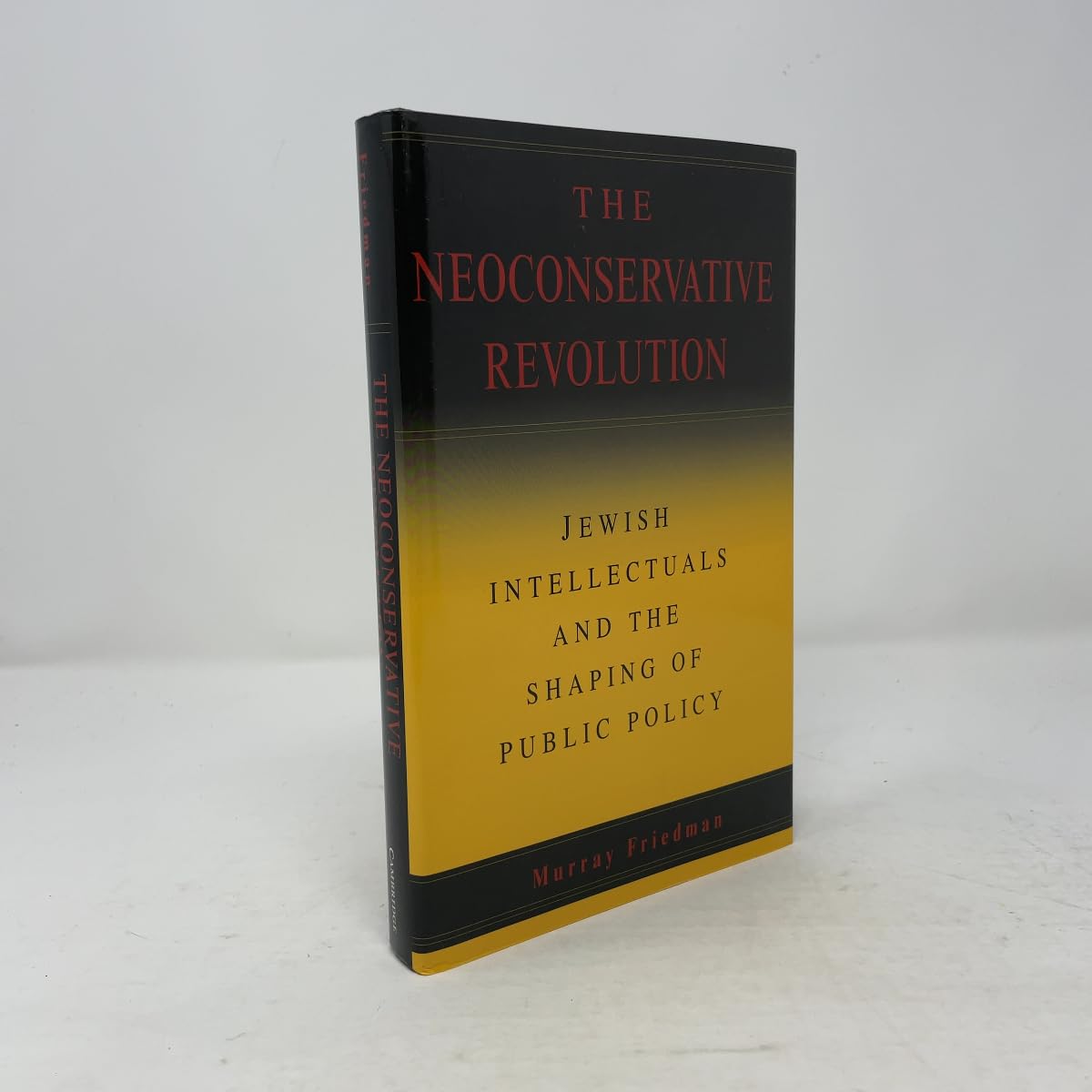
The Neoconservative Revolution: Jewish Intellectuals And The Shaping Of Public Policy – A Definitive History by Murray F
Inclusive of all applicable taxes. FREE shipping on all orders.
Available Offers
- 🚚Free Delivery — Free shipping on all orders
- 💵Cash on Delivery — Pay when your order arrives
- ↩️15-Day Easy Returns — Hassle-free return policy
- 🔒Cash on Delivery — Pay safely when your order arrives
Check Delivery
Product Description
Introduction
In the landscape of modern political thought, few movements have stirred as much debate as neoconservatism. Murray Friedman's The Neoconservative Revolution: Jewish Intellectuals And The Shaping Of Public Policy offers a compelling and meticulously researched account of how a small group of Jewish thinkers and activists rose from the margins of American intellectual life to become architects of some of the most consequential policies of the late twentieth and early twenty-first centuries. This hardcover volume, published by Cambridge University Press, is an essential read for anyone seeking to understand the ideological currents that have shaped global affairs.
Book Overview
This book traces the evolution of neoconservatism from its roots in the 1940s and 1950s, when figures such as Irving Kristol, Nathan Glazer, and Norman Podhoretz began to challenge the prevailing liberal consensus. Friedman documents how these intellectuals, drawing on their Jewish heritage and experiences, forged a new political philosophy that emphasized anti-communism, free markets, and a robust American role in the world. Over the decades, their ideas spread to a younger generation—including Paul Wolfowitz, David Brooks, and Charles Krauthammer—who would go on to influence policies from the Cold War to the Iraq War. The narrative is both a biographical history and a deep dive into the mechanisms of intellectual influence.
Key Highlights
- Pioneering Intellectual History: The first comprehensive study of Jewish involvement in the rise of American neoconservatism.
- Influential Figures: Detailed profiles of key thinkers like Irving Kristol, Norman Podhoretz, and later Paul Wolfowitz and David Brooks.
- Policy Impact: Examines how neoconservative ideas shaped U.S. foreign policy, especially in the Middle East.
- Cultural Context: Explores the intersection of Jewish identity, intellectual life, and political activism.
- Critical Analysis: Offers a balanced perspective on the successes and controversies of the neoconservative movement.
Inside the Book
The book is structured chronologically, beginning with the early stirrings of dissent among Jewish intellectuals in post-war America. Friedman delves into the founding of influential journals like Commentary and The Public Interest, showing how these publications served as incubators for neoconservative ideas. Later chapters cover the movement's rise during the Reagan era, its role in the end of the Cold War, and its controversial influence on the George W. Bush administration's foreign policy. The author draws on archival materials, personal interviews, and a wealth of secondary sources to paint a vivid picture of intellectual ferment.
Key Topics
- The origins of neoconservatism in the Jewish intellectual milieu of New York City.
- The shift from left-wing politics to a more hawkish, anti-communist stance.
- The role of think tanks, journals, and universities in spreading neoconservative thought.
- Debates over Israel, democracy promotion, and American power.
- The legacy of neoconservatism in contemporary politics, both in the U.S. and globally.
Reader Benefits
- Deepen Your Understanding: Gain a nuanced grasp of one of the most influential political movements of our time.
- Critical Thinking: Learn to evaluate the arguments for and against neoconservative policies.
- Historical Insight: Understand how ideas translate into action on the world stage.
- Cultural Awareness: Appreciate the diverse intellectual traditions that shape American politics.
- Context for Current Events: Better comprehend news about U.S. foreign policy and its global repercussions.
Learning Outcomes
- Identify the key figures and institutions that drove the neoconservative revolution.
- Analyze the intellectual and social factors that led to the rise of this movement.
- Evaluate the impact of neoconservatism on U.S. foreign and domestic policy.
- Connect historical developments to ongoing political debates in India and around the world.
- Develop a framework for understanding how minority groups can shape national ideologies.
Who Should Read
This book is ideal for students of political science, history, and international relations, as well as for journalists, policy analysts, and general readers interested in the intersection of ideas and power. Indian readers, in particular, will find parallels with the role of intellectual communities in shaping policy debates in a diverse democracy. It is also a valuable resource for anyone curious about the Jewish contribution to modern conservatism.
About the Author
Murray Friedman (1926–2005) was a distinguished historian and the director of the Myer and Rosaline Feinstein Center for American Jewish History at Temple University. He wrote extensively on Jewish life in America and the role of Jewish intellectuals in public life. His works include What Went Wrong? The Creation and Collapse of the Black-Jewish Alliance and Jewish Intellectuals and the Shaping of Public Policy. Friedman was known for his meticulous scholarship and his ability to bridge academic research with accessible writing.
About the Publisher
Cambridge University Press, founded in 1534, is one of the oldest and most prestigious academic publishers in the world. With a commitment to advancing knowledge, education, and learning, Cambridge University Press publishes authoritative works across all disciplines. This hardcover edition reflects the Press's high standards of editorial excellence and scholarly rigor.
Conclusion
The Neoconservative Revolution is more than a history of an ideology—it is a story of how passionate individuals can change the course of history. Murray Friedman's masterful narrative sheds light on the complex relationship between Jewish identity, intellectual life, and American power. For Indian readers, this book offers a window into the global dynamics of political thought, reminding us that ideas born in one corner of the world can have far-reaching consequences. Add this hardcover to your library and explore the fascinating journey of the neoconservative movement.
Quick Summary
The Neoconservative Revolution by Murray Friedman is the first comprehensive history of how Jewish intellectuals built the neoconservative movement in America and shaped U.S. public policy. Starting with a handful of figures in the 1940s and 1950s—like Irving Kristol, Nathan Glazer, and Norman Podhoretz—the book traces their evolution into a powerful network that influenced everything from domestic policy to the Iraq war. Friedman profiles later-generation neoconservatives such as Paul Wolfowitz, David Brooks, and Charles Krauthammer, showing how their ideas moved from the margins to the center of American power. This book is ideal for students of political science, history, and international relations, as well as anyone curious about the intellectual roots of modern conservatism. Readers will learn how a distinctively Jewish political tradition merged with anti-communism and hawkish foreign policy to create a lasting impact. By purchasing from Bookshops.in, you get a genuine hardcover edition with reliable delivery across India.
Book Highlights
Book Specifications
| ISBN-13 | 9780521836562 |
| ISBN-10 | 0521836565 |
| Publisher | Cambridge Univ Pr |
| Language | English |
| Dimensions | 16 x 2.8 x 23.3 cm |
| Weight | 558 g |
| Category | Americas › United States |
| Genre | Nonfiction |
| Original Language | English |
Frequently Asked Questions
What is The Neoconservative Revolution about?
Who is the author of this book?
Which key figures are covered in the book?
Is this book suitable for Indian readers?
Does the book discuss the Iraq war?
What is the ISBN-13 of this book?
Is this a hardcover edition?
What is the price of this book at Bookshops.in?
What language is the book written in?
What is the book's rating?
Can I use this book for academic research?
Why should I buy from Bookshops.in?
Readers Also Search For
Related Products
View All
History
The Information Revolution: Transforming the World Through Technology (World History)
History
Human Nature and the French Revolution: From the Enlightenment to the Napoleonic Code: 3 (Polygons: Cultural Diversities and Intersections, 3)
History
The Unmaking of Home in Contemporary Art (Cultural Spaces)

History
Handbook to Life in Medieval and Early Modern Japan | by William E. Deal | Oxford University Press | by William E. Deal | Oxford University Press | by William E. Deal | Oxford University Press | by William E. Deal | Oxford University Press | by William E. Deal | Oxford University Press | by William E. Deal | Oxford University Press | by William E. Deal | Oxford University Press | by William E. Deal | Oxford University Press | by William E. Deal | Oxford University Press | by William E. Deal | Ox

History
The Narrators of Barbarian History (A.D. 550-800) | by Walter Goffart | University of Notre Dame Press | by Walter Goffart | University of Notre Dame Press | by Walter Goffart | University of Notre Dame Press | by Walter Goffart | University of Notre Dame Press | by Walter Goffart | University of Notre Dame Press | by Walter Goffart | University of Notre Dame Press | by Walter Goffart | University of Notre Dame Press | by Walter Goffart | University of Notre Dame Press | by Walter Goffart | Univ

History