
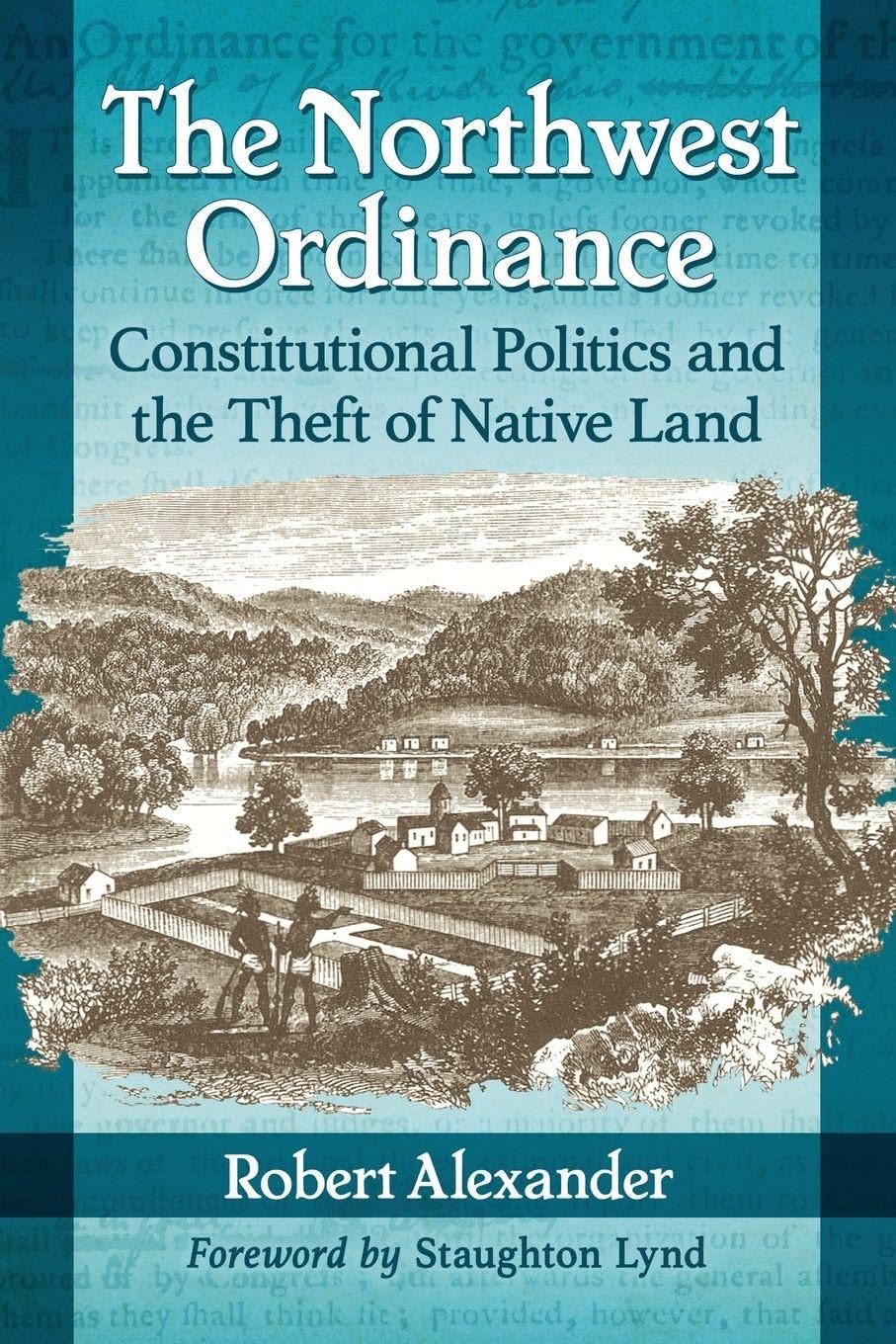
The Northwest Ordinance: Constitutional Politics and the Theft of Native Land by Robert Alexander – A Critical Study of
Inclusive of all applicable taxes. FREE shipping on all orders.
Available Offers
- 🚚Free Delivery — Free shipping on all orders
- 💵Cash on Delivery — Pay when your order arrives
- ↩️15-Day Easy Returns — Hassle-free return policy
- 🔒Cash on Delivery — Pay safely when your order arrives
Check Delivery
Product Description
Introduction
The Northwest Ordinance: Constitutional Politics and the Theft of Native Land by Robert Alexander offers a groundbreaking re-examination of one of the most consequential yet misunderstood laws in American history. Passed in 1787, the Northwest Ordinance shaped the political geography of the United States, but its legacy is far more complex than most textbooks reveal. This hardcover edition from McFarland & Company is an essential read for students, historians, and anyone interested in the intersections of law, land, and power.
Book Overview
Robert Alexander dives deep into the political bargains struck between the U.S. Congress and the Constitutional Convention during the summer of 1787. While the Constitution was being drafted in Philadelphia, Congress passed the Northwest Ordinance, which established a framework for governing the vast territories north of the Ohio River. The Ordinance famously outlawed slavery in those lands, but it also made a fateful compromise: Southern states could count enslaved people as three-fifths of a person for representation in Congress and the Electoral College. This deal allowed slavery to expand westward, setting the stage for the Civil War decades later. Drawing on contemporary letters and documents, Alexander reveals how historians long denied this political trade-off, and he reconstructs the true story of how the Northwest Ordinance facilitated the theft of Native lands and the spread of the 'peculiar institution.'
Key Highlights
- Original Research: Based on meticulous analysis of primary sources, including letters and government records from the 1780s.
- Reveals Hidden History: Challenges the long-standing denial by historians that a political deal linked the Ordinance to the Constitution.
- Connects Land and Slavery: Shows how the Ordinance enabled the dispossession of Native American tribes while simultaneously allowing slavery to move westward.
- Comprehensive Analysis: Covers the political, constitutional, and moral dimensions of the 1787 compromise.
Inside the Book
This volume is structured to guide readers through the complex web of events and decisions. Alexander begins by setting the stage after the Revolutionary War, when the United States acquired vast western lands from Great Britain. He then explores the debates in Congress over how to govern these territories, the secret negotiations with the Constitutional Convention, and the eventual passage of the Ordinance. The book examines the three-fifths clause in detail, showing how it gave Southern states disproportionate power. Finally, it traces the long-term consequences: the division of the West into slave and free states, the violent removal of Native peoples, and the eventual collapse of the compromise that led to the Civil War.
Key Topics
- The Northwest Ordinance of 1787 and its provisions
- The Constitutional Convention and the three-fifths compromise
- The political trade-off between Congress and the Convention
- The expansion of slavery into the western territories
- The dispossession and theft of Native American lands
- The roots of the American Civil War in the 1787 bargain
- Historiographical debates and the denial of the deal by earlier scholars
Reader Benefits
- Deepen Your Understanding: Gain a nuanced perspective on a pivotal moment in U.S. history that is often oversimplified.
- Critical Thinking: Learn how political compromises can have unintended and devastating consequences.
- Primary Source Insight: Access original letters and documents that bring the past to life.
- Relevant Today: Understand the historical roots of ongoing debates about land rights, representation, and racial justice.
Learning Outcomes
- Analyze the political motivations behind the Northwest Ordinance and the Constitution.
- Evaluate the role of slavery in early American territorial expansion.
- Explain how the three-fifths clause shaped U.S. political power for decades.
- Critique the historical narrative that downplayed the connection between the Ordinance and slavery.
- Assess the impact of the Ordinance on Native American communities.
Who Should Read
This book is ideal for undergraduate and postgraduate students of American history, constitutional law, and political science. It is also a valuable resource for researchers focusing on slavery, Native American studies, and early U.S. politics. General readers with an interest in the hidden stories behind the founding of the United States will find it equally compelling. Indian readers studying comparative constitutionalism or colonial history will appreciate the parallels with other land and power struggles around the world.
About the Author
Robert Alexander is a historian and scholar specializing in the political and constitutional history of the early American republic. His work focuses on the intersection of law, land policy, and slavery. He has published extensively in academic journals and is known for his meticulous archival research and revisionist interpretations. The Northwest Ordinance represents the culmination of years of study into the forgotten bargains that shaped the United States.
About the Publisher
McFarland & Company is a respected independent academic publisher based in the United States, known for producing high-quality hardcover books in history, biography, and cultural studies. Their publications are widely used in university libraries and by serious scholars. This edition is printed on durable paper and bound in sturdy hardcover, making it a lasting addition to any collection.
Conclusion
The Northwest Ordinance: Constitutional Politics and the Theft of Native Land is a vital corrective to the sanitized versions of American history. Robert Alexander’s clear prose and rigorous scholarship make this a must-read for anyone seeking to understand the real foundations of the United States—foundations built on compromise, land theft, and the expansion of slavery. Order your copy today from Bookshops.in and add this essential work to your library.
Quick Summary
The Northwest Ordinance: Constitutional Politics and the Theft of Native Land by Robert Alexander is a groundbreaking historical study that re-examines the 1787 law often celebrated as a model of territorial governance. Alexander reveals that the ordinance was in fact a calculated political bargain: it prohibited slavery north of the Ohio River but gave Southern states outsized representation in Congress and the Electoral College through the three-fifths clause. This deal simultaneously enabled the dispossession of Native American nations from their lands. The book meticulously traces how this compromise set the stage for the division of the American West into slave and free states, a fault line that ultimately erupted in the Civil War. Written for scholars and advanced students, the work challenges long-held historical narratives that minimize the role of slavery in the founding era. Indian readers interested in comparative colonial history, constitutional law, and the politics of land theft will find the analysis both rigorous and eye-opening. By ordering from Bookshops.in, you receive a premium hardcover edition with fast delivery across India, backed by a trusted local bookstore that curates important academic titles.
Book Highlights
Book Specifications
| ISBN-13 | 9781476665191 |
| ISBN-10 | 1476665192 |
| Publisher | McFarland & Co Inc |
| Language | English |
| Dimensions | 15.24 x 1.17 x 22.86 cm |
| Weight | 299 g |
| Country | India |
| Category | Americas › United States |
| Genre | History |
| Original Language | English |
Frequently Asked Questions
What is the Northwest Ordinance?
Who is Robert Alexander?
What is the main argument of this book?
Is this book suitable for Indian readers?
Does the book cover Native American perspectives?
What is the three-fifths clause?
How does this book relate to the US Civil War?
What sources does the author use?
Is this a hardcover edition?
Can I use this book for my university course?
Does the book challenge mainstream history?
What is the price in India?
Why should I buy from Bookshops.in?
Readers Also Search For
Related Products
View All
History
The Information Revolution: Transforming the World Through Technology (World History)
History
Human Nature and the French Revolution: From the Enlightenment to the Napoleonic Code: 3 (Polygons: Cultural Diversities and Intersections, 3)
History
The Unmaking of Home in Contemporary Art (Cultural Spaces)

History
Handbook to Life in Medieval and Early Modern Japan | by William E. Deal | Oxford University Press | by William E. Deal | Oxford University Press | by William E. Deal | Oxford University Press | by William E. Deal | Oxford University Press | by William E. Deal | Oxford University Press | by William E. Deal | Oxford University Press | by William E. Deal | Oxford University Press | by William E. Deal | Oxford University Press | by William E. Deal | Oxford University Press | by William E. Deal | Ox

History
The Narrators of Barbarian History (A.D. 550-800) | by Walter Goffart | University of Notre Dame Press | by Walter Goffart | University of Notre Dame Press | by Walter Goffart | University of Notre Dame Press | by Walter Goffart | University of Notre Dame Press | by Walter Goffart | University of Notre Dame Press | by Walter Goffart | University of Notre Dame Press | by Walter Goffart | University of Notre Dame Press | by Walter Goffart | University of Notre Dame Press | by Walter Goffart | Univ
History