
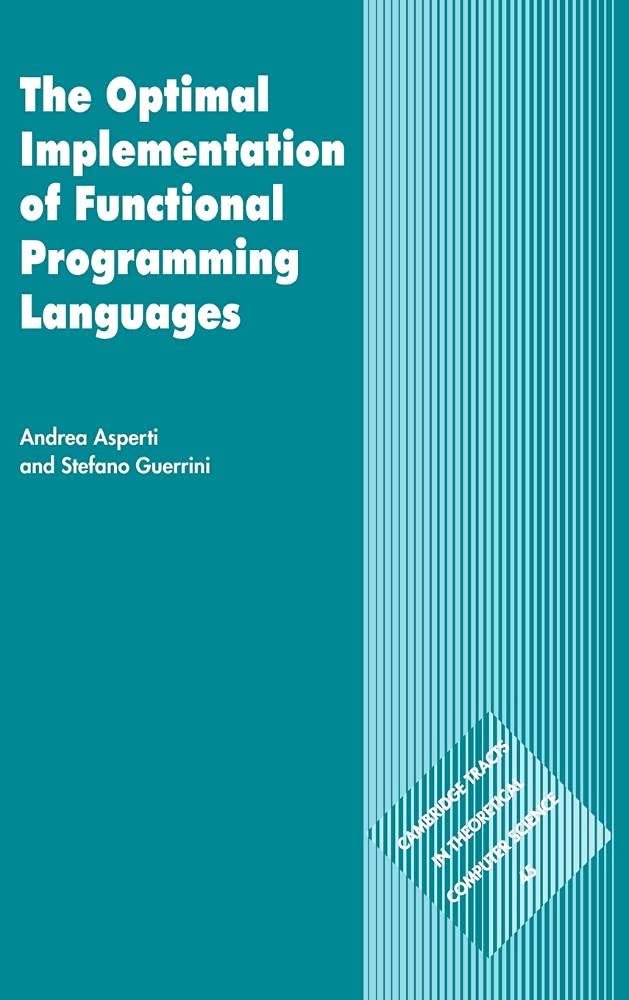
The Optimal Implementation of Functional Programming Languages by Andrea Asperti – A Cambridge University Press Referenc
Inclusive of all applicable taxes. FREE shipping on all orders.
Available Offers
- 🚚Free Delivery — Free shipping on all orders
- 💵Cash on Delivery — Pay when your order arrives
- ↩️15-Day Easy Returns — Hassle-free return policy
- 🔒Cash on Delivery — Pay safely when your order arrives
Check Delivery
Product Description
Introduction
Functional programming has long been celebrated for its mathematical elegance and expressive power, but its practical adoption has often been hindered by inefficiencies in implementation. Among the most persistent challenges is the problem of sharing—how to avoid redundant computation when evaluating functional expressions. Traditional methods, such as supercombinators, environments, and continuations, all fail to eliminate unnecessary repetition, leading to catastrophic exponential blow-ups in reduction time. The Optimal Implementation of Functional Programming Languages by Andrea Asperti offers a groundbreaking solution: optimal reduction. This book is the first comprehensive treatment of the subject, presenting a graph reduction technique introduced by John Lamping in 1990 that finally addresses the sharing problem. Written for students, researchers, and practitioners, this volume bridges the gap between advanced theoretical concepts and practical implementation, making it an essential resource for anyone serious about functional programming.
Book Overview
Published by Cambridge University Press, this hardcover edition is a definitive guide to optimal reduction—a technique that ensures no work is ever duplicated during the evaluation of functional expressions. The book systematically covers both the mathematical foundations and the practical aspects of implementing this approach. It explores the deep connections between optimal reduction, Lévy's pioneering work on labelling, and Girard's Geometry of Interaction, revealing how a beautiful mathematical theory can lead to tangible performance gains. The text is self-contained, requiring only basic familiarity with functional programming, and progresses from core ideas to advanced topics such as interaction nets, sharing graphs, and abstract machines. With clear explanations, detailed algorithms, and numerous examples, Asperti provides a roadmap for building compilers and interpreters that achieve true optimality.
Key Highlights
- First comprehensive book on optimal reduction for functional languages, covering both theory and practice.
- Self-contained approach—no specialized prerequisites beyond basic functional programming knowledge.
- Deep integration of Lévy's theory of optimal reductions and Girard's Geometry of Interaction.
- Practical implementation details, including interaction nets, sharing graphs, and abstract machines.
- Authored by Andrea Asperti, a leading exponent of optimal reduction and a respected researcher in the field.
- Published by Cambridge University Press, ensuring high academic and editorial standards.
Inside the Book
The book is structured to take the reader on a journey from the fundamental problem of sharing to the most advanced implementation techniques. Early chapters establish the limitations of traditional approaches, then introduce Lamping's optimal reduction algorithm. Subsequent chapters delve into the mathematics of interaction nets—a graphical formalism that naturally expresses optimal reduction—and explore how to compile functional languages into these nets. The latter part of the book covers abstract machines for executing optimal reductions, the relationship to linear logic, and the Geometry of Interaction. Each chapter includes illustrative examples, exercises, and references to the original research literature. The result is a thorough, self-contained exposition that serves both as a textbook and a reference work.
Key Topics
- Optimal reduction and the sharing problem in functional programming
- Lamping's algorithm for optimal graph reduction
- Interaction nets and their role in implementing optimal reduction
- Lévy's theory of optimal reductions and labelling
- Girard's Geometry of Interaction and its connection to optimality
- Abstract machines for optimal reduction
- Compilation techniques for functional languages using optimal strategies
- Linear logic and its computational interpretation
Reader Benefits
- Gain a deep understanding of why traditional implementation techniques fail to avoid redundant work.
- Learn a proven method for eliminating exponential blow-ups in functional program evaluation.
- Master interaction nets—a powerful graphical tool for modeling computation.
- Connect theory to practice with concrete algorithms and implementation strategies.
- Stay ahead in the field of programming languages by understanding cutting-edge research.
- Build a strong foundation for further study in compilers, formal methods, and computational mathematics.
Learning Outcomes
By the end of this book, readers will be able to: explain the sharing problem and its impact on functional language performance; describe the key ideas behind optimal reduction and Lamping's algorithm; implement interaction nets and use them to represent functional expressions; analyse the relationship between optimal reduction and the Geometry of Interaction; design abstract machines that execute optimal reduction strategies; and critically evaluate the trade-offs between different implementation techniques. These outcomes make the book suitable for advanced undergraduate and graduate courses in programming languages, compiler design, and theoretical computer science.
Who Should Read
This book is ideal for computer science students, researchers, and software engineers who wish to understand the deepest aspects of functional language implementation. It is particularly valuable for those studying or working on compilers, interpreters, and runtime systems for functional languages like Haskell, OCaml, or Scheme. Academics interested in the mathematical foundations of computation—especially linear logic, graph rewriting, and optimality—will find it an indispensable resource. Practitioners looking to optimise their functional programs or build high-performance functional language tools will also benefit greatly. The book assumes only basic knowledge of functional programming, making it accessible to motivated readers at the advanced undergraduate level and beyond.
About the Author
Andrea Asperti is a professor of computer science at the University of Bologna, Italy, and a leading authority on optimal reduction and the implementation of functional programming languages. He has made seminal contributions to the theory and practice of interaction nets and optimal reduction, co-authoring numerous influential papers and software tools. Asperti is also known for his work on the Matita interactive theorem prover and for his research in computational logic and formal verification. His deep understanding of both the mathematical underpinnings and the practical challenges of functional language implementation shines through in this book, making complex ideas accessible without sacrificing rigour.
About the Publisher
Cambridge University Press is one of the world's oldest and most prestigious academic publishers, with a history dating back to 1534. Renowned for its high-quality publications in science, technology, and mathematics, Cambridge University Press brings rigorous editorial standards and global reach to every title it publishes. This book is part of their distinguished series in computer science, reflecting the press's commitment to advancing knowledge and supporting the academic community. Indian readers can trust that this hardcover edition meets the highest production and content standards, making it a valuable addition to any library.
Conclusion
The Optimal Implementation of Functional Programming Languages is a landmark work that solves one of the most enduring problems in functional language design. By presenting optimal reduction in a clear, self-contained manner, Andrea Asperti has created a resource that is both theoretically profound and practically useful. Whether you are a student aiming to master advanced compiler techniques, a researcher exploring the frontiers of computation, or a developer seeking to build faster functional language tools, this book will deepen your understanding and enhance your skills. Its unique blend of mathematical elegance and engineering insight makes it a must-read for anyone passionate about functional programming. Order your copy from Bookshops.in today and explore the future of efficient functional computation.
Quick Summary
The Optimal Implementation of Functional Programming Languages by Andrea Asperti is a seminal work that addresses a critical challenge in functional language implementation: the avoidance of redundant work during reduction. Traditional techniques like supercombinators, environments, and continuations often lead to exponential explosion in reduction time due to improper handling of sharing. This book introduces and explains optimal reduction, a graph reduction method pioneered by Lamping in 1990, which solves the sharing problem. Asperti provides both practical implementation guidance and thorough mathematical foundations, including connections to Lévy's work and Girard's Geometry of Interaction. Aimed at researchers, graduate students, and advanced practitioners, this hardcover volume is essential for anyone serious about functional language theory and compiler design. Published by Cambridge University Press, it remains a definitive reference. Purchasing from Bookshops.in ensures a reliable physical copy for your library.
Book Highlights
Book Specifications
| ISBN-13 | 9780521621120 |
| ISBN-10 | 0521621127 |
| Publisher | Cambridge University Press |
| Language | English |
| Dimensions | 16.51 x 2.54 x 24.13 cm |
| Weight | 770 g |
| Country | India |
| Category | Languages › C & C++ |
| Series | Cambridge Tracts in Theoretical Computer Science |
| Genre | Non-fiction |
| Original Language | English |
Frequently Asked Questions
What is this book about?
Who is the author?
Is this book suitable for beginners?
What is the main problem addressed?
Does it cover practical implementation?
What is Lamping's algorithm?
Is the book mathematically rigorous?
What is the binding?
Is it available in Indian bookstores?
What is the price?
What language is the book in?
Does it cover supercombinators?
Is this the first book on optimal reduction?
Readers Also Search For
Customers Also Bought

Programming
Algorithmische Sprache Und Programmentwicklung | by H. Partsch | F. L. Bauer | P. Pepper | Springer | by H. Partsch | F. L. Bauer | P. Pepper | Springer | by H. Partsch | F. L. Bauer | P. Pepper | Springer | by H. Partsch | F. L. Bauer | P. Pepper | Springer | by H. Partsch | F. L. Bauer | P. Pepper | Springer | by H. Partsch | F. L. Bauer | P. Pepper | Springer | by H. Partsch | F. L. Bauer | P. Pepper | Springer | by H. Partsch | F. L. Bauer | P. Pepper | Springer | by H. Partsch | F. L. Bauer
Programming
Distributed Algorithms | by Jean-Claude Bermond | Michel Raynal | Springer | by Jean-Claude Bermond | Michel Raynal | Springer | by Jean-Claude Bermond | Michel Raynal | Springer | by Jean-Claude Bermond | Michel Raynal | Springer | by Jean-Claude Bermond | Michel Raynal | Springer | by Jean-Claude Bermond | Michel Raynal | Springer | by Jean-Claude Bermond | Michel Raynal | Springer | by Jean-Claude Bermond | Michel Raynal | Springer | by Jean-Claude Bermond | Michel Raynal | Springer | by Jean
Programming
Meta-Level Control for Deductive Database Systems | by Helmut Schmidt | Springer | by Helmut Schmidt | Springer | by Helmut Schmidt | Springer | by Helmut Schmidt | Springer | by Helmut Schmidt | Springer | by Helmut Schmidt | Springer | by Helmut Schmidt | Springer | by Helmut Schmidt | Springer | by Helmut Schmidt | Springer | by Helmut Schmidt | Springer | by Helmut Schmidt | Springer | by Helmut Schmidt | Springer | by Helmut Schmidt | Springer | by Helmut Schmidt | Springer | by Helmut Schm
Programming
Java Web Services | by David A. Chappell | Tyler Jewell | O'Reilly Media | by David A. Chappell | Tyler Jewell | O'Reilly Media | by David A. Chappell | Tyler Jewell | O'Reilly Media | by David A. Chappell | Tyler Jewell | O'Reilly Media | by David A. Chappell | Tyler Jewell | O'Reilly Media | by David A. Chappell | Tyler Jewell | O'Reilly Media | by David A. Chappell | Tyler Jewell | O'Reilly Media | by David A. Chappell | Tyler Jewell | O'Reilly Media | by David A. Chappell | Tyler Jewell | O'
Programming
Database in Depth | by Chris J. Date | O'Reilly Media | by Chris J. Date | O'Reilly Media | by Chris J. Date | O'Reilly Media | by Chris J. Date | O'Reilly Media | by Chris J. Date | O'Reilly Media | by Chris J. Date | O'Reilly Media | by Chris J. Date | O'Reilly Media | by Chris J. Date | O'Reilly Media | by Chris J. Date | O'Reilly Media | by Chris J. Date | O'Reilly Media | by Chris J. Date | O'Reilly Media | by Chris J. Date | O'Reilly Media | by Chris J. Date | O'Reilly Media | by Chris J.
Programming
Integration of AI and OR Techniques in Constraint Programming for Combinatorial Optimization Problem | by Nicolas Beldiceanu | Narendra Jussien | Eric Pinson | Springer | by Nicolas Beldiceanu | Narendra Jussien | Eric Pinson | Springer | by Nicolas Beldiceanu | Narendra Jussien | Eric Pinson | Springer | by Nicolas Beldiceanu | Narendra Jussien | Eric Pinson | Springer | by Nicolas Beldiceanu | Narendra Jussien | Eric Pinson | Springer | by Nicolas Beldiceanu | Narendra Jussien | Eric Pinson |
Related Products
View All
Computers & Internet
Modern Full-Stack React Projects by Daniel Bugl
Computers & Internet
Mootools 1.2 Beginner's Guide (English, Jacob Gube)
Computers & Internet
Contemporary Methods for Speech Parameterization (Springerbriefs in Electrical and Computer Engineering / Springerbriefs in Speech Technology)

Computers & Internet
Information Technology and Lawyers | by Arno R. Lodder | Anja Oskamp | Springer | by Arno R. Lodder | Anja Oskamp | Springer | by Arno R. Lodder | Anja Oskamp | Springer | by Arno R. Lodder | Anja Oskamp | Springer | by Arno R. Lodder | Anja Oskamp | Springer | by Arno R. Lodder | Anja Oskamp | Springer | by Arno R. Lodder | Anja Oskamp | Springer | by Arno R. Lodder | Anja Oskamp | Springer | by Arno R. Lodder | Anja Oskamp | Springer | by Arno R. Lodder | Anja Oskamp | Springer | by Arno R. Lo

Computers & Internet
Digital Analysis of Remotely Sensed Imagery | by Jay Gao | McGraw-Hill Companies | by Jay Gao | McGraw-Hill Companies | by Jay Gao | McGraw-Hill Companies | by Jay Gao | McGraw-Hill Companies | by Jay Gao | McGraw-Hill Companies | by Jay Gao | McGraw-Hill Companies | by Jay Gao | McGraw-Hill Companies | by Jay Gao | McGraw-Hill Companies | by Jay Gao | McGraw-Hill Companies | by Jay Gao | McGraw-Hill Companies | by Jay Gao | McGraw-Hill Companies | by Jay Gao | McGraw-Hill Companies | by Jay Gao
Computers & Internet