
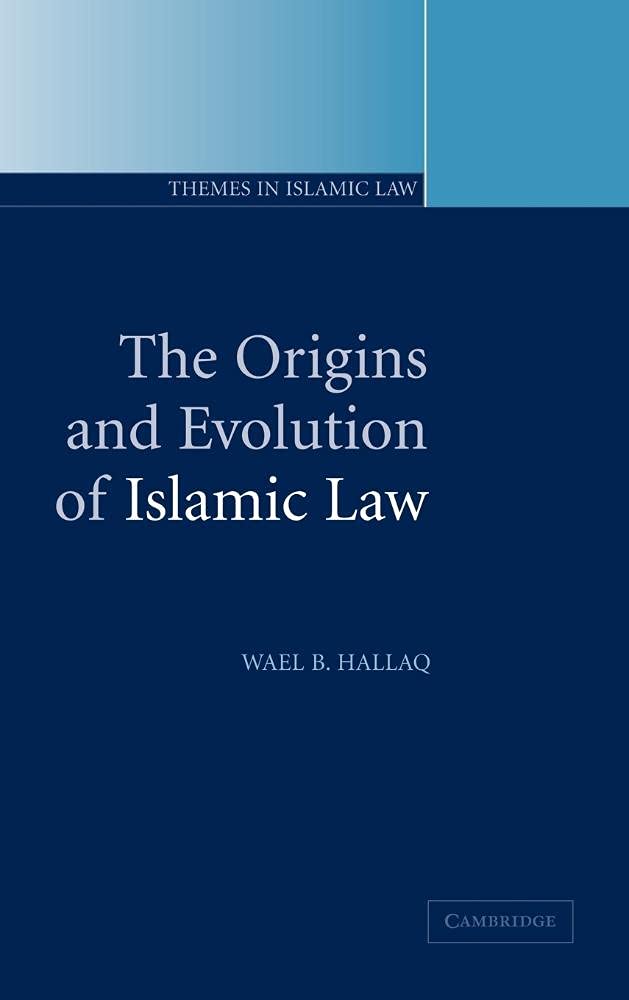
The Origins and Evolution of Islamic Law: A Scholarly History of Legal Theory, Judiciary, and Schools by Wael B. Hallaq
Inclusive of all applicable taxes. FREE shipping on all orders.
Available Offers
- 🚚Free Delivery — Free shipping on all orders
- 💵Cash on Delivery — Pay when your order arrives
- ↩️15-Day Easy Returns — Hassle-free return policy
- 🔒Cash on Delivery — Pay safely when your order arrives
Check Delivery
Product Description
Introduction
Islamic law stands as one of the most sophisticated and enduring legal systems in human history, yet its formative centuries remain a source of deep scholarly inquiry. In The Origins and Evolution of Islamic Law, acclaimed historian Wael B. Hallaq offers a masterful exploration of how Islamic jurisprudence emerged not in isolation, but as a dynamic synthesis of ancient Near Eastern traditions, pre-Islamic Arabian customs, and the transformative revelations of the Qur’an. This hardcover edition from Cambridge University Press is an indispensable resource for students, researchers, and anyone seeking to understand the intellectual and political forces that shaped classical Islamic law.
Book Overview
Spanning more than three centuries of legal history, this book traces the journey of Islamic law from its earliest roots in the seventh-century Arabian Peninsula to the crystallization of the great legal schools. Hallaq challenges simplistic narratives by showing how jurists, judges, and rulers engaged in a complex dance of authority and autonomy. The work examines the development of legal reasoning, the rise of prophetic authority, and the paradoxical relationship between law and state power—where jurists maintained remarkable independence even as they served the ruling elite. This is not merely a chronology but a deep analysis of how law, religion, and politics intertwined to create a unique legal civilization.
Key Highlights
- Comprehensive Chronology: Covers the first three centuries of Islamic legal history, from the Prophet Muhammad’s time through the early Abbasid period.
- Comparative Framework: Positions Islamic law within the broader context of ancient Near Eastern legal cultures, including Mesopotamian, Roman, and Persian influences.
- Prophetic Authority: A detailed account of how the Sunna and Hadith gained normative force in legal discourse.
- School Formation: Explains the emergence of the Hanafi, Maliki, Shafi‘i, and Hanbali madhhabs as distinct interpretive communities.
- Judicial Evolution: Traces the transformation of the qadi (judge) from a local arbiter to a sophisticated legal officer.
- Law and Politics: Analyzes the symbiotic yet independent relationship between jurists and the caliphal state.
Inside the Book
The volume is organized into thematic chapters that build a coherent narrative. Early sections explore the legal landscape of pre-Islamic Arabia and the impact of Qur’anic reforms on existing customs. Subsequent chapters delve into the emergence of the judiciary, the development of legal reasoning (ijtihad and qiyas), and the pivotal role of the prophetic tradition. A significant portion is devoted to the formation of legal schools, examining how regional practices and scholarly networks gave rise to distinct methodologies. The final chapters confront the perennial question of law’s autonomy from political power, revealing how jurists maintained their interpretive authority even as the state sought to control legal institutions.
Key Topics
- Pre-Islamic Arabian customary law and its transformation
- Qur’anic legal reforms and their social impact
- The early judiciary and the office of the qadi
- Rise of prophetic authority and Hadith criticism
- Crystallization of legal theory (usul al-fiqh)
- Formation of the four Sunni legal schools
- Relationship between jurists, caliphs, and governors
- Legal pluralism and regional variation
- Role of custom (urf) and consensus (ijma)
Reader Benefits
- Gain a clear, scholarly understanding of how Islamic law originated and evolved over three centuries.
- Appreciate the intellectual rigor of early Muslim jurists and their methods of reasoning.
- Understand the social and political contexts that shaped legal doctrines.
- Develop a critical perspective on the relationship between religion, law, and state power.
- Access a balanced, non-polemical account suitable for both academic and general readers.
Learning Outcomes
- Identify the key historical stages in the formation of Islamic law.
- Analyze the influence of pre-Islamic Arabian and Near Eastern legal traditions.
- Explain the role of the Qur’an and Sunna in shaping legal principles.
- Describe the process by which the major legal schools emerged.
- Evaluate the dynamics of legal authority and political power in early Islamic society.
Who Should Read
This book is ideal for university students of Islamic studies, law, history, and comparative religion. It is equally valuable for legal professionals, scholars of jurisprudence, and anyone with a serious interest in the intellectual heritage of Islam. Indian readers, in particular, will find parallels in the subcontinent’s own rich tradition of Islamic legal scholarship and its interaction with colonial and post-colonial legal systems. The accessible prose makes it suitable for advanced undergraduates and motivated general readers alike.
About the Author
Wael B. Hallaq is one of the world’s foremost authorities on Islamic law. A professor at Columbia University, he has authored numerous seminal works, including Shari‘a: Theory, Practice, Transformations and The Impossible State. His scholarship combines deep philological expertise with a keen sensitivity to historical context, making him a trusted guide through the complexities of Islamic legal history.
About the Publisher
Cambridge University Press has been a pillar of academic publishing since 1534. Renowned for its rigorous peer-review process and global reach, Cambridge produces authoritative works that set the standard in fields ranging from law and history to science and mathematics. This hardcover edition reflects the press’s commitment to durable, high-quality production—perfect for a lifetime of study and reference.
Conclusion
The Origins and Evolution of Islamic Law is not just a book; it is a gateway to understanding one of the world’s great legal traditions. Wael B. Hallaq’s erudition and narrative skill make this a compelling read for anyone curious about how law, religion, and society interact. Whether you are a student preparing for exams, a researcher building your library, or a reader seeking intellectual depth, this Cambridge University Press hardcover belongs on your shelf. Order your copy today from Bookshops.in and embark on a journey through the foundations of Islamic jurisprudence.
Quick Summary
The Origins and Evolution of Islamic Law by Wael B. Hallaq is a definitive scholarly work that traces the development of Islamic jurisprudence from its pre-Islamic roots in Arabian customary law and ancient Near Eastern legal cultures, through the transformative impact of Quranic reforms, to the crystallization of legal theory and the formation of the major legal schools. Spanning over three centuries, the book examines the rise of prophetic authority, the evolution of the judiciary, and the complex interplay between law and politics. Readers will learn how early jurists shaped legal reasoning and how the ruling elite and religious scholars coexisted in a symbiotic yet paradoxical relationship that allowed Islamic law to flourish. This hardcover edition from Cambridge University Press is ideal for students of Islamic studies, legal history, and comparative law, as well as scholars and informed general readers. By purchasing from Bookshops.in, Indian customers receive a genuine, high-quality print edition with reliable delivery and customer support.
Book Highlights
Book Specifications
| ISBN-13 | 9780521803328 |
| ISBN-10 | 0521803322 |
| Publisher | Cambridge University Press |
| Language | English |
| Dimensions | 15.88 x 1.91 x 22.86 cm |
| Weight | 520 g |
| Country | India |
| Category | Region & Countries › Asia |
| Genre | Non-fiction |
| Original Language | English |
Frequently Asked Questions
What is The Origins and Evolution of Islamic Law about?
Who is Wael B. Hallaq?
Is this book suitable for beginners?
Does the book cover modern Islamic law?
What time period does the book cover?
What is the role of the Quran in this book?
Does the book discuss the four Sunni schools of law?
Is this a textbook or a monograph?
What is the binding of this edition?
What is the ISBN for this book?
Does the book address Shia legal traditions?
Can I buy this book from Bookshops.in?
What makes this book different from other Islamic law histories?
Readers Also Search For
Related Products
View All
History
The Information Revolution: Transforming the World Through Technology (World History)
History
Human Nature and the French Revolution: From the Enlightenment to the Napoleonic Code: 3 (Polygons: Cultural Diversities and Intersections, 3)
History
The Unmaking of Home in Contemporary Art (Cultural Spaces)

History
Handbook to Life in Medieval and Early Modern Japan | by William E. Deal | Oxford University Press | by William E. Deal | Oxford University Press | by William E. Deal | Oxford University Press | by William E. Deal | Oxford University Press | by William E. Deal | Oxford University Press | by William E. Deal | Oxford University Press | by William E. Deal | Oxford University Press | by William E. Deal | Oxford University Press | by William E. Deal | Oxford University Press | by William E. Deal | Ox

History
The Narrators of Barbarian History (A.D. 550-800) | by Walter Goffart | University of Notre Dame Press | by Walter Goffart | University of Notre Dame Press | by Walter Goffart | University of Notre Dame Press | by Walter Goffart | University of Notre Dame Press | by Walter Goffart | University of Notre Dame Press | by Walter Goffart | University of Notre Dame Press | by Walter Goffart | University of Notre Dame Press | by Walter Goffart | University of Notre Dame Press | by Walter Goffart | Univ

History