
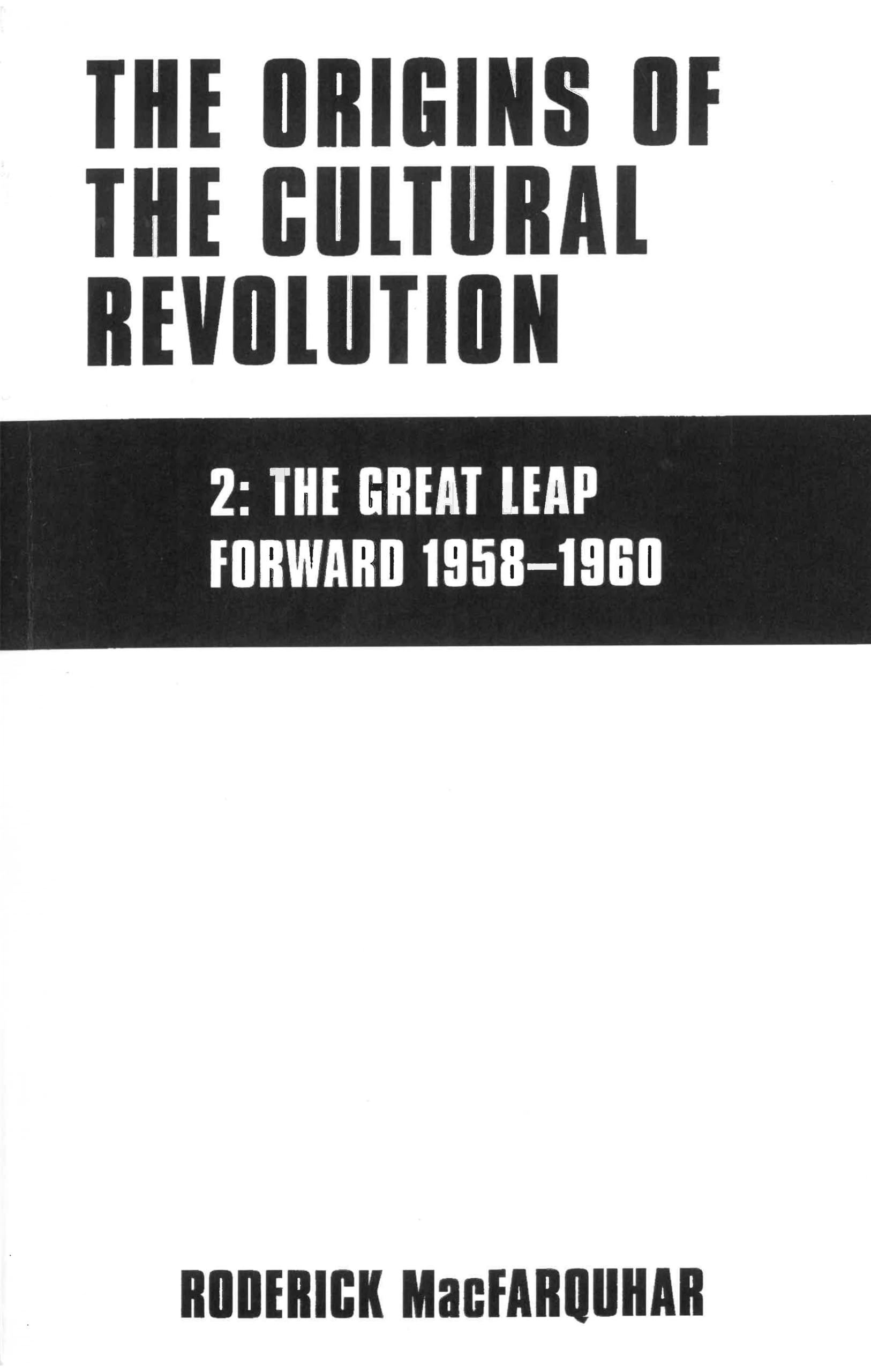
Macfarquhar: Origins Of Cultural Revolution Vol 2: The Great Leap Forward, 1958–1960 by Roderick Macfarquhar – A Critica
Inclusive of all applicable taxes. FREE shipping on all orders.
Available Offers
- 🚚Free Delivery — Free shipping on all orders
- 💵Cash on Delivery — Pay when your order arrives
- ↩️15-Day Easy Returns — Hassle-free return policy
- 🔒Cash on Delivery — Pay safely when your order arrives
Check Delivery
Product Description
Introduction
Roderick Macfarquhar's trilogy on the origins of the Cultural Revolution stands as a monumental achievement in modern historical scholarship. This second volume, Macfarquhar: Origins Of Cultural Revolution Vol 2: The Great Leap Forward, 1958–1960, offers an unflinching and deeply researched account of one of the most ambitious and disastrous campaigns in twentieth-century China. Published by Columbia University Press, this hardcover edition is an essential resource for students, historians, and anyone seeking to understand the complex forces that shaped modern China.
Book Overview
This volume focuses squarely on the Great Leap Forward, Mao Zedong's utopian attempt to catapult China into an industrialized superpower within a few short years. Macfarquhar masterfully unravels the political infighting, economic miscalculations, and social upheaval that defined this period. Drawing on newly released Chinese documents, political memoirs, and economic data, the author reconstructs the events with unprecedented clarity. The narrative reveals how Mao's vision, driven by revolutionary zeal and a desire to surpass the Soviet Union, led to widespread famine, political dissent, and the eventual Sino-Soviet split. The book is not merely a chronicle of failure but a nuanced exploration of ideology, power, and human cost.
Key Highlights
- First comprehensive scholarly work to incorporate newly declassified Chinese documents, including speeches, economic statistics, and party reminiscences
- Detailed analysis of the political dynamics between Mao, his allies, and his critics within the Communist Party
- Vivid portrayal of the human impact of the Great Leap Forward, including the catastrophic famine
- Examination of the Great Leap's role in precipitating the Sino-Soviet split
- Rigorous yet accessible writing that balances academic depth with narrative flow
Inside the Book
Macfarquhar structures the volume chronologically, beginning with the optimistic launch of the Great Leap in 1958 and tracing its descent into disaster by 1960. Each chapter dissects key events: the backyard steel furnaces, the commune system, the exaggerated harvest reports, and the ensuing famine. The author also delves into the inner workings of the Politburo, revealing the fierce debates and power struggles that accompanied the campaign. The book draws on Red Guard newspapers, official records, and personal accounts, weaving them into a coherent and gripping story. Readers will find detailed footnotes and a comprehensive bibliography, making it a valuable reference work.
Key Topics
- The ideology and implementation of the Great Leap Forward
- Mao's leadership style and his relationship with other party leaders such as Liu Shaoqi and Deng Xiaoping
- The role of propaganda and mass mobilization in Chinese society
- Economic policies: collectivization, steel production, and agricultural reform
- The human catastrophe: famine, displacement, and mortality
- The breakdown of Sino-Soviet relations
- The origins of the Cultural Revolution in the aftermath of the Great Leap
Reader Benefits
This book provides Indian readers with a deep understanding of a pivotal moment in modern history that continues to influence China's trajectory. It offers critical insights into how revolutionary ideology can clash with economic reality, a lesson relevant to students of political science, history, and international relations. The author's balanced approach—neither apologetic nor polemical—allows readers to form their own judgments. For scholars and researchers, the volume is an indispensable source of primary material and analysis. General readers will find the narrative engaging and thought-provoking, shedding light on the roots of contemporary China.
Learning Outcomes
- Understand the causes and consequences of the Great Leap Forward
- Analyze the interplay between individual leadership and institutional politics
- Evaluate the use of historical sources in reconstructing complex events
- Grasp the long-term impact of the Great Leap on Chinese society and governance
- Develop a nuanced perspective on the origins of the Cultural Revolution
Who Should Read
This volume is ideal for university students and faculty in history, political science, Asian studies, and economics. It is also highly recommended for journalists, diplomats, and policy analysts seeking a deeper understanding of China's political evolution. General readers with an interest in modern history or comparative revolutions will find the book both informative and compelling. The hardcover edition is a durable addition to any serious library.
About the Author
Roderick Macfarquhar is one of the world's foremost scholars of modern Chinese history. A former journalist and member of the British Parliament, he served as the founding editor of The China Quarterly and later as a professor at Harvard University. His trilogy on the origins of the Cultural Revolution is widely regarded as the definitive work on the subject. Macfarquhar's unique blend of academic rigor, political insight, and narrative skill makes his writing accessible to both specialists and general readers.
About the Publisher
Columbia University Press, established in 1893, is a prestigious academic publisher known for its outstanding contributions to the humanities, social sciences, and sciences. Their Asian studies list is particularly strong, featuring works by leading scholars that illuminate the region's history, culture, and politics. This hardcover edition reflects their commitment to producing high-quality, durable books that stand the test of time.
Conclusion
Macfarquhar: Origins Of Cultural Revolution Vol 2: The Great Leap Forward, 1958–1960 is an indispensable volume for anyone serious about understanding modern China. It combines meticulous scholarship with a gripping narrative, offering insights that are both profound and sobering. Whether you are a student, a researcher, or a curious reader, this book will deepen your appreciation of the complexities of history. Order your copy today from Bookshops.in and add this masterwork to your collection.
Quick Summary
This book is the second volume of Roderick Macfarquhar's acclaimed trilogy on the origins of China's Cultural Revolution. It focuses on the Great Leap Forward (1958-1960), Mao Zedong's radical attempt to leapfrog China into a modern communist utopia through forced agricultural collectivization and backyard industrialization. Macfarquhar meticulously documents how this campaign led to a catastrophic famine, economic collapse, and intense political infighting within the Chinese Communist Party. Drawing on recently released Chinese documents, memoirs, and economic data, the author reveals the human cost and political machinations behind Mao's vision. The book also explores how the Leap's failures precipitated the Sino-Soviet split and set the stage for the Cultural Revolution. Ideal for students, historians, and anyone seeking a deep understanding of modern China, this work is both scholarly and compelling. Purchasing from Bookshops.in ensures you receive a genuine hardcover edition from a trusted Indian bookstore with reliable delivery.
Book Highlights
Book Specifications
| ISBN-13 | 9780231057172 |
| ISBN-10 | 0231057172 |
| Publisher | Columbia University Press |
| Language | English |
| Dimensions | 13.97 x 2.82 x 21.59 cm |
| Weight | 567 g |
| Country | USA |
| Category | Region & Countries › Asia |
| Series | Origins of the Cultural Revolution |
| Genre | History |
| Reading Age | Adult |
| Original Language | English |
Frequently Asked Questions
What is the Great Leap Forward?
Who is Roderick Macfarquhar?
Is this book part of a series?
What sources does the author use?
Does the book cover the famine?
Is this book suitable for non-academic readers?
What is the Sino-Soviet split?
How does this volume relate to the Cultural Revolution?
Does the book include maps or illustrations?
Is the book biased against Mao?
Can I use this book for a university course?
Does the book cover the role of other leaders like Deng Xiaoping?
Why is this book still relevant today?
Readers Also Search For
Related Products
View All
History
The Information Revolution: Transforming the World Through Technology (World History)
History
Human Nature and the French Revolution: From the Enlightenment to the Napoleonic Code: 3 (Polygons: Cultural Diversities and Intersections, 3)
History
The Unmaking of Home in Contemporary Art (Cultural Spaces)

History
Handbook to Life in Medieval and Early Modern Japan | by William E. Deal | Oxford University Press | by William E. Deal | Oxford University Press | by William E. Deal | Oxford University Press | by William E. Deal | Oxford University Press | by William E. Deal | Oxford University Press | by William E. Deal | Oxford University Press | by William E. Deal | Oxford University Press | by William E. Deal | Oxford University Press | by William E. Deal | Oxford University Press | by William E. Deal | Ox

History
The Narrators of Barbarian History (A.D. 550-800) | by Walter Goffart | University of Notre Dame Press | by Walter Goffart | University of Notre Dame Press | by Walter Goffart | University of Notre Dame Press | by Walter Goffart | University of Notre Dame Press | by Walter Goffart | University of Notre Dame Press | by Walter Goffart | University of Notre Dame Press | by Walter Goffart | University of Notre Dame Press | by Walter Goffart | University of Notre Dame Press | by Walter Goffart | Univ

History