
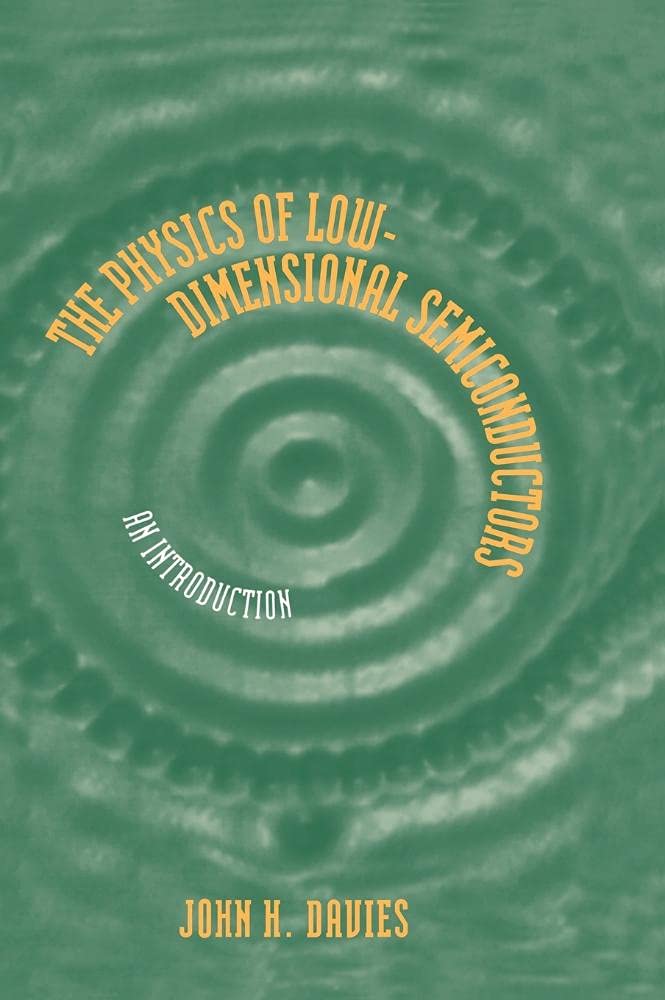
The Physics of Low-dimensional Semiconductors: An Introduction by John H. Davies – Essential Guide for Semiconductor Phy
Inclusive of all applicable taxes. FREE shipping on all orders.
Available Offers
- 🚚Free Delivery — Free shipping on all orders
- 💵Cash on Delivery — Pay when your order arrives
- ↩️15-Day Easy Returns — Hassle-free return policy
- 🔒Cash on Delivery — Pay safely when your order arrives
Check Delivery
Product Description
Introduction
Semiconductor physics has entered a transformative era, where shrinking dimensions and novel structures have unlocked extraordinary electronic and optical properties. For students and researchers seeking a clear yet rigorous entry point into this fascinating domain, The Physics of Low-dimensional Semiconductors: An Introduction by John H. Davies stands as an essential guide. Published by Cambridge University Press, this hardcover volume offers a comprehensive foundation in the principles governing two-dimensional electron gases, quantum wells, and related systems. Tailored for undergraduate and graduate students in physics and electrical engineering, the book bridges theoretical concepts with practical device applications, making it a valuable resource for Indian academic institutions and research labs alike.
Book Overview
This carefully structured textbook introduces the reader to the physics of semiconductors where charge carriers are confined in one or more dimensions. The author begins with the essential concepts of quantum mechanics and solid-state physics, gradually building a formalism that describes low-dimensional systems. The book focuses on two key systems: the two-dimensional electron gas (2DEG), which is the heart of modern field-effect transistors, and the quantum well, whose optical properties drive lasers and optoelectronic devices. Throughout, Davies uses simple physical explanations and real device examples to demystify complex phenomena. The text is richly illustrated with diagrams, energy band sketches, and experimental data, ensuring that abstract ideas become tangible. This edition is particularly suited for Indian students who require a balance of theoretical depth and practical relevance in their semiconductor coursework.
Key Highlights
- Clear Physical Explanations: Complex topics like quantum confinement, density of states, and heterojunctions are explained using intuitive analogies and minimal mathematics, making them accessible to newcomers.
- Device-Oriented Approach: Every concept is linked to real devices—HEMTs, quantum well lasers, and modulators—giving students a direct connection to technology.
- Focus on Two Key Systems: The book dedicates substantial coverage to the 2D electron gas and quantum wells, which are foundational to modern nanoelectronics and photonics.
- Pedagogical Features: Each chapter includes worked examples, end-of-chapter problems, and further reading suggestions to reinforce learning.
- Authoritative Publisher: Cambridge University Press ensures high editorial standards and accuracy, making this a trusted reference for Indian academic curricula.
Inside the Book
The book is organized into ten well-paced chapters. It opens with a review of basic semiconductor physics, including band theory and effective mass. Subsequent chapters introduce the concept of quantum confinement in one, two, and three dimensions. The core of the book explores the two-dimensional electron gas at heterojunctions, covering modulation doping, subband structure, and transport properties. Later chapters delve into quantum wells, superlattices, and optical properties, including absorption, gain, and excitonic effects. The final chapters address practical devices like high-electron-mobility transistors (HEMTs) and quantum well lasers, showing how theory translates into engineering. Appendices provide useful mathematical tools and material parameters for common semiconductors like GaAs and InP.
Key Topics
- Quantum confinement and density of states in 1D, 2D, and 3D systems
- Heterojunctions and band engineering
- Two-dimensional electron gas: formation, mobility, and scattering
- Modulation doping and the HEMT device
- Quantum wells: energy levels, wavefunctions, and optical transitions
- Excitons in confined systems
- Quantum well lasers and optical modulators
- Superlattices and minibands
- Strained layers and band offsets
- Experimental techniques for low-dimensional systems
Reader Benefits
Students will gain a solid conceptual framework that prepares them for advanced research or industry roles in semiconductor physics. The book’s emphasis on physical intuition over heavy mathematics means that even those with a basic background in quantum mechanics can follow along. Engineers and scientists working in optoelectronics will find the chapters on optical properties directly applicable to laser design and photodetector analysis. For Indian readers, the book aligns well with standard postgraduate syllabi in physics and electrical engineering, covering topics like quantum wells and heterostructures that are increasingly part of curriculum. The hardcover format ensures durability for frequent reference, and the clear writing style reduces the learning curve for self-study.
Learning Outcomes
By the end of this book, readers will be able to: understand the origin of quantized energy levels in low-dimensional semiconductors; calculate the density of states for 2D, 1D, and 0D systems; explain the operation of a HEMT and a quantum well laser; analyze the optical absorption spectrum of a quantum well; and apply the concept of band engineering to design heterostructures. These outcomes equip students to tackle advanced topics like spintronics, topological insulators, and quantum computing with confidence.
Who Should Read
- Undergraduate and postgraduate students in physics, applied physics, and electrical engineering taking courses on semiconductor physics or solid-state devices
- Researchers entering the field of low-dimensional systems or nanophotonics
- Working professionals in the Indian semiconductor and optoelectronics industry seeking a refresher on fundamental principles
- Faculty members designing courses on advanced semiconductor devices
About the Author
John H. Davies is a respected physicist and educator with extensive experience in semiconductor research and teaching. He has contributed to the understanding of low-dimensional systems through both theoretical work and practical device studies. His ability to distill complex ideas into clear, accessible language has made his textbook a favourite among students worldwide. Davies’s background in both academia and industry ensures that the content remains grounded in real-world applications.
About the Publisher
Cambridge University Press is one of the oldest and most prestigious academic publishers in the world. With a legacy of excellence spanning over four centuries, CUP is known for its rigorous peer review and high-quality production. Their science and mathematics titles are widely adopted in Indian universities, and this book maintains the same standard of clarity, accuracy, and pedagogical value. The hardcover edition ensures longevity, making it a worthy addition to any institutional or personal library.
Conclusion
The Physics of Low-dimensional Semiconductors: An Introduction is more than a textbook—it is a gateway to understanding the devices that power modern electronics and photonics. Whether you are a student preparing for exams, a researcher exploring new frontiers, or a professional seeking to deepen your knowledge, John H. Davies’s work provides the clarity and depth you need. With its focus on foundational principles and real devices, this book will remain a trusted companion throughout your academic and professional journey. Order your copy from Bookshops.in today and take a confident step into the world of low-dimensional semiconductors.
Quick Summary
The Physics of Low-dimensional Semiconductors: An Introduction by John H. Davies is a foundational textbook that explains the principles of semiconductor systems where charge carriers are confined in one or more dimensions. The book focuses on two key systems: the two-dimensional electron gas (2DEG) used in high-electron-mobility transistors, and the quantum well, which is central to modern lasers and optoelectronic devices. Davies uses simple physical reasoning and real device examples to make the concepts accessible. The formalism presented can be applied to other low-dimensional structures such as quantum wires and dots. This book is ideal for undergraduate and graduate students in physics or electrical engineering, as well as researchers entering the field. It balances theory with practical applications, helping readers connect quantum confinement effects to device performance. By purchasing from Bookshops.in, Indian students gain access to a premium hardcover edition with reliable delivery and competitive pricing.
Book Highlights
Book Specifications
| ISBN-13 | 9780521481489 |
| ISBN-10 | 0521481481 |
| Publisher | Cambridge University Press |
| Language | English |
| Dimensions | 19.05 x 2.54 x 26.04 cm |
| Weight | 1 kg 20 g |
| Category | Electrical & Electronic Engineering › Electronics |
| Genre | Non-fiction |
| Reading Age | Adult |
| Original Language | English |
Frequently Asked Questions
What is the main focus of this book?
Who is the author of this book?
Is this book suitable for beginners?
What topics are covered in the book?
Does the book include device examples?
Is this book used in Indian universities?
What is the ISBN of this book?
Is this a hardcover or paperback?
Can I use this book for self-study?
Does the book cover quantum dots?
What prior knowledge is needed?
Is the book available in India?
What is the price of the book?
Readers Also Search For
Customers Also Bought
Computer Science
Spring 2.5 Aspect Oriented Programming (English, Massimiliano Dess� | Massimiliano Dessi)

Computer Science
Asterisk 1.4 - the Professional's Guide (English, Colman Carpenter | David Duffett | Nik Middleton)

Computer Science
Advances In Natural Language Processing: 4th International Conference, Estal 2004, Alicante, Spain, October 20-22, 2004. Proceedings: 3230 (Lecture Notes in Computer Science)
Computer Science
Multimedia, Communication and Computing Application: Proceedings of the 2014 International Conference on Multimedia, Communication and Computing ... 2014), Xiamen, China, October 16-17, 2014
Computer Science
Cases on Database Technologies and Applications (Cases on Information Technology Series)

Computer Science
ASP.Net 3.5 Social Networking (English, Andrew Siemer)
Related Products
View All
Electronics
Multiprocessor System-on-Chip: Hardware Design and Tool Integration
Electronics
Robust Sram Designs and Analysis
Electronics
Computational Accelerator Physics 2003 (English, M. Berz | K. Makino)
Electronics
Tiny Machine Learning Techniques for Constrained Devices (English, Khalid El-Makkaoui | Ismail Lamaakal | Ibrahim Ouahbi)
Electronics
Applied Computer Vision and Soft Computing with Interpretable AI (English, Swati V. Shinde | Darshan V. Medhane | Oscar Castillo)

Electronics