
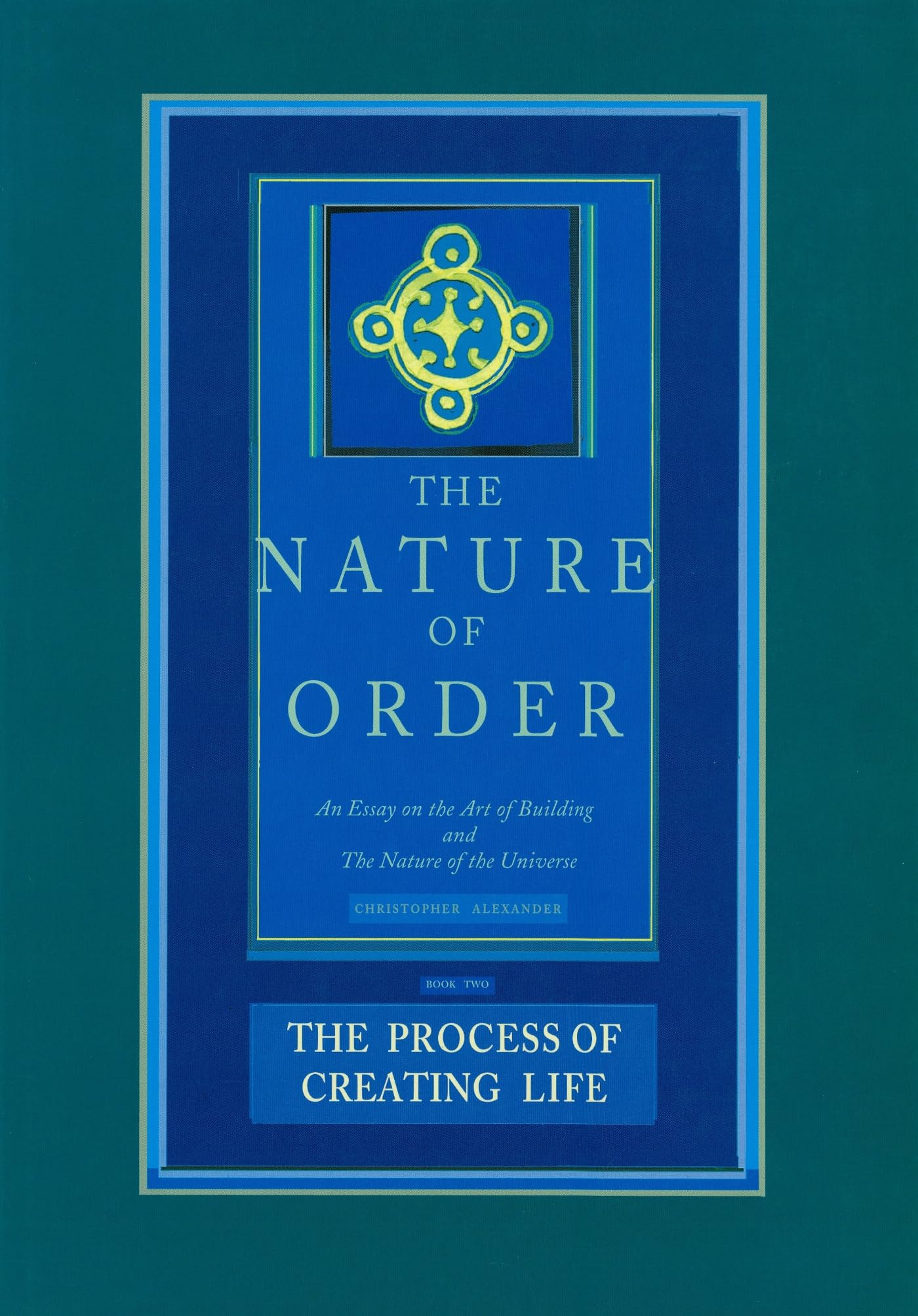
The Process of Creating Life: An Essay on the Art of Building and the Nature of the Universe by Christopher Alexander
Inclusive of all applicable taxes. FREE shipping on all orders.
Available Offers
- 🚚Free Delivery — Free shipping on all orders
- 💵Cash on Delivery — Pay when your order arrives
- ↩️15-Day Easy Returns — Hassle-free return policy
- 🔒Cash on Delivery — Pay safely when your order arrives
Check Delivery
Product Description
Introduction
In the vast landscape of architectural theory and design philosophy, few works resonate as deeply as Christopher Alexander's monumental series, The Nature of Order. The second volume, The Process of Creating Life, is a profound exploration into how living structures emerge, not just in buildings but in the fabric of the universe itself. For Indian readers—whether you are an architect, a student of design, a philosopher, or a curious mind—this book offers timeless insights that bridge ancient wisdom with modern science. It challenges us to see creation as a living, unfolding process rather than a mechanical act.
Book Overview
The Process of Creating Life is the second book in Christopher Alexander's four-volume masterpiece, The Nature of Order. Published by the Center for Environmental Structure, this hardcover edition is the result of 27 years of rigorous research. Alexander weaves together three vital perspectives: a scientific perspective grounded in empirical observation; a perspective based on beauty, grace, and human feeling; and a commonsense perspective rooted in our daily intuitions. The book argues that life in buildings and cities is not arbitrary but arises from a deep, generative process that mirrors the creative forces of nature itself. It is an essay on the art of building and the nature of the universe, offering a unified theory of how wholeness and coherence emerge in the world around us.
Key Highlights
- Generative Processes: Alexander introduces the concept of 'unfolding wholeness'—a step-by-step method to create living structures that feel alive and harmonious.
- 15 Fundamental Properties: The book details 15 geometric properties (such as levels of scale, strong centers, and boundaries) that appear in all living systems, from cells to cathedrals.
- Practical Application: Unlike abstract theory, this volume provides concrete examples and diagrams showing how to apply these principles in real-world design and construction.
- Interdisciplinary Depth: Blending architecture, biology, physics, and psychology, it offers a holistic view of creation that resonates with Indian philosophical traditions like Vastu Shastra and the concept of cosmic order (Rta).
- Beautifully Illustrated: The hardcover edition includes over 300 black-and-white illustrations, diagrams, and photographs that clarify complex ideas.
Inside the Book
Opening The Process of Creating Life, readers are guided through a journey from the micro to the macro. Alexander begins by defining what 'life' means in a structural sense—not biological life, but the quality of being whole, coherent, and deeply satisfying. He then introduces the concept of 'centers' as fundamental building blocks of any living structure. The book is divided into three major parts: the first part explores the nature of living processes in the universe; the second part describes the 15 properties that make structures alive; and the third part presents a step-by-step method for creating living form. Throughout, Alexander uses examples from traditional villages, Gothic cathedrals, and even modern buildings to illustrate his points. The writing is dense yet accessible, with a poetic rhythm that mirrors the creative process itself.
Key Topics
- The concept of wholeness and how it unfolds in space and time
- 15 fundamental geometric properties of living structures
- The role of adaptation, feedback, and incremental growth in design
- How to create buildings that heal and nourish human experience
- Connections between biological morphogenesis and architectural form
- The relationship between beauty, truth, and the nature of the universe
Reader Benefits
For Indian readers, this book offers a rare synthesis of scientific rigor and spiritual depth. You will learn to see the world around you with new eyes—noticing how a well-designed courtyard, a traditional temple, or a bustling bazaar embodies living structure. Architects and designers will gain a practical toolkit for creating spaces that feel alive, not sterile. Students of philosophy and science will appreciate the elegant arguments that tie together quantum physics, biology, and aesthetics. The book also provides a powerful antidote to the mechanized, soulless architecture that dominates modern cities. By understanding the process of creating life, you can contribute to a built environment that is more humane, sustainable, and beautiful.
Learning Outcomes
- Understand the 15 properties that define living structure and how to apply them in design
- Learn to identify and nurture 'centers' in any spatial configuration
- Gain a step-by-step method for unfolding wholeness in architectural projects
- Develop a deep intuition for how life emerges in natural and built systems
- Connect ancient Indian design principles (like Vastu) with contemporary scientific insights
- Critique modern architecture with a new, coherent framework based on life and beauty
Who Should Read
This book is essential for architecture students, practicing architects, urban planners, and interior designers who wish to move beyond superficial styles. It is equally valuable for philosophers, environmental psychologists, and anyone interested in the intersection of science, art, and spirituality. Indian readers with an appreciation for traditional crafts, temple architecture, and organic urbanism will find deep resonance. Even if you are not a professional, if you have ever wondered why certain places feel 'alive' and others feel dead, this book will transform your understanding. It is a must-read for those who believe that beauty and life are not luxuries but necessities for human flourishing.
About the Author
Christopher Alexander (1936–2022) was a renowned architect, mathematician, and design theorist. Born in Vienna and educated in England and the United States, he taught for decades at the University of California, Berkeley. His earlier work, A Pattern Language, revolutionized architecture by offering a practical vocabulary for human-centered design. The Nature of Order, his magnum opus, represents a lifetime of research into the fundamental principles of living structure. Alexander's ideas have influenced fields as diverse as computer science, software engineering, and organizational theory. His work continues to inspire a generation of designers who seek to create a world that is more whole, beautiful, and alive.
About the Publisher
The Center for Environmental Structure is a nonprofit organization founded by Christopher Alexander and his colleagues to promote research and education in the field of environmental design. Based in Berkeley, California, the Center has published Alexander's seminal works for over four decades. It is dedicated to advancing the understanding of how built environments can support human well-being and ecological health. This hardcover edition reflects the Center's commitment to high-quality production, ensuring that the book's physical form matches the depth of its content.
Conclusion
The Process of Creating Life is not just a book about architecture—it is a meditation on how the universe creates order, beauty, and life. For Indian readers, it offers a bridge between ancient wisdom and contemporary science, between the intuition of the craftsman and the rigor of the scientist. Whether you are designing a home, a campus, or simply seeking a deeper understanding of the world, this volume will enrich your perspective. Dive into Alexander's luminous vision and discover how the art of building can become a living art, one that heals both our spaces and our souls.
Quick Summary
The Process of Creating Life is the second volume of Christopher Alexander's extraordinary four-book series, The Nature of Order. After 27 years of research, Alexander presents a unified theory of how buildings, cities, and even natural forms can be created as 'living structures' that support human well-being. This book is written for architects, urban planners, designers, and anyone curious about why some spaces feel alive and beautiful while others feel dead. Readers will learn the fifteen fundamental properties of wholeness, how to apply them in design, and how to trust their own intuition alongside scientific principles. Alexander bridges the gap between art and science, offering a practical yet deeply philosophical approach to creating environments that nourish the human spirit. For Indian readers, this book is especially valuable as it provides timeless principles that can guide the design of vibrant, context-sensitive cities and homes. By ordering from Bookshops.in, you receive an authentic hardcover edition delivered to your doorstep, ensuring you have a lasting reference for years to come.
Book Highlights
Book Specifications
| ISBN-13 | 9780972652926 |
| ISBN-10 | 0972652922 |
| Publisher | Routledge |
| Language | English |
| Dimensions | 20.29 x 3.05 x 27.89 cm |
| Weight | 1 kg 660 g |
| Category | Arts, Film & Photography › Architecture |
| Series | The Nature of Order |
| Genre | Non-fiction |
| Reading Age | Adult |
| Original Language | English |
Frequently Asked Questions
What is The Process of Creating Life about?
Who is the author of this book?
Do I need to read the first book in the series?
Is this book suitable for beginners in architecture?
What makes this book different from other architecture books?
Is the book relevant for Indian readers?
What is the price of the book?
What is the ISBN?
Is this book part of a series?
What is the binding of the book?
Can I use this book for academic reference?
Does the book have illustrations?
Where can I buy this book in India?
Readers Also Search For
Customers Also Bought
Art History
The Italian Renaissance in Art

Art History
Photovoltaic Design & Installation For Dummies | by Mayfield | ForDummies | by Mayfield | ForDummies | by Mayfield | ForDummies | by Mayfield | ForDummies | by Mayfield | ForDummies | by Mayfield | ForDummies | by Mayfield | ForDummies | by Mayfield | ForDummies | by Mayfield | ForDummies | by Mayfield | ForDummies | by Mayfield | ForDummies | by Mayfield | ForDummies | by Mayfield | ForDummies | by Mayfield | ForDummies | by Mayfield | ForDummies | by Mayfield | ForDummies | by Mayfield | ForDu
Art History
Designing School Systems for All Students (English, Robert J. Manley | Richard J. Hawkins)
Art History
Routledge Library Editions: Art and Culture in the Nineteenth Century
Art History
An Errant Design (English, S. H. Long)
Art History
Distributed System Design | by Jie Wu | CRC Press | by Jie Wu | CRC Press | by Jie Wu | CRC Press | by Jie Wu | CRC Press | by Jie Wu | CRC Press | by Jie Wu | CRC Press | by Jie Wu | CRC Press | by Jie Wu | CRC Press | by Jie Wu | CRC Press | by Jie Wu | CRC Press | by Jie Wu | CRC Press | by Jie Wu | CRC Press | by Jie Wu | CRC Press | by Jie Wu | CRC Press | by Jie Wu | CRC Press | by Jie Wu | CRC Press | by Jie Wu | CRC Press | by Jie Wu | CRC Press | by Jie Wu | CRC Press | by Jie Wu | CRC
Related Products
View All
Architecture
Literatur Und Buhn: Tamil Literature: 2 (Hanbuch Der Orientalistik - Abeilung - Indien, Vol 2/1)
Architecture
Handbook of Synagogue Architecture: 29 (Brown Judaic Studies)

Architecture
Houses, Cottages & Bungalows: A Selection of Representative Examples ... Edited by F. Chatterton. Illustrations and Plans, With Explanatory Text
Architecture
Sport and Architecture (Frontiers of Sport)
Architecture
Britain's New Towns: an Experiment in Living
Architecture