
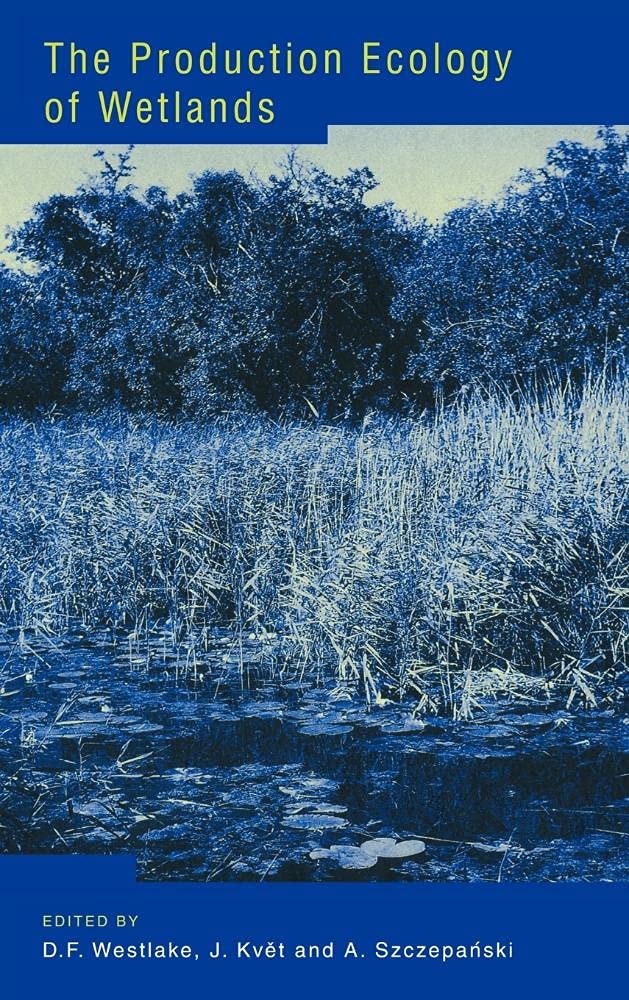
The Production Ecology of Wetlands: The IBP Synthesis by D. F. Westlake – A Definitive Guide to Freshwater Wetland Ecosy
Inclusive of all applicable taxes. FREE shipping on all orders.
Available Offers
- 🚚Free Delivery — Free shipping on all orders
- 💵Cash on Delivery — Pay when your order arrives
- ↩️15-Day Easy Returns — Hassle-free return policy
- 🔒Cash on Delivery — Pay safely when your order arrives
Check Delivery
Product Description
Introduction
Wetlands are among the most productive and ecologically significant ecosystems on Earth, yet they remain some of the most misunderstood and threatened. The Production Ecology of Wetlands: The IBP Synthesis offers a comprehensive scientific exploration of these vital transitional zones between aquatic and terrestrial environments. This authoritative volume, published by Cambridge University Press, distils decades of rigorous research conducted under the International Biological Programme (IBP) into a single, indispensable reference. For Indian students, researchers, and environmental professionals, this book provides a deep understanding of wetland dynamics that is crucial for conservation and sustainable management in a country blessed with diverse wetland ecosystems.
Book Overview
This hardbound edition brings together a wealth of data and insights on freshwater wetlands dominated by emergent vegetation. It systematically examines productivity in relation to plant and animal communities, environmental factors, mineral cycling, hydrology, and management practices. The book emphasises the biological interactions and underlying processes that shape wetland structure and function. Rather than a mere collection of facts, it reveals the interconnectedness of wetland components, showing how energy flows, nutrients cycle, and species interact to maintain these fragile habitats. The IBP Synthesis serves as a bridge between scattered research findings and a unified understanding of wetland ecology, making it an essential resource for anyone involved in the study or stewardship of these sensitive natural habitats.
Key Highlights
- Comprehensive IBP Research Synthesis: Consolidates decades of international collaborative research, presenting a coherent picture of wetland ecosystem functioning.
- Focus on Freshwater Emergent Wetlands: Delves into the ecology of wetlands with rooted, emergent vegetation, which are common across Indian landscapes.
- Interdisciplinary Approach: Integrates hydrology, nutrient cycling, plant and animal ecology, and management into a single analytical framework.
- Practical Management Insights: Offers principles for conservation and wise use of wetlands, directly applicable to Indian contexts like the Sundarbans, Chilika Lake, and Keoladeo National Park.
- Rigorous Scientific Foundation: Based on field studies and experiments from the IBP, ensuring data reliability and methodological depth.
Inside the Book
The book is structured to guide readers from foundational concepts to advanced applications. Early chapters establish the physical and chemical environment of wetlands, including hydrology, sediment dynamics, and nutrient availability. Subsequent sections explore primary production by emergent macrophytes and algae, and secondary production by invertebrates, fish, and birds. Detailed chapters on decomposition, mineral cycling, and energy flow reveal how wetlands function as integrated systems. The final parts address human impacts, management strategies, and conservation priorities, making the book equally valuable for theoretical understanding and practical decision-making.
Key Topics
- Hydrology and Water Regime: How water level fluctuations, flow patterns, and groundwater interactions shape wetland ecology.
- Primary Production: Photosynthetic rates, biomass accumulation, and factors limiting plant growth in emergent wetlands.
- Nutrient Cycling: Pathways of carbon, nitrogen, phosphorus, and other elements through wetland soils, plants, and animals.
- Decomposition and Detritus Dynamics: The role of microbial communities in breaking down organic matter and recycling nutrients.
- Food Webs and Trophic Interactions: Energy transfer from producers to herbivores, predators, and decomposers.
- Wetland Management and Restoration: Principles for maintaining ecological integrity, controlling invasive species, and restoring degraded wetlands.
Reader Benefits
- Deep Scientific Knowledge: Gain a thorough understanding of wetland ecology from a globally recognised research programme.
- Practical Application: Learn how to apply ecological principles to wetland conservation, assessment, and restoration projects.
- Research Foundation: Equip yourself with a solid baseline for conducting further studies in limnology, ecology, or environmental science.
- Indian Relevance: The principles discussed are directly transferable to Indian wetlands, aiding in local conservation efforts.
- Comprehensive Reference: A single volume that saves hours of searching through scattered literature.
Learning Outcomes
By reading this book, you will be able to: analyse the hydrological and biogeochemical processes that sustain wetlands; evaluate primary and secondary productivity in relation to environmental variables; interpret food web dynamics and nutrient cycles in freshwater emergent wetlands; assess the impacts of human activities such as drainage, pollution, and agriculture; and design informed management strategies for wetland conservation and restoration. The synthesis of IBP data also equips you to critically evaluate ecological studies and identify gaps in current knowledge.
Who Should Read
- Environmental Science and Ecology Students: Undergraduate and postgraduate students seeking a comprehensive textbook on wetland ecology.
- Researchers and Academics: Scientists studying limnology, biogeochemistry, botany, zoology, or conservation biology.
- Wildlife and Wetland Managers: Professionals working with forest departments, NGOs, or international agencies on wetland conservation.
- Policy Makers and Planners: Individuals involved in environmental impact assessments and land-use planning in wetland-rich regions.
- Naturalists and Conservation Enthusiasts: Anyone with a serious interest in understanding the ecological complexity of wetlands.
About the Author
D. F. Westlake is a distinguished ecologist whose career has been dedicated to understanding aquatic and wetland ecosystems. As a key contributor to the International Biological Programme, he played a pivotal role in coordinating and synthesising research on primary production in freshwater environments. His meticulous work has helped shape modern wetland science, and his writings continue to influence ecologists worldwide. Westlake’s expertise in plant ecology and ecosystem analysis is evident in the clarity and depth of this synthesis.
About the Publisher
Cambridge University Press is one of the world’s oldest and most respected academic publishers, with a history spanning over four centuries. Renowned for its rigorous peer-review process and commitment to scholarly excellence, Cambridge University Press publishes authoritative works across all fields of science, including ecology and environmental studies. This book upholds the Press’s tradition of making high-quality research accessible to a global audience, supporting both learning and practical application.
Conclusion
The Production Ecology of Wetlands: The IBP Synthesis is more than a book; it is a gateway to understanding one of Earth’s most valuable yet vulnerable ecosystems. For Indian readers, where wetlands face mounting pressures from urbanisation, agriculture, and climate change, this volume offers timeless scientific insights that can inform effective conservation. Whether you are a student, researcher, or practitioner, this comprehensive synthesis will enrich your knowledge and empower you to contribute to the preservation of these irreplaceable habitats. Add this essential resource to your library and deepen your connection with the natural world.
Quick Summary
The Production Ecology of Wetlands: The IBP Synthesis by D. F. Westlake is a comprehensive scientific work that explores the ecology of freshwater wetlands dominated by emergent vegetation. Published by Cambridge University Press in 1999, this hardcover volume synthesizes research conducted under the International Biological Programme, offering a detailed analysis of wetland productivity, mineral cycling, hydrology, and management. The book emphasizes the biological interactions and ecological processes that define wetland structure and function, making it a vital resource for understanding these fragile transitional habitats. Readers will learn about the dynamics of plant and animal communities, nutrient flows, and the hydrological regimes that sustain wetlands. The text is particularly valuable for Indian ecologists, environmental scientists, and students seeking a solid foundation in wetland science. By purchasing from Bookshops.in, customers receive an authentic print edition with prompt service across India, supporting academic and research needs with a trusted online bookstore.
Book Highlights
Book Specifications
| ISBN-13 | 9780521228220 |
| ISBN-10 | 0521228220 |
| Publisher | Cambridge University Press |
| Language | English |
| Dimensions | 15.88 x 3.81 x 23.5 cm |
| Weight | 1 kg 30 g |
| Country | India |
| Category | Biology & Life Sciences › Biology |
| Genre | Science & Mathematics |
| Original Language | English |
Frequently Asked Questions
What is the main focus of this book?
Who is the author of The Production Ecology of Wetlands?
What does IBP stand for in the title?
Is this book suitable for undergraduate students?
Does the book cover Indian wetlands?
What types of wetlands are discussed?
How does the book address wetland management?
Is this book still relevant today?
Does the book include case studies?
Are there illustrations or diagrams?
What is the price of the book on Bookshops.in?
Can I use this book for research on wetland hydrology?
Does the book discuss climate change impacts on wetlands?
Why buy this book from Bookshops.in?
Readers Also Search For
Customers Also Bought
Mathematics
Stereotype Spaces and Algebras: 73 (De Gruyter Expositions in Mathematics, 73)

Mathematics
Semigroups in Algebra, Geometry and Analysis: 20 (De Gruyter Expositions in Mathematics, 20)

Mathematics
Geometry from the Pacific Rim: Proceedings of the Pacific Rim Geometry Conference held at National University of Singapore, Republic of Singapore, ... 1994 (De Gruyter Proceedings in Mathematics)

Mathematics
First International Tainan-Moscow Algebra Workshop: Proceedings of the International Conference held at National Cheng Kung University Tainan, Taiwan, ... 1994 (De Gruyter Proceedings in Mathematics)

Mathematics
Differential Geometry - Proceedings of the VIII International Colloquium (English, Jesus A. Alvarez Lopez | Eduardo Garcia-Rio)

Mathematics
Mathematical Theory of Optimal Processes (Classics of Soviet Mathematics)
Related Products
View All
Biology
Evolution: What the Fossils Say and Why It Matters by Donald R. Prothero
Biology
From Taxonomy to Phylogenetics – Life and Work of Willi Hennig
Biology
The Marine Biology of the South China Sea
Biology
Genetics Meets Metabolomics: from Experiment to Systems Biology
Biology
The Elements of Natural or Experimental Philosophy: 2
Biology