
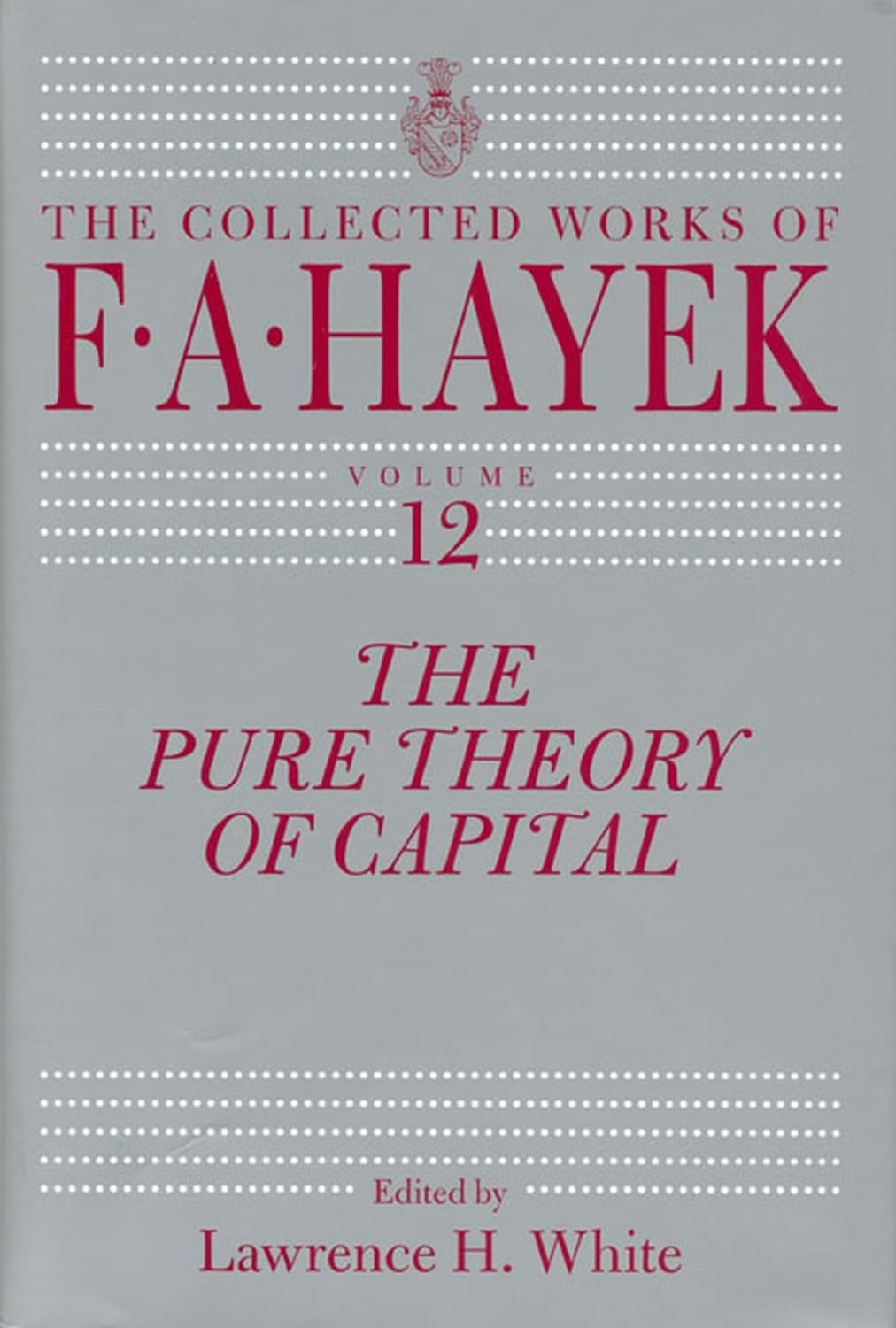
The Pure Theory of Capital: F. A. Hayek's Definitive Work on Capital Theory and Economic Equilibrium
Inclusive of all applicable taxes. FREE shipping on all orders.
Available Offers
- 🚚Free Delivery — Free shipping on all orders
- 💵Cash on Delivery — Pay when your order arrives
- ↩️15-Day Easy Returns — Hassle-free return policy
- 🔒Cash on Delivery — Pay safely when your order arrives
Check Delivery
Product Description
Introduction
In the vast landscape of economic thought, few works have been as misunderstood or as prescient as F. A. Hayek’s The Pure Theory of Capital. Originally published in 1941, this dense and rigorous treatise represents Hayek’s most sustained effort to build a coherent theory of capital that bridges the gap between abstract equilibrium analysis and the messy realities of money, credit, and business cycles. For Indian students and scholars of economics, law, and political philosophy, this University of Chicago Press hardcover edition—with a fresh introduction by Hayek expert Lawrence H. White—offers an indispensable key to understanding not only capital theory but also the foundations of modern Austrian economics. This book is not a casual read; it is a demanding, rewarding journey into the very structure of production and time.
Book Overview
The Pure Theory of Capital is Hayek’s attempt to answer a deceptively simple question: How do we understand the relationship between inputs and outputs in a dynamic, time-bound economy? Rejecting the static equilibrium models of his contemporaries, Hayek builds a framework where capital goods are not homogeneous lumps but a complex, heterogeneous structure that must be coordinated through time. The book systematically explores how savings, investment, interest rates, and monetary policy interact with this capital structure. It is a work of extraordinary ambition—Hayek’s last major contribution to pure economic theory before he turned his attention to broader social and political questions. This edition restores the original 1941 text, making it available to a new generation of readers in India who wish to grapple with the deepest problems of economic coordination.
Key Highlights
- Foundational Text: Hayek’s most detailed and systematic work on capital theory, essential for understanding the Austrian school of economics.
- New Introduction: Lawrence H. White provides critical historical and theoretical context, connecting the book to Hayek’s life and to ongoing debates in monetary economics.
- Rigorous Analysis: Offers a step-by-step exploration of the equilibrium relationships between inputs, outputs, and time, using clear logical reasoning rather than mathematical formalism.
- Monetary Integration: Aims to make capital theory directly applicable to real-world monetary phenomena, including business cycles and inflation.
- Hardcover Quality: A durable, premium edition from the University of Chicago Press, ideal for serious study and long-term reference.
Inside the Book
The book is divided into several parts, each building on the last. Hayek begins by defining capital and its role in a progressive economy, then moves to a detailed discussion of the structure of production—what he calls the “time structure” of capital goods. He explores the concept of the “average period of production” and its relationship to interest rates, savings, and investment. Later chapters delve into the role of money, the effects of monetary disturbances on the capital structure, and the conditions for intertemporal equilibrium. The writing is dense and analytical, with frequent references to earlier economists such as Böhm-Bawerk, Wicksell, and Mises. This is not a textbook but a profound theoretical investigation, best approached with patience and a willingness to engage with abstract reasoning.
Key Topics
- Capital and Time: The fundamental role of time in production and the heterogeneity of capital goods.
- Structure of Production: How different stages of production (from raw materials to final goods) are coordinated.
- Interest and Savings: The relationship between the rate of interest, the time preference of consumers, and the accumulation of capital.
- Monetary Theory: How changes in the money supply distort the capital structure and lead to booms and busts.
- Equilibrium Analysis: Hayek’s unique approach to equilibrium as a process of coordination through time, not a static state.
Reader Benefits
- Deepen Your Understanding: Gain a rigorous, non-mathematical grasp of capital theory that most modern textbooks overlook.
- Critical Thinking: Learn to think about the economy as a dynamic, time-dependent system, not a simple supply-and-demand diagram.
- Historical Insight: Understand why Hayek’s ideas were marginalized in the 1940s and how they are being rediscovered today.
- Academic Edge: Equip yourself with arguments that challenge mainstream Keynesian and neoclassical frameworks—useful for debates in economics, law, and public policy.
- Collector’s Value: Own a high-quality hardcover edition of a classic that is increasingly cited in contemporary economic research.
Learning Outcomes
After engaging with this book, readers will be able to: (1) Explain the concept of the capital structure and its significance for economic growth; (2) Critically evaluate the role of interest rates in coordinating saving and investment; (3) Identify how monetary expansion can misdirect capital and cause recessions; (4) Understand the limitations of aggregative economic models that ignore the heterogeneity of capital; (5) Apply Hayek’s insights to modern issues such as financial crises, inflation, and development policy in India.
Who Should Read
- Economics Students (Graduate and Advanced Undergraduate): Those studying macroeconomics, monetary theory, or the history of economic thought.
- Law and Policy Scholars: Anyone interested in the legal and institutional foundations of markets, property rights, and economic coordination.
- Indian Civil Services Aspirants: Candidates preparing for UPSC or state services who want a deeper understanding of capital and economic cycles beyond standard textbooks.
- Business and Finance Professionals: Those seeking a theoretical foundation for long-term investment and capital budgeting decisions.
- General Readers: intellectually curious individuals ready to tackle one of the 20th century’s most challenging economic works.
About the Author
Friedrich August von Hayek (1899–1992) was one of the most influential economists and social philosophers of the twentieth century. A Nobel laureate in Economic Sciences (1974), Hayek made seminal contributions to monetary theory, business cycle theory, the theory of knowledge, and political philosophy. His works, including The Road to Serfdom and The Constitution of Liberty, have shaped modern libertarian and classical liberal thought. The Pure Theory of Capital represents the culmination of his technical economic work, written during his time at the London School of Economics. Hayek’s ideas on the use of knowledge in society and the limits of central planning remain profoundly relevant for India’s ongoing debates on market reform and institutional design.
About the Publisher
The University of Chicago Press is one of the most prestigious academic publishers in the world, known for producing authoritative editions of classic works in economics, philosophy, and the social sciences. This hardcover edition of The Pure Theory of Capital reflects the Press’s commitment to scholarly excellence, with careful typesetting, durable binding, and a thoughtful new introduction. For Indian readers, this edition offers a reliable, permanent addition to any serious library of economic thought.
Conclusion
The Pure Theory of Capital is not a book for the faint-hearted, but for the serious student of economics and society, it is an intellectual treasure. In an era when economic models often ignore the role of time, capital heterogeneity, and monetary distortions, Hayek’s work provides a powerful corrective. This University of Chicago Press hardcover edition, with its new introduction and pristine text, is the definitive way to experience Hayek’s masterpiece. Whether you are a researcher, a policymaker, or a curious reader in India, this book will challenge your assumptions and sharpen your understanding of how economies truly work. Add it to your shelf and prepare for a rewarding intellectual journey.
Quick Summary
The Pure Theory of Capital is F. A. Hayek's magnum opus on capital theory, originally published in 1941 and now available in a 2007 hardcover edition from University of Chicago Press. This book offers a rigorous analysis of equilibrium relationships between inputs and outputs, exploring the time structure of production, saving, investment, and business cycles. It is Hayek's last major work in economics and stands as a key text for understanding Austrian economics and capital theory. The edition includes a new introduction by Lawrence H. White, which situates the work within Hayek's life and the broader economic debates of the time, particularly the shift toward Keynesian thought. This book is ideal for advanced economics students, scholars, and anyone interested in the foundations of capital theory. By purchasing from Bookshops.in, Indian readers get a premium hardcover edition with fast delivery and excellent customer service, making it a valuable addition to any academic library.
Book Highlights
Book Specifications
| ISBN-13 | 9780226320991 |
| ISBN-10 | 0226320995 |
| Publisher | Univ of Chicago Pr |
| Language | English |
| Dimensions | 15.24 x 3.3 x 22.86 cm |
| Weight | 771 g |
| Category | Economics › Economic Theory |
| Genre | Non-fiction |
| Reading Age | Adult |
| Original Language | English |
Frequently Asked Questions
What is The Pure Theory of Capital about?
Who is the author of this book?
Is this book suitable for beginners in economics?
Why is this book important?
What is the price in Indian rupees?
Can I get this book in India?
Does this book include any new material?
How is this book different from Hayek's other works?
What is the binding type?
Who is Lawrence H. White?
Is this book relevant to Indian economics?
What is the language of the book?
Where can I read reviews?
Readers Also Search For
Customers Also Bought
Entrepreneurship
Chinese Economic Revolution (English, Linda Grove)
Entrepreneurship
Engines of Innovation: The Entrepreneurial University in the Twenty-First Century by Holden Thorp
Entrepreneurship
Invention to Innovation (English, PhD Marshall Larry | Jenna Daroczy)

Entrepreneurship
Database Management Systems by Raghu Ramakrishnan – DBMS Textbook

Entrepreneurship
Decision-making for Technology Executives by Harold A. Linstone
Entrepreneurship
The Business Innovation Audit (English, William Tate)
Related Products
View All
Economics
Women's Entrepreneurship and Economics (English, Miguel-Angel Galindo | Domingo Ribeiro)
Economics
Trade Policy and Industrialization in Turbulent Times | by Gerry Helleiner | Routledge | by Gerry Helleiner | Routledge | by Gerry Helleiner | Routledge | by Gerry Helleiner | Routledge | by Gerry Helleiner | Routledge | by Gerry Helleiner | Routledge | by Gerry Helleiner | Routledge | by Gerry Helleiner | Routledge | by Gerry Helleiner | Routledge | by Gerry Helleiner | Routledge | by Gerry Helleiner | Routledge | by Gerry Helleiner | Routledge | by Gerry Helleiner | Routledge | by Gerry Hellei
Economics
History of Economic Analysis | by Schumpeter Joseph A. | Taylor & Francis Ltd | by Schumpeter Joseph A. | Taylor & Francis Ltd | by Schumpeter Joseph A. | Taylor & Francis Ltd | by Schumpeter Joseph A. | Taylor & Francis Ltd | by Schumpeter Joseph A. | Taylor & Francis Ltd | by Schumpeter Joseph A. | Taylor & Francis Ltd | by Schumpeter Joseph A. | Taylor & Francis Ltd | by Schumpeter Joseph A. | Taylor & Francis Ltd | by Schumpeter Joseph A. | Taylor & Franci
Economics
OECD Compendium of Productivity Indicators 2015 | by Organization for Economic Cooperation an | Organization for Economic Co-Operation & Deve | by Organization for Economic Cooperation an | Organization for Economic Co-Operation & Deve | by Organization for Economic Cooperation an | Organization for Economic Co-Operation & Deve | by Organization for Economic Cooperation an | Organization for Economic Co-Operation & Deve | by Organization for Economic Cooperation an | Organization

Economics
The Hacker's Handbook: The Strategy Behind Breaking into and Defending Networks by Susan Young
Economics