
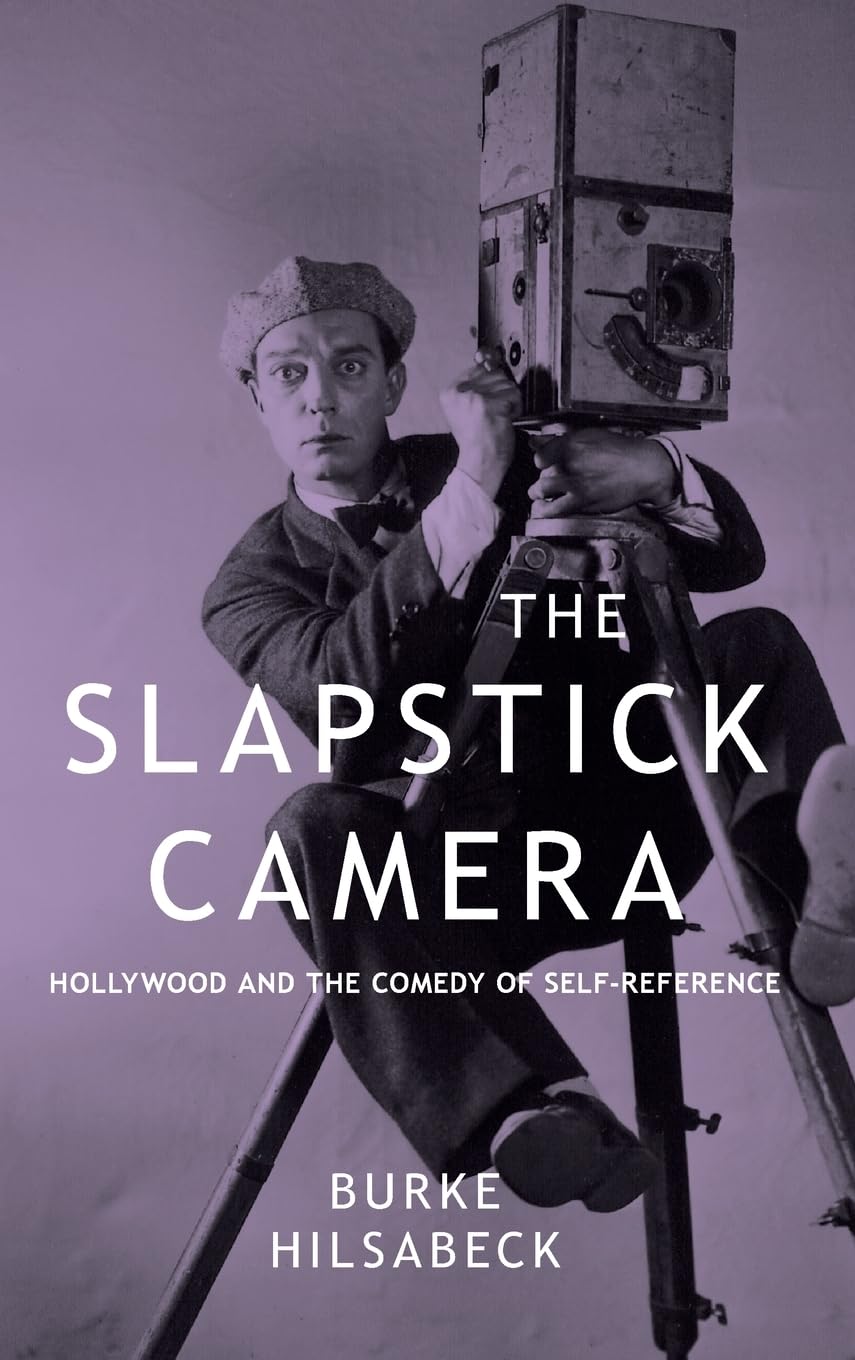
The Slapstick Camera: Hollywood and the Comedy of Self-Reference by Burke Hilsabeck – A Deep Dive into Film Philosophy a
Inclusive of all applicable taxes. FREE shipping on all orders.
Available Offers
- 🚚Free Delivery — Free shipping on all orders
- 💵Cash on Delivery — Pay when your order arrives
- ↩️15-Day Easy Returns — Hassle-free return policy
- 🔒Cash on Delivery — Pay safely when your order arrives
Check Delivery
Product Description
Introduction
Slapstick comedy is often dismissed as mindless physical humour, but The Slapstick Camera: Hollywood and the Comedy of Self-Reference by Burke Hilsabeck reveals a startling truth: the genre is a sophisticated philosophical playground. Published by State University of New York Press, this hardcover volume takes readers on a journey through Hollywood’s golden age, showing how comedians like Buster Keaton, the Marx Brothers, and Jerry Lewis used their craft to reflect on the very nature of cinema itself. For Indian students and film enthusiasts, this book offers a fresh lens to understand how laughter can be a form of deep artistic inquiry.
Book Overview
Hilsabeck’s work is a rigorous yet accessible exploration of self-reference in slapstick film comedy. Moving chronologically through the studio era, the book examines how classic gags—such as Keaton stepping into a movie screen in Sherlock Jr. (1924) or Harpo Marx lip-syncing to a phonograph in Monkey Business (1931)—are not just funny but also meditations on film production, technology, and economics. The author draws on philosopher Stanley Cavell’s idea that cinema “exists in a state of philosophy” to argue that slapstick comedians were unwitting theorists of their medium. Each chapter unpacks a different film or gag, connecting it to broader changes in Hollywood’s industrial practices.
Key Highlights
- Original Thesis: Challenges the notion that slapstick is merely lowbrow entertainment, positioning it as a form of cinematic philosophy.
- Rich Film Analysis: In-depth readings of iconic films from the 1920s to the 1960s, including works by Keaton, Chaplin, the Marx Brothers, and Jerry Lewis.
- Historical Context: Links comedic techniques to shifts in Hollywood technology, such as the arrival of sound and the rise of the studio system.
- Accessible Scholarship: Written for both academic readers and general enthusiasts, with clear explanations of complex ideas.
Inside the Book
The book is structured around key moments in slapstick history. Early chapters focus on silent-era comedians who broke the fourth wall and played with the mechanics of film projection. Later sections explore how sound and colour changed the possibilities for self-reference, and the final chapters examine post-war comedies that critiqued the very industry that produced them. Each analysis is grounded in close viewing and supported by references to film theory, making it a treasure trove for serious cinephiles.
Key Topics
- Self-reference and reflexivity in classical Hollywood cinema
- The philosophy of comedy and humour
- Film technology and its impact on narrative form
- Studio-era economics and creative labour
- Stanley Cavell’s concept of film as philosophy
- Case studies of Buster Keaton, Charlie Chaplin, Harpo Marx, and Jerry Lewis
Reader Benefits
- Deepen Your Film Appreciation: Understand how slapstick comedians were pioneers of meta-cinematic storytelling.
- Enhance Critical Thinking: Learn to see comedy as a vehicle for philosophical reflection on art and reality.
- Broaden Your Knowledge: Gain insight into Hollywood’s industrial history through the lens of popular entertainment.
- Engage with Scholarship: Access a well-researched yet lively text that bridges film studies and philosophy.
Learning Outcomes
By reading this book, you will be able to identify and analyse self-referential techniques in film comedy, trace the evolution of slapstick from silent to sound cinema, and articulate how comedians used their medium to comment on the film industry itself. You will also develop a deeper understanding of how humour can serve as a form of cultural critique, and how seemingly trivial gags can carry profound intellectual weight.
Who Should Read
- Students of film studies, media studies, and cultural theory
- Indian cinephiles curious about Hollywood’s comedic legacy
- Scholars and researchers working on comedy, philosophy, or film history
- Writers and critics looking for fresh perspectives on classic cinema
- Anyone who loves slapstick and wants to understand its hidden depths
About the Author
Burke Hilsabeck is a scholar of film and literature whose work focuses on the intersections of comedy, philosophy, and media history. He has published widely in academic journals and brings a passionate, accessible voice to his writing. His research demonstrates that the most playful art can also be the most thoughtful.
About the Publisher
State University of New York Press (SUNY Press) is a leading academic publisher known for its rigorous scholarship in the humanities and social sciences. With a commitment to making specialised knowledge accessible, SUNY Press produces books that challenge, inform, and inspire readers around the world.
Conclusion
The Slapstick Camera is a must-read for anyone who believes that comedy is more than just laughter. By uncovering the philosophical soul of slapstick, Burke Hilsabeck transforms how we see classic Hollywood—and reminds us that even the silliest gags can be profound. Whether you are a student, a teacher, or a lifelong film lover, this book will change the way you watch comedies forever. Order your copy from Bookshops.in today and add a fresh voice to your library.
Quick Summary
The Slapstick Camera: Hollywood and the Comedy of Self-Reference by Burke Hilsabeck is a groundbreaking study that reveals the philosophical intelligence behind slapstick film comedy. Far from being mere physical humour, slapstick gags often serve as a mirror to the cinema itself. Hilsabeck closely examines iconic films such as Buster Keaton's Sherlock Jr. (1924), Harpo Marx's lip-sync performance in Monkey Business (1931), and Jerry Lewis's film-within-a-film in The Errand Boy (1961). Drawing on the ideas of philosopher Stanley Cavell, the book argues that these comedians were deeply aware of their medium and used self-reference to explore how movies are made, projected, and perceived. This book is ideal for Indian film students, academics, and cinephiles who want to deepen their understanding of Hollywood comedy and film theory. By purchasing from Bookshops.in, you get an authentic hardcover edition delivered to your doorstep in India, backed by reliable service and competitive pricing.
Book Highlights
Book Specifications
| ISBN-13 | 9781438477312 |
| ISBN-10 | 1438477317 |
| Publisher | State University of New York Press |
| Language | English |
| Dimensions | 15.24 x 1.91 x 22.86 cm |
| Weight | 408 g |
| Country | India |
| Category | Performing Arts › Film & Television |
| Genre | Film Studies |
| Original Language | English |
Frequently Asked Questions
What is The Slapstick Camera about?
Who is the author?
Which comedians are discussed?
Is this book only for academics?
What films are analyzed in detail?
Does the book connect to Indian cinema?
What is the ISBN?
Is this a hardcover or paperback?
What is the price in India?
Which publisher released this book?
Can I use this book for a film studies course?
Does the book include illustrations?
Where can I buy this book in India?
Readers Also Search For
Customers Also Bought
CRC Press
Practical Sampling Techniques | by Ranjan K. Som | CRC Press | by Ranjan K. Som | CRC Press | by Ranjan K. Som | CRC Press | by Ranjan K. Som | CRC Press | by Ranjan K. Som | CRC Press | by Ranjan K. Som | CRC Press | by Ranjan K. Som | CRC Press | by Ranjan K. Som | CRC Press | by Ranjan K. Som | CRC Press | by Ranjan K. Som | CRC Press | by Ranjan K. Som | CRC Press | by Ranjan K. Som | CRC Press | by Ranjan K. Som | CRC Press | by Ranjan K. Som | CRC Press | by Ranjan K. Som | CRC Press | by
CRC Press
Number Theory | by Don Redmond | CRC Press | by Don Redmond | CRC Press | by Don Redmond | CRC Press | by Don Redmond | CRC Press | by Don Redmond | CRC Press | by Don Redmond | CRC Press | by Don Redmond | CRC Press | by Don Redmond | CRC Press | by Don Redmond | CRC Press | by Don Redmond | CRC Press | by Don Redmond | CRC Press | by Don Redmond | CRC Press | by Don Redmond | CRC Press | by Don Redmond | CRC Press | by Don Redmond | CRC Press | by Don Redmond | CRC Press | by Don Redmond | CRC
CRC Press
Partial Differential Equations and Applications | by Giorgio Talenti | CRC Press | by Giorgio Talenti | CRC Press | by Giorgio Talenti | CRC Press | by Giorgio Talenti | CRC Press | by Giorgio Talenti | CRC Press | by Giorgio Talenti | CRC Press | by Giorgio Talenti | CRC Press | by Giorgio Talenti | CRC Press | by Giorgio Talenti | CRC Press | by Giorgio Talenti | CRC Press | by Giorgio Talenti | CRC Press | by Giorgio Talenti | CRC Press | by Giorgio Talenti | CRC Press | by Giorgio Talenti |

CRC Press
Fauna in Soil Ecosystems | by Gero Benckiser | CRC Press | by Gero Benckiser | CRC Press | by Gero Benckiser | CRC Press | by Gero Benckiser | CRC Press | by Gero Benckiser | CRC Press | by Gero Benckiser | CRC Press | by Gero Benckiser | CRC Press | by Gero Benckiser | CRC Press | by Gero Benckiser | CRC Press | by Gero Benckiser | CRC Press | by Gero Benckiser | CRC Press | by Gero Benckiser | CRC Press | by Gero Benckiser | CRC Press | by Gero Benckiser | CRC Press | by Gero Benckiser | CRC P

CRC Press
Expert Systems | by Chris Nikolopoulos | CRC Press | by Chris Nikolopoulos | CRC Press | by Chris Nikolopoulos | CRC Press | by Chris Nikolopoulos | CRC Press | by Chris Nikolopoulos | CRC Press | by Chris Nikolopoulos | CRC Press | by Chris Nikolopoulos | CRC Press | by Chris Nikolopoulos | CRC Press | by Chris Nikolopoulos | CRC Press | by Chris Nikolopoulos | CRC Press | by Chris Nikolopoulos | CRC Press | by Chris Nikolopoulos | CRC Press | by Chris Nikolopoulos | CRC Press | by Chris Nikolo
CRC Press
Commutative Ring Theory | by Paul-Jean Cahen | Douglas L. Costa | Marco Fontana | CRC Press | by Paul-Jean Cahen | Douglas L. Costa | Marco Fontana | CRC Press | by Paul-Jean Cahen | Douglas L. Costa | Marco Fontana | CRC Press | by Paul-Jean Cahen | Douglas L. Costa | Marco Fontana | CRC Press | by Paul-Jean Cahen | Douglas L. Costa | Marco Fontana | CRC Press | by Paul-Jean Cahen | Douglas L. Costa | Marco Fontana | CRC Press | by Paul-Jean Cahen | Douglas L. Costa | Marco Fontana | CRC Press
Related Products
View All
State University of New York Press
The Hard Sell of Paradise: Hawai'i, Hollywood, Tourism (SUNY series, Horizons of Cinema)

State University of New York Press
Work and Lifecourse in Japan | by David W. Plath | State University of New York Press | by David W. Plath | State University of New York Press | by David W. Plath | State University of New York Press | by David W. Plath | State University of New York Press | by David W. Plath | State University of New York Press | by David W. Plath | State University of New York Press | by David W. Plath | State University of New York Press | by David W. Plath | State University of New York Press | by David W. P

State University of New York Press
For We are Sold, I and My People | by María P. Fernández-Kelly | State University of New York Press | by María P. Fernández-Kelly | State University of New York Press | by María P. Fernández-Kelly | State University of New York Press | by María P. Fernández-Kelly | State University of New York Press | by María P. Fernández-Kelly | State University of New York Press | by María P. Fernández-Kelly | State University of New York Press | by María P. Fernández-Kelly | State University of New York Pres

State University of New York Press
Education in the Third Reich | by Gilmer W. Blackburn | State University of New York Press | by Gilmer W. Blackburn | State University of New York Press | by Gilmer W. Blackburn | State University of New York Press | by Gilmer W. Blackburn | State University of New York Press | by Gilmer W. Blackburn | State University of New York Press | by Gilmer W. Blackburn | State University of New York Press | by Gilmer W. Blackburn | State University of New York Press | by Gilmer W. Blackburn | State Univ
State University of New York Press
Mantra | by Harvey P. Alper | State University of New York Press | by Harvey P. Alper | State University of New York Press | by Harvey P. Alper | State University of New York Press | by Harvey P. Alper | State University of New York Press | by Harvey P. Alper | State University of New York Press | by Harvey P. Alper | State University of New York Press | by Harvey P. Alper | State University of New York Press | by Harvey P. Alper | State University of New York Press | by Harvey P. Alper | State
State University of New York Press