
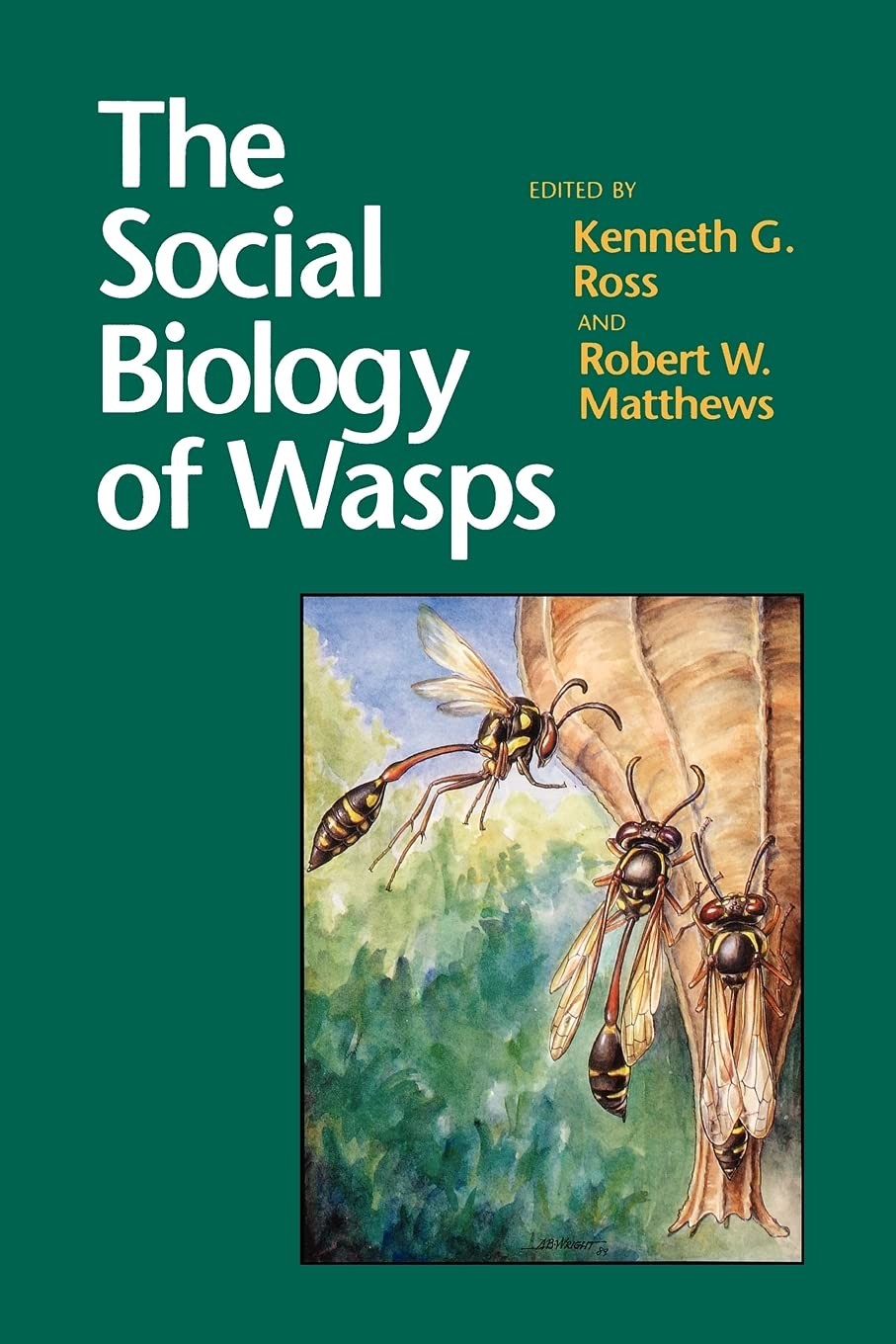
The Social Biology of Wasps by Kenneth G. Ross – A Deep Dive into Vespidae Natural History, Genetics, and Social Evoluti
Inclusive of all applicable taxes. FREE shipping on all orders.
Available Offers
- 🚚Free Delivery — Free shipping on all orders
- 💵Cash on Delivery — Pay when your order arrives
- ↩️15-Day Easy Returns — Hassle-free return policy
- 🔒Cash on Delivery — Pay safely when your order arrives
Check Delivery
Product Description
Introduction
Wasps are among the most fascinating yet misunderstood creatures in the insect world. In The Social Biology of Wasps, edited by Kenneth G. Ross, readers are invited to explore the intricate social structures, behaviours, and evolutionary adaptations of these remarkable insects. This hardcover volume, published by Cornell University Press, is an essential resource for students, researchers, and science enthusiasts in India who wish to deepen their understanding of insect sociobiology. Whether you are a postgraduate student of zoology, an entomologist, or simply a curious mind, this book offers a comprehensive and authoritative look into the social lives of wasps.
Book Overview
This edited collection brings together the work of seventeen internationally recognised experts in the field. The book is divided into two major parts. The first part begins with a detailed review of the classification of the family Vespidae and includes a revision of the subfamily Polistinae. Subsequent chapters delve into the natural history and social biology of each major taxon of social and presocial vespids. The second part shifts focus to broader evolutionary and behavioural themes, including reproductive competition, worker polyethism, nest architecture, queen number and control, exocrine glands, population genetics, and the nutritional basis of social evolution. A final chapter offers a comparative discussion of social behaviour in the Sphecidae family, the only other wasp group where well-developed sociality is observed.
Key Highlights
- Comprehensive coverage of all major social and presocial vespid taxa
- Original research from seventeen leading international scientists
- Integration of natural history, ecology, behaviour, morphology, and genetics
- Updated classification of Vespidae with a revision of Polistinae
- Comparative analysis of social behaviour across wasp families
- Detailed discussion of nest architecture, queen dynamics, and exocrine glands
- Population genetics and nutritional perspectives on social evolution
Inside the Book
The book opens with foundational chapters on taxonomy and classification, providing a clear framework for understanding the diversity of social wasps. Readers will then journey through the natural history of key groups, from primitively social to highly eusocial species. Later chapters explore the mechanisms that drive sociality, such as worker division of labour, reproductive conflicts, and the role of chemical communication. The final comparative chapter broadens the scope by examining social behaviour in Sphecidae, offering a unique evolutionary perspective. Each chapter is richly illustrated with diagrams, tables, and photographs that enhance comprehension.
Key Topics
- Classification and phylogeny of Vespidae
- Natural history of Polistinae, Vespinae, Stenogastrinae, and other subfamilies
- Reproductive competition and worker polyethism
- Evolution of nest architecture and queen control
- Exocrine glands and chemical communication
- Population genetics of social wasps
- Nutritional foundations of social evolution
- Social behaviour in Sphecidae
Reader Benefits
- Deepen your knowledge of insect sociality and evolutionary biology
- Access cutting-edge research compiled by world-renowned experts
- Understand complex concepts through clear, well-structured chapters
- Apply insights to fields such as ecology, behaviour, genetics, and conservation
- Enhance academic writing with authoritative references and data
Learning Outcomes
By reading this book, you will be able to: describe the major taxonomic groups of social wasps and their evolutionary relationships; explain the mechanisms of reproductive competition and worker division of labour; analyse the role of nest architecture in colony success; evaluate the genetic and nutritional factors that influence social evolution; and compare social systems across different wasp families. These outcomes make the book particularly valuable for graduate courses in entomology, animal behaviour, and evolutionary biology.
Who Should Read
- Students of zoology, entomology, and evolutionary biology at the postgraduate level
- Researchers and academics specialising in insect sociobiology
- Wildlife enthusiasts and naturalists interested in Indian wasp diversity
- Conservation biologists studying hymenopteran ecology
- Science teachers seeking in-depth reference material
About the Author
Kenneth G. Ross is a distinguished entomologist and evolutionary biologist known for his groundbreaking work on the genetics and social behaviour of social insects. He has published extensively on the population genetics of ants, bees, and wasps, and has contributed to major advances in understanding the evolution of eusociality. As editor of this volume, Ross has curated contributions from seventeen leading scientists, ensuring a cohesive and authoritative treatment of the subject.
About the Publisher
Cornell University Press is a prestigious academic publisher based in Ithaca, New York. With a long history of publishing high-quality scholarly works in the natural and social sciences, the press is renowned for its rigorous editorial standards and commitment to advancing knowledge. This hardcover edition reflects the publisher's dedication to producing durable, well-illustrated books that serve as lasting resources for the academic community.
Conclusion
The Social Biology of Wasps is an indispensable volume for anyone serious about understanding the evolution and ecology of social insects. Its blend of taxonomy, natural history, genetics, and behaviour offers a holistic view that is rare in entomological literature. For Indian students and researchers looking to build a strong foundation in insect sociobiology, this book is a must-have addition to their library. Order your copy from Bookshops.in today and embark on a fascinating journey into the world of wasps.
Quick Summary
'The Social Biology of Wasps' is an authoritative edited volume by Kenneth G. Ross that compiles cutting-edge research from 17 international experts on the social behavior, ecology, genetics, and evolution of wasps in the family Vespidae. The book is structured in two parts: the first provides a taxonomic revision of Polistinae and detailed natural histories of major social and presocial vespids; the second delves into reproductive competition, worker polyethism, nest architecture, queen control, exocrine glands, population genetics, and the nutritional basis of social evolution. This work is essential for entomology students, behavioral ecologists, and evolutionary biologists in India who seek a deep understanding of how sociality arises and persists in insects. Readers will gain insights into the complex colony dynamics, adaptive strategies, and genetic underpinnings that make wasps a fascinating model for studying social evolution. By purchasing from Bookshops.in, Indian customers receive a premium hardcover edition with reliable delivery and customer support, ensuring this academic treasure reaches them in pristine condition.
Book Highlights
Book Specifications
| ISBN-13 | 9780801499067 |
| ISBN-10 | 0801499062 |
| Publisher | Cornell Univ Pr |
| Language | English |
| Dimensions | 15.54 x 3.81 x 23.5 cm |
| Weight | 953 g |
| Country | India |
| Category | Biology & Life Sciences › Biology |
| Genre | Non-fiction |
| Original Language | English |
Frequently Asked Questions
What is 'The Social Biology of Wasps' about?
Who edited this book?
Which wasp groups are covered in the book?
Is this book suitable for Indian students?
Does the book include Indian wasp species?
What topics are covered in the second part of the book?
Is this book technical or accessible to beginners?
How many chapters are in the book?
Does the book include illustrations?
What is the price of the book?
Can I use this book for my research paper?
Is there a focus on genetics?
What makes this book different from other insect sociobiology texts?
How does this book help in understanding social evolution?
Readers Also Search For
Customers Also Bought

Mathematics
Stereotype Spaces and Algebras: 73 (De Gruyter Expositions in Mathematics, 73)

Mathematics
Semigroups in Algebra, Geometry and Analysis: 20 (De Gruyter Expositions in Mathematics, 20)

Mathematics
Geometry from the Pacific Rim: Proceedings of the Pacific Rim Geometry Conference held at National University of Singapore, Republic of Singapore, ... 1994 (De Gruyter Proceedings in Mathematics)

Mathematics
First International Tainan-Moscow Algebra Workshop: Proceedings of the International Conference held at National Cheng Kung University Tainan, Taiwan, ... 1994 (De Gruyter Proceedings in Mathematics)

Mathematics
Differential Geometry - Proceedings of the VIII International Colloquium (English, Jesus A. Alvarez Lopez | Eduardo Garcia-Rio)

Mathematics
Mathematical Theory of Optimal Processes (Classics of Soviet Mathematics)
Related Products
View All
Biology
Evolution: What the Fossils Say and Why It Matters by Donald R. Prothero

Biology
From Taxonomy to Phylogenetics – Life and Work of Willi Hennig

Biology
The Marine Biology of the South China Sea

Biology
Genetics Meets Metabolomics: from Experiment to Systems Biology

Biology
The Elements of Natural or Experimental Philosophy: 2

Biology