
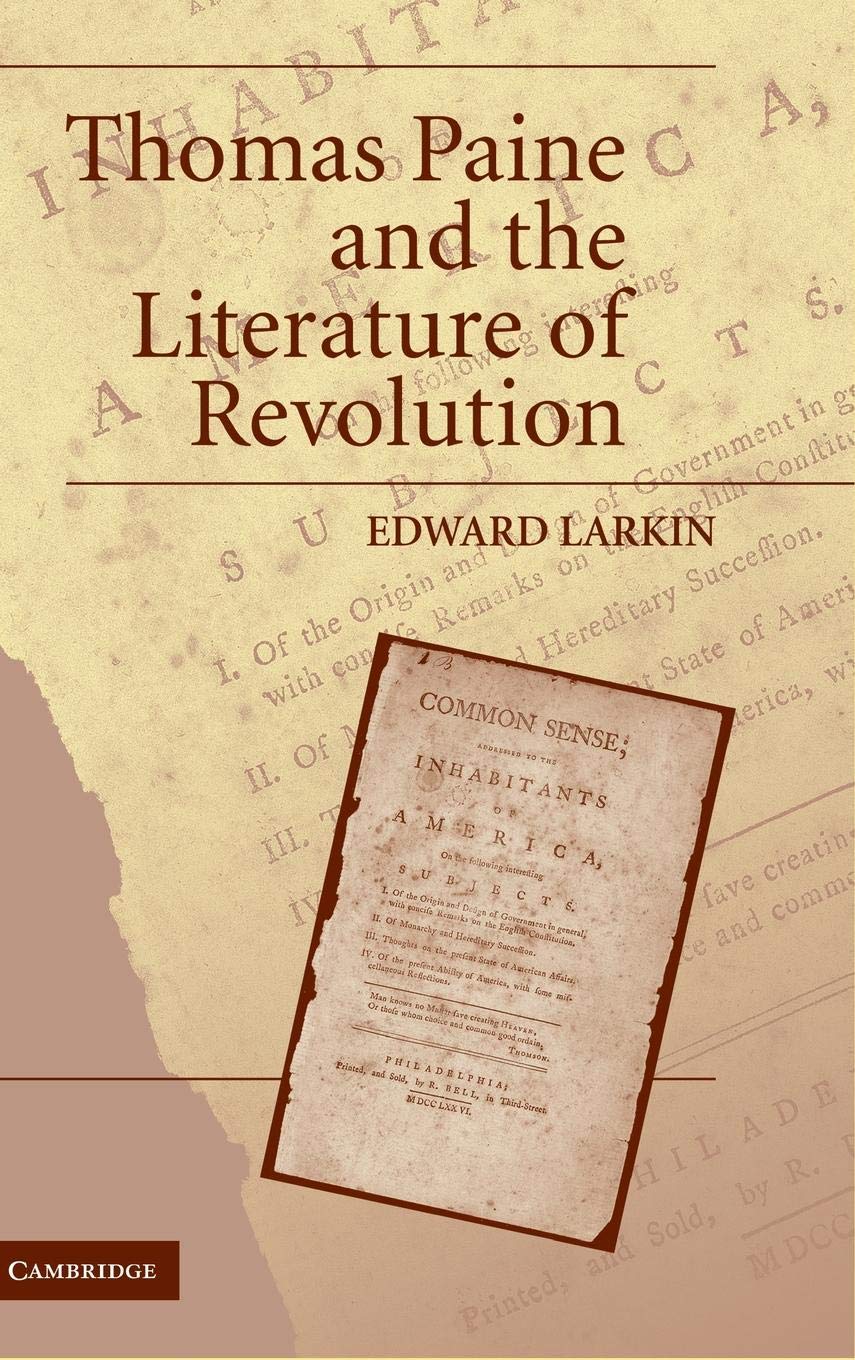
Thomas Paine and the Literature of Revolution by Edward Larkin: A Literary Analysis of Paine's Political Writings
Inclusive of all applicable taxes. FREE shipping on all orders.
Available Offers
- 🚚Free Delivery — Free shipping on all orders
- 💵Cash on Delivery — Pay when your order arrives
- ↩️15-Day Easy Returns — Hassle-free return policy
- 🔒Cash on Delivery — Pay safely when your order arrives
Check Delivery
Product Description
Introduction
In the vast landscape of revolutionary thought, few figures have stirred as much debate as Thomas Paine. While historians and political scientists have long acknowledged his role in shaping the American and French Revolutions, his literary genius has often been overlooked. Thomas Paine and the Literature of Revolution by Edward Larkin offers a refreshing and rigorous examination of Paine as a literary figure, revealing how his mastery of language made radical ideas accessible to the common citizen. This hardcover edition from Cambridge University Press is an essential read for Indian students and scholars eager to understand the intersection of literature, politics, and popular mobilization in the eighteenth century.
Book Overview
Edward Larkin’s work challenges the conventional view that Paine was merely a propagandist or a political pamphleteer. Instead, the book positions Paine as a transatlantic popular intellectual who translated complex political theories into a language that resonated with ordinary people in America and Europe. By analyzing texts like Common Sense and The Rights of Man, Larkin demonstrates that Paine’s literary sensibility was not separate from his political impact but integral to it. The book argues that Paine’s ability to connect with the masses—far from diminishing his intellectual stature—marks him as a uniquely effective writer who democratized political discourse. This is a vital resource for anyone interested in how literature can shape revolutionary change.
Key Highlights
- Original Perspective: Breaks new ground by treating Paine as a literary figure rather than solely a political theorist or historian’s subject.
- Transatlantic Focus: Explores Paine’s influence on both sides of the Atlantic, making it relevant for comparative studies.
- Accessible Analysis: Written in clear, engaging prose suitable for advanced undergraduates and general readers alike.
- Scholarly Rigor: Published by Cambridge University Press, ensuring academic credibility and depth.
- Hardcover Quality: A durable edition perfect for library collections and long-term reference.
Inside the Book
The book is structured to guide readers through Paine’s literary evolution. Larkin begins by contextualizing Paine’s early writings and his rise as a popular author. Subsequent chapters dissect key works, examining their rhetorical strategies, use of biblical and classical references, and appeal to diverse audiences. The author also addresses the criticism that Paine was a mere propagandist, turning this dismissal on its head by showing how his “propaganda” was a sophisticated literary craft. The final sections explore Paine’s legacy and his continued relevance in contemporary discussions about democracy, media, and public intellectualism. Each chapter is rich with textual analysis and historical context, making the book both informative and thought-provoking.
Key Topics
- Thomas Paine as a literary figure and public intellectual
- The rhetoric of revolution in Common Sense and The Rights of Man
- Transatlantic literary and political exchanges in the eighteenth century
- Language, class, and the democratization of political ideas
- Paine’s influence on American and French revolutionary thought
- The relationship between popular literature and political change
Reader Benefits
This book offers Indian readers a unique lens to understand how revolutionary ideas travel across cultures and languages. For students of English literature, it provides a model for analyzing political texts as literary works. For history and political science students, it deepens the understanding of Paine’s methods and impact. The book also encourages critical thinking about the role of accessible writing in social movements—a lesson highly relevant in today’s media-saturated world. By reading this work, you will gain a more nuanced appreciation of how language can empower ordinary citizens to challenge authority and imagine new forms of governance.
Learning Outcomes
- Understand Thomas Paine’s literary techniques and their political significance
- Analyze the rhetorical strategies that made revolutionary ideas accessible
- Compare transatlantic literary and political cultures of the eighteenth century
- Evaluate the relationship between popular literature and democratic movements
- Critique the dismissal of Paine as a mere propagandist through textual evidence
- Apply insights to contemporary discussions on media, rhetoric, and public discourse
Who Should Read
This book is ideal for university students and researchers in English literature, history, political science, and cultural studies. It is also highly recommended for teachers designing courses on the Enlightenment, revolutions, or the history of political writing. General readers with an interest in the American Revolution, Thomas Paine, or the power of persuasive writing will find it equally rewarding. The book’s accessible style makes it suitable for advanced undergraduates, while its scholarly depth ensures it remains valuable for postgraduates and academics. Indian readers curious about how Western revolutionary ideas were shaped and spread will find this a compelling addition to their library.
About the Author
Edward Larkin is a respected scholar of early American literature and culture. He has taught at several leading universities and published extensively on the intersections of literature, politics, and public life in the eighteenth century. His research focuses on how writers like Paine, Franklin, and others used the printed word to shape democratic consciousness. Larkin’s work is known for its clarity, originality, and ability to bridge the gap between literary analysis and historical context. In Thomas Paine and the Literature of Revolution, he brings his expertise to bear on one of the most misunderstood yet influential writers of the revolutionary era.
About the Publisher
Cambridge University Press is one of the world’s oldest and most prestigious academic publishers. Founded in 1534, it has a long tradition of publishing groundbreaking works in the humanities, social sciences, and sciences. This hardcover edition reflects the Press’s commitment to high-quality scholarship and durable production standards. For Indian readers and institutions, Cambridge University Press books are a trusted source of rigorous, well-researched content that supports academic excellence and intellectual growth.
Conclusion
Thomas Paine and the Literature of Revolution is more than a study of one man’s writings—it is an exploration of how language can ignite change. Edward Larkin’s insightful analysis restores Thomas Paine to his rightful place as a literary innovator and a transatlantic intellectual who spoke to the common person. Whether you are a student, teacher, or curious reader, this book will deepen your understanding of the power of words in times of upheaval. Add this hardcover edition to your collection and discover the literary genius behind the revolutionary pen.
Quick Summary
'Thomas Paine and the Literature of Revolution' by Edward Larkin is a groundbreaking academic work that repositions Thomas Paine as a literary figure of the first order. Published by Cambridge University Press, this hardcover volume argues that Paine's political writings—most notably Common Sense and The Rights of Man—are not mere propaganda but carefully crafted literary texts that employ sophisticated rhetorical strategies. Larkin, a professor at the University of Delaware, demonstrates how Paine translated complex enlightenment theories into accessible language for a broad audience, thereby creating a new model of popular intellectual engagement. The book explores Paine's transatlantic perspective, his use of narrative voice, and his ability to bridge the gap between elite philosophy and grassroots political action. This study is ideal for Indian postgraduate students and scholars of American literature, political theory, and revolutionary history. Readers will gain a richer understanding of how literary form shapes political impact. By purchasing from Bookshops.in, you support a trusted Indian bookstore that offers genuine imported editions and reliable delivery across India.
Book Highlights
Book Specifications
| ISBN-13 | 9780521841153 |
| ISBN-10 | 0521841151 |
| Publisher | Cambridge University Press |
| Language | English |
| Dimensions | 15.24 x 1.91 x 22.23 cm |
| Weight | 490 g |
| Country | India |
| Category | Americas › United States |
| Genre | Literary Criticism |
| Original Language | English |
Frequently Asked Questions
What is 'Thomas Paine and the Literature of Revolution' about?
Who is the author of this book?
Is this book suitable for undergraduate students?
Does the book cover Common Sense and Rights of Man?
What makes this book different from other studies of Thomas Paine?
Can this book help with Indian university exams?
Is the book written in complex academic language?
Does the book include a bibliography?
Is this book available in paperback?
How is the book relevant to Indian readers?
Does the book compare Paine to other writers?
Where can I buy this book in India?
Readers Also Search For
Related Products
View All
History
The Information Revolution: Transforming the World Through Technology (World History)
History
Human Nature and the French Revolution: From the Enlightenment to the Napoleonic Code: 3 (Polygons: Cultural Diversities and Intersections, 3)
History
The Unmaking of Home in Contemporary Art (Cultural Spaces)

History
Handbook to Life in Medieval and Early Modern Japan | by William E. Deal | Oxford University Press | by William E. Deal | Oxford University Press | by William E. Deal | Oxford University Press | by William E. Deal | Oxford University Press | by William E. Deal | Oxford University Press | by William E. Deal | Oxford University Press | by William E. Deal | Oxford University Press | by William E. Deal | Oxford University Press | by William E. Deal | Oxford University Press | by William E. Deal | Ox

History
The Narrators of Barbarian History (A.D. 550-800) | by Walter Goffart | University of Notre Dame Press | by Walter Goffart | University of Notre Dame Press | by Walter Goffart | University of Notre Dame Press | by Walter Goffart | University of Notre Dame Press | by Walter Goffart | University of Notre Dame Press | by Walter Goffart | University of Notre Dame Press | by Walter Goffart | University of Notre Dame Press | by Walter Goffart | University of Notre Dame Press | by Walter Goffart | Univ
History