
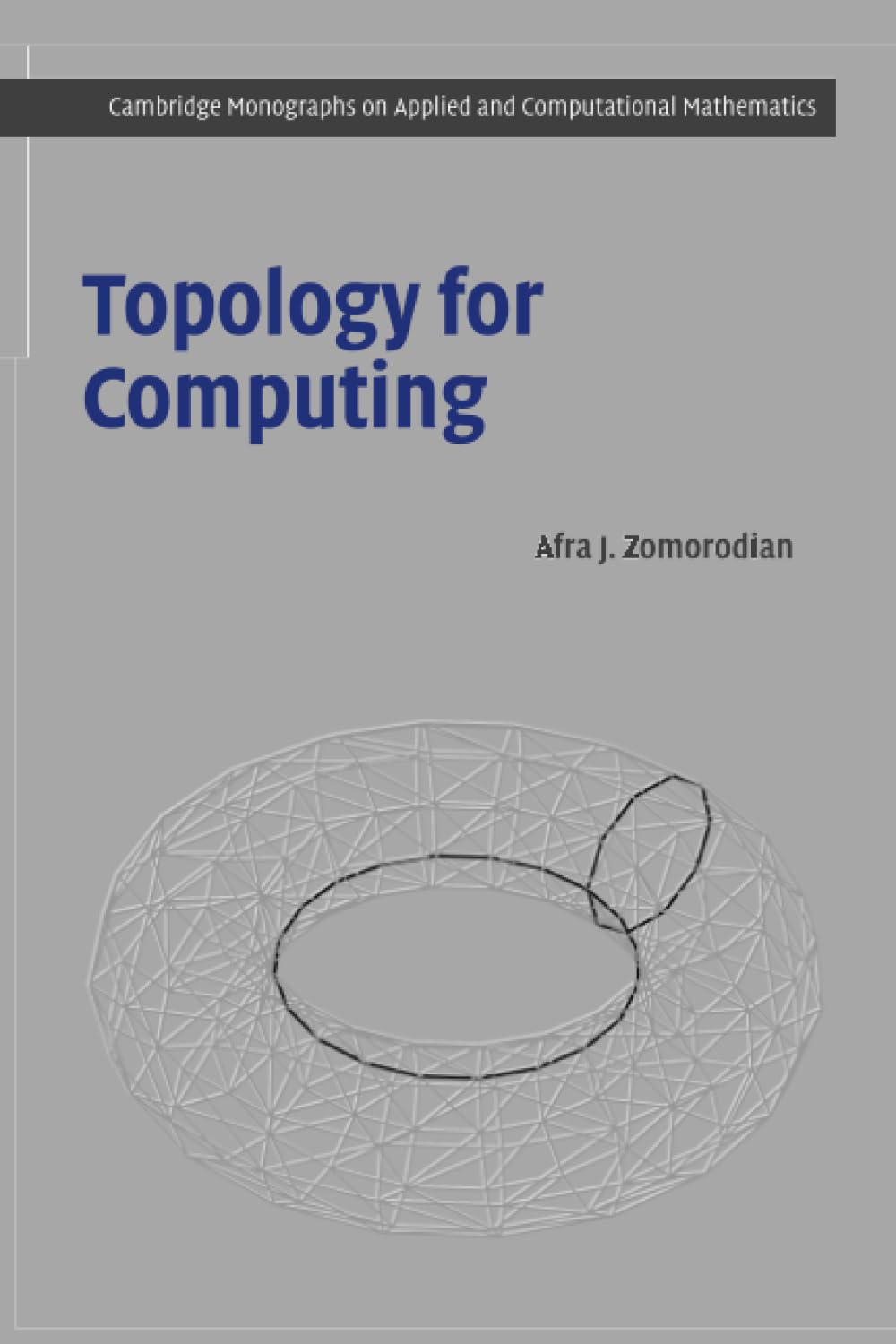
Topology for Computing: A Self-Contained Introduction to Computational Topology by Afra J. Zomorodian
Inclusive of all applicable taxes. FREE shipping on all orders.
Available Offers
- 🚚Free Delivery — Free shipping on all orders
- 💵Cash on Delivery — Pay when your order arrives
- ↩️15-Day Easy Returns — Hassle-free return policy
- 🔒Cash on Delivery — Pay safely when your order arrives
Check Delivery
Product Description
Introduction
Topology for Computing by Afra J. Zomorodian bridges the gap between abstract mathematical concepts and practical computational applications. This hardcover edition from Cambridge University Press is a definitive resource for Indian students, researchers, and professionals seeking to understand how topology drives modern algorithms in computer graphics, computer-aided design, and structural biology. The book presents complex ideas in a clear, self-contained manner, making it accessible even to those with a computer science background rather than a pure mathematics one.
Book Overview
This volume offers a comprehensive introduction to computational topology, a field that uses topological theory alongside computational methods to solve real-world problems involving shape analysis. Zomorodian combines point set topology, algebraic topology, group theory, differential manifolds, and Morse theory into a single coherent narrative. The focus is always on computational challenges, algorithms, and data structures, ensuring readers can immediately apply the concepts to their own work. The book also covers recent advances like topological persistence and hierarchical Morse complexes, making it highly relevant for current research.
Key Highlights
- Self-contained presentation of topology from a computer scientist’s perspective
- Integration of theory and practice with algorithms and data structures throughout
- Coverage of cutting-edge topics including topological persistence and Morse complexes
- Real-world applications in computer graphics, CAD, and structural biology
- Hardcover edition from Cambridge University Press, ideal for academic libraries and personal collections
Inside the Book
The book systematically introduces foundational concepts before moving to advanced topics. Early chapters cover point set topology and algebraic topology, building a strong base. Later chapters delve into group theory and differential manifolds, culminating in Morse theory and its computational implementations. Each concept is explained with algorithms, pseudocode, and data structure discussions, ensuring readers can translate theory into working code. The final chapters explore recent developments, including algorithms for computing topological persistence and constructing hierarchical Morse complexes.
Key Topics
- Point set topology and continuity
- Algebraic topology including homology and cohomology
- Group theory and its role in topological analysis
- Differential manifolds and smooth structures
- Morse theory and its computational aspects
- Topological persistence for data analysis
- Hierarchical Morse complexes for shape understanding
Reader Benefits
- Gain a solid foundation in topology without needing a mathematics degree
- Learn to implement algorithms for shape analysis and computational geometry
- Understand cutting-edge research in computational topology
- Apply concepts to computer graphics, CAD, and structural biology projects
- Save time with a single book covering theory, algorithms, and applications
Learning Outcomes
By the end of this book, readers will be able to understand and apply key topological concepts to computational problems. They will develop the ability to design algorithms for analyzing shapes, compute topological invariants like homology groups, and implement Morse theory-based techniques for feature extraction. Readers will also gain familiarity with persistent homology and its use in data analysis, preparing them for advanced research or industry roles in areas such as geometric modeling, visualization, and scientific computing.
Who Should Read
- Computer science students interested in computational geometry and graphics
- Mathematics students wanting to apply topology to computing
- Researchers in computer graphics, CAD, and structural biology
- Software engineers working on shape analysis or visualization tools
- Data scientists exploring topological data analysis
About the Author
Afra J. Zomorodian is a renowned computer scientist and mathematician known for his pioneering work in computational topology. He has held academic positions at Dartmouth College and other leading institutions, and his research has significantly advanced the field. His ability to explain complex mathematical ideas in an accessible way makes this book a classic in the domain.
About the Publisher
Cambridge University Press is one of the oldest and most respected academic publishers in the world. With a history spanning over four centuries, they are known for producing high-quality scholarly works. This hardcover edition reflects their commitment to excellence, with durable binding and clear typesetting suitable for intensive study.
Conclusion
Topology for Computing is an essential addition to the library of anyone serious about understanding the intersection of topology and computation. Whether you are a student, researcher, or practitioner, this book provides the tools and knowledge to tackle complex shape-related problems. Order your copy today from Bookshops.in and embark on a journey into the fascinating world of computational topology.
Quick Summary
Topology for Computing by Afra J. Zomorodian is a self-contained introduction to computational topology designed for computer scientists and mathematicians. The book covers essential concepts from point set topology, algebraic topology, group theory, differential manifolds, and Morse theory, all presented from a computational perspective. Readers will learn how to apply topological methods to understand the intrinsic shape of spaces, with applications in computer graphics, computer-aided design, and structural biology. The author also discusses recent advances like persistent homology, making this a valuable resource for graduate students and researchers. By bridging pure mathematics and practical computing, this book empowers readers to solve complex problems in shape analysis and data topology. Buying from Bookshops.in ensures you receive a genuine hardcover edition with reliable delivery across India.
Book Highlights
Book Specifications
| ISBN-13 | 9780521136099 |
| ISBN-10 | 0521136091 |
| Publisher | Cambridge University Press |
| Language | English |
| Dimensions | 15.24 x 1.65 x 22.86 cm |
| Weight | 360 g |
| Country | India |
| Category | Programming & Software Development › Graphics & Multimedia |
| Genre | Science & Mathematics |
| Original Language | English |
Frequently Asked Questions
What is Topology for Computing about?
Who is the author of this book?
Do I need a strong math background to read this book?
Is this book suitable for Indian students?
What topics are covered in the book?
Does the book include applications?
Is this a textbook or a reference?
What is the ISBN-13?
Is the book available in hardcover?
Can I use this book for self-study?
What makes this book different from other topology books?
Does the book cover persistent homology?
Where can I buy this book in India?
Readers Also Search For
Customers Also Bought

Programming
Algorithmische Sprache Und Programmentwicklung | by H. Partsch | F. L. Bauer | P. Pepper | Springer | by H. Partsch | F. L. Bauer | P. Pepper | Springer | by H. Partsch | F. L. Bauer | P. Pepper | Springer | by H. Partsch | F. L. Bauer | P. Pepper | Springer | by H. Partsch | F. L. Bauer | P. Pepper | Springer | by H. Partsch | F. L. Bauer | P. Pepper | Springer | by H. Partsch | F. L. Bauer | P. Pepper | Springer | by H. Partsch | F. L. Bauer | P. Pepper | Springer | by H. Partsch | F. L. Bauer
Programming
Distributed Algorithms | by Jean-Claude Bermond | Michel Raynal | Springer | by Jean-Claude Bermond | Michel Raynal | Springer | by Jean-Claude Bermond | Michel Raynal | Springer | by Jean-Claude Bermond | Michel Raynal | Springer | by Jean-Claude Bermond | Michel Raynal | Springer | by Jean-Claude Bermond | Michel Raynal | Springer | by Jean-Claude Bermond | Michel Raynal | Springer | by Jean-Claude Bermond | Michel Raynal | Springer | by Jean-Claude Bermond | Michel Raynal | Springer | by Jean

Programming
Meta-Level Control for Deductive Database Systems | by Helmut Schmidt | Springer | by Helmut Schmidt | Springer | by Helmut Schmidt | Springer | by Helmut Schmidt | Springer | by Helmut Schmidt | Springer | by Helmut Schmidt | Springer | by Helmut Schmidt | Springer | by Helmut Schmidt | Springer | by Helmut Schmidt | Springer | by Helmut Schmidt | Springer | by Helmut Schmidt | Springer | by Helmut Schmidt | Springer | by Helmut Schmidt | Springer | by Helmut Schmidt | Springer | by Helmut Schm

Programming
Java Web Services | by David A. Chappell | Tyler Jewell | O'Reilly Media | by David A. Chappell | Tyler Jewell | O'Reilly Media | by David A. Chappell | Tyler Jewell | O'Reilly Media | by David A. Chappell | Tyler Jewell | O'Reilly Media | by David A. Chappell | Tyler Jewell | O'Reilly Media | by David A. Chappell | Tyler Jewell | O'Reilly Media | by David A. Chappell | Tyler Jewell | O'Reilly Media | by David A. Chappell | Tyler Jewell | O'Reilly Media | by David A. Chappell | Tyler Jewell | O'
Programming
Database in Depth | by Chris J. Date | O'Reilly Media | by Chris J. Date | O'Reilly Media | by Chris J. Date | O'Reilly Media | by Chris J. Date | O'Reilly Media | by Chris J. Date | O'Reilly Media | by Chris J. Date | O'Reilly Media | by Chris J. Date | O'Reilly Media | by Chris J. Date | O'Reilly Media | by Chris J. Date | O'Reilly Media | by Chris J. Date | O'Reilly Media | by Chris J. Date | O'Reilly Media | by Chris J. Date | O'Reilly Media | by Chris J. Date | O'Reilly Media | by Chris J.

Programming
Integration of AI and OR Techniques in Constraint Programming for Combinatorial Optimization Problem | by Nicolas Beldiceanu | Narendra Jussien | Eric Pinson | Springer | by Nicolas Beldiceanu | Narendra Jussien | Eric Pinson | Springer | by Nicolas Beldiceanu | Narendra Jussien | Eric Pinson | Springer | by Nicolas Beldiceanu | Narendra Jussien | Eric Pinson | Springer | by Nicolas Beldiceanu | Narendra Jussien | Eric Pinson | Springer | by Nicolas Beldiceanu | Narendra Jussien | Eric Pinson |
Related Products
View All
Computers & Internet
Modern Full-Stack React Projects by Daniel Bugl

Computers & Internet
Mootools 1.2 Beginner's Guide (English, Jacob Gube)
Computers & Internet
Contemporary Methods for Speech Parameterization (Springerbriefs in Electrical and Computer Engineering / Springerbriefs in Speech Technology)

Computers & Internet
Information Technology and Lawyers | by Arno R. Lodder | Anja Oskamp | Springer | by Arno R. Lodder | Anja Oskamp | Springer | by Arno R. Lodder | Anja Oskamp | Springer | by Arno R. Lodder | Anja Oskamp | Springer | by Arno R. Lodder | Anja Oskamp | Springer | by Arno R. Lodder | Anja Oskamp | Springer | by Arno R. Lodder | Anja Oskamp | Springer | by Arno R. Lodder | Anja Oskamp | Springer | by Arno R. Lodder | Anja Oskamp | Springer | by Arno R. Lodder | Anja Oskamp | Springer | by Arno R. Lo

Computers & Internet
Digital Analysis of Remotely Sensed Imagery | by Jay Gao | McGraw-Hill Companies | by Jay Gao | McGraw-Hill Companies | by Jay Gao | McGraw-Hill Companies | by Jay Gao | McGraw-Hill Companies | by Jay Gao | McGraw-Hill Companies | by Jay Gao | McGraw-Hill Companies | by Jay Gao | McGraw-Hill Companies | by Jay Gao | McGraw-Hill Companies | by Jay Gao | McGraw-Hill Companies | by Jay Gao | McGraw-Hill Companies | by Jay Gao | McGraw-Hill Companies | by Jay Gao | McGraw-Hill Companies | by Jay Gao

Computers & Internet