
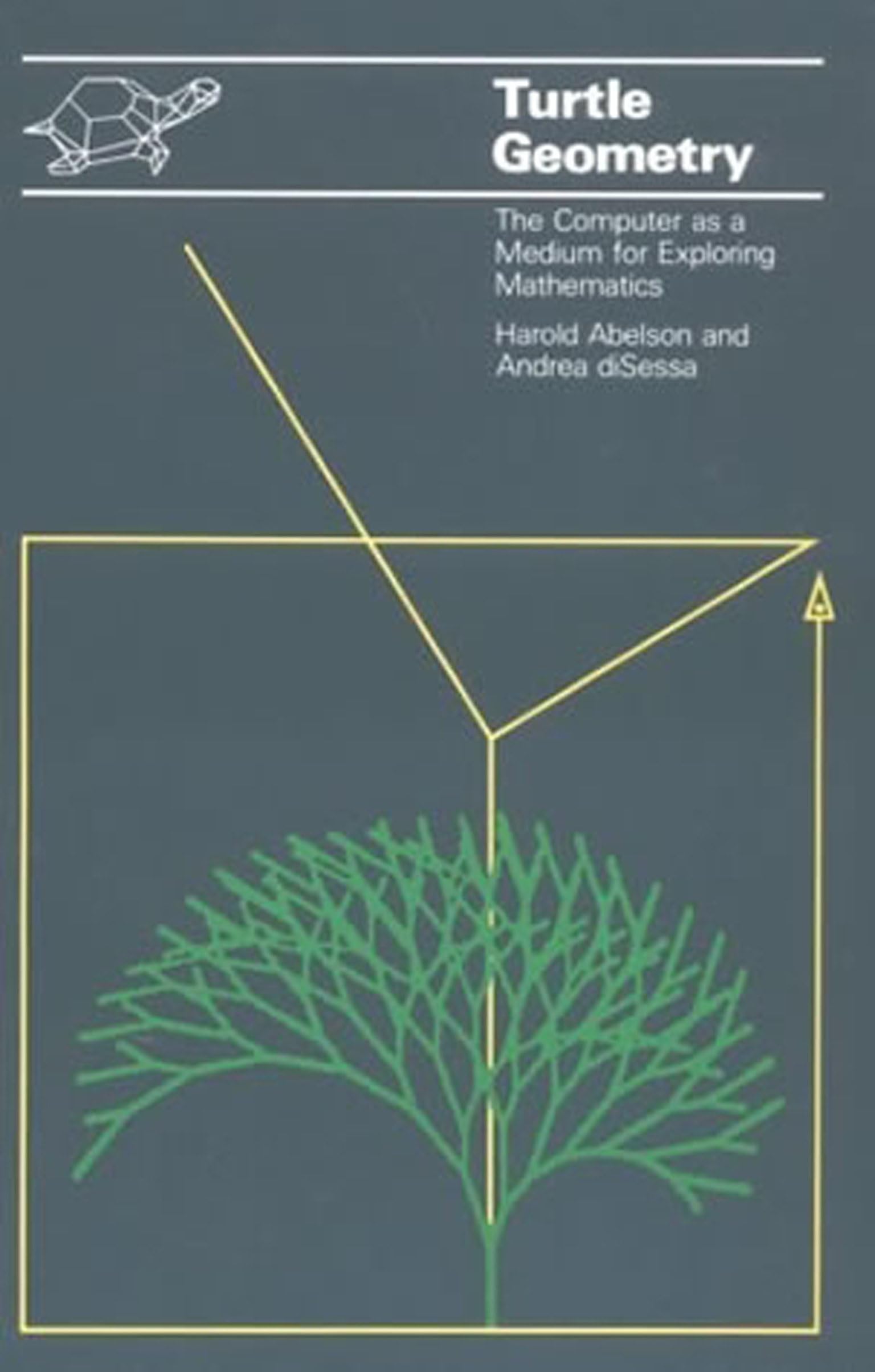
Turtle Geometry: The Computer As a Medium for Exploring Mathematics by Harold Abelson – A Classic MIT Press Book on Logo
Inclusive of all applicable taxes. FREE shipping on all orders.
Available Offers
- 🚚Free Delivery — Free shipping on all orders
- 💵Cash on Delivery — Pay when your order arrives
- ↩️15-Day Easy Returns — Hassle-free return policy
- 🔒Cash on Delivery — Pay safely when your order arrives
Check Delivery
Product Description
Introduction
In the world of mathematics education, few books have dared to reimagine how students engage with abstract concepts. Turtle Geometry: The Computer As a Medium for Exploring Mathematics, authored by Harold Abelson and published by MIT Press, stands as a landmark work that bridges the gap between computational thinking and geometric discovery. This hardcover edition invites Indian students, educators, and self-learners to embark on a journey where a simple on-screen turtle becomes a powerful guide through the landscapes of space, shape, and logic. Instead of memorizing formulas, readers learn to program the turtle's movements, turning mathematics into a hands-on, visual, and deeply intuitive experience.
Book Overview
Originally emerging from the pioneering Logo Group at MIT, this book presents a revolutionary approach to mathematics. It replaces passive learning with active exploration: you command a turtle to draw lines, curves, and complex patterns, and in doing so, you uncover the properties of Euclidean and non-Euclidean geometries. The text is designed for anyone with access to a computer and a curiosity about how programming can illuminate mathematical truths. From preschoolers to university students, the methods in this book have been tested across ages and abilities, proving that mathematics is not a spectator sport but a creative, iterative process of discovery.
Key Highlights
- Pioneering pedagogy: Introduces turtle geometry as a way to learn mathematics through programming, not rote memorization.
- Hands-on approach: Encourages readers to write simple programs that generate geometric figures, fostering deep understanding.
- Cross-disciplinary relevance: Connects computer science, geometry, and cognitive development in a single cohesive framework.
- Timeless concepts: The ideas remain relevant for modern coding education, robotics, and design thinking.
- MIT Press quality: A durable hardcover edition that is built for repeated reference and classroom use.
Inside the Book
The book is structured as a series of explorations rather than traditional chapters. Readers begin by controlling a turtle that moves forward, backward, and turns left or right. Through these simple commands, they learn to draw squares, triangles, and spirals. Gradually, the challenges become more sophisticated: creating polygonal stars, simulating planetary orbits, and even exploring the curvature of surfaces that bend like spheres or saddles. Each section includes exercises that prompt the reader to predict outcomes, debug programs, and reflect on the mathematics behind the screen. The text is rich with diagrams, code snippets, and thought experiments that make abstract ideas tangible.
Key Topics
- Fundamentals of turtle graphics and Logo programming
- Properties of polygons, circles, and regular tilings
- Vector geometry and coordinate systems
- Curvature and the geometry of surfaces
- Non-Euclidean geometries (spherical and hyperbolic)
- Fractals, recursive patterns, and self-similarity
- Motion, simulation, and the mathematics of change
Reader Benefits
This book empowers readers to become active creators of mathematical knowledge. By writing code to direct the turtle, you develop problem-solving skills, logical reasoning, and computational fluency. The visual feedback from the turtle's movements makes abstract concepts concrete, reducing the fear often associated with mathematics. For teachers, it offers a ready-made curriculum that integrates computer science into math lessons. For self-learners, it provides a structured yet open-ended path to mastery. The hardcover format ensures that this resource can be used in labs, libraries, and classrooms for years to come.
Learning Outcomes
- Ability to write simple programs that generate geometric shapes and patterns
- Deep understanding of angle, distance, and symmetry through direct manipulation
- Familiarity with the concept of curvature and its application to real-world surfaces
- Proficiency in debugging and iterative design—a core skill in both math and coding
- Enhanced spatial reasoning and visualization abilities
- Confidence to explore advanced topics like topology and non-Euclidean geometry
Who Should Read
Turtle Geometry is ideal for Indian students from Class 8 upward who want to go beyond textbook problems. It is equally valuable for teachers of mathematics and computer science seeking innovative classroom resources. Parents looking to introduce their children to computational thinking will find this book a gentle yet profound starting point. College undergraduates in mathematics, engineering, or design can use it to build a strong foundation in geometric reasoning. Anyone who has ever wondered how programming can reveal the hidden patterns of the universe will delight in these pages.
About the Author
Harold Abelson is a Professor of Electrical Engineering and Computer Science at the Massachusetts Institute of Technology (MIT). He is a co-author of the classic computer science text Structure and Interpretation of Computer Programs (SICP) and a leading figure in the movement to make computation accessible to all learners. His work at the MIT Media Lab and the Logo Group, directed by Seymour Papert, has influenced generations of educators and technologists. Abelson’s writing is known for its clarity, wit, and deep respect for the learner’s journey.
About the Publisher
MIT Press is one of the world’s most respected academic publishers, known for advancing knowledge in science, technology, and the humanities. Based at the Massachusetts Institute of Technology, it has a long tradition of publishing groundbreaking works that shape how we think about computation, education, and design. This hardcover edition reflects MIT Press’s commitment to producing durable, beautifully crafted books that stand the test of time and use.
Conclusion
Turtle Geometry: The Computer As a Medium for Exploring Mathematics is more than a book—it is an invitation to rethink what mathematics can be. By placing the learner in control of a tiny turtle, it transforms abstract theorems into living, moving creations. Whether you are a student in Mumbai, a teacher in Bengaluru, or a curious mind anywhere in India, this book will change the way you see both computers and geometry. Order your hardcover copy from Bookshops.in today and start your journey of discovery with every command you write.
Quick Summary
Turtle Geometry: The Computer As a Medium for Exploring Mathematics by Harold Abelson is a seminal work that redefines how mathematics can be taught and learned. Published by MIT Press, this hardcover book invites readers to use the Logo programming language to control a virtual turtle on screen, turning abstract geometric concepts into tangible, interactive experiences. Based on pioneering research by the Logo Group at MIT, including Seymour Papert, the book empowers students from high school to university level to discover mathematical truths through programming. Readers will learn to think computationally, solve spatial problems, and build a deep intuition for geometry. This book is perfect for Indian students, educators, and self-learners who want a hands-on, engaging approach to math. By purchasing from Bookshops.in, you get a genuine, high-quality edition delivered to your doorstep, ensuring a lasting resource for your educational journey.
Book Highlights
Book Specifications
| ISBN-13 | 9780262510370 |
| ISBN-10 | 0262510375 |
| Publisher | Mit Pr |
| Language | English |
| Dimensions | 15.24 x 2.87 x 22.86 cm |
| Weight | 794 g |
| Country | India |
| Category | Mathematics › Geometry |
| Genre | Non-fiction |
| Original Language | English |
Frequently Asked Questions
What is Turtle Geometry about?
Who is the author of Turtle Geometry?
Do I need prior programming experience to use this book?
Is this book suitable for Indian school students?
What is the Logo programming language?
How is this book different from a regular math textbook?
Can I use this book without a computer?
What age group is this book for?
Does the book cover advanced geometry?
Is this a hardcover edition?
What is the ISBN of this book?
Why should I buy this book from Bookshops.in?
Is there a digital version of this book?
Readers Also Search For
Customers Also Bought
Mathematics
Stereotype Spaces and Algebras: 73 (De Gruyter Expositions in Mathematics, 73)
Mathematics
Semigroups in Algebra, Geometry and Analysis: 20 (De Gruyter Expositions in Mathematics, 20)
Mathematics
Geometry from the Pacific Rim: Proceedings of the Pacific Rim Geometry Conference held at National University of Singapore, Republic of Singapore, ... 1994 (De Gruyter Proceedings in Mathematics)
Mathematics
First International Tainan-Moscow Algebra Workshop: Proceedings of the International Conference held at National Cheng Kung University Tainan, Taiwan, ... 1994 (De Gruyter Proceedings in Mathematics)
Mathematics
Differential Geometry - Proceedings of the VIII International Colloquium (English, Jesus A. Alvarez Lopez | Eduardo Garcia-Rio)
Mathematics
Mathematical Theory of Optimal Processes (Classics of Soviet Mathematics)
Related Products
View AllMathematics
Stereotype Spaces and Algebras: 73 (De Gruyter Expositions in Mathematics, 73)
Mathematics
Semigroups in Algebra, Geometry and Analysis: 20 (De Gruyter Expositions in Mathematics, 20)
Mathematics
Geometry from the Pacific Rim: Proceedings of the Pacific Rim Geometry Conference held at National University of Singapore, Republic of Singapore, ... 1994 (De Gruyter Proceedings in Mathematics)
Mathematics
First International Tainan-Moscow Algebra Workshop: Proceedings of the International Conference held at National Cheng Kung University Tainan, Taiwan, ... 1994 (De Gruyter Proceedings in Mathematics)
Mathematics
Differential Geometry - Proceedings of the VIII International Colloquium (English, Jesus A. Alvarez Lopez | Eduardo Garcia-Rio)
Mathematics