
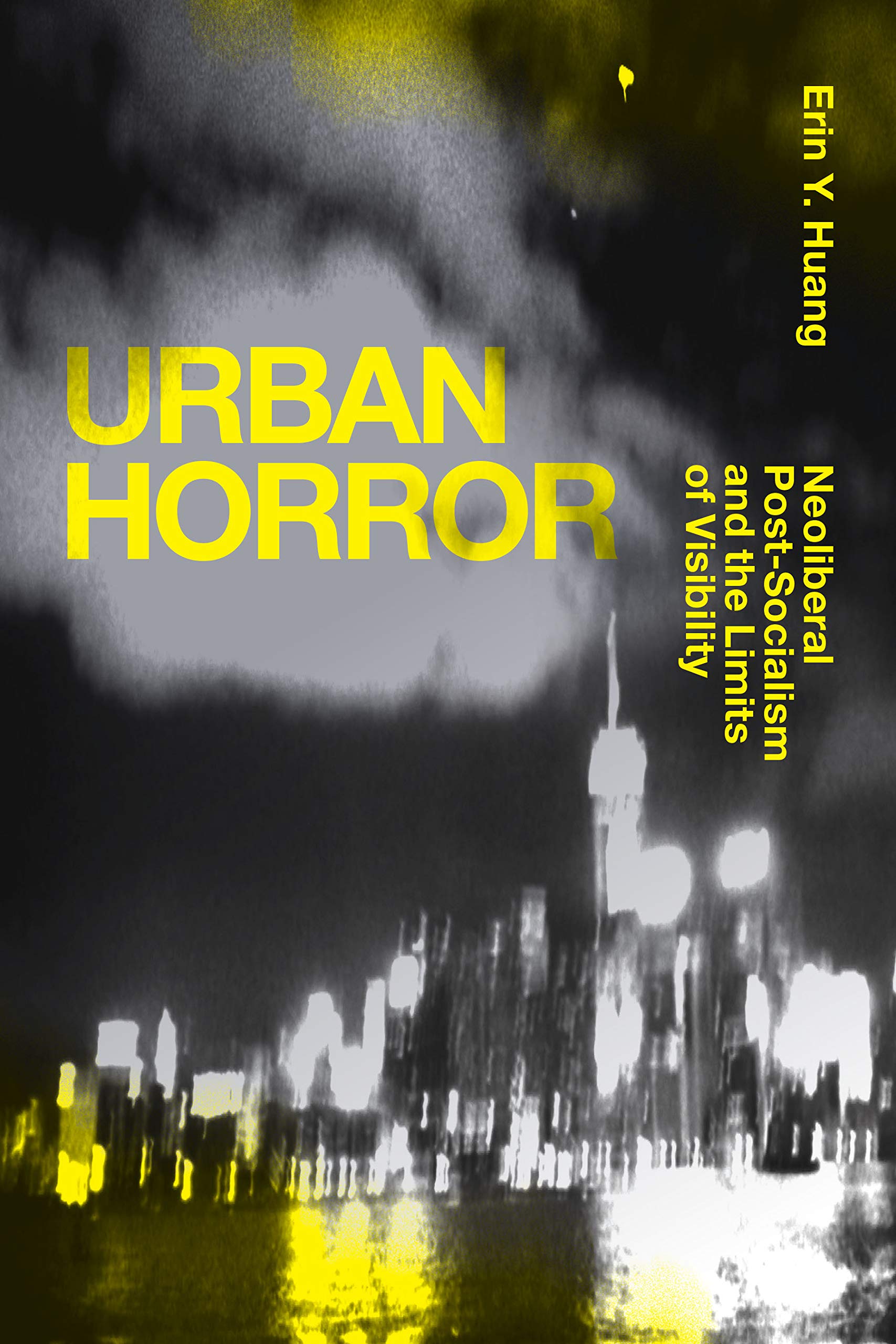
Urban Horror: Neoliberal Post-Socialism and the Limits of Visibility by Erin Y. Huang – A Study of Chinese Cinema and Ur
Inclusive of all applicable taxes. FREE shipping on all orders.
Available Offers
- 🚚Free Delivery — Free shipping on all orders
- 💵Cash on Delivery — Pay when your order arrives
- ↩️15-Day Easy Returns — Hassle-free return policy
- 🔒Cash on Delivery — Pay safely when your order arrives
Check Delivery
Product Description
Introduction
In an era where urban landscapes are rapidly transformed by market forces, Urban Horror: Neoliberal Post-Socialism and the Limits of Visibility offers a profound and unsettling examination of life in contemporary Chinese cities. Authored by Erin Y. Huang, this hardcover volume from Duke University Press challenges readers to see beyond the gleaming skyscrapers and economic success stories, revealing the hidden anxieties, spatial dislocations, and political tensions that define the post-socialist urban experience. This is not merely a work of film criticism; it is a bold theoretical intervention that bridges Marxist phenomenology, geography, and aesthetics to articulate a new public affect—urban horror.
Book Overview
Urban Horror is a rigorous academic study that explores how cinema and video art from China, Hong Kong, and Taiwan (1990s to present) give form to the psychological and material disruptions of neoliberal urbanism. Huang argues that the city itself becomes a site of speculative crises, shifting temporalities, and dystopian environments that are inhospitable to the human body. Through close readings of documentaries, blockbuster films, and experimental video works, she demonstrates how these visual narratives rehearse and communicate a collective feeling of dread that exceeds rational comprehension. This affect, she contends, contains the seeds of future revolutionary dissent. The book is essential reading for anyone interested in contemporary Chinese culture, urban theory, or the politics of visual media.
Key Highlights
- Original Theoretical Framework: Introduces the concept of 'urban horror' as a sociopolitical affect specific to neoliberal post-socialist China.
- Interdisciplinary Approach: Weaves together Marxist phenomenology, geography, and aesthetics, drawing on thinkers from Engels and Merleau-Ponty to Lefebvre and Rancière.
- Rich Media Analysis: Examines a wide range of visual works, from independent documentaries to mainstream cinema and cutting-edge video art.
- Transregional Scope: Covers films and art from mainland China, Hong Kong, and Taiwan, highlighting shared yet distinct experiences of urban transformation.
- Critical Engagement with Neoliberalism: Offers a sharp critique of how market reforms reshape space, time, and human subjectivity.
Inside the Book
The book is organized around the cinematic and artistic mediation of urban horror. Huang dissects how the camera lens captures the creation of speculative crises—real estate bubbles, labor precarity, environmental degradation—and translates them into visceral images. She explores how shifting temporalities in film (e.g., nonlinear narratives, ghostly returns) mirror the disorienting pace of urban development. The analysis extends to dystopic environments, such as abandoned factories, overcrowded apartments, and polluted landscapes, which become stages for human vulnerability. Throughout, Huang insists that these aesthetic choices are not merely artistic but are political acts that make visible what neoliberal ideology tries to hide: the limits of visibility itself.
Key Topics
- Urban horror as a public affect
- Neoliberal post-socialism in China
- Marxist phenomenology and geography
- Cinematic aesthetics of crisis and dystopia
- Space, time, and the human body in the city
- Documentary, blockbuster, and video art practices
- Revolutionary potential in contemporary visual culture
Reader Benefits
- Gain a sophisticated understanding of how urban life under neoliberalism produces new forms of anxiety and resistance.
- Learn to read films and visual art as critical documents of social and political change.
- Develop a vocabulary for discussing the emotional and sensory dimensions of urban transformation.
- Connect abstract theory (Marxism, phenomenology) to concrete cultural examples.
- Access a unique perspective that bridges Chinese, Hong Kong, and Taiwanese cultural production.
Learning Outcomes
- Define and apply the concept of 'urban horror' to contemporary visual media.
- Analyze how film and video art reflect and critique neoliberal spatial politics.
- Identify key aesthetic strategies used to convey temporal dislocation and bodily precarity.
- Evaluate the relationship between visibility, power, and resistance in post-socialist contexts.
- Articulate the political stakes of representing urban crisis in the 21st century.
Who Should Read
This book is ideal for graduate students and scholars in film studies, cultural theory, urban geography, Chinese studies, and political philosophy. It will also appeal to artists, curators, and filmmakers interested in the politics of space and representation. For Indian readers engaged with comparative urbanisms or the cultural impacts of neoliberalism, Urban Horror offers a powerful case study that resonates with global experiences of rapid development and social dislocation.
About the Author
Erin Y. Huang is a scholar of Chinese cinema, visual culture, and critical theory. Her work sits at the intersection of Marxist thought, phenomenology, and urban studies. She has published widely on the aesthetics of neoliberalism and the politics of visibility in East Asian media. Her research brings a sharp theoretical lens to contemporary cultural production, making her a leading voice in the field.
About the Publisher
Duke University Press is a prestigious academic publisher known for its groundbreaking titles in the humanities and social sciences. With a strong focus on critical theory, cultural studies, and global perspectives, Duke University Press consistently publishes works that challenge conventional thinking and push disciplinary boundaries. This hardcover edition reflects the high production standards and intellectual rigor for which the press is renowned.
Conclusion
Urban Horror: Neoliberal Post-Socialism and the Limits of Visibility is an indispensable book for anyone seeking to understand the dark underbelly of China's urban miracle. Erin Y. Huang's meticulous analysis and bold theoretical insights illuminate how cinema and art can capture the unspoken dread of a neoliberal age. By making visible what is often hidden, this work not only diagnoses our present but also points toward the political futures that might emerge from the ruins of the contemporary city. Add this essential volume to your library and see the urban landscape with new, critical eyes.
Quick Summary
Urban Horror: Neoliberal Post-Socialism and the Limits of Visibility by Erin Y. Huang is a groundbreaking academic work that theorizes the economic, cultural, and political conditions of neoliberal post-socialist China. Drawing on Marxist phenomenology, geography, and aesthetics—from Engels and Merleau-Ponty to Lefebvre and Rancière—Huang traces the emergence of 'urban horror,' a sociopolitical public affect that exceeds comprehension and provides grounds for future revolutionary dissent. The book examines how documentaries, blockbuster feature films, and video art from China, Hong Kong, and Taiwan (1990s–present) rehearse and communicate this affect through urban spaces marked by speculative crises, shifting temporalities, and dystopic environments. This book is ideal for scholars, graduate students, and advanced undergraduates in Chinese studies, film theory, urban geography, and critical theory. Readers will learn to connect cinematic aesthetics with political economy, understand the limits of visibility in contemporary Chinese media, and explore the revolutionary potential embedded in urban horror. Buy from Bookshops.in, India's premium online bookstore, for a reliable, high-quality hardcover edition.
Book Highlights
Book Specifications
| ISBN-13 | 9781478008095 |
| ISBN-10 | 1478008091 |
| Publisher | Duke University Press |
| Language | English |
| Dimensions | 15.24 x 1.65 x 22.86 cm |
| Weight | 424 g |
| Country | India |
| Category | Literature › Literary Theory |
| Genre | Academic / Critical Theory |
| Reading Age | Adult |
| Original Language | English |
Frequently Asked Questions
What is the main argument of Urban Horror?
Who is the author Erin Y. Huang?
Which theoretical frameworks does the book use?
What types of films are analyzed?
Is this book suitable for undergraduate students?
Does the book cover contemporary Chinese politics?
Which publisher released this book?
Is this book available in hardcover?
What is the price of Urban Horror in India?
Does the book include analysis of Hong Kong and Taiwan cinema?
What is the ISBN-13 for this book?
What is the primary keyword for this book?
Can I buy this book from Bookshops.in?
Readers Also Search For
Customers Also Bought
McFarland & Company
Playing with the Guys | by Marc A. Ouellette | Matthew Wilhelm Kapell | McFarland & Company | by Marc A. Ouellette | Matthew Wilhelm Kapell | McFarland & Company | by Marc A. Ouellette | Matthew Wilhelm Kapell | McFarland & Company | by Marc A. Ouellette | Matthew Wilhelm Kapell | McFarland & Company | by Marc A. Ouellette | Matthew Wilhelm Kapell | McFarland & Company | by Marc A. Ouellette | Matthew Wilhelm Kapell | McFarland & Company | by Marc A. Ouellette | Matthew W
Rowman & Littlefield Publishers
Joss Whedon's Dollhouse: Confounding Purpose, Confusing Identity (Science Fiction Television)
State University of New York Press
Mexico Unmanned: The Cultural Politics of Masculinity in Mexican Cinema (SUNY series in Latin American Cinema)

McFarland & Company
Valley Forge to Monmouth | by Jim Stempel | McFarland & Company | by Jim Stempel | McFarland & Company | by Jim Stempel | McFarland & Company | by Jim Stempel | McFarland & Company | by Jim Stempel | McFarland & Company | by Jim Stempel | McFarland & Company | by Jim Stempel | McFarland & Company | by Jim Stempel | McFarland & Company | by Jim Stempel | McFarland & Company | by Jim Stempel | McFarland & Company | by Jim Stempel | McFarland & Company |
University of Toronto Press
Structures of Feeling in Seventeenth-Century Cultural Expression (UCLA Center Clark Library)
McFarland & Company
Welcome to Arkham Asylum | by Sharon Packer | Daniel R. Fredrick | McFarland & Company | by Sharon Packer | Daniel R. Fredrick | McFarland & Company | by Sharon Packer | Daniel R. Fredrick | McFarland & Company | by Sharon Packer | Daniel R. Fredrick | McFarland & Company | by Sharon Packer | Daniel R. Fredrick | McFarland & Company | by Sharon Packer | Daniel R. Fredrick | McFarland & Company | by Sharon Packer | Daniel R. Fredrick | McFarland & Company | by Sharon P
Related Products
View All
Duke University Press
The Human in Bits: Graphical Computers, Black Abstractions
Duke University Press
Figures of Time: Affect and the Television of Preemption (Thought in the Act)
Duke University Press
Tourist Distractions: Traveling and Feeling in Transnational Hallyu Cinema by Youngmin Choe
Duke University Press
Partisan Canons (English, Anna Brzyski)
Duke University Press
Impersonal Passion (English, Denise Riley)
Duke University Press