
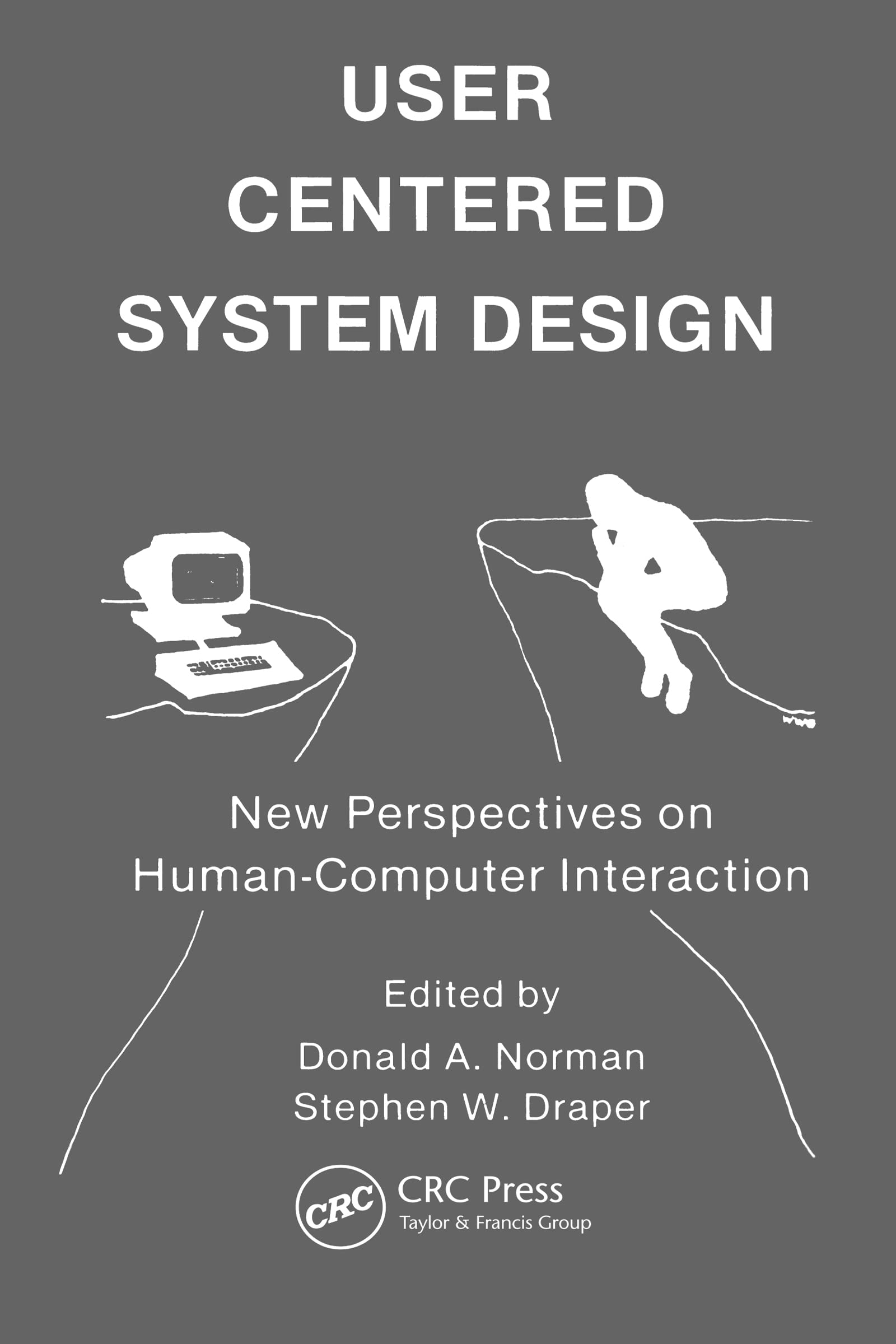
User Centered System Design: New Perspectives on Human-Computer Interaction by Donald A. Norman – A Landmark Work on Usa
Inclusive of all applicable taxes. FREE shipping on all orders.
Available Offers
- 🚚Free Delivery — Free shipping on all orders
- 💵Cash on Delivery — Pay when your order arrives
- ↩️15-Day Easy Returns — Hassle-free return policy
- 🔒Cash on Delivery — Pay safely when your order arrives
Check Delivery
Product Description
Introduction
In a world where technology increasingly shapes every facet of human life, understanding the intricate relationship between people and machines has never been more critical. User Centered System Design: New Perspectives on Human-Computer Interaction by Donald A. Norman offers a groundbreaking exploration of how design can bridge the gap between human cognition and digital systems. This hardcover edition, published by CRC Press, is a must-have for students, researchers, and professionals in India who seek to create intuitive, human-first technologies. It challenges traditional approaches and presents a fresh framework for thinking about usability, empathy, and interaction in the digital age.
Book Overview
This comprehensive volume is the result of a collaborative effort among leading researchers from the United States, Europe, and Japan. It brings together diverse perspectives to redefine how we approach human-computer interaction (HCI). Rather than treating users as passive operators, the book places them at the center of the design process, emphasizing cognitive psychology, ergonomics, and user experience. Through detailed case studies and theoretical insights, Norman and his contributors illustrate how system design can be transformed by understanding human needs, limitations, and behaviors. This is not a technical manual but a philosophical and practical guide to creating systems that adapt to people, not the other way around.
Key Highlights
- Pioneering Framework: Introduces the concept of user-centered design as a core principle for system development, long before it became an industry standard.
- Global Collaboration: Features contributions from top HCI researchers across three continents, offering a rich, multicultural perspective on design challenges.
- Cognitive Foundations: Explores how memory, attention, and decision-making influence human interaction with technology, grounded in real-world examples.
- Practical Relevance: Provides actionable insights for designers, engineers, and students who want to build systems that are both functional and humane.
Inside the Book
The book is structured into multiple chapters that delve into the theoretical and applied aspects of user-centered design. It begins by examining the historical evolution of HCI and the shift from machine-centric to human-centric models. Subsequent sections discuss mental models, error analysis, task analysis, and the role of feedback in interface design. Each chapter includes illustrative diagrams and thought-provoking discussions that encourage readers to question conventional design wisdom. The concluding chapters synthesize the research into a cohesive vision for future systems that prioritize user well-being and efficiency.
Key Topics
- Human Cognition and Technology: How cognitive processes like perception, memory, and learning shape interaction with computers.
- Designing for Error: Understanding and designing for human error as a natural part of system use.
- User-Centered Methods: Techniques such as user observation, iterative prototyping, and usability testing.
- Cross-Cultural Perspectives: Insights from Japanese, European, and American approaches to HCI.
- Future Directions: Emerging trends in adaptive systems, intelligent interfaces, and collaborative design.
Reader Benefits
By reading this book, you will gain a deep appreciation for the complexities of human-computer interaction and learn to think critically about the systems you use and build. It empowers you to advocate for users in design discussions and equips you with the vocabulary to articulate design challenges. Whether you are a student in India studying computer science, psychology, or design, or a seasoned professional, this book will enhance your ability to create products that are not only functional but also delightful and accessible. It fosters a mindset that values empathy, iteration, and continuous improvement.
Learning Outcomes
- Understand Core Principles: Grasp the fundamental concepts of user-centered design and their application in real-world scenarios.
- Analyze User Needs: Learn to conduct user research and translate findings into design requirements.
- Evaluate Interfaces: Develop skills to critique and improve existing systems based on cognitive ergonomics.
- Design with Empathy: Cultivate a user-first approach that reduces frustration and enhances satisfaction.
- Apply Cross-Disciplinary Knowledge: Integrate psychology, engineering, and design thinking into your projects.
Who Should Read
This book is ideal for undergraduate and postgraduate students in India pursuing degrees in human-computer interaction, user experience design, cognitive science, computer science, and information technology. It is also invaluable for practicing designers, software engineers, product managers, and researchers who want to deepen their understanding of how people interact with technology. Educators and trainers will find it a rich resource for designing courses on usability and system design. Anyone curious about why some technologies feel intuitive while others are frustrating will find profound answers within these pages.
About the Author
Donald A. Norman is a world-renowned cognitive scientist and usability engineer, often called the father of user-centered design. He is the author of classic books like The Design of Everyday Things and has held influential roles at Apple, Northwestern University, and the Nielsen Norman Group. His work has shaped how millions of people interact with technology, from smartphones to kitchen appliances. Norman's unique ability to blend rigorous research with accessible writing makes him a trusted voice in the field of HCI. In this volume, he brings together a global network of experts to push the boundaries of design thinking.
About the Publisher
CRC Press, an imprint of Taylor & Francis Group, is a leading publisher of scientific, technical, and medical content. With a legacy spanning over a century, CRC Press is known for its high-quality academic and professional books that serve researchers, students, and practitioners worldwide. This hardcover edition reflects their commitment to producing durable, authoritative works that stand the test of time. For Indian readers, CRC Press offers a gateway to cutting-edge knowledge in engineering, technology, and applied sciences.
Conclusion
User Centered System Design: New Perspectives on Human-Computer Interaction remains a seminal text that has lost none of its relevance. In an era of artificial intelligence, virtual reality, and ubiquitous computing, Norman's insights are more vital than ever. This book is not just a historical artifact but a living guide for anyone who wants to shape the future of technology with humanity at its core. Order your hardcover copy from Bookshops.in today and join the ranks of designers and thinkers who are redefining what it means to build for people.
Quick Summary
User Centered System Design: New Perspectives on Human-Computer Interaction by Donald A. Norman is a landmark text that redefined the field of human-computer interaction. Published in 1986 by CRC Press, this hardcover volume emerged from an intensive international collaboration among researchers in the United States, Europe, and Japan. The book argues for a fundamental shift in how we design technology—placing human needs, cognitive abilities, and tasks at the center of system development. Readers will explore cognitive psychology principles, usability evaluation methods, task analysis, and design strategies that accommodate human error and learning. This book is essential for Indian students and professionals in HCI, UX design, computer science, and cognitive science. It provides a deep theoretical foundation while offering practical insights that remain relevant decades later. By reading this work, you will understand the origins of user-centered design and how to create interfaces that are intuitive, efficient, and satisfying. Purchase this classic from Bookshops.in, India's trusted bookstore, and receive a genuine hardcover edition with prompt delivery.
Book Highlights
Book Specifications
| ISBN-13 | 9780898598728 |
| ISBN-10 | 0898598729 |
| Publisher | CRC Pr I Llc |
| Language | English |
| Dimensions | 15.19 x 3.1 x 22.91 cm |
| Weight | 885 g |
| Country | India |
| Category | Engineering Textbooks › Industrial Engineering |
| Genre | Non-fiction |
| Reading Age | Adult |
| Original Language | English |
Frequently Asked Questions
What is User Centered System Design about?
Who is the author of this book?
Is this book suitable for beginners in HCI?
What is the ISBN-13 for this book?
Is this book available in hardcover?
What language is the book written in?
Who should read this book?
What are the main topics covered?
Does this book include practical examples?
How is this book different from modern HCI textbooks?
Can I use this book for academic research?
What is the price of this book?
Why buy from Bookshops.in?
Readers Also Search For
Customers Also Bought

Art History
The Italian Renaissance in Art

Art History
Photovoltaic Design & Installation For Dummies | by Mayfield | ForDummies | by Mayfield | ForDummies | by Mayfield | ForDummies | by Mayfield | ForDummies | by Mayfield | ForDummies | by Mayfield | ForDummies | by Mayfield | ForDummies | by Mayfield | ForDummies | by Mayfield | ForDummies | by Mayfield | ForDummies | by Mayfield | ForDummies | by Mayfield | ForDummies | by Mayfield | ForDummies | by Mayfield | ForDummies | by Mayfield | ForDummies | by Mayfield | ForDummies | by Mayfield | ForDu
Art History
Designing School Systems for All Students (English, Robert J. Manley | Richard J. Hawkins)

Art History
Routledge Library Editions: Art and Culture in the Nineteenth Century
Art History
An Errant Design (English, S. H. Long)
Art History
Distributed System Design | by Jie Wu | CRC Press | by Jie Wu | CRC Press | by Jie Wu | CRC Press | by Jie Wu | CRC Press | by Jie Wu | CRC Press | by Jie Wu | CRC Press | by Jie Wu | CRC Press | by Jie Wu | CRC Press | by Jie Wu | CRC Press | by Jie Wu | CRC Press | by Jie Wu | CRC Press | by Jie Wu | CRC Press | by Jie Wu | CRC Press | by Jie Wu | CRC Press | by Jie Wu | CRC Press | by Jie Wu | CRC Press | by Jie Wu | CRC Press | by Jie Wu | CRC Press | by Jie Wu | CRC Press | by Jie Wu | CRC
Related Products
View AllArt History
Distributed System Design | by Jie Wu | CRC Press | by Jie Wu | CRC Press | by Jie Wu | CRC Press | by Jie Wu | CRC Press | by Jie Wu | CRC Press | by Jie Wu | CRC Press | by Jie Wu | CRC Press | by Jie Wu | CRC Press | by Jie Wu | CRC Press | by Jie Wu | CRC Press | by Jie Wu | CRC Press | by Jie Wu | CRC Press | by Jie Wu | CRC Press | by Jie Wu | CRC Press | by Jie Wu | CRC Press | by Jie Wu | CRC Press | by Jie Wu | CRC Press | by Jie Wu | CRC Press | by Jie Wu | CRC Press | by Jie Wu | CRC
Art History
The Italian Renaissance in Art
Art History
Photovoltaic Design & Installation For Dummies | by Mayfield | ForDummies | by Mayfield | ForDummies | by Mayfield | ForDummies | by Mayfield | ForDummies | by Mayfield | ForDummies | by Mayfield | ForDummies | by Mayfield | ForDummies | by Mayfield | ForDummies | by Mayfield | ForDummies | by Mayfield | ForDummies | by Mayfield | ForDummies | by Mayfield | ForDummies | by Mayfield | ForDummies | by Mayfield | ForDummies | by Mayfield | ForDummies | by Mayfield | ForDummies | by Mayfield | ForDu
Art History
Designing School Systems for All Students (English, Robert J. Manley | Richard J. Hawkins)
Art History
Routledge Library Editions: Art and Culture in the Nineteenth Century
Art History