
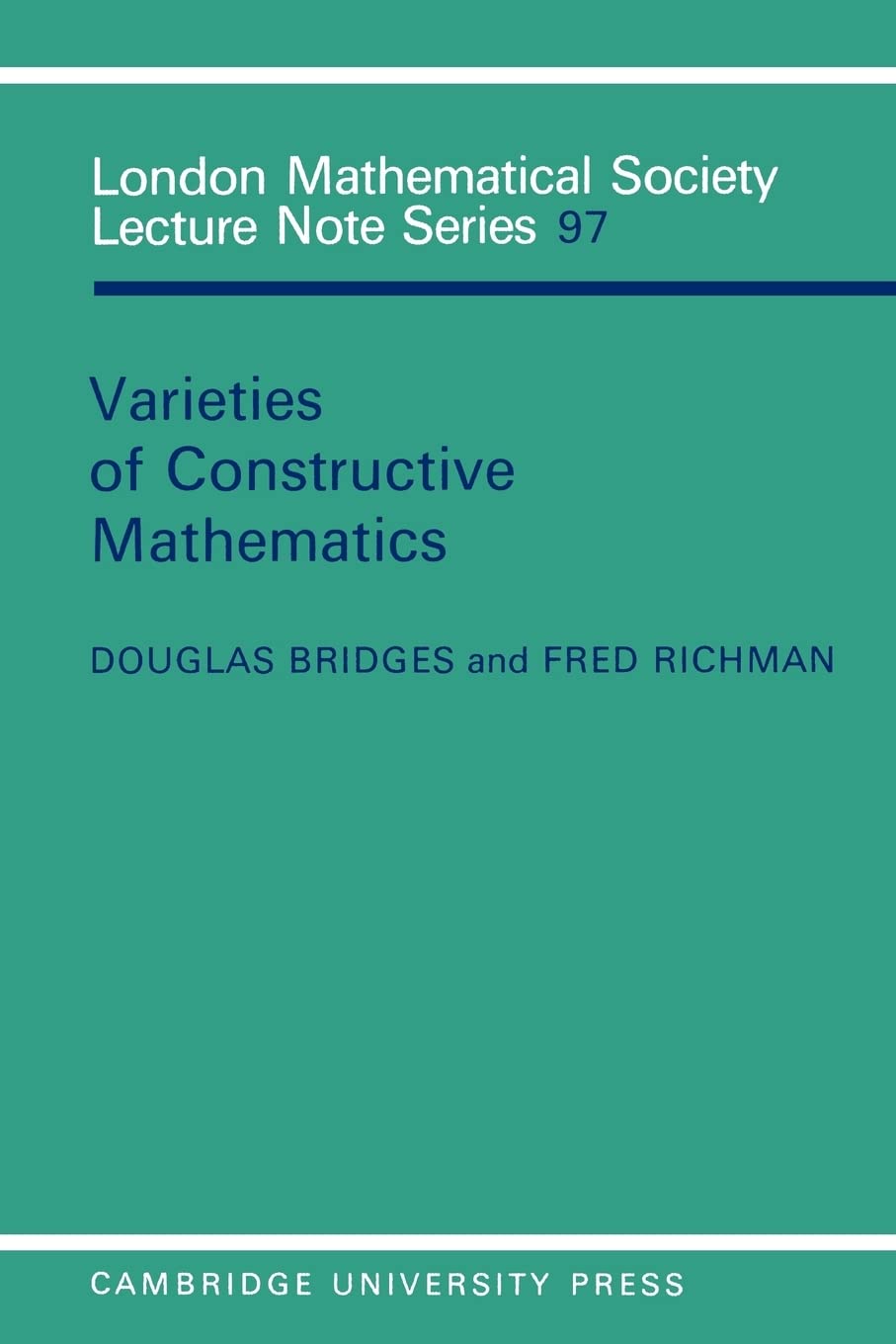
Varieties of Constructive Mathematics by Douglas S. Bridges – A Comprehensive Introduction to Constructive Approaches in
Inclusive of all applicable taxes. FREE shipping on all orders.
Available Offers
- 🚚Free Delivery — Free shipping on all orders
- 💵Cash on Delivery — Pay when your order arrives
- ↩️15-Day Easy Returns — Hassle-free return policy
- 🔒Cash on Delivery — Pay safely when your order arrives
Check Delivery
Product Description
Introduction
In an era where mathematical thought is often dominated by classical logic and non-constructive proofs, Varieties of Constructive Mathematics by Douglas S. Bridges offers a refreshing and rigorous exploration of mathematics built on explicit, algorithmic foundations. This hardcover volume from Cambridge University Press is an indispensable resource for Indian students, researchers, and educators who wish to understand the philosophical and practical underpinnings of constructive approaches to pure mathematics. Whether you are a mathematician, a logician, or a computer scientist, this book opens the door to a world where every existence proof yields a concrete method of construction.
Book Overview
This book serves as both an introduction and a comprehensive survey of the major schools of constructive mathematics. Bridges, a leading figure in the field, presents a balanced treatment of Errett Bishop's school of constructive mathematics, alongside intuitionism, Russian constructivism, and recursive analysis. The text is designed to be accessible to non-specialists while retaining depth for advanced readers. It systematically compares these approaches, highlighting their shared principles and key differences. The book is particularly relevant today, as constructive methods find renewed applications in category theory, theoretical computer science, and recursive function theory.
Key Highlights
- Authoritative Coverage: Bridges brings decades of expertise, offering a clear and authoritative voice on constructive mathematics.
- Comparative Approach: The book uniquely contrasts Bishop's constructivism with intuitionism, Russian constructivism, and recursive analysis, helping readers appreciate the nuances.
- Rigorous Yet Accessible: Complex ideas are presented with clarity, making the book suitable for graduate students and researchers new to the field.
- Foundational Relevance: The content bridges mathematics, logic, and computer science, making it a cross-disciplinary treasure.
- Timely Revival: With growing interest in algorithmic mathematics, this book addresses a critical gap in modern mathematical education.
Inside the Book
The book is structured to guide readers from foundational principles to advanced topics. It begins with a philosophical motivation for constructive mathematics, then delves into the specifics of Bishop's constructive analysis, including real numbers, metric spaces, and algebra. Subsequent chapters explore intuitionistic logic and set theory, the Russian school's reliance on recursive functions, and the techniques of recursive analysis. Each chapter includes carefully crafted examples and exercises that reinforce understanding. The book concludes with a comparative discussion that ties together the various strands, offering a unified perspective on constructive mathematics.
Key Topics
- Foundations of constructive mathematics and its philosophical justification
- Bishop's constructive analysis: real numbers, sequences, and continuity
- Intuitionism: logic, choice sequences, and the continuum
- Russian constructivism: Markov's principle and recursive functions
- Recursive analysis: computability and real numbers
- Comparisons between classical and constructive approaches
- Applications in category theory and theoretical computer science
Reader Benefits
By reading this book, you will gain a deep appreciation for the constructive viewpoint, which insists that mathematical objects must be explicitly constructed. This perspective sharpens your problem-solving skills and fosters a more algorithmic mindset. You will learn to distinguish between different constructive schools and understand their strengths and limitations. The book also equips you with the tools to read and critique modern research in constructive mathematics, logic, and computation. For Indian students preparing for competitive exams or research, this book provides a solid foundation in a niche but increasingly important area.
Learning Outcomes
- Understand the core principles of constructive mathematics and why they matter
- Differentiate between Bishop's constructivism, intuitionism, and Russian constructivism
- Apply constructive techniques to real analysis, algebra, and topology
- Critically evaluate classical proofs and identify non-constructive steps
- Connect constructive mathematics to computability and theoretical computer science
Who Should Read
This book is ideal for graduate students and researchers in pure mathematics, logic, and computer science. It is also valuable for undergraduate students with a strong background in analysis and algebra who wish to explore alternative foundations. Philosophers of mathematics and educators seeking to broaden their curriculum will find the book enlightening. Indian readers, especially those in academic institutions like the IITs, IISc, and central universities, will benefit from its rigorous yet approachable treatment. No prior exposure to constructive mathematics is required, though familiarity with basic real analysis and logic is helpful.
About the Author
Douglas S. Bridges is a distinguished mathematician and a leading authority on constructive mathematics. He has contributed extensively to Bishop's constructive analysis and has authored several seminal texts in the field. Bridges is known for his clear exposition and his ability to make complex ideas accessible. His work has influenced generations of mathematicians and computer scientists worldwide. Currently a professor at the University of Canterbury, New Zealand, he continues to advance the frontiers of constructive and computable mathematics.
About the Publisher
Cambridge University Press is one of the world's oldest and most respected academic publishers. With a history spanning over four centuries, Cambridge University Press is renowned for its rigorous editorial standards and commitment to scholarly excellence. This hardcover edition is printed on high-quality paper, ensuring durability for years of study and reference. For Indian readers, Cambridge University Press books are widely available and trusted in academic circles.
Conclusion
Varieties of Constructive Mathematics is more than a textbook—it is a gateway to a deeper, more rigorous understanding of mathematics. In a world increasingly driven by algorithms and computation, the constructive approach offers timeless insights. Douglas S. Bridges has crafted a work that is both a historical survey and a practical guide. Whether you are a student embarking on advanced studies or a researcher seeking fresh perspectives, this book will enrich your mathematical journey. Add this essential volume to your library today and explore the rich tapestry of constructive thought.
Quick Summary
Varieties of Constructive Mathematics by Douglas S. Bridges is an authoritative introduction to the major constructive approaches in pure mathematics. The book centers on the school of Errett Bishop, known for its rigorous yet accessible style, while also exploring intuitionism (rooted in Brouwer's work), Russian constructivism (associated with Markov), and recursive analysis. Bridges compares these schools, highlighting their philosophical differences and mathematical consequences. This volume is ideal for advanced undergraduate and graduate students in mathematics, as well as researchers in logic, category theory, and theoretical computer science who wish to understand constructive methods. Readers will learn how constructive mathematics redefines fundamental concepts like real numbers, continuity, and sets, and how it avoids non-constructive principles like the law of excluded middle. The book is written in a clear, non-specialist-friendly style, making it accessible even to those new to the field. By purchasing from Bookshops.in, Indian readers gain access to a premium hardcover edition with reliable delivery and customer support, ensuring a valuable addition to any academic library.
Book Highlights
Book Specifications
| ISBN-13 | 9780521318020 |
| ISBN-10 | 0521318025 |
| Publisher | Cambridge University Press |
| Language | English |
| Dimensions | 15.24 x 1.02 x 22.86 cm |
| Weight | 248 g |
| Country | India |
| Category | Science & Mathematics › Mathematics |
| Genre | Non-fiction |
| Original Language | English |
Frequently Asked Questions
What is constructive mathematics?
Who is the author of Varieties of Constructive Mathematics?
Which constructive schools are covered in this book?
Is this book suitable for beginners?
Does the book compare different constructive approaches?
What topics in mathematics are addressed?
Why is this book relevant to computer science?
What is the ISBN of this book?
Is this book available in hardcover?
Can I use this book for self-study?
Does the book include exercises?
How does this book relate to Errett Bishop's work?
Where can I buy this book in India?
Readers Also Search For
Customers Also Bought
Mathematics
Stereotype Spaces and Algebras: 73 (De Gruyter Expositions in Mathematics, 73)
Mathematics
Semigroups in Algebra, Geometry and Analysis: 20 (De Gruyter Expositions in Mathematics, 20)
Mathematics
Geometry from the Pacific Rim: Proceedings of the Pacific Rim Geometry Conference held at National University of Singapore, Republic of Singapore, ... 1994 (De Gruyter Proceedings in Mathematics)
Mathematics
First International Tainan-Moscow Algebra Workshop: Proceedings of the International Conference held at National Cheng Kung University Tainan, Taiwan, ... 1994 (De Gruyter Proceedings in Mathematics)
Mathematics
Differential Geometry - Proceedings of the VIII International Colloquium (English, Jesus A. Alvarez Lopez | Eduardo Garcia-Rio)
Mathematics
Mathematical Theory of Optimal Processes (Classics of Soviet Mathematics)
Related Products
View AllMathematics
Stereotype Spaces and Algebras: 73 (De Gruyter Expositions in Mathematics, 73)
Mathematics
Semigroups in Algebra, Geometry and Analysis: 20 (De Gruyter Expositions in Mathematics, 20)
Mathematics
Geometry from the Pacific Rim: Proceedings of the Pacific Rim Geometry Conference held at National University of Singapore, Republic of Singapore, ... 1994 (De Gruyter Proceedings in Mathematics)
Mathematics
First International Tainan-Moscow Algebra Workshop: Proceedings of the International Conference held at National Cheng Kung University Tainan, Taiwan, ... 1994 (De Gruyter Proceedings in Mathematics)
Mathematics
Differential Geometry - Proceedings of the VIII International Colloquium (English, Jesus A. Alvarez Lopez | Eduardo Garcia-Rio)
Mathematics