
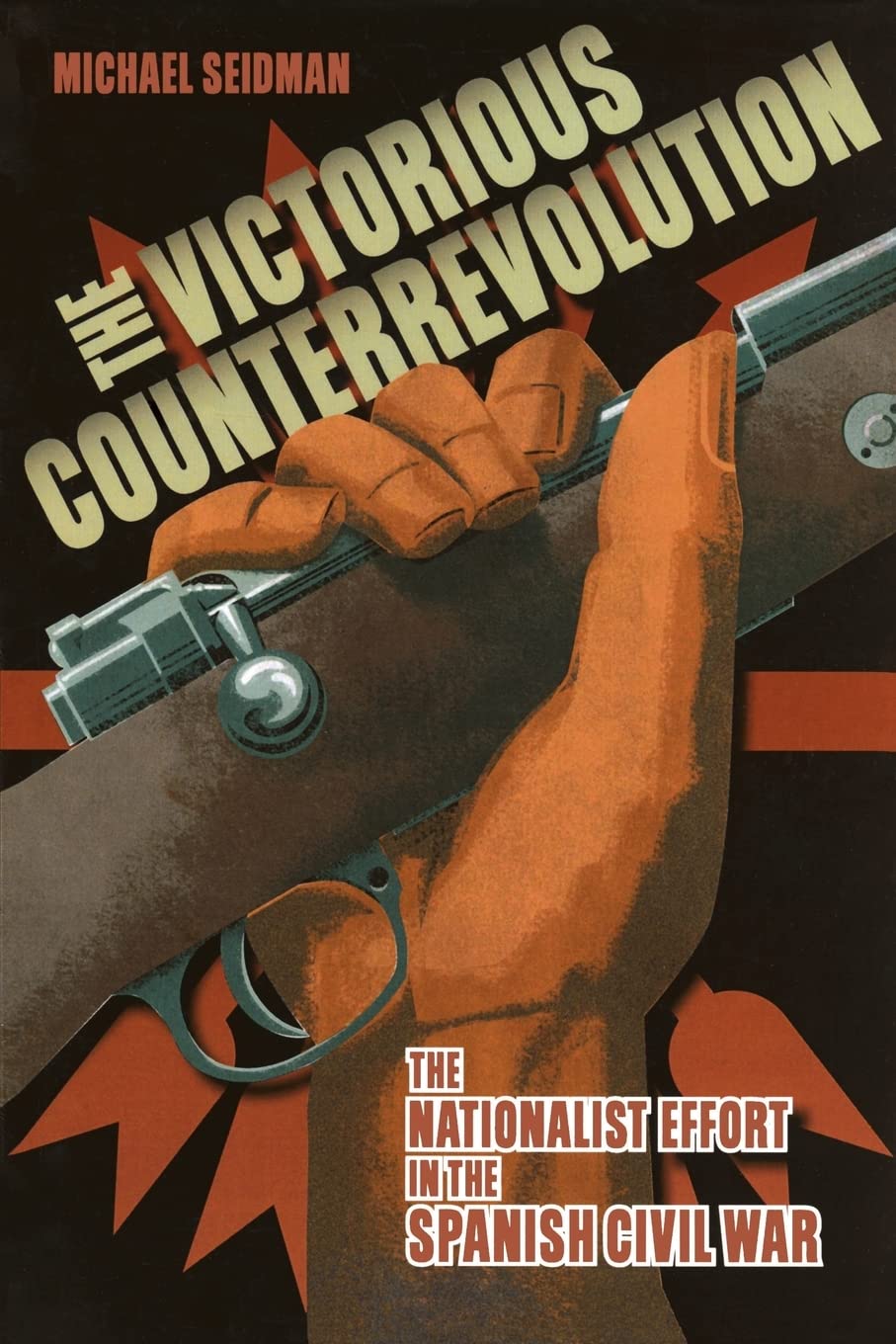
The Victorious Counterrevolution: The Nationalist Effort in the Spanish Civil War by Michael Seidman – A Deep Dive into
Inclusive of all applicable taxes. FREE shipping on all orders.
Available Offers
- 🚚Free Delivery — Free shipping on all orders
- 💵Cash on Delivery — Pay when your order arrives
- ↩️15-Day Easy Returns — Hassle-free return policy
- 🔒Cash on Delivery — Pay safely when your order arrives
Check Delivery
Product Description
Introduction
In the annals of modern history, few conflicts have been as ideologically charged and meticulously studied as the Spanish Civil War (1936–1939). Yet, for decades, one crucial question remained underexplored: how did General Francisco Franco and his Nationalist forces secure their victory? Michael Seidman’s The Victorious Counterrevolution: The Nationalist Effort in the Spanish Civil War offers a groundbreaking, meticulously researched answer. This hardcover volume, published by the University of Wisconsin Press, is an essential addition to the library of any serious student of history, political science, or military strategy. It shifts the focus from battlefield heroics to the less glamorous but decisive realms of finance, food production, and civilian mobilization.
Book Overview
Unlike conventional histories that dwell on Republican failures or international interventions, Seidman’s work is a deep dive into the Nationalist side’s organizational and economic strategies. The book argues that Franco’s regime was exceptional among twentieth-century counterrevolutionary movements—including the Russian Whites and Chinese Nationalists—because it successfully avoided the crippling inflation and shortages that doomed its rivals. By prioritizing regular pay for soldiers and workers, protecting property rights for small and large landowners, and maintaining a tightly controlled but functional economy, the Nationalists built a sustainable war machine. Seidman’s analysis reveals how repression, resource management, and middle-class support coalesced into a formidable force that ultimately triumphed.
Key Highlights
- First-of-its-kind analysis: The only book in any language to focus exclusively on the Nationalist economic and administrative effort during the Spanish Civil War.
- Comparative perspective: Draws parallels with other counterrevolutionary movements to highlight what made the Spanish Nationalists uniquely successful.
- Original archival research: Based on primary sources from Spanish military, financial, and agricultural archives, offering fresh insights.
- Focus on everyday life: Examines how food, wages, and property rights influenced civilian morale and military effectiveness.
- Rigorous yet accessible: Written for both academic historians and general readers interested in modern warfare and political economy.
Inside the Book
Seidman opens with a stark contrast: while the Republican zone descended into revolutionary chaos and scarcity, the Nationalist zone maintained relative stability. He details how Franco’s administration managed state finance through a mix of foreign loans, domestic taxation, and confiscation of enemy assets. The book explores the agricultural policies that kept bread on the table—and soldiers in the field—by guaranteeing prices for farmers and rationing for urban populations. Industrial production, too, is scrutinized: from munitions to textiles, the Nationalists avoided bottlenecks that plagued their opponents. Perhaps most revealing is Seidman’s analysis of how property rights were upheld for the middle and upper classes, securing their loyalty and financial contributions. The narrative also tackles the brutal repression that underpinned this stability, showing how terror was used to enforce labor discipline and silence dissent.
Key Topics
- War finance and monetary policy in a civil conflict
- Agricultural production and food distribution under siege
- Industrial mobilization and labor control
- The role of the middle class and elites in counterrevolution
- Comparative counterrevolutionary strategies (Russia, China, Spain)
- Repression as a tool of economic management
- The logistics of victory: supply chains, wages, and morale
Reader Benefits
This book provides a nuanced understanding of why wars are won not just on the front lines but in the fields, factories, and treasuries. For students of history, it offers a corrective to narratives that attribute Franco’s victory solely to foreign aid or Republican disunity. For political science enthusiasts, it is a case study in how authoritarian regimes can achieve long-term stability through economic pragmatism. For military historians, the logistical insights are invaluable. Indian readers will find parallels in other asymmetric conflicts and appreciate the book’s clear, jargon-free prose. The hardcover edition is built to last, making it a durable reference for years of study.
Learning Outcomes
- Understand the economic foundations of Franco’s victory in the Spanish Civil War.
- Analyze how counterrevolutionary movements manage resources differently from revolutionary ones.
- Evaluate the role of property rights, wages, and food supply in sustaining a war effort.
- Compare the Spanish Nationalist model with other twentieth-century counterrevolutions.
- Critically assess the relationship between repression and economic productivity in wartime.
Who Should Read
This book is ideal for undergraduate and postgraduate students of modern European history, political economy, and military studies. It will also appeal to researchers focusing on authoritarianism, civil wars, and comparative revolutions. General readers with a keen interest in the Spanish Civil War or the mechanics of how regimes survive internal conflict will find it equally rewarding. For Indian readers, the book offers a window into a European conflict that reshaped global politics, with lessons applicable to understanding state-building and conflict management elsewhere.
About the Author
Michael Seidman is a professor of history at the University of North Carolina Wilmington. He is a specialist in modern Spanish history, revolutionary movements, and the political economy of war. His previous works have explored the Spanish Civil War from the Republican perspective, but The Victorious Counterrevolution represents his most original contribution—a rigorous, archivally grounded study of the Nationalist war effort. Seidman’s scholarship is known for its clarity, balance, and willingness to challenge established orthodoxies.
About the Publisher
The University of Wisconsin Press is a distinguished academic publisher based in Madison, Wisconsin. Founded in 1936, it is renowned for its high-quality scholarship in history, political science, and the humanities. The press has a strong track record of publishing works that combine rigorous research with accessible writing, making complex subjects available to a broad readership. This hardcover edition reflects their commitment to durable, well-produced books that stand the test of time.
Conclusion
The Victorious Counterrevolution is not just a history of a war; it is a masterclass in how power is organized, resources are allocated, and loyalty is secured in times of extreme crisis. By focusing on the Nationalist side’s economic and administrative triumphs, Michael Seidman fills a critical gap in our understanding of the Spanish Civil War. For anyone seeking to move beyond romanticized narratives and grasp the gritty, often brutal mechanics of victory, this book is indispensable. Order your hardcover copy from Bookshops.in today and add a landmark work to your collection.
Quick Summary
The Victorious Counterrevolution: The Nationalist Effort in the Spanish Civil War by Michael Seidman is a pioneering academic work that delves into the economic and financial machinery behind Franco's victory. Unlike traditional histories that focus on battles or ideology, this book reveals how the Nationalists maintained stable currency, controlled inflation, and ensured steady supplies of food and ammunition—areas where their Republican adversaries and other counterrevolutionary movements (like the Russian Whites) failed. Seidman argues that Franco's highly repressive regime, combined with pragmatic state management, won over elites and the middle class, securing the resources needed for a protracted war. This book is ideal for history students, political science scholars, and military historians seeking a nuanced understanding of how authoritarian regimes can triumph through economic discipline. Readers will learn about the logistics of civil war, the role of finance in warfare, and the comparative dynamics of counterrevolution. By purchasing from Bookshops.in, Indian readers receive a premium hardcover edition with fast delivery and excellent customer service, making it a valuable addition to any serious history collection.
Book Highlights
Book Specifications
| ISBN-13 | 9780299249649 |
| ISBN-10 | 0299249646 |
| Publisher | University of Wisconsin Press |
| Language | English |
| Dimensions | 22.61 x 14.99 x 2.54 cm |
| Weight | 499 g |
| Country | United Kingdom |
| Category | Political Science › International Relations |
| Genre | History |
| Reading Age | Adult |
| Original Language | English |
Frequently Asked Questions
What is the main focus of this book?
Who is the author of The Victorious Counterrevolution?
How does this book differ from other Spanish Civil War histories?
Is this book suitable for undergraduate students?
Does the book cover the Republican side?
What time period does the book cover?
What makes the Spanish Nationalists exceptional?
Is this a hardcover or paperback?
What language is the book in?
What is the publisher's name?
What is the ISBN-13?
Does the book include comparisons to other civil wars?
What is the price in India?
Where can I buy this book in India?
Readers Also Search For
Customers Also Bought
International Relations
Clients, Rivals, and Rogues: Why Great Powers Intervene in Revolutionary Civil Wars

International Relations
Foreign Ministries and the Information Revolution: Going Virtual?: 2 (Diplomatic Studies)
International Relations
From Pki to Comintern, 1924-1941: The Apprenticeship of the Malayan Communist Party: 8 (Southeast Asia Program Series, 8)
International Relations
The Evolving Terrorist Threat to Southeast Asia: A Net Assessment
International Relations
The Naval Policy of Austria-Hungary 1867-1918: Navalism, Industrial Development, and the Politics of Dualism (Central European Studies)

International Relations
New Technologies and Law of the Marine Environment: Nouvelles Technologies Et Droit De L'Environment Marin: 55 (International Enviornmental Law and Policy, 55)
Related Products
View AllInternational Relations
Clients, Rivals, and Rogues: Why Great Powers Intervene in Revolutionary Civil Wars
International Relations
Foreign Ministries and the Information Revolution: Going Virtual?: 2 (Diplomatic Studies)
International Relations
From Pki to Comintern, 1924-1941: The Apprenticeship of the Malayan Communist Party: 8 (Southeast Asia Program Series, 8)
International Relations
The Evolving Terrorist Threat to Southeast Asia: A Net Assessment
International Relations
The Naval Policy of Austria-Hungary 1867-1918: Navalism, Industrial Development, and the Politics of Dualism (Central European Studies)
International Relations