
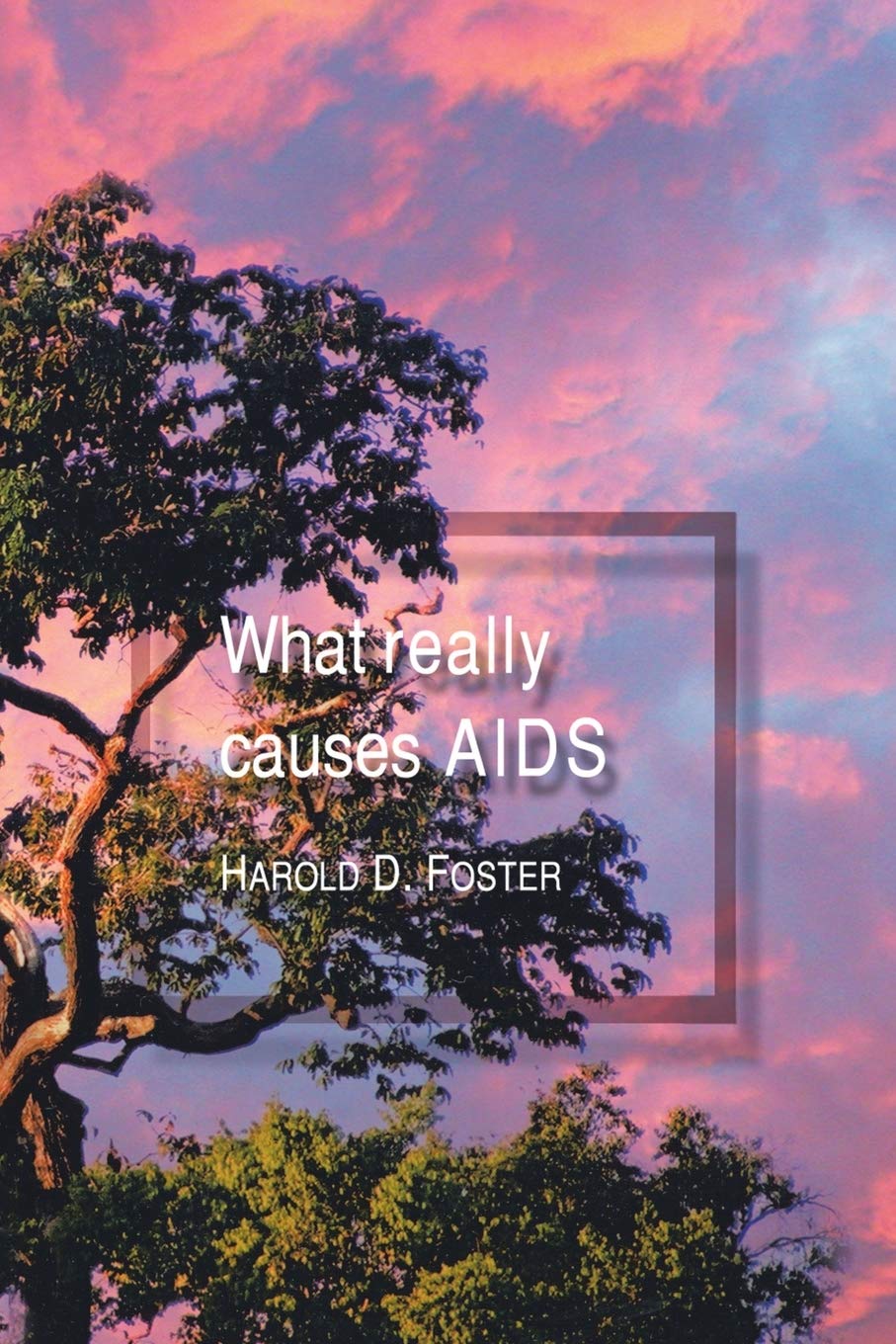
What Really Causes AIDS
Inclusive of all applicable taxes. FREE shipping on all orders.
Available Offers
- 🚚Free Delivery — Free shipping on all orders
- 💵Cash on Delivery — Pay when your order arrives
- ↩️15-Day Easy Returns — Hassle-free return policy
- 🔒Cash on Delivery — Pay safely when your order arrives
Check Delivery
Product Description
"What Really Causes AIDS" by Harold D. Foster, published by Trafford Publishing. WHAT REALLY CAUSES AIDS: AN EXECUTIVE SUMMARY The AIDS pandemic is likely to become the greatest catastrophe in human history. Unless a safe, effective vaccine is quickly developed, or the preventive strategies outlined in this book are widely applied, by 2015 one sixth of the world's population will be infected by HIV-1 and some 250 million people will have died from AIDS. Its associated losses by then will be more than those of the Black Death and World War II combined, the equivalent of eight World War Is.1 This pandemic is only one of several ongoing catastrophes involving viruses that encode the selenoenzyme glutathione peroxidase.2 Indeed, the world is experiencing simultaneous pandemics caused by Hepatitis B and C viruses, Coxsackie B virus and HIV-1 and HIV-2. As these viruses replicate, because their genetic codes include a gene that is virtually identical to that of the human enzyme glutathione peroxidase, they rob their hosts of selenium. Paradoxically, however, they diffuse most easily in populations that are very selenium deficient,3 possibly because their members have depressed immune systems. It is no coincidence that such viruses are causing havoc at the beginning of the 21st century. The last 50 years have seen enormous expansions in the use of fossil fuels and deforestation by fire. The resulting pollutants have greatly increased the acidity of global precipitation, reducing selenium's ability to enter the food chain. This situation is being made worse by the widespread use of commercial fertilizers since their sulphates, nitrogen, and phosphorus all depress the uptake of selenium by crops. Deficiencies in this essential trace element are being felt most acutely in areas, such as sub-Saharan Africa, where soil selenium levels are naturally very low. Acid rain is making a bad situation worse, so increasing vulnerability to those viruses that encode glutathione peroxidase. Many populations are also being exposed to a thinning ozone layer, heavy metals such as mercury and cadmium, pesticides, and drug, tobacco, and alcohol abuse, all of which depress the human immune system, increasing vulnerability to viruses, including HIV-1 and HIV-2. In July 2000, physicians and scientists from around the world met in Durban, South Africa for the XIII International AIDS Conference. In a declaration, named after the city, 5,018 of them proclaimed that "HIV is the sole cause of AIDS."4 There are, however, at least seven anomalies that strongly suggest that this conventional wisdom is incorrect and that belief in it is blocking progress in the development of new treatments for AIDS and of novel ways of preventing its spread. To illustrate, despite widespread unprotected promiscuous sexual activity in Senegal, HIV- 1 is diffusing very slowly, if at all, amongst the Senegalese.5 It is very apparent that in Africa, differences in soil selenium levels are greatly influencing who becomes infected with HIV-1 and who does not. Indeed, the recently published Selenium World Atlas used the incidence of HIV-1 as a surrogate measure of soil selenium levels because actual levels are, as yet, poorly established in sub-Saharan Africa. A similar relationship has been documented in the United States6 where there has been an inverse relationship, especially in the Black population, between mortality from AIDS and local soil selenium levels. It is well established that individuals who are HIV-positive gradually become more and more selenium deficient.7 This decline, which is known to undermine immune functions, is not unique to HIV-infection but is seen in almost all infectious pathogens.8 However, under normal circumstances, where death does not occur, selenium levels rebound soon after recovery. HIV-1, however, can effectively elude the defense mechanisms of the immune system, and can continue to replicate indefinitely, endlessly depressing serum selenium. As a result, the immune system is compromised, allowing infection by other pathogens that continue to deplete the host of selenium, allowing HIV-1 to replicate more easily, further undermining immunity. Therefore, this relationship between selenium and the immune system is one of positive feedback, in which a decline in either of these two variables causes further depression in the other. Termed the "selenium- CD4 T cell tailspin" by the author,9 it is the reason that serum selenium levels are a better predictor of AIDS mortality than CD4 T cell counts. Like other positive feedback systems, such as avalanches and forest fires, it is extremely difficult to control and gains momentum as it progresses. HIV-1, however, encodes the entire selenoenzyme, glutathione peroxidase. As it replicates, therefore, it depletes its host not only of selenium but also of the other three components of this enzyme: namely, cysteine, glutamine, and tryptophan.10 AIDS, therefore, is a nutritional deficiency illness caused by a virus. Its victims suffer from extreme deficiencies of all four of these nutrients which are responsible for such symptoms as depressed CD4T lymphocyte count, vulnerability to cancers (including Kaposi's sarcoma), depression, psoriasis, diarrhea, muscle wasting, and dementia. Associated infections cause their own unique symptoms and increased risk of death. HIV-1 alone, therefore, does not cause AIDS. It involves a multiplicity of co-factors, specifically anything that either depletes serum selenium levels or depresses the immune system enough to permit viral replication. Manipulating the "selenium-CD4T cell tailspin" by adding this trace element to fertilizers and food stuffs opens new avenues for both prevention and treatment. This strategy has been shown to work on other viruses that encode glutathione peroxidase, such as Hepatitis B and C and the Coxsackievirus. The logical treatment of AIDS patients involves supplementation with selenium, cysteine, glutamine, and tryptophan, at least to levels at which deficiency symptoms associated with a lack of these nutrients disappear. While this can be most easily achieved by supplements, certain foods contain elevated levels of those four nutrients. Strangely enough, one of the ideal meals for anyone who is HIV-seropositive would include a cheeseburger to which Brazilnut flour had been added to the bun. REFERENCES 1. Foster, H.D. (1976). Assessing disaster magnitude: A social science approach. The Professional Geographer, xxviii(3), 241-247. 2. Taylor, E.W. (1997). Selenium and viral diseases: Facts and hypotheses. Journal of Orthomolecular Medicine, 12 (4), 227-239. 3. Ibid. 4. The Durban Declaration (2000). Nature, 406, 15-16. 5. UNAIDS/WHO Epidemiological Fact Sheet on HIV/AIDS and sexually transmitted infections: Senegal. 2000 update (revised). 6. Cowgill, U.M. (1997). The distribution of selenium and mortality owing to acquired immune deficiency syndrome in the continental United States. Biological Trace Element Research, 56, 43-61. 7. Baum, M.K., Shor-Posner, G., Lai, S., Zhang, G., Lai, H., Fletcher, M.A., Sauberlich, H., and Page, J.B. (1997). High risk of HIV-related mortality is associated with selenium deficiency. Journal of Acquired Immune Deficiency Syndromes and Human Retrovirology, 15(5), 370- 374. 8. Sammalkorpi, K., Valtonen, V., Alfthan, G., Aro, A., and Huttunen, J. (1988). Serum selenium in acute infections. Infection, 16(4), 222- 224. 9. Foster, H.D. (2000). Aids and the "selenium-CD4T cell tailspin": The geography of a pandemic. Townsend Letter for Doctors and Patients, 209, 94-99. 10. Mariorino, M., Aumann, K.D., Brigelius-Flohe;, R., and Doria, D., van den Heuvel, J., McCarthy, J.E.G., Roveri, A., Ursini, F., and Flohé, L. (1998). Probing the presumed catalytic triad of a seleniumcontaining peroxidase by mutational analysis. Z. Ernahrungswiss, 37(Supplement 1), 118-121. Book details: 213 pages, published 2002. Order now on BookShops.in with fast, reliable delivery across India.
Book Specifications
| ISBN-13 | 9781553691327 |
| ISBN-10 | 1553691326 |
| Publisher | Trafford Publishing |
| Language | english |
| Print Length | 214 pages |
| Category | Health, Family & Personal Development |
Frequently Asked Questions
What is the price of What Really Causes AIDS?
Does BookShops.in offer free delivery for What Really Causes AIDS?
Is Cash on Delivery available for What Really Causes AIDS?
What is the return policy for What Really Causes AIDS?
Is What Really Causes AIDS authentic?
Related Products
View All
Health, Family & Personal Development
Creating Cultures of Consent: A Guide for Parents and Educators

Health, Family & Personal Development
Women's Fitness Eat Yourself Slim

Health, Family & Personal Development
Why Won't My Teenager Talk to Me?

Health, Family & Personal Development
The Erotic Mind: Unlocking the Inner Sources of Sexual Passion and Fulfillment

Health, Family & Personal Development
Bringing Up Bookmonsters: The Joyful Way to Turn Your Child into a Fearless, Ravenous Reader

Health, Family & Personal Development