
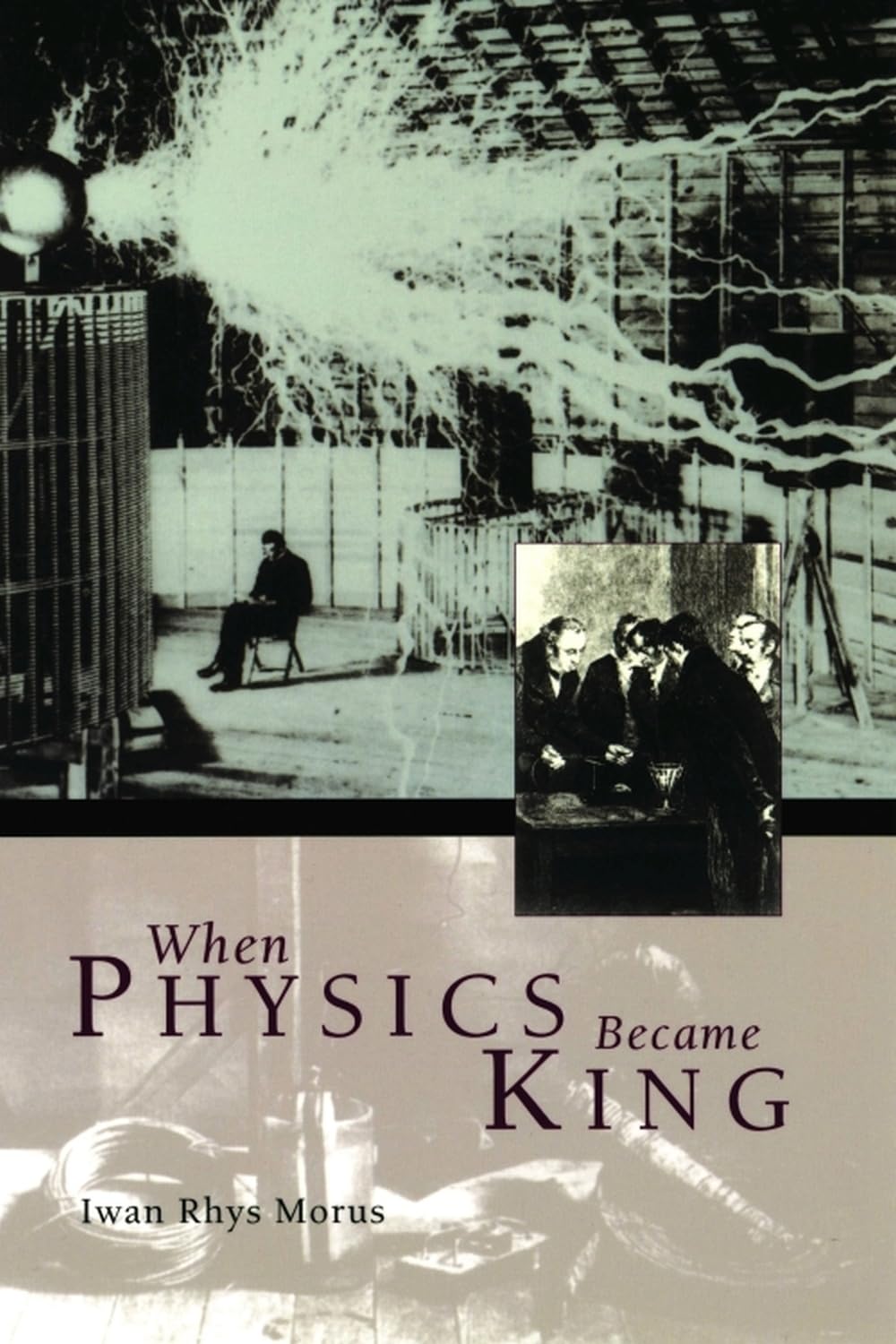
When Physics Became King: A Cultural History of the Rise of Physics in the Nineteenth Century by Iwan Rhys Morus
Inclusive of all applicable taxes. FREE shipping on all orders.
Available Offers
- 🚚Free Delivery — Free shipping on all orders
- 💵Cash on Delivery — Pay when your order arrives
- ↩️15-Day Easy Returns — Hassle-free return policy
- 🔒Cash on Delivery — Pay safely when your order arrives
Check Delivery
Product Description
Introduction
Two centuries ago, the word 'physicist' did not even exist. Today, physics is regarded as the queen of sciences—the ultimate key to unlocking the secrets of the universe. When Physics Became King by Iwan Rhys Morus is a masterful cultural history that takes you on a fascinating journey through the birth and rise of modern physics. This hardcover edition from the University of Chicago Press is an essential addition to the library of every science enthusiast, student, and educator in India who wants to understand how a discipline that barely existed in 1800 came to dominate our understanding of nature.
Book Overview
This book traces the dramatic transformation of physics from a fledgling branch of natural philosophy into a powerful, institutionalised science. Iwan Rhys Morus reveals how the second scientific revolution of the early nineteenth century gave rise to what we now call physics—a field that not only explained natural phenomena but also reshaped industry, technology, and society itself. The narrative spans France, England, and Germany, showing how mathematical physics emerged and spread across Europe, eventually becoming the ultimate arbiter of truth about the physical world.
Key Highlights
- Cultural history approach: Understand physics not just as a set of equations, but as a human endeavour shaped by ambition, rivalry, and social change.
- Rise of the physicist: Discover how the term 'physicist' was coined in the 1830s and how early practitioners fought for legitimacy.
- Industrial connections: Explore the links between physics and the Industrial Revolution, including steam engines, telegraphy, and precision instruments.
- Global perspective: Follow the transfer of ideas from French mathematical physics to English and German laboratories.
- Engaging storytelling: Morus brings to life the personalities and controversies that defined the field's formative years.
Inside the Book
The book is divided into thematic chapters that move chronologically and geographically. It begins with the state of natural philosophy around 1800, then delves into the rise of mathematical physics in Napoleonic France. Subsequent chapters trace how these ideas were adopted and adapted in Britain and Germany, highlighting the role of institutions like the Royal Institution and the University of Berlin. The final sections examine how physics became a professional discipline, complete with laboratories, journals, and a growing public audience. Throughout, Morus weaves together scientific developments with social, political, and economic contexts.
Key Topics
- The second scientific revolution (1800–1900)
- Mathematical physics in France (Laplace, Fourier, Ampère)
- British physics and the industrial context (Faraday, Joule, Maxwell)
- German physics and the research university (Helmholtz, Clausius)
- The professionalisation of physics
- Physics and technology: steam, electricity, and measurement
- Public engagement with physics in the nineteenth century
Reader Benefits
For Indian readers—students, teachers, and curious minds—this book offers a rare perspective that goes beyond textbooks. You will gain a deeper appreciation for how physics evolved as a cultural force, not just a collection of laws. The book is written in accessible prose, making complex historical developments easy to follow. It also highlights the global nature of scientific progress, showing how ideas travelled across borders—a theme that resonates strongly in today's interconnected world. Whether you are preparing for competitive exams, teaching a course, or simply love science, this book will enrich your understanding.
Learning Outcomes
- Understand the historical origins of modern physics and its key concepts.
- Identify the social and institutional factors that shaped scientific discovery.
- Analyse the relationship between physics, industry, and technology in the nineteenth century.
- Appreciate the contributions of major physicists within their cultural context.
- Develop a critical perspective on how science gains authority and legitimacy.
Who Should Read
This book is ideal for undergraduate and postgraduate students of physics, history of science, and science communication. It is equally valuable for teachers looking to enrich their lessons with historical context, and for general readers who want to know how physics became the dominant science. If you enjoyed works by James Gleick, Richard Holmes, or Dava Sobel, you will find Morus's narrative equally compelling. It is also a perfect gift for science enthusiasts who appreciate well-researched, beautifully written hardcovers.
About the Author
Iwan Rhys Morus is a professor of history at Aberystwyth University in Wales. He is a leading scholar of the history of nineteenth-century physics and has written extensively on the cultural history of science. His works include Frankenstein's Children and Michael Faraday and the Electrical Century. Morus is known for his ability to make the history of science accessible and engaging, blending scholarly rigour with vivid storytelling.
About the Publisher
The University of Chicago Press is one of the most prestigious academic publishers in the world. Founded in 1890, it has a long tradition of publishing groundbreaking works in science, history, and the humanities. This hardcover edition reflects the press's commitment to quality—from the durable binding to the clear, readable type. When you hold this book, you are holding a piece of scholarly excellence.
Conclusion
When Physics Became King is not just a history of science—it is a story of how a community of thinkers, tinkerers, and theorists built a discipline that changed the world. Iwan Rhys Morus has given us a vivid, insightful, and thoroughly researched account that will appeal to anyone curious about the roots of modern physics. Add this beautiful hardcover to your collection today from Bookshops.in and discover how physics rose to claim its throne.
Quick Summary
When Physics Became King by Iwan Rhys Morus is a cultural history that explores how physics transformed from a barely recognized pursuit in 1800 to the dominant science of the late 19th century. The book delves into the social, institutional, and intellectual efforts that shaped physics as a distinct discipline, including the coining of the term 'physicist' in the 1830s. It highlights key figures like Faraday, Maxwell, and Kelvin, and shows how their work on energy, electromagnetism, and thermodynamics helped physics gain legitimacy. This book is ideal for students, historians, and general readers interested in the origins of modern science. It offers a big-picture view that connects scientific developments to Victorian culture and society. By purchasing from Bookshops.in, Indian readers receive a genuine hardcover edition with fast, reliable delivery, supporting a local bookstore that values quality and customer satisfaction.
Book Highlights
Book Specifications
| ISBN-13 | 9780226542027 |
| ISBN-10 | 0226542025 |
| Publisher | Univ of Chicago Pr |
| Language | English |
| Dimensions | 15.24 x 2.01 x 22.86 cm |
| Weight | 431 g |
| Country | India |
| Category | Science & Mathematics › Physics |
| Genre | Nonfiction |
| Original Language | English |
Frequently Asked Questions
What is When Physics Became King about?
Who is the author of When Physics Became King?
Is this book suitable for beginners?
What time period does the book cover?
Does the book include biographies of famous physicists?
What makes this book different from other history of physics books?
Can I use this book for academic research?
What language is the book written in?
What is the price of When Physics Became King on Bookshops.in?
Does the book discuss physics in India?
Is the book illustrated?
Why should I buy this book from Bookshops.in?
Readers Also Search For
Customers Also Bought
Mathematics
Stereotype Spaces and Algebras: 73 (De Gruyter Expositions in Mathematics, 73)

Mathematics
Semigroups in Algebra, Geometry and Analysis: 20 (De Gruyter Expositions in Mathematics, 20)

Mathematics
Geometry from the Pacific Rim: Proceedings of the Pacific Rim Geometry Conference held at National University of Singapore, Republic of Singapore, ... 1994 (De Gruyter Proceedings in Mathematics)

Mathematics
First International Tainan-Moscow Algebra Workshop: Proceedings of the International Conference held at National Cheng Kung University Tainan, Taiwan, ... 1994 (De Gruyter Proceedings in Mathematics)
Mathematics
Differential Geometry - Proceedings of the VIII International Colloquium (English, Jesus A. Alvarez Lopez | Eduardo Garcia-Rio)
Mathematics
Mathematical Theory of Optimal Processes (Classics of Soviet Mathematics)
Related Products
View All
Physics
The Quantum and Cosmic Codes of the Universe
Physics
Physics for You by Keith Johnson – GCSE Physics Textbook
Physics
Experimental Techniques in Nuclear Physics
Physics
Essential Physics I

Physics
Modern Foundations of Quantum Optics
Physics