
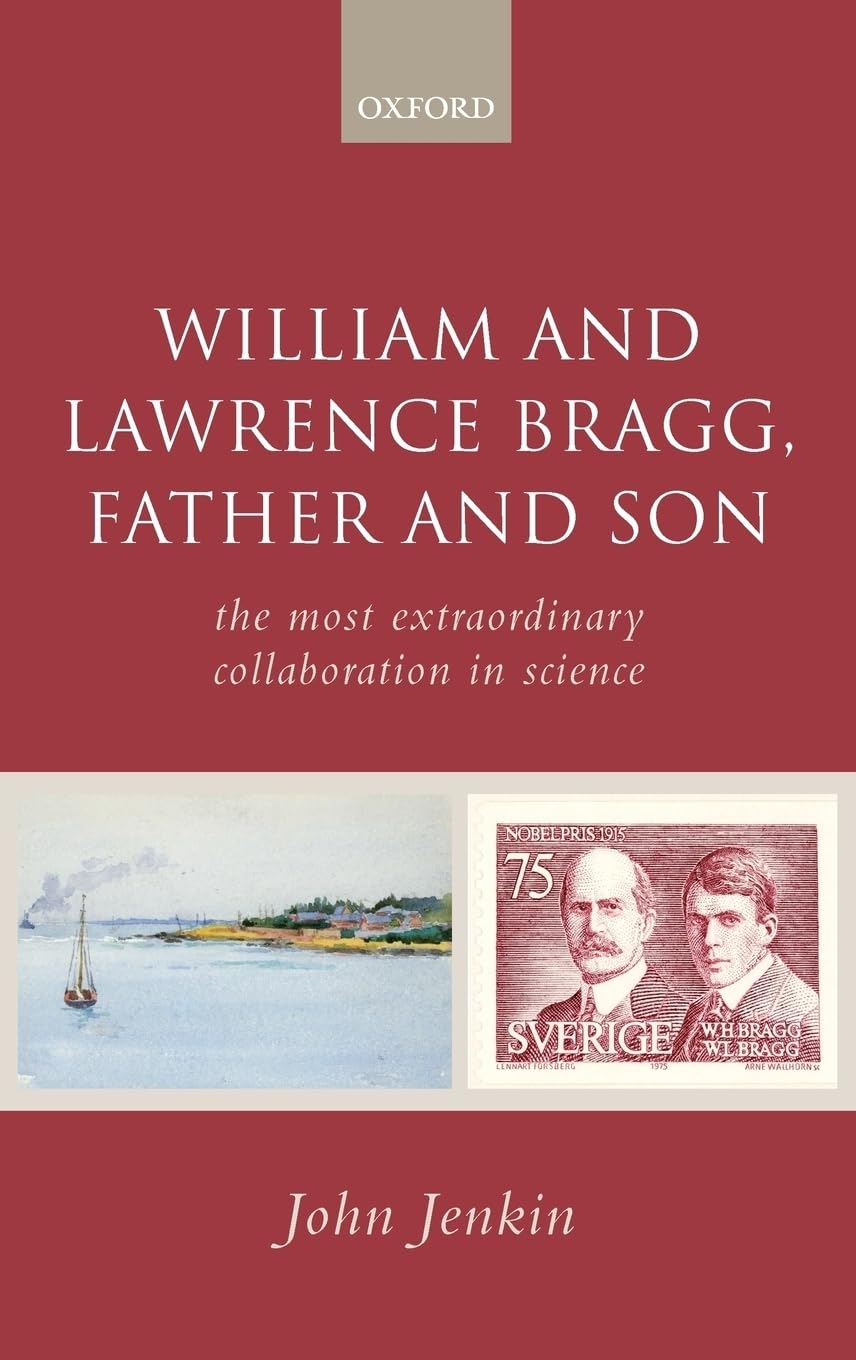
William and Lawrence Bragg, Father and Son: The Most Extraordinary Collaboration in Science – A Biography by John Jenkin
Inclusive of all applicable taxes. FREE shipping on all orders.
Available Offers
- 🚚Free Delivery — Free shipping on all orders
- 💵Cash on Delivery — Pay when your order arrives
- ↩️15-Day Easy Returns — Hassle-free return policy
- 🔒Cash on Delivery — Pay safely when your order arrives
Check Delivery
Product Description
Introduction
In the annals of scientific history, few partnerships have been as profound and transformative as that of William Henry Bragg and his son, William Lawrence Bragg. Their collaboration, spanning decades, not only reshaped our understanding of the atomic world but also laid the foundation for entire fields of modern science. John Jenkin’s meticulously researched biography, William and Lawrence Bragg, Father and Son: The Most Extraordinary Collaboration in Science, offers an intimate and comprehensive look at this unique relationship. Published by OUP Oxford in a premium hardcover edition, this book is an essential addition to the library of any serious student of science, history, or human achievement.
Book Overview
This volume chronicles the remarkable journey of two men who, together, pioneered X-ray spectroscopy and crystallography. Lawrence Bragg, at the tender age of 25, formulated the famous Bragg’s Law, forever changing how scientists visualize the structure of matter. His father, William, was a brilliant physicist in his own right, whose early belief in the dual wave-particle nature of radiation was later vindicated. The book traces their rise from humble beginnings—William English, his son Australian—to global scientific stardom, and then to their current, undeserved obscurity. Jenkin goes beyond mere scientific achievement, delving into the intimate personal dynamics, family life, and the immense pressures of the First World War that shaped their work and their bond.
Key Highlights
- Unique Father-Son Dynamic: Explores the extraordinary intellectual and emotional collaboration that made their scientific project possible.
- Foundational Science: Details the discovery of Bragg’s Law and the birth of X-ray crystallography, which unlocked the secrets of crystals, DNA, and proteins.
- Wartime Contributions: Highlights the crucial, often overlooked roles both men played during the First World War, using science for national service.
- Legacy of Discovery: Shows how their work transformed physics, chemistry, geology, materials science, electronics, and modern biology.
Inside the Book
Jenkin’s narrative is rich with personal correspondence, family anecdotes, and detailed scientific exposition. Readers will walk through the Braggs’ laboratory, witness their struggles with experimental apparatus, and share in their moments of triumphant insight. The book also paints a vivid picture of the scientific community in the early 20th century, from the Cavendish Laboratory to the Royal Institution. It is a story not just of equations and crystals, but of a father’s pride, a son’s genius, and the quiet, powerful ways in which family can drive groundbreaking innovation.
Key Topics
- The development of X-ray crystallography and spectroscopy
- William Bragg’s early advocacy for wave-particle duality
- The impact of World War I on scientific research and personal lives
- The internationalization of science: from Australia to England
- The Nobel Prize shared by father and son in 1915
- The long-term influence on molecular biology and materials science
Reader Benefits
This book offers Indian readers a rare, humanizing perspective on scientific giants. It demonstrates that great science often emerges from deep personal relationships and perseverance. For students, it provides a compelling case study in how to approach complex problems. For educators, it is a rich source of historical context and inspiration. For general readers, it is a beautifully written story of ambition, love, and intellectual courage that transcends disciplines.
Learning Outcomes
- Understand the historical context and significance of the Braggs’ discoveries.
- Appreciate the collaborative nature of scientific progress.
- Gain insight into the interplay between personal life and professional achievement.
- Learn the foundational principles of X-ray crystallography in an accessible narrative.
- Recognize the Braggs’ enduring legacy in modern science and technology.
Who Should Read
This book is ideal for physics and chemistry students, science historians, educators, researchers in crystallography and materials science, and anyone fascinated by the human stories behind great discoveries. It is also a compelling read for parents and mentors interested in how nurturing talent across generations can lead to extraordinary outcomes. The narrative is accessible to advanced high school students and undergraduates, while remaining deeply rewarding for professionals.
About the Author
John Jenkin is a respected historian of science with a deep expertise in Australian and British physics. His rigorous scholarship is matched by a narrative flair that brings historical figures to life. He has spent years researching the Braggs’ personal papers and scientific archives, resulting in a biography that is both authoritative and deeply human.
About the Publisher
OUP Oxford is one of the world’s most prestigious academic publishers, known for its commitment to scholarly excellence. This hardcover edition reflects the high production standards expected of a definitive work of scientific biography, making it a durable and elegant addition to any personal or institutional library.
Conclusion
William and Lawrence Bragg, Father and Son is more than a biography; it is a testament to the power of collaboration, the beauty of scientific inquiry, and the enduring bond between a father and his son. By bringing this extraordinary story back into the light, John Jenkin reminds us that even the most profound discoveries are, at heart, deeply human endeavours. For anyone seeking to understand how science truly advances, this book is an indispensable and inspiring guide.
Quick Summary
William and Lawrence Bragg, Father and Son: The Most Extraordinary Collaboration in Science by John Jenkin is a captivating biography of the only father-son duo to win a Nobel Prize in Physics. The book traces their journey from humble beginnings to becoming pioneers of X-ray crystallography, a technique that revolutionised physics, chemistry, biology, and materials science. It delves into their separate and joint contributions, including Lawrence Bragg's famous equation and their work during World War I. Written for Indian students and science enthusiasts, the narrative is both informative and inspiring, highlighting the power of mentorship and family collaboration. Readers will gain a deep appreciation for how the Braggs' discoveries laid the groundwork for modern scientific advancements. This hardcover edition from OUP Oxford is a valuable addition to any library. Buy it from Bookshops.in for a reliable, high-quality copy delivered to your doorstep.
Book Highlights
Book Specifications
| ISBN-13 | 9780199235209 |
| ISBN-10 | 0199235201 |
| Publisher | OUP Oxford |
| Language | English |
| Dimensions | 23.62 x 3.05 x 15.49 cm |
| Weight | 953 g |
| Category | Americas › United States |
| Genre | Biography |
| Original Language | English |
Frequently Asked Questions
Is this book suitable for undergraduate students?
Does the book cover the scientific details of X-ray crystallography?
Why is this book important for Indian readers?
Who is the author John Jenkin?
Does the book include photographs or illustrations?
Can I use this book for a research paper?
What is the ISBN-13?
Is the book available in other languages?
How does this book differ from other biographies of scientists?
Does the book discuss the Braggs' personal lives?
Is the book heavy or bulky?
Where can I buy this book in India?
Readers Also Search For
Related Products
View All
History
The Information Revolution: Transforming the World Through Technology (World History)
History
Human Nature and the French Revolution: From the Enlightenment to the Napoleonic Code: 3 (Polygons: Cultural Diversities and Intersections, 3)
History
The Unmaking of Home in Contemporary Art (Cultural Spaces)

History
Handbook to Life in Medieval and Early Modern Japan | by William E. Deal | Oxford University Press | by William E. Deal | Oxford University Press | by William E. Deal | Oxford University Press | by William E. Deal | Oxford University Press | by William E. Deal | Oxford University Press | by William E. Deal | Oxford University Press | by William E. Deal | Oxford University Press | by William E. Deal | Oxford University Press | by William E. Deal | Oxford University Press | by William E. Deal | Ox

History
The Narrators of Barbarian History (A.D. 550-800) | by Walter Goffart | University of Notre Dame Press | by Walter Goffart | University of Notre Dame Press | by Walter Goffart | University of Notre Dame Press | by Walter Goffart | University of Notre Dame Press | by Walter Goffart | University of Notre Dame Press | by Walter Goffart | University of Notre Dame Press | by Walter Goffart | University of Notre Dame Press | by Walter Goffart | University of Notre Dame Press | by Walter Goffart | Univ
History