
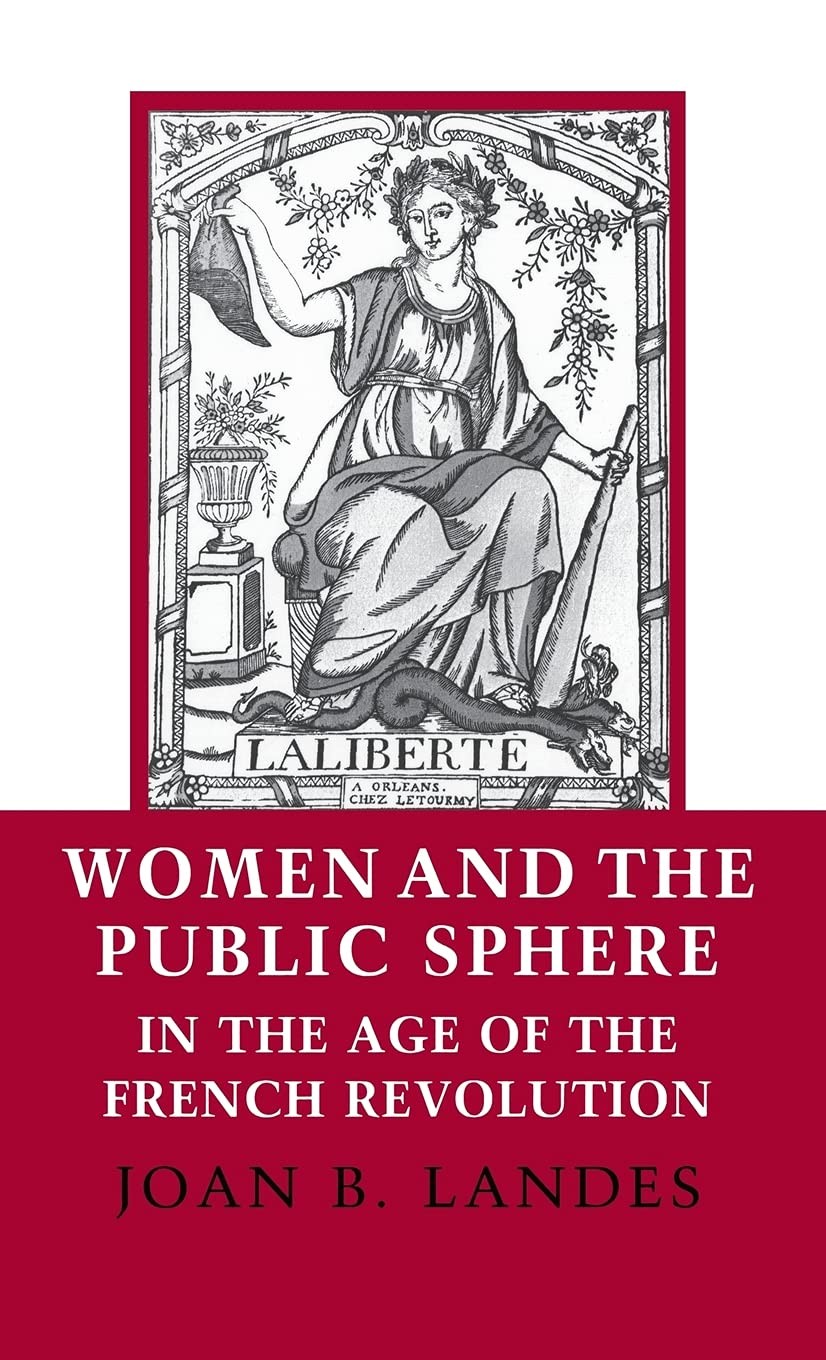
Women and the Public Sphere in the Age of the French Revolution by Joan B. Landes – A Feminist Interdisciplinary Study o
Inclusive of all applicable taxes. FREE shipping on all orders.
Available Offers
- 🚚Free Delivery — Free shipping on all orders
- 💵Cash on Delivery — Pay when your order arrives
- ↩️15-Day Easy Returns — Hassle-free return policy
- 🔒Cash on Delivery — Pay safely when your order arrives
Check Delivery
Product Description
Introduction
In the vast landscape of historical scholarship, few works have reshaped our understanding of gender and politics as profoundly as Joan B. Landes's Women and the Public Sphere in the Age of the French Revolution. This hardcover edition from Cornell University Press offers Indian readers, students, and researchers a rigorous yet accessible exploration of how the French Revolution, often celebrated as a triumph of liberty and equality, paradoxically curtailed women's participation in public life. Landes challenges conventional narratives by examining the shift from the Old Regime's complex gender dynamics to the rigidly masculine bourgeois public sphere that emerged after 1789. For anyone studying political theory, feminist history, or eighteenth-century Europe, this book is an indispensable resource.
Book Overview
Joan B. Landes presents a provocative interdisciplinary essay that interrogates the relationship between gender, representation, and the public sphere. Drawing on Jürgen Habermas's concept of the public sphere and combining it with feminist theory, Landes argues that the French Revolution did not liberate women but instead excluded them from the new political order. Under the Old Regime, elite women exercised significant influence through salons and courtly networks, while urban working-class women participated actively in economic and public life. However, the revolutionary bourgeoisie constructed a public sphere defined by masculinity, reason, and property ownership, relegating women to the private domestic realm. Landes uses visual culture, political pamphlets, and philosophical texts to trace this transformation, offering a nuanced critique of Enlightenment ideals.
Key Highlights
- Interdisciplinary Approach: Merges history, political theory, art criticism, and feminist analysis to provide a comprehensive view of gender and power.
- Habermasian Framework: Critically engages with and extends Habermas's theory of the public sphere from a feminist perspective, making it relevant for contemporary debates.
- Visual and Textual Analysis: Examines paintings, engravings, and revolutionary iconography to show how women were represented and marginalized.
- Counter-Narrative: Challenges the myth of the Revolution as an unqualified step forward for women's rights, revealing its patriarchal underpinnings.
- Rich Historical Context: Contrasts the roles of salonnières, market women, and female revolutionaries across different social classes.
Inside the Book
The book is divided into thematic chapters that build a compelling argument. Landes begins by describing the Old Regime's public sphere, where aristocratic women like Madame de Pompadour and salon hostesses shaped intellectual and political discourse. She then examines the revolutionary period, analyzing how Rousseau's philosophy and revolutionary legislation constructed women as naturally domestic and apolitical. A key chapter focuses on the visual representation of women in revolutionary art, showing how female allegories like Marianne were stripped of actual political agency. The final sections explore the aftermath, including the Napoleonic Code's legal codification of women's subordination. Throughout, Landes balances theoretical sophistication with vivid historical detail, making complex ideas accessible.
Key Topics
- Public vs. Private Sphere: The gendered division of space and its political consequences.
- Salon Culture: The power and limitations of elite women in pre-revolutionary France.
- Rousseau and Republican Motherhood: How Enlightenment philosophy justified women's exclusion.
- Revolutionary Iconography: The symbolic use of female figures in propaganda.
- Women's Political Activism: The role of sans-culottes women, the Society of Revolutionary Republican Women, and their suppression.
- Napoleonic Reforms: Legal entrenchment of patriarchal authority in the Civil Code.
Reader Benefits
- Critical Thinking Skills: Develops the ability to question dominant historical narratives and uncover hidden power structures.
- Feminist Theory Foundation: Provides a solid grounding in key concepts like gender performativity, representation, and the public/private dichotomy.
- Contextual Understanding: Connects the French Revolution to broader debates about democracy, citizenship, and inclusion that remain relevant today.
- Research Tool: Offers extensive footnotes and a bibliography that serve as a gateway to further study.
- Cross-Disciplinary Value: Useful for coursework in history, political science, sociology, gender studies, and cultural studies.
Learning Outcomes
After reading this book, you will be able to: analyze the gendered assumptions underlying modern democratic theory; compare the public roles of women across different social classes in eighteenth-century France; evaluate the limitations of Habermas's public sphere model from a feminist perspective; interpret visual and textual sources as evidence of gender ideology; and articulate how revolutionary movements can simultaneously advance and restrict women's rights. These skills are essential for any student or scholar engaged with contemporary issues of gender, citizenship, and political participation.
Who Should Read
- History Students: Especially those specializing in modern European history, the French Revolution, or women's history.
- Gender Studies Scholars: Anyone researching feminist political theory, the history of feminism, or gender and the state.
- Political Scientists: Those interested in democratic theory, public sphere theory, and the politics of exclusion.
- Sociologists: Readers exploring the social construction of gender and public life.
- General Readers: Anyone curious about why the French Revolution failed to deliver equality for women and what that means for modern democracies.
- Indian Academia: Especially relevant for postgraduate courses in women's studies, political thought, and comparative revolutions offered at Indian universities.
About the Author
Joan B. Landes is a distinguished professor of political science and women's studies, known for her pioneering work on gender, visual culture, and political theory. She has taught at several leading universities and is the author of numerous articles and books that bridge the gap between feminist theory and historical analysis. Landes's scholarship is characterized by its interdisciplinary rigor, drawing on art history, philosophy, and sociology to illuminate how power operates through representation. Her work has been translated into multiple languages and continues to influence a new generation of feminist historians and political theorists. In this book, she brings her expertise to bear on one of the most transformative periods in modern history.
About the Publisher
Cornell University Press is one of the most respected academic publishers in the United States, with a long tradition of producing high-quality scholarly works in the humanities and social sciences. Founded in 1869, the press is known for its commitment to rigorous peer review, elegant design, and durable hardcover editions that stand the test of time. Its catalog includes landmark titles in history, political theory, and gender studies, making it a trusted source for students and researchers worldwide. This hardcover edition ensures that Landes's important contribution will remain accessible for years to come, both on library shelves and in personal collections.
Conclusion
Women and the Public Sphere in the Age of the French Revolution is not just a history book; it is a powerful rethinking of modernity itself. Joan B. Landes demonstrates that the exclusion of women from public life was not an accident but a foundational feature of bourgeois democracy. For Indian readers grappling with similar questions about gender, tradition, and modernity, this book offers invaluable insights. Whether you are a student preparing for exams, a researcher building your theoretical toolkit, or a curious reader seeking to understand the roots of contemporary gender inequalities, this hardcover edition from Bookshops.in deserves a place on your shelf. Order your copy today and join the conversation about what it truly means to be a citizen.
Quick Summary
Women and the Public Sphere in the Age of the French Revolution by Joan B. Landes is a landmark feminist critique of the French Revolution's impact on women. Landes challenges the traditional narrative that the Revolution advanced liberty for all, showing instead that it systematically excluded women from the emerging bourgeois public sphere. She contrasts the Old Regime, where elite women wielded influence through court and salons, with the post-revolutionary order that confined women to the private domain. Drawing on Habermas' public sphere theory and contemporary theories of representation, Landes offers a fresh, interdisciplinary analysis. This book is essential for students and scholars of gender studies, history, political theory, and French studies. Readers will learn how gender shaped revolutionary politics and how women's agency was both present and suppressed. By purchasing from Bookshops.in, Indian readers gain access to a premium hardcover edition of a foundational text, delivered with trusted service.
Book Highlights
Book Specifications
| ISBN-13 | 9780801421419 |
| ISBN-10 | 0801421411 |
| Publisher | Cornell University Press |
| Language | English |
| Dimensions | 13.97 x 2.69 x 21.59 cm |
| Weight | 499 g |
| Country | India |
| Category | Political Science › Political History |
| Genre | Non-fiction |
| Reading Age | Adult |
| Original Language | English |
Frequently Asked Questions
What is the main argument of Women and the Public Sphere?
Who is the author Joan B. Landes?
Is this book suitable for undergraduate students?
Does the book cover only France?
What theoretical frameworks does Landes use?
How does this book differ from other histories of the French Revolution?
Is the book still relevant today?
Is this book available in hardcover?
Can I use this book for my MA dissertation?
Does the book discuss salon women?
What is the price in India?
Is the language difficult?
Does the book have an index?
Readers Also Search For
Related Products
View All
Science & Mathematics
Elements of Pelagos Biology: With Focus on the Mediterranean Sea

Science & Mathematics
Mathematical Theory of Optimal Processes (Classics of Soviet Mathematics)
Science & Mathematics
Cambridge IGCSE and O Level Additional Mathematics by Val Hanrahan – Textbook for 0606/4037
Science & Mathematics
Theorie der algebraischen Gleichungen: 9 (Gschens Lehrbcherei/ Gruppe I: Reine Und Angewandte Mathematik)

Science & Mathematics
Algebra (De Gruyter Lehrbuch)
Science & Mathematics