
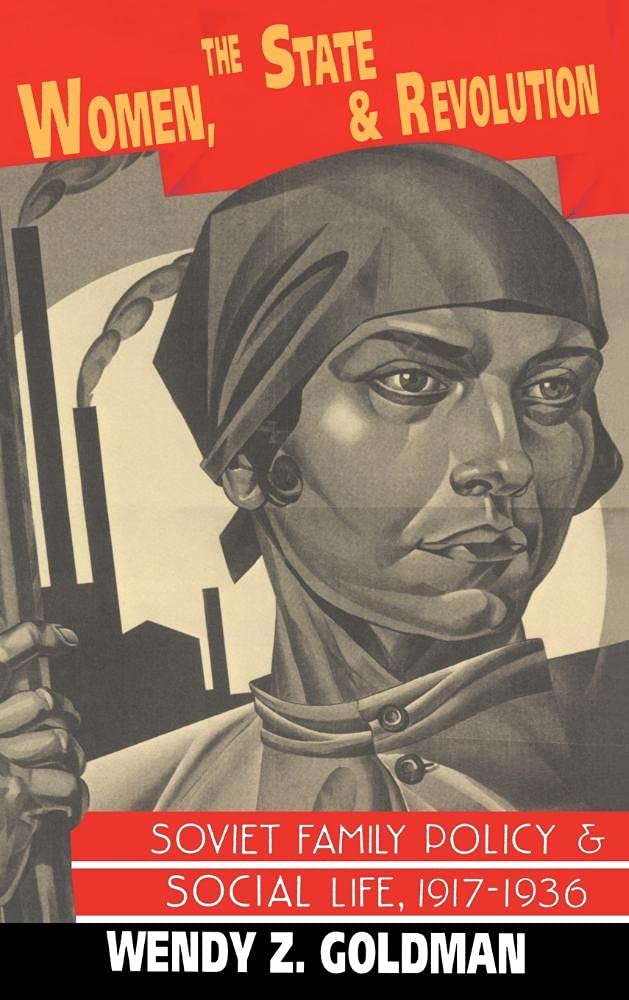
Women, the State and Revolution: Soviet Family Policy and Social Life, 1917–1936 by Wendy Z. Goldman – A Cambridge Unive
Inclusive of all applicable taxes. FREE shipping on all orders.
Available Offers
- 🚚Free Delivery — Free shipping on all orders
- 💵Cash on Delivery — Pay when your order arrives
- ↩️15-Day Easy Returns — Hassle-free return policy
- 🔒Cash on Delivery — Pay safely when your order arrives
Check Delivery
Product Description
Introduction
In the turbulent years following the Russian Revolution, the Bolsheviks envisioned a world where the family would dissolve into a collective society. But what happened when this radical dream collided with the harsh realities of poverty, war, and human resilience? Wendy Z. Goldman’s Women, the State and Revolution: Soviet Family Policy and Social Life, 1917–1936 offers a gripping, scholarly account of this dramatic transformation. Published by Cambridge University Press, this hardcover volume is an essential read for Indian students of history, political science, and sociology who wish to understand how state policies can reshape—and be reshaped by—the most intimate aspects of human life.
Book Overview
This meticulously researched work examines the Soviet experiment with family policy from the Bolshevik takeover in 1917 to the conservative turn of 1936. Goldman challenges simplistic narratives by showing that the reversal from liberating women to reinforcing traditional roles was not a top-down decree alone. Instead, it emerged from a complex dialogue between the state and ordinary citizens—peasant women, urban workers, and orphans—whose daily struggles and resistance forced the government to abandon its utopian ideals. The book reveals how economic scarcity, social chaos, and the sheer weight of patriarchal traditions ultimately shaped Stalinist policies on marriage, divorce, abortion, and childcare.
Key Highlights
- Original archival research drawing on Soviet government records, letters from women, and local party reports.
- Focus on marginalized voices—peasant women, homeless children, and working-class mothers—often ignored in mainstream histories.
- Clear analysis of policy shifts from the 1918 Family Code to the 1936 ban on abortion and promotion of motherhood.
- Comparative perspective linking Soviet family policy to broader debates on gender, state power, and social engineering.
- Accessible narrative style that balances academic rigor with storytelling, making it suitable for both scholars and curious readers.
Inside the Book
The book is divided into thematic chapters that trace the evolution of Soviet family ideology. Early sections explore the Bolshevik belief that women’s domestic labour could be collectivized through communal kitchens and nurseries. Middle chapters delve into the catastrophic impact of civil war, famine, and industrialization, which created millions of orphans and strained state resources. Later sections document the backlash: the rise of pronatalist policies, the criminalization of abortion, and the glorification of the ‘mother-heroine.’ Goldman uses vivid case studies—such as the fate of homeless children known as besprizorniki—to illustrate how policy failures led to a retreat from revolutionary ideals.
Key Topics
- Gender and revolution: How Bolshevik ideology initially sought to liberate women from domestic servitude.
- State vs. society: The tension between top-down decrees and grassroots resistance from women and peasants.
- Family as a political battleground: Debates over divorce, alimony, illegitimacy, and communal childcare.
- Social welfare and its limits: The failure of state-provided services like public dining halls and laundries.
- The Stalinist turn: How economic pressures and demographic fears produced a conservative family policy by 1936.
Reader Benefits
- Deepen your understanding of how revolutionary ideals can be compromised by practical constraints.
- Gain insights into gender studies by seeing how women’s agency shaped—and was shaped by—state power.
- Enhance your knowledge of Soviet history beyond the typical focus on political leaders and industrial plans.
- Develop critical thinking about contemporary debates on family, welfare, and women’s rights in India and globally.
- Access a well-referenced academic work that is also engaging enough for general readers.
Learning Outcomes
After reading this book, you will be able to: analyse the relationship between ideology and policy in revolutionary contexts; evaluate the role of ordinary people in shaping state decisions; understand the historical roots of modern debates on reproductive rights and family structure; and apply comparative perspectives to contemporary issues in Indian family law and social policy. The book also equips you with a nuanced view of how economic crises can drive social conservatism—a lesson relevant to many developing nations today.
Who Should Read
This book is ideal for university students and faculty in history, political science, sociology, and gender studies. It is also highly recommended for policymakers, activists, and journalists interested in the intersections of state power, gender, and social welfare. Indian readers will find striking parallels in debates around the Uniform Civil Code, women’s labour, and family support systems. General readers with a curiosity about how revolutions change everyday life will also find it deeply rewarding.
About the Author
Wendy Z. Goldman is a renowned historian of modern Russia and the Soviet Union. She is the Paul Mellon Distinguished Professor of History at Carnegie Mellon University, where she has taught for decades. Her research focuses on gender, labour, and social policy, and she has authored several acclaimed books, including Inventing the Enemy: Denunciation and Terror in Stalin’s Russia. Goldman’s work is known for its meticulous archival scholarship and its attention to the experiences of ordinary people, especially women and workers.
About the Publisher
Cambridge University Press is one of the world’s oldest and most prestigious academic publishers, with a history dating back to 1534. Known for its rigorous peer-review process and high-quality scholarship, Cambridge publishes groundbreaking works across all disciplines. This hardcover edition reflects the Press’s commitment to durable, beautifully produced books that stand the test of time—perfect for building a serious academic library.
Conclusion
Women, the State and Revolution is not just a history of Soviet family policy; it is a profound meditation on the limits of state power and the resilience of human relationships. For Indian readers, it offers a valuable lens through which to examine our own society’s struggles with gender equality, welfare, and tradition. Whether you are a student preparing for competitive exams, a researcher seeking authoritative sources, or a reader fascinated by Russia’s tumultuous past, this book will challenge and enlighten you. Order your hardcover copy from Bookshops.in today and add a cornerstone of historical scholarship to your collection.
Quick Summary
Women, the State and Revolution: Soviet Family Policy and Social Life, 1917–1936 by Wendy Z. Goldman is a seminal academic work published by Cambridge University Press. It examines the Bolshevik vision of a society where the family would 'wither away,' replaced by communal services like dining halls, daycare, and laundries. Goldman traces how this radical project, launched after the 1917 Russian Revolution, faced resistance from women, peasants, and orphans, ultimately leading to a conservative reversal by 1936 that strengthened traditional family structures and women's reproductive roles. The book is ideal for Indian students and researchers in history, gender studies, and sociology who seek a rigorous, archive-based analysis of state-society interactions. Readers will learn about the interplay between ideology and everyday life, the limits of revolutionary transformation, and the enduring influence of social forces on policy. Buying from Bookshops.in ensures you receive a genuine Cambridge University Press hardcover with reliable delivery across India.
Book Highlights
Book Specifications
| ISBN-13 | 9780521374040 |
| ISBN-10 | 0521374049 |
| Publisher | Cambridge University Press |
| Language | English |
| Dimensions | 16.51 x 2.54 x 24.13 cm |
| Weight | 710 g |
| Country | India |
| Category | World › Women in History |
| Genre | Non-fiction |
| Reading Age | 18+ |
| Original Language | English |
Frequently Asked Questions
What is the main theme of Women, the State and Revolution?
Who is the author Wendy Z. Goldman?
Is this book suitable for undergraduate students in India?
Does the book cover Stalin's era?
What type of binding is this book?
Is the book focused only on women?
What primary sources does the author use?
Can this book help with comparative studies of revolutions?
Is the language complex for non-native English speakers?
Does the book discuss communal living experiments?
Why did the family not wither away according to the book?
Is there a focus on Indian context?
Where can I buy this book in India?
Readers Also Search For
Related Products
View All
History
The Information Revolution: Transforming the World Through Technology (World History)
History
Human Nature and the French Revolution: From the Enlightenment to the Napoleonic Code: 3 (Polygons: Cultural Diversities and Intersections, 3)
History
The Unmaking of Home in Contemporary Art (Cultural Spaces)

History
Handbook to Life in Medieval and Early Modern Japan | by William E. Deal | Oxford University Press | by William E. Deal | Oxford University Press | by William E. Deal | Oxford University Press | by William E. Deal | Oxford University Press | by William E. Deal | Oxford University Press | by William E. Deal | Oxford University Press | by William E. Deal | Oxford University Press | by William E. Deal | Oxford University Press | by William E. Deal | Oxford University Press | by William E. Deal | Ox

History
The Narrators of Barbarian History (A.D. 550-800) | by Walter Goffart | University of Notre Dame Press | by Walter Goffart | University of Notre Dame Press | by Walter Goffart | University of Notre Dame Press | by Walter Goffart | University of Notre Dame Press | by Walter Goffart | University of Notre Dame Press | by Walter Goffart | University of Notre Dame Press | by Walter Goffart | University of Notre Dame Press | by Walter Goffart | University of Notre Dame Press | by Walter Goffart | Univ
History