
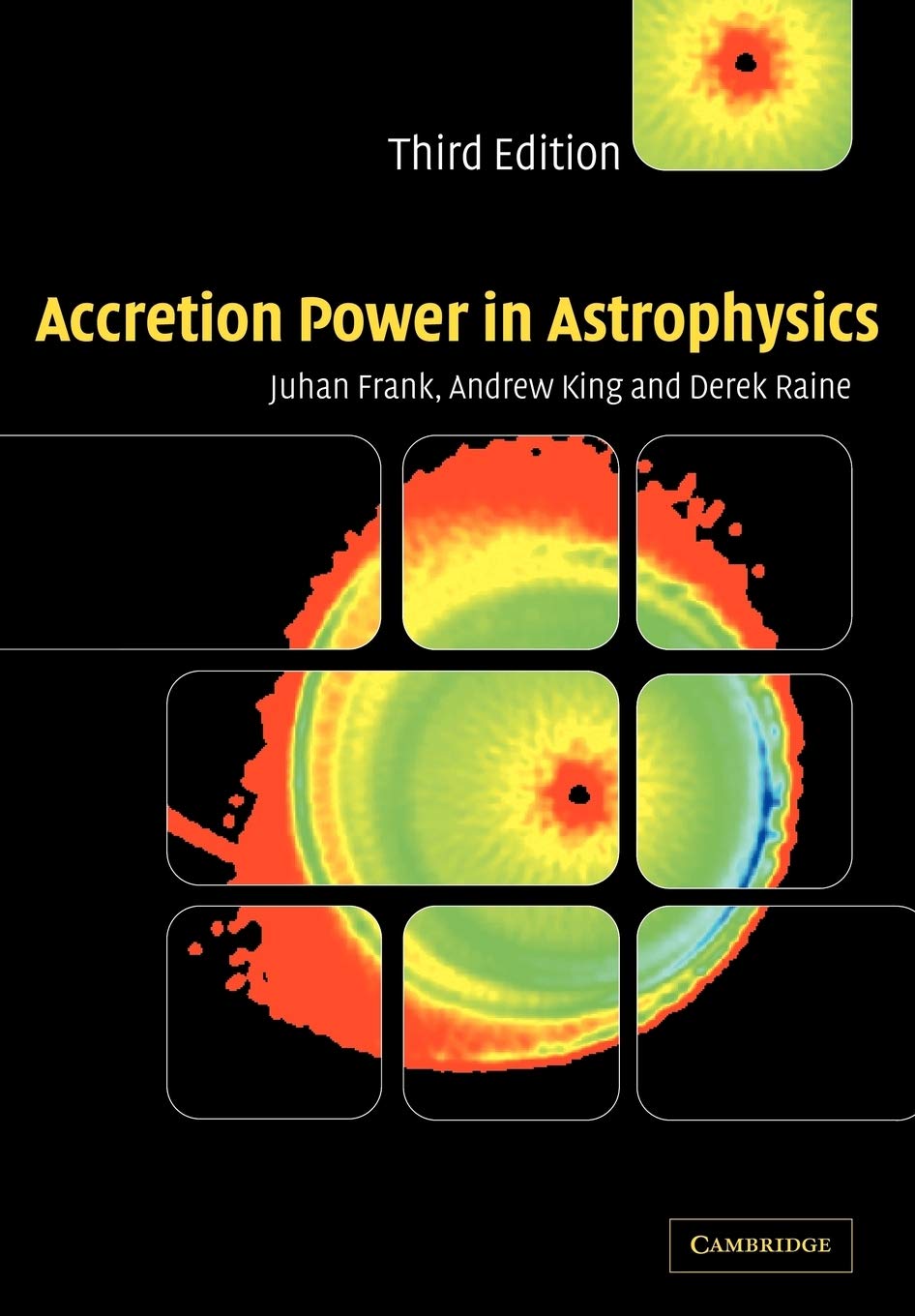
Accretion Power in Astrophysics by Juhan Frank: Advanced Textbook on Accretion Discs and Active Galactic Nuclei
Inclusive of all applicable taxes. FREE shipping on all orders.
Available Offers
- 🚚Free Delivery — Free shipping on all orders
- 💵Cash on Delivery — Pay when your order arrives
- ↩️15-Day Easy Returns — Hassle-free return policy
- 🔒Cash on Delivery — Pay safely when your order arrives
Check Delivery
Product Description
Introduction
Accretion processes are among the most powerful and fascinating phenomena in the universe, driving the energy output of everything from newborn stars to supermassive black holes at the hearts of galaxies. In Accretion Power in Astrophysics, Juhan Frank delivers a masterful and thoroughly updated third edition of the definitive guide to this dynamic field. This hardbound volume from Cambridge University Press is an essential resource for any serious student or researcher of astrophysics in India, offering a deep yet accessible exploration of how matter spirals into compact objects and releases immense energy.
Book Overview
This newly expanded edition builds on the classic foundations of the previous versions, providing a comprehensive treatment of both the theoretical underpinnings and the latest observational insights. Frank meticulously explains the physics of accretion discs, boundary layers, and other flow geometries, connecting them to real astronomical systems such as X-ray binaries, cataclysmic variables, and active galactic nuclei. The book assumes a solid undergraduate grounding in physics and mathematics, making it suitable for advanced B.Sc., M.Sc., and Ph.D. students across Indian universities, as well as for researchers seeking a modern reference.
Key Highlights
- Third Edition Updates: Includes detailed new sections on disc instabilities, irradiated discs, disc warping, and general accretion flows, reflecting the latest research.
- Physical Clarity: Emphasizes the fundamental physics—viscosity, radiation transport, magnetohydrodynamics—without oversimplifying the complexities.
- Broad Scope: Covers both stellar-mass compact objects (white dwarfs, neutron stars, black holes) and supermassive black holes in galactic nuclei.
- Pedagogical Structure: Each chapter builds logically from basic principles to advanced applications, with numerous worked examples and problems.
Inside the Book
The book opens with a review of the observational evidence for accretion and the basic equations of fluid dynamics and radiation transfer. Subsequent chapters delve into the structure of steady thin accretion discs, the role of viscosity, and the emission spectra produced. Later sections explore time-dependent phenomena, including dwarf nova outbursts and the thermal-viscous instability, as well as the unique properties of advection-dominated accretion flows. The final chapters connect these ideas to active galactic nuclei, quasars, and the growth of supermassive black holes.
Key Topics
- Basic equations of accretion flows and angular momentum transport
- Steady thin accretion discs: structure and emission
- Disc instabilities: thermal, viscous, and irradiation-driven
- Boundary layers and the interaction with the central object
- Accretion onto magnetized neutron stars and white dwarfs
- Warped discs and precession phenomena
- Radiatively inefficient accretion flows (ADAFs and RIAFs)
- Accretion in active galactic nuclei and quasar engines
Reader Benefits
By studying this book, readers gain a rigorous, quantitative understanding of how accretion powers some of the brightest sources in the cosmos. The clear derivations and physical insights help bridge the gap between textbook theory and cutting-edge research. Indian students preparing for competitive exams like JEST, GATE, or NET in astrophysics will find the problem sets invaluable for testing their grasp of complex concepts. Researchers will appreciate the extensive references and the synthesis of recent developments.
Learning Outcomes
After working through this volume, readers will be able to: derive the basic equations governing accretion discs; calculate the emitted spectrum from a thin disc; explain the origin of variability in accreting systems; analyze the stability of different accretion regimes; and apply these principles to interpret observations of binary systems and active galaxies. The book equips you with the tools to pursue independent research in high-energy astrophysics.
Who Should Read
This book is ideal for advanced undergraduate and graduate students in physics and astrophysics, postdoctoral researchers, and professional astronomers who want a thorough, modern treatment of accretion physics. It is particularly suited for Indian students enrolled in M.Sc. or integrated Ph.D. programs in astrophysics, as well as faculty members designing courses on compact objects or high-energy phenomena. Anyone with a working knowledge of classical mechanics, electromagnetism, and thermodynamics at the B.Sc. level will find the material accessible and rewarding.
About the Author
Juhan Frank is a distinguished astrophysicist and professor known for his extensive contributions to the study of accretion processes and compact objects. With decades of teaching and research experience, he has a gift for explaining complex physical ideas with clarity and precision. His work has shaped the modern understanding of how matter falls onto black holes and neutron stars, making him a leading authority in the field.
About the Publisher
Cambridge University Press is one of the world's oldest and most respected academic publishers, with a long tradition of producing authoritative textbooks and monographs in the sciences. Their titles are synonymous with rigorous peer review, high editorial standards, and enduring value. This hardcover edition is built to last, featuring high-quality paper and binding suitable for repeated reference in the library or study.
Conclusion
Accretion Power in Astrophysics is more than a textbook; it is a gateway to understanding the engines that drive the most luminous objects in the universe. Whether you are a student embarking on your astrophysics journey or a seasoned researcher seeking a comprehensive update, this third edition delivers the depth and clarity you need. Order your copy today from Bookshops.in and add this cornerstone volume to your collection.
Quick Summary
Accretion Power in Astrophysics by Juhan Frank is a comprehensive third edition that explores the fundamental role of accretion as an energy source in the universe. The book examines accretion in binary star systems containing compact objects like white dwarfs, neutron stars, and black holes, as well as in active galactic nuclei (AGN). It provides a detailed treatment of the physical processes governing accretion discs, including viscosity, turbulence, and magnetic fields. New to this edition are chapters on disc instabilities, irradiated discs, disc warping, and general accretion flows, reflecting the latest research. Assuming a basic knowledge of physics, the text is designed for advanced undergraduates, graduate students, and researchers. Readers will learn how accretion powers phenomena such as X-ray binaries, quasars, and other high-energy astrophysical sources. By integrating theoretical models with observational data, the book offers a thorough understanding of accretion physics. Purchasing from Bookshops.in ensures you receive a genuine, high-quality hardcover copy delivered to your doorstep in India, making it an excellent investment for academic and research purposes.
Book Highlights
Book Specifications
| ISBN-13 | 9780521629577 |
| ISBN-10 | 0521629578 |
| Publisher | Cambridge University Press |
| Language | English |
| Dimensions | 16.99 x 2.31 x 24.41 cm |
| Weight | 640 g |
| Category | Science & Mathematics › Astronomy & Astrophysics |
| Genre | Non-fiction |
| Reading Age | Adult |
| Original Language | English |
Frequently Asked Questions
What is the main focus of Accretion Power in Astrophysics?
Who is the author of this book?
Is this book suitable for beginners?
Does the book include mathematical derivations?
What topics are covered in the new edition?
Is this book used in Indian universities?
How is the book structured?
What is the price of this book at Bookshops.in?
Can I order this book for delivery in India?
Does the book cover black hole accretion?
Are there any prerequisites for reading this book?
What makes this book different from other astrophysics texts?
Is the book available in hardcover?
Does the book include references for further reading?
Readers Also Search For
Customers Also Bought
Mathematics
Stereotype Spaces and Algebras: 73 (De Gruyter Expositions in Mathematics, 73)
Mathematics
Semigroups in Algebra, Geometry and Analysis: 20 (De Gruyter Expositions in Mathematics, 20)
Mathematics
Geometry from the Pacific Rim: Proceedings of the Pacific Rim Geometry Conference held at National University of Singapore, Republic of Singapore, ... 1994 (De Gruyter Proceedings in Mathematics)
Mathematics
First International Tainan-Moscow Algebra Workshop: Proceedings of the International Conference held at National Cheng Kung University Tainan, Taiwan, ... 1994 (De Gruyter Proceedings in Mathematics)
Mathematics
Differential Geometry - Proceedings of the VIII International Colloquium (English, Jesus A. Alvarez Lopez | Eduardo Garcia-Rio)
Mathematics
Mathematical Theory of Optimal Processes (Classics of Soviet Mathematics)
Related Products
View All
Science & Mathematics
Squid - Superconducting Quantum Interference Devices and Their Applications: Proceedings of the International Conference on Superconducting Quantum Devices, Berlin-west, October 4-8, 1976
Science & Mathematics
Thermodynamics and Pattern Formation in Biology
Science & Mathematics
The Nature of Mathematics and the Mathematics of Nature by S. Andersson – Mathematics & Science

Science & Mathematics
Linear Algebra | by Stephen Friedberg | Arnold Insel | Lawrence Spence | Pearson | by Stephen Friedberg | Arnold Insel | Lawrence Spence | Pearson | by Stephen Friedberg | Arnold Insel | Lawrence Spence | Pearson | by Stephen Friedberg | Arnold Insel | Lawrence Spence | Pearson | by Stephen Friedberg | Arnold Insel | Lawrence Spence | Pearson | by Stephen Friedberg | Arnold Insel | Lawrence Spence | Pearson | by Stephen Friedberg | Arnold Insel | Lawrence Spence | Pearson | by Stephen Friedberg
Science & Mathematics
University Calculus | by Joel Hass | Christopher Heil | Maurice Weir | Pearson | by Joel Hass | Christopher Heil | Maurice Weir | Pearson | by Joel Hass | Christopher Heil | Maurice Weir | Pearson | by Joel Hass | Christopher Heil | Maurice Weir | Pearson | by Joel Hass | Christopher Heil | Maurice Weir | Pearson | by Joel Hass | Christopher Heil | Maurice Weir | Pearson | by Joel Hass | Christopher Heil | Maurice Weir | Pearson | by Joel Hass | Christopher Heil | Maurice Weir | Pearson | by Joe

Science & Mathematics