
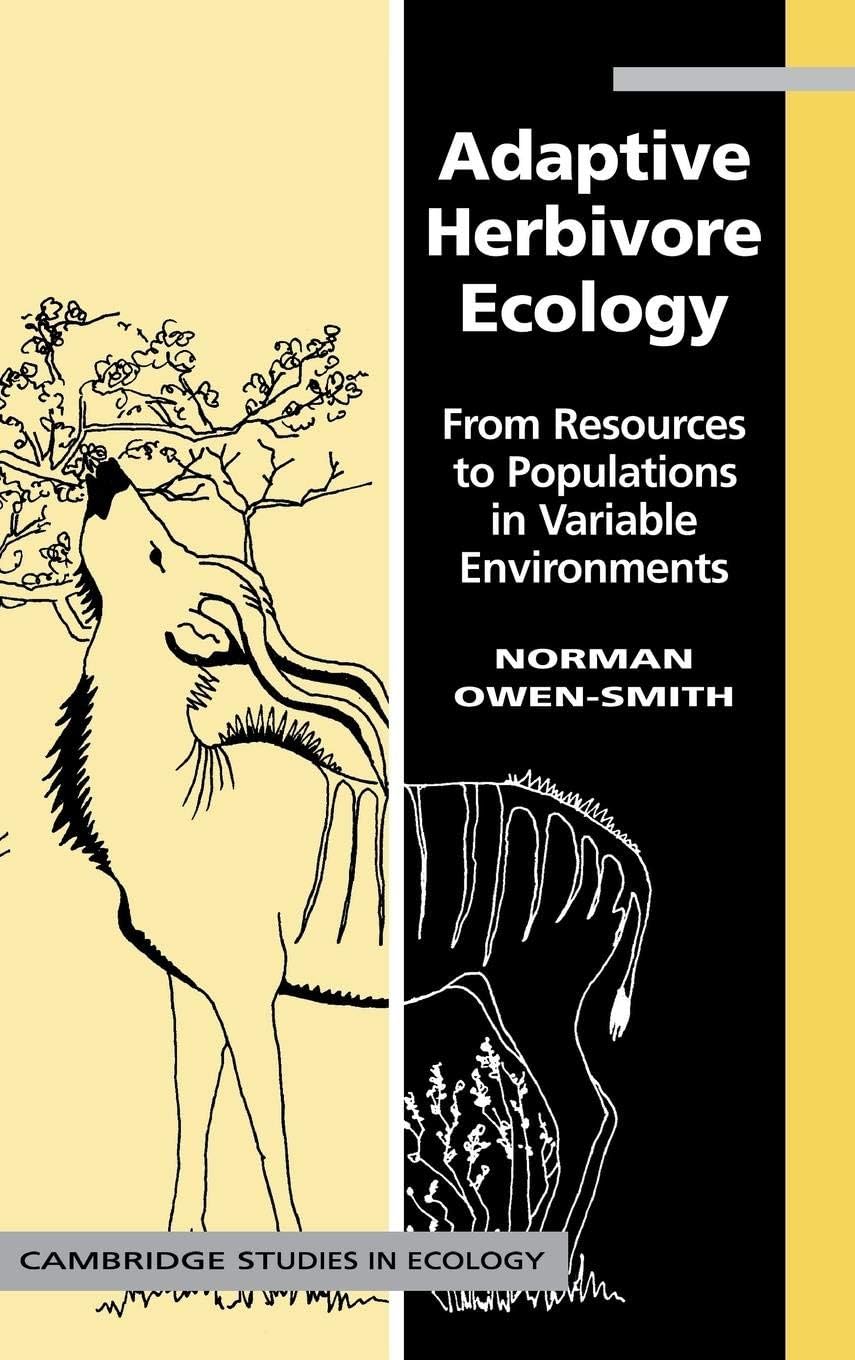
Adaptive Herbivore Ecology: From Resources to Populations in Variable Environments by R. Norman Owen-Smith – A Deep Dive
Inclusive of all applicable taxes. FREE shipping on all orders.
Available Offers
- 🚚Free Delivery — Free shipping on all orders
- 💵Cash on Delivery — Pay when your order arrives
- ↩️15-Day Easy Returns — Hassle-free return policy
- 🔒Cash on Delivery — Pay safely when your order arrives
Check Delivery
Product Description
Introduction
Understanding how large herbivores navigate the challenges of fluctuating food resources is a complex puzzle that ecologists have long sought to solve. In the Indian context, where seasonal monsoons and diverse landscapes create dramatic shifts in vegetation, the principles explored in this book hold particular significance. Adaptive Herbivore Ecology: From Resources to Populations in Variable Environments presents a groundbreaking framework that bridges the gap between individual animal behaviour and broader population dynamics. Written by R. Norman Owen-Smith and published by Cambridge University Press, this hardcover volume offers students and researchers a fresh perspective on how herbivores adapt to environmental variability.
Book Overview
This book moves beyond traditional ecological models that often fail to capture the real-world complexity of herbivore decision-making. Owen-Smith introduces a metaphysiological modelling approach that links adaptive behaviour to population consequences. The work focuses primarily on large mammalian herbivores in seasonally variable environments, such as African savannahs, but extends its insights to temperate zone ungulates. For Indian readers studying systems like the grasslands of the Deccan Plateau or the Himalayan foothills, the concepts are directly transferable. The text carefully examines habitat suitability, species coexistence, and the stability or instability of populations in the face of spatial and temporal resource fluctuations.
Key Highlights
- Innovative modelling framework: A metaphysiological approach that integrates behavioural adaptation with population ecology.
- Focus on variable environments: Emphasis on how seasonal and locational changes in vegetation quantity and quality affect herbivore populations.
- Real-world applications: Examples from African savannahs and temperate zones, with relevance to Indian ecosystems.
- Adaptive consumer responses: Highlights the critical role of flexible behaviour in determining population outcomes.
- Broad applicability: Principles extend to other consumer-resource systems beyond herbivores.
Inside the Book
The book is structured to build from foundational concepts to advanced modelling. Early chapters establish the ecological context of variable environments and the challenges they pose for herbivores. Subsequent sections delve into the metaphysiological model, showing how individual foraging decisions, energy allocation, and movement patterns translate into population-level phenomena. Owen-Smith uses mathematical formulations alongside clear narrative explanations, making the material accessible to readers with a basic background in ecology. Case studies illustrate how the model predicts population responses to droughts, habitat fragmentation, and resource pulses. The final chapters explore implications for community ecology, including competition and coexistence among herbivore species.
Key Topics
- Adaptive foraging behaviour and its ecological consequences
- Metaphysiological modelling of consumer-resource dynamics
- Seasonal and spatial variability in vegetation resources
- Population regulation and stability in variable environments
- Habitat selection and niche partitioning among herbivores
- Implications for conservation and wildlife management
Reader Benefits
- Deepen your understanding: Gain a comprehensive view of how behaviour, ecology, and environment interact.
- Learn a powerful modelling tool: Acquire skills to apply metaphysiological approaches to your own research.
- Bridge theory and practice: See how abstract models explain real-world patterns in herbivore populations.
- Expand your ecological perspective: Appreciate the importance of adaptive responses in shaping community structure.
- Enhance your academic work: Use the book as a reference for papers, theses, or field studies.
Learning Outcomes
By engaging with this book, readers will be able to: explain the limitations of conventional herbivore population models; describe the metaphysiological modelling approach and its components; analyse how environmental variability influences herbivore behaviour and population dynamics; apply the concepts to predict population responses to environmental change; and evaluate the role of adaptive behaviour in species coexistence and community stability.
Who Should Read
This book is ideal for postgraduate students, researchers, and academicians in ecology, wildlife biology, and conservation science. Undergraduate students with a strong foundation in ecology will also find it valuable. Wildlife managers, conservation practitioners, and anyone involved in the study of herbivore populations in seasonally variable environments—including those working in Indian national parks and sanctuaries—will benefit from the insights presented. The book is also relevant for modellers interested in consumer-resource dynamics.
About the Author
R. Norman Owen-Smith is a distinguished ecologist known for his extensive work on large herbivore ecology, particularly in African savannah ecosystems. His research has profoundly influenced our understanding of how herbivores interact with their environment. With decades of field experience and theoretical contributions, Owen-Smith brings a rare combination of empirical knowledge and modelling expertise to this book. His work continues to inspire ecologists worldwide, including those studying similar systems in India.
About the Publisher
Cambridge University Press is one of the world’s oldest and most respected academic publishers. With a reputation for excellence in science and mathematics, the press ensures that each title meets the highest standards of scholarly rigour. This hardcover edition is produced with durable binding and clear typesetting, making it a lasting addition to any academic library.
Conclusion
Adaptive Herbivore Ecology is not just a textbook—it is a paradigm shift in how we think about herbivore populations in changing environments. For Indian ecologists and students grappling with the complexities of monsoon-driven landscapes and human-modified habitats, this book offers both theoretical depth and practical tools. By emphasising the adaptive decisions of animals, Owen-Smith provides a more realistic and predictive framework for understanding population dynamics. Whether you are a researcher, a student, or a wildlife professional, this volume will enrich your perspective and sharpen your analytical skills.
Quick Summary
Adaptive Herbivore Ecology: From Resources to Populations in Variable Environments by R. Norman Owen-Smith is a seminal work that redefines how ecologists understand herbivore adaptation in dynamic landscapes. The book introduces a metaphysiological modelling framework that integrates behavioural plasticity with population-level outcomes, focusing on large mammalian herbivores like those in African savannahs and temperate regions. It examines how seasonal and spatial variations in vegetation quantity and quality drive foraging decisions, habitat use, and ultimately population stability or instability. Readers will learn to apply these models to real-world scenarios, including species coexistence and conservation planning. This book is essential for graduate students, researchers, and wildlife professionals seeking a deeper grasp of ecological complexity. By purchasing from Bookshops.in, Indian readers gain access to a premium hardcover edition from Cambridge University Press, ensuring reliable delivery and authentic products. The book’s rigorous yet accessible approach makes it a valuable addition to any ecology library, bridging theory and practice in a changing world.
Book Highlights
Book Specifications
| ISBN-13 | 9780521810616 |
| ISBN-10 | 0521810612 |
| Publisher | Cambridge University Press |
| Language | English |
| Dimensions | 15.88 x 3.18 x 22.86 cm |
| Weight | 740 g |
| Category | Biology & Life Sciences › Ecology |
| Genre | Non-fiction |
| Original Language | English |
Frequently Asked Questions
What is the main focus of Adaptive Herbivore Ecology?
Who is the author of this book?
Is this book suitable for Indian students?
What kind of modelling approach does the book use?
Which ecosystems are primarily covered?
What topics are explored besides population dynamics?
Is this book a textbook or a research monograph?
Does the book include case studies?
What is the ISBN-13 of this book?
Is the book written in English?
Can this book help in wildlife conservation?
Where can I buy this book in India?
Readers Also Search For
Customers Also Bought

Mathematics
Stereotype Spaces and Algebras: 73 (De Gruyter Expositions in Mathematics, 73)

Mathematics
Semigroups in Algebra, Geometry and Analysis: 20 (De Gruyter Expositions in Mathematics, 20)

Mathematics
Geometry from the Pacific Rim: Proceedings of the Pacific Rim Geometry Conference held at National University of Singapore, Republic of Singapore, ... 1994 (De Gruyter Proceedings in Mathematics)

Mathematics
First International Tainan-Moscow Algebra Workshop: Proceedings of the International Conference held at National Cheng Kung University Tainan, Taiwan, ... 1994 (De Gruyter Proceedings in Mathematics)

Mathematics
Differential Geometry - Proceedings of the VIII International Colloquium (English, Jesus A. Alvarez Lopez | Eduardo Garcia-Rio)

Mathematics
Mathematical Theory of Optimal Processes (Classics of Soviet Mathematics)
Related Products
View All
Science & Mathematics
Elements of Pelagos Biology: With Focus on the Mediterranean Sea

Science & Mathematics
Squid - Superconducting Quantum Interference Devices and Their Applications: Proceedings of the International Conference on Superconducting Quantum Devices, Berlin-west, October 4-8, 1976

Science & Mathematics
Thermodynamics and Pattern Formation in Biology

Science & Mathematics
The Nature of Mathematics and the Mathematics of Nature by S. Andersson – Mathematics & Science

Science & Mathematics
Linear Algebra | by Stephen Friedberg | Arnold Insel | Lawrence Spence | Pearson | by Stephen Friedberg | Arnold Insel | Lawrence Spence | Pearson | by Stephen Friedberg | Arnold Insel | Lawrence Spence | Pearson | by Stephen Friedberg | Arnold Insel | Lawrence Spence | Pearson | by Stephen Friedberg | Arnold Insel | Lawrence Spence | Pearson | by Stephen Friedberg | Arnold Insel | Lawrence Spence | Pearson | by Stephen Friedberg | Arnold Insel | Lawrence Spence | Pearson | by Stephen Friedberg

Science & Mathematics