

Algebraic Statistics for Computational Biology: A Foundational Textbook by L. Pachter for Students and Researchers in Bi
Inclusive of all applicable taxes. FREE shipping on all orders.
Available Offers
- 🚚Free Delivery — Free shipping on all orders
- 💵Cash on Delivery — Pay when your order arrives
- ↩️15-Day Easy Returns — Hassle-free return policy
- 🔒Cash on Delivery — Pay safely when your order arrives
Check Delivery
Product Description
Introduction
Algebraic statistics is a rapidly growing field that merges algebraic geometry with statistical theory, offering powerful tools for analysing complex biological data. In the Indian academic context, where computational biology and bioinformatics are gaining momentum, this book serves as an essential bridge between abstract mathematical concepts and practical biological applications. Algebraic Statistics for Computational Biology, edited by L. Pachter, is a landmark volume that introduces researchers and students to the algebraic underpinnings of modern computational biology. Published by Cambridge University Press, this hardcover edition is a must-have for anyone serious about understanding the mathematical foundations of biological data analysis.
Book Overview
This book presents a cohesive collection of chapters that demonstrate how algebraic methods—such as toric varieties, Gröbner bases, and polytopes—can be applied to problems in phylogenetics, sequence analysis, and statistical modelling. The volume emerged from a series of lectures and workshops, making it highly accessible to readers with a background in mathematics or computer science who are new to biology, as well as biologists seeking deeper mathematical insights. Each chapter is written by leading experts, ensuring both rigour and clarity. The text is self-contained, with introductory material on algebra and statistics, making it suitable for graduate courses and self-study in Indian universities.
Key Highlights
- Pioneering integration of algebraic geometry and statistics tailored for biological problems
- Hands-on approach with examples drawn from real genomic and proteomic datasets
- Comprehensive coverage of phylogenetic trees, hidden Markov models, and contingency tables
- Algorithmic focus suitable for computational implementation in R, MATLAB, or Python
- Authored by international experts including L. Pachter, Bernd Sturmfels, and others
- Hardcover binding ensures durability for frequent reference in libraries and labs
Inside the Book
The book is organised into thirteen chapters, each building on the previous. Early chapters introduce basic algebraic statistics concepts, including the geometry of statistical models and the algebra of discrete data. Middle chapters delve into applications such as constructing phylogenetic trees using algebraic invariants, analysing DNA sequence evolution, and understanding the structure of graphical models. Later chapters explore advanced topics like parametric inference, model selection, and the use of toric ideals in biology. The inclusion of exercises and computational projects makes it ideal for coursework at institutions like IISc, IITs, and NISER.
Key Topics
- Algebraic models for phylogenetic inference
- Gröbner bases and their biological applications
- Markov chains on trees and hidden Markov models
- Polytope methods for evolutionary biology
- Statistical inference using algebraic invariants
- Discrete exponential families and contingency tables
- Parametric alignment and sequence analysis
- Computational algorithms for biological data
Reader Benefits
Readers will gain a solid understanding of how algebraic tools can simplify complex biological problems. The book demystifies the mathematics behind popular bioinformatics methods, enabling researchers to design better algorithms and interpret results more accurately. For Indian students preparing for competitive exams or research careers, this book offers a unique perspective that combines theoretical depth with practical relevance. The clear exposition and worked examples reduce the learning curve for those new to algebraic geometry. Additionally, the hardcover format ensures long-lasting value for personal libraries and institutional collections.
Learning Outcomes
- Understand the algebraic foundations of statistical models used in computational biology
- Apply Gröbner bases and toric geometry to analyse biological sequence data
- Construct and evaluate phylogenetic trees using algebraic invariants
- Implement computational algorithms for model selection and parameter estimation
- Interpret biological results through the lens of algebraic statistics
- Develop original research projects at the intersection of mathematics and biology
Who Should Read
This book is ideal for graduate students and researchers in computational biology, bioinformatics, statistics, and applied mathematics. It is also valuable for faculty members in Indian universities who wish to incorporate modern algebraic methods into their curriculum. Professionals working in genomics, drug discovery, and evolutionary biology will find the practical algorithms directly applicable. Undergraduates with a strong foundation in linear algebra and calculus can also benefit, especially those pursuing honours programmes in mathematics or biotechnology. The book assumes some familiarity with basic statistics and programming, but the introductory chapters make it accessible to a wide audience.
About the Author
L. Pachter is a distinguished professor of computational biology and mathematics at the University of California, Berkeley. He is widely recognised for his pioneering contributions to algebraic statistics, comparative genomics, and RNA sequencing analysis. Pachter has authored numerous influential papers and has been at the forefront of developing mathematical tools for biological discovery. His editorial work on this volume brings together some of the brightest minds in the field, ensuring a high-quality, coherent text. His passion for teaching and interdisciplinary research shines through every chapter, making complex ideas accessible to learners from diverse backgrounds.
About the Publisher
Cambridge University Press is one of the oldest and most respected academic publishers in the world. With a history spanning over four centuries, Cambridge University Press is known for its rigorous peer review and high editorial standards. Their science and mathematics catalogues include seminal works that have shaped modern research. This hardcover edition reflects their commitment to producing durable, high-quality books that serve as trusted resources for scholars and students globally. For Indian readers, Cambridge University Press publications are widely available through Bookshops.in, ensuring timely delivery across the country.
Conclusion
Algebraic Statistics for Computational Biology is more than just a textbook—it is a gateway to a new way of thinking about biological data. By combining algebraic rigour with statistical insight, it equips readers with the intellectual tools needed to tackle some of the most challenging problems in modern biology. Whether you are a student in an Indian university, a researcher in a genomics lab, or a faculty member designing a new course, this book will serve as an invaluable companion. Add this hardcover volume to your collection today and take a definitive step toward mastering the algebraic foundations of computational biology.
Quick Summary
Algebraic Statistics for Computational Biology by L. Pachter is a seminal hardcover textbook that bridges the disciplines of algebra and statistics for applications in computational biology. Published by Cambridge University Press, this book is designed for graduate students and researchers who want to understand how algebraic methods—such as algebraic geometry, tropical geometry, and Markov chains—can be used to model and analyze biological data, particularly in phylogenetics and genomics. Readers will learn to construct statistical models for discrete biological data, infer phylogenetic trees using algebraic techniques, and apply hidden Markov models to sequence analysis. The book is rigorous yet accessible, with numerous examples and exercises that reinforce key concepts. It stands out for its unique focus on the algebraic foundations of statistical inference in biology, making it a valuable resource for Indian students and professionals in bioinformatics, statistics, and computational biology. Purchasing from Bookshops.in ensures you receive a genuine hardcover copy with prompt delivery across India, ideal for academic libraries and personal collections.
Book Highlights
Book Specifications
| ISBN-13 | 9780521857000 |
| ISBN-10 | 0521857007 |
| Publisher | Cambridge University Press |
| Language | English |
| Dimensions | 17.78 x 2.54 x 25.4 cm |
| Weight | 1 kg 120 g |
| Country | India |
| Category | Basic Sciences › Biochemistry |
| Genre | Science & Mathematics |
| Original Language | English |
Frequently Asked Questions
What is Algebraic Statistics for Computational Biology about?
Who is the author of this book?
Is this book suitable for Indian students?
What is the binding of this book?
Does the book include exercises?
What topics are covered in the book?
Is this book for beginners?
Can I use this book for self-study?
What is the ISBN of this book?
Is this book available in Indian bookstores?
Does the book cover practical applications?
What makes this book unique?
What is the price of the book?
Readers Also Search For
Customers Also Bought

Anatomy
Ultrastructure of the Digestive Tract: 4 (Electron Microscopy in Biology and Medicine)

Anatomy
Ultrastructure of the Connective Tissue Matrix: 3 (Electron Microscopy in Biology and Medicine)

Anatomy
Reproductive Genetics (Royal College of Obstetricians and Gynaecologists Study Group)

Anatomy
Human Gross Anatomy: An Outline Text by Robert J. Leonard – Medical Anatomy

Pharmacology
Mathematical Modeling and Simulation in Enteric Neurobiology

Anatomy
Nature’s Patterns and the Fractional Calculus: 2 (Fractional Calculus in Applied Sciences and Engineering, 2)
Related Products
View All
Medicine & Health Sciences
Pediatrics on Call | by Charles A. Pohl | Kathleen Bradford | Clara Callahan | McGraw Hill / Medical | by Charles A. Pohl | Kathleen Bradford | Clara Callahan | McGraw Hill / Medical | by Charles A. Pohl | Kathleen Bradford | Clara Callahan | McGraw Hill / Medical | by Charles A. Pohl | Kathleen Bradford | Clara Callahan | McGraw Hill / Medical | by Charles A. Pohl | Kathleen Bradford | Clara Callahan | McGraw Hill / Medical | by Charles A. Pohl | Kathleen Bradford | Clara Callahan | McGraw Hill

Medicine & Health Sciences
The Physician's Guide to Depression and Bipolar Disorders | by Dwight L. Evans | Dennis S. Charney | Lydia Lewis | McGraw Hill / Medical | by Dwight L. Evans | Dennis S. Charney | Lydia Lewis | McGraw Hill / Medical | by Dwight L. Evans | Dennis S. Charney | Lydia Lewis | McGraw Hill / Medical | by Dwight L. Evans | Dennis S. Charney | Lydia Lewis | McGraw Hill / Medical | by Dwight L. Evans | Dennis S. Charney | Lydia Lewis | McGraw Hill / Medical | by Dwight L. Evans | Dennis S. Charney | Lydi
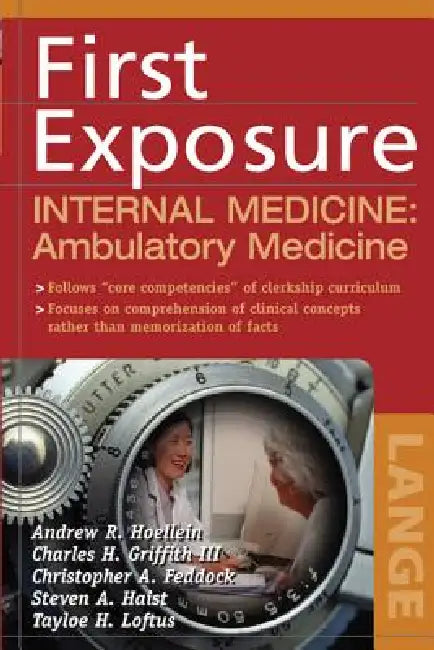
Medicine & Health Sciences
First Exposure to Internal Medicine | by Andrew R. Hoellein | Charles H. Griffith | McGraw Hill / Medical | by Andrew R. Hoellein | Charles H. Griffith | McGraw Hill / Medical | by Andrew R. Hoellein | Charles H. Griffith | McGraw Hill / Medical | by Andrew R. Hoellein | Charles H. Griffith | McGraw Hill / Medical | by Andrew R. Hoellein | Charles H. Griffith | McGraw Hill / Medical | by Andrew R. Hoellein | Charles H. Griffith | McGraw Hill / Medical | by Andrew R. Hoellein | Charles H. Griffit

Medicine & Health Sciences
First Exposure to Internal Medicine | by Charles H. Griffith | Andrew R. Hoellein | McGraw Hill / Medical | by Charles H. Griffith | Andrew R. Hoellein | McGraw Hill / Medical | by Charles H. Griffith | Andrew R. Hoellein | McGraw Hill / Medical | by Charles H. Griffith | Andrew R. Hoellein | McGraw Hill / Medical | by Charles H. Griffith | Andrew R. Hoellein | McGraw Hill / Medical | by Charles H. Griffith | Andrew R. Hoellein | McGraw Hill / Medical | by Charles H. Griffith | Andrew R. Hoellei

Medicine & Health Sciences
Internal Medicine | by Paul G. Schmitz | Kevin J. Martin | McGraw Hill / Medical | by Paul G. Schmitz | Kevin J. Martin | McGraw Hill / Medical | by Paul G. Schmitz | Kevin J. Martin | McGraw Hill / Medical | by Paul G. Schmitz | Kevin J. Martin | McGraw Hill / Medical | by Paul G. Schmitz | Kevin J. Martin | McGraw Hill / Medical | by Paul G. Schmitz | Kevin J. Martin | McGraw Hill / Medical | by Paul G. Schmitz | Kevin J. Martin | McGraw Hill / Medical | by Paul G. Schmitz | Kevin J. Martin |

Medicine & Health Sciences