
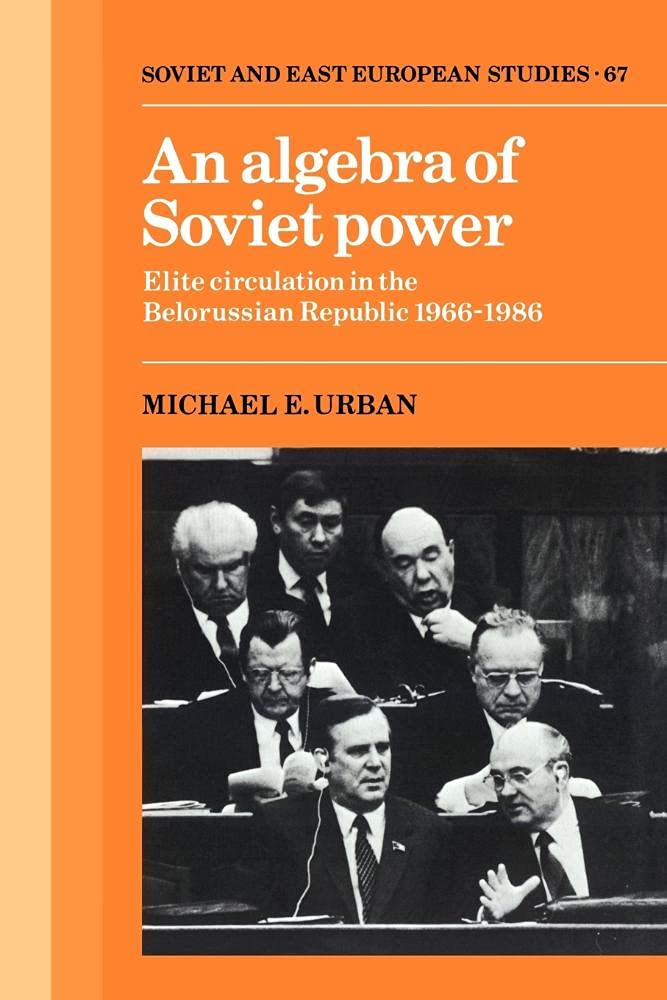
An Algebra of Soviet Power: Elite Circulation in the Belorussian Republic 1966–86 by Michael E. Urban – A Groundbreaking
Inclusive of all applicable taxes. FREE shipping on all orders.
Available Offers
- 🚚Free Delivery — Free shipping on all orders
- 💵Cash on Delivery — Pay when your order arrives
- ↩️15-Day Easy Returns — Hassle-free return policy
- 🔒Cash on Delivery — Pay safely when your order arrives
Check Delivery
Product Description
Introduction
In the study of Soviet politics, few questions are as enduring as that of power: who holds it, how is it gained, and what determines the movement of individuals through the corridors of authority? An Algebra of Soviet Power: Elite Circulation in the Belorussian Republic 1966–86 by Michael E. Urban offers a groundbreaking analytical lens to understand these dynamics. This hardcover volume from Cambridge University Press is an essential resource for students, researchers, and scholars of political science, sociology, and Soviet history who seek a rigorous, data-driven exploration of elite mobility within a Soviet republic.
Book Overview
Published by the prestigious Cambridge University Press, this work introduces a novel methodological approach—vacancy chain analysis—to the study of political elites. Focusing on the Belorussian Soviet Socialist Republic over two decades (1966–1986), Urban meticulously examines career trajectories of thousands of officials. Rather than relying on anecdotal evidence or individual case studies, the book treats personnel movements as structured sequences shaped by the systemic properties of the nomenklatura system. The result is a compelling, algebraically informed portrait of how power circulated in one of the USSR's key republics, revealing patterns that challenge conventional understandings of Soviet governance.
Key Highlights
- Innovative Methodology: Pioneers the use of vacancy chain analysis—typically applied in organizational sociology—to Soviet elite studies.
- Rich Empirical Data: Based on extensive career records of Belorussian party and state officials over a twenty-year period.
- Systemic Focus: Moves beyond individual intentions to explore how the personnel system itself structures elite movement.
- Rigorous Academic Scholarship: Published by Cambridge University Press, ensuring high standards of peer review and academic credibility.
- Contextual Relevance: Offers insights into the internal workings of a non-Russian Soviet republic, often underrepresented in mainstream Soviet studies.
Inside the Book
Urban systematically builds his argument across chapters that blend theoretical exposition with empirical analysis. He first introduces the concept of vacancy chains and explains its applicability to Soviet political structures. Subsequent chapters detail the career data from Belorussia, mapping how vacancies at higher levels create cascading opportunities downward. The book examines the interplay between formal nomenklatura rules and actual mobility patterns, revealing that despite central control, local dynamics and institutional constraints significantly shaped who rose to power. Tables, charts, and statistical models support the analysis, making complex ideas accessible to readers with a background in social science methods.
Key Topics
- Vacancy chain theory and its application to political systems
- Nomenklatura system: formal rules versus practical operation
- Elite circulation and career mobility in Soviet republics
- Political sociology of the Belorussian SSR (1966–1986)
- Quantitative methods in political science and history
- Comparative elite studies and institutional analysis
Reader Benefits
By engaging with this book, you will gain a sophisticated understanding of how power actually functioned at the republic level in the late Soviet period. The analytical framework equips you with tools to study elite dynamics in other authoritarian or hierarchical systems. For researchers, the methodological innovation offers a replicable model for analyzing career data. Students will appreciate the clear exposition of complex sociological concepts, while policy analysts can draw parallels to contemporary bureaucratic systems. The book also deepens appreciation for the diversity of Soviet experiences beyond Moscow-centric narratives.
Learning Outcomes
- Understand vacancy chain analysis and its application to political elite studies
- Analyze how the nomenklatura system structured career opportunities and constraints
- Evaluate the role of institutional rules versus informal practices in shaping elite mobility
- Interpret quantitative data on career trajectories within a historical context
- Critically assess conventional theories of Soviet power and decision-making
- Apply insights from Belorussian case study to broader comparative politics
Who Should Read
This book is ideal for postgraduate students and faculty in political science, sociology, history, and Soviet studies. It will also appeal to researchers specializing in elite theory, organizational behavior, and quantitative social science. Professionals in public administration or policy analysis with an interest in bureaucratic systems will find the vacancy chain framework valuable. Finally, anyone with a serious interest in understanding the inner workings of Soviet power—beyond the Kremlin—will find this a rewarding and intellectually stimulating read.
About the Author
Michael E. Urban is a distinguished scholar of Soviet and post-Soviet politics. With a career spanning several decades, he has contributed extensively to the study of elite recruitment, political institutions, and comparative communism. His work is known for its methodological rigor and theoretical depth, combining quantitative techniques with nuanced historical analysis. Urban’s research has been published in leading academic journals and by top university presses, cementing his reputation as an innovative thinker in the field.
About the Publisher
Cambridge University Press is one of the world’s oldest and most respected academic publishers. Founded in 1534, it has a long tradition of disseminating high-quality scholarship across disciplines. The Press is known for its rigorous editorial standards, and its publications are widely used in universities and research institutions globally. This book exemplifies Cambridge’s commitment to advancing knowledge through innovative and carefully researched works.
Conclusion
An Algebra of Soviet Power is not merely a study of one republic’s elite; it is a methodological landmark that reshapes how we understand political mobility in hierarchical systems. Michael Urban’s application of vacancy chain analysis to the Belorussian case offers fresh insights into the interplay of structure, opportunity, and power. For anyone serious about Soviet history, political sociology, or elite studies, this hardcover edition is an indispensable addition to your library. Order your copy today from Bookshops.in and delve into a work that combines analytical brilliance with empirical depth.
Quick Summary
An Algebra of Soviet Power by Michael E. Urban is a groundbreaking work that applies vacancy chain analysis—a sociological technique—to the study of Soviet elite circulation. Focusing on the Belorussian Republic from 1966 to 1986, Urban uses extensive career data to show how the personnel system, rather than individual intentions, structured the movement of officials into positions of power. This book challenges conventional understandings of Soviet politics by revealing the underlying algebraic logic of office control. It is ideal for graduate students, researchers, and academics in political science, sociology, and Soviet history who seek a rigorous, quantitative approach to elite studies. Readers will learn how vacancy chains operate in authoritarian contexts and gain new insights into the mechanics of power. By purchasing from Bookshops.in, Indian customers receive a genuine hardcover edition from Cambridge University Press with fast, reliable service.
Book Highlights
Book Specifications
| ISBN-13 | 9780521054881 |
| ISBN-10 | 0521054885 |
| Publisher | Cambridge University Press |
| Language | English |
| Dimensions | 15.24 x 1.27 x 22.86 cm |
| Weight | 308 g |
| Country | India |
| Category | Social Sciences › Political Science |
| Genre | Political Science |
| Original Language | English |
Frequently Asked Questions
What is vacancy chain analysis?
Who is the author of An Algebra of Soviet Power?
Which time period does the book cover?
Is this book suitable for undergraduate students?
What makes this book different from other studies of Soviet elites?
Does the book discuss the Communist Party of the Soviet Union?
What is the main argument of the book?
Is the book available in hardcover?
What language is the book written in?
Which publisher released this book?
Can this book be used for a course on Soviet politics?
Does the book include data on individual officials?
Why buy from Bookshops.in?
Readers Also Search For
Customers Also Bought
Mathematics
Stereotype Spaces and Algebras: 73 (De Gruyter Expositions in Mathematics, 73)
Mathematics
Semigroups in Algebra, Geometry and Analysis: 20 (De Gruyter Expositions in Mathematics, 20)
Mathematics
Geometry from the Pacific Rim: Proceedings of the Pacific Rim Geometry Conference held at National University of Singapore, Republic of Singapore, ... 1994 (De Gruyter Proceedings in Mathematics)
Mathematics
First International Tainan-Moscow Algebra Workshop: Proceedings of the International Conference held at National Cheng Kung University Tainan, Taiwan, ... 1994 (De Gruyter Proceedings in Mathematics)
Mathematics
Differential Geometry - Proceedings of the VIII International Colloquium (English, Jesus A. Alvarez Lopez | Eduardo Garcia-Rio)
Mathematics
Mathematical Theory of Optimal Processes (Classics of Soviet Mathematics)
Related Products
View All
Science & Mathematics
Elements of Pelagos Biology: With Focus on the Mediterranean Sea
Science & Mathematics
Squid - Superconducting Quantum Interference Devices and Their Applications: Proceedings of the International Conference on Superconducting Quantum Devices, Berlin-west, October 4-8, 1976
Science & Mathematics
Thermodynamics and Pattern Formation in Biology

Science & Mathematics
The Nature of Mathematics and the Mathematics of Nature by S. Andersson – Mathematics & Science

Science & Mathematics
Linear Algebra | by Stephen Friedberg | Arnold Insel | Lawrence Spence | Pearson | by Stephen Friedberg | Arnold Insel | Lawrence Spence | Pearson | by Stephen Friedberg | Arnold Insel | Lawrence Spence | Pearson | by Stephen Friedberg | Arnold Insel | Lawrence Spence | Pearson | by Stephen Friedberg | Arnold Insel | Lawrence Spence | Pearson | by Stephen Friedberg | Arnold Insel | Lawrence Spence | Pearson | by Stephen Friedberg | Arnold Insel | Lawrence Spence | Pearson | by Stephen Friedberg

Science & Mathematics