
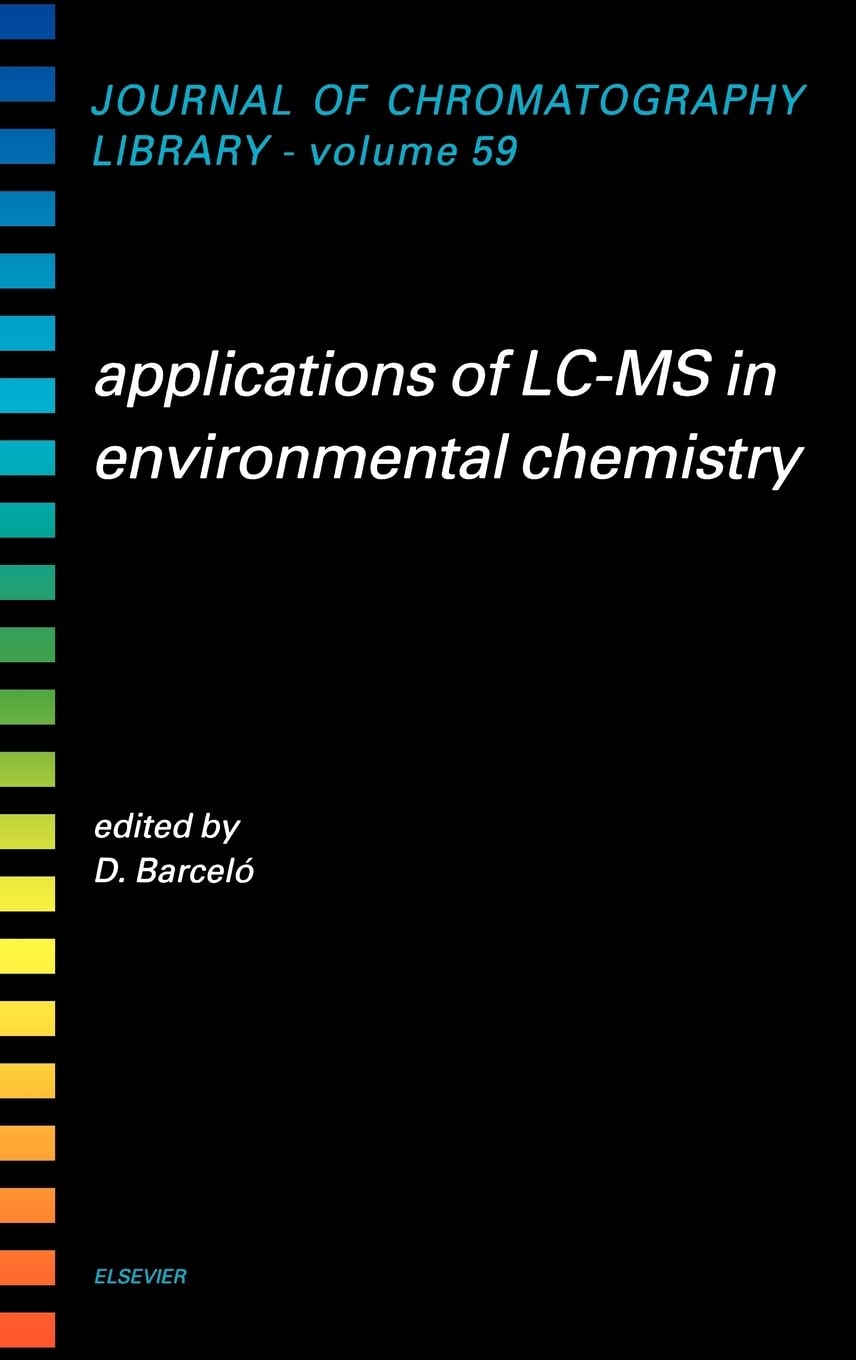
Applications of LC-MS in Environmental Chemistry: A Critical Evaluation of Liquid Chromatography-Mass Spectrometry Inter
Inclusive of all applicable taxes. FREE shipping on all orders.
Available Offers
- 🚚Free Delivery — Free shipping on all orders
- 💵Cash on Delivery — Pay when your order arrives
- ↩️15-Day Easy Returns — Hassle-free return policy
- 🔒Cash on Delivery — Pay safely when your order arrives
Check Delivery
Product Description
Introduction
In an era where environmental monitoring and chemical safety are paramount, analytical chemists and environmental scientists face the challenge of detecting and quantifying trace-level contaminants in complex matrices. Applications of LC-MS in Environmental Chemistry, authored by Damià Barceló and published by Elsevier Science, offers a rigorous, hands-on guide to liquid chromatography-mass spectrometry (LC-MS) techniques tailored for environmental analysis. This hardbound volume bridges the gap between fundamental theory and real-world application, making it an indispensable resource for researchers, laboratory professionals, and postgraduate students in India and worldwide.
Book Overview
This comprehensive reference work systematically addresses the critical questions that practitioners encounter: Which interface should be used to solve a specific detection problem? Can sufficient sensitivity be achieved for confirmation of target compounds in actual environmental samples? Is the structural information obtained adequate for regulatory compliance? By focusing on the most relevant interfacing systems—particle beam (PB), thermospray (TSP), and electrospray (ES)—the book provides a critical evaluation of LC-MS methodologies. It covers the characterization of pesticides, detergents, industrial dyes, polar metabolites, waste streams, organotin compounds, and marine toxins, with detailed comparisons between different interfacing approaches.
Key Highlights
- Critical evaluation of LC-MS interfaces – In-depth analysis of PB, TSP, and ES systems for environmental applications
- Real-world sample focus – Strategies for achieving sensitivity and confirmation in complex matrices like river water, soil, and wastewater
- Comparative studies – Side-by-side assessments of different interfacing techniques for specific compound classes
- Practical guidance – Step-by-step approaches to method development and troubleshooting
- Regulatory relevance – Coverage of compounds listed in Indian and international environmental monitoring programs
Inside the Book
The book is structured into distinct thematic sections, beginning with fundamental aspects of LC-MS interfacing and ionization mechanisms. Subsequent chapters delve into application areas, each dedicated to a specific class of environmental contaminants. Detailed case studies illustrate how to optimize parameters for detection limits, selectivity, and structural elucidation. The text also includes discussions on waste stream analysis and the challenges of polar metabolite identification, making it equally valuable for academic research and routine laboratory work.
Key Topics
- Fundamentals of LC-MS interfacing: PB, TSP, and ES systems
- Optimization of ionization conditions for environmental pollutants
- Analysis of pesticides and their transformation products
- Characterization of surfactants, detergents, and industrial dyes
- Detection of polar metabolites in water and soil samples
- Organotin compounds and marine toxin identification
- Waste stream profiling and environmental forensic applications
- Comparison of sensitivity and structural information across interfaces
Reader Benefits
This book empowers readers to make informed decisions about instrument selection and method design. It reduces trial-and-error in the laboratory by providing proven protocols and troubleshooting tips. Indian students and professionals will appreciate the focus on compounds relevant to local agricultural, industrial, and coastal environments. The critical comparisons help laboratories optimize resources, whether they are using older TSP systems or modern ES interfaces. Ultimately, the reader gains the confidence to tackle challenging environmental samples with robust, reproducible results.
Learning Outcomes
- Select the appropriate LC-MS interface for a given environmental detection problem
- Develop sensitive methods for trace-level confirmation of contaminants
- Interpret mass spectral data for structural identification of unknown compounds
- Compare and contrast the performance of PB, TSP, and ES systems
- Apply LC-MS techniques to real-world samples including water, sediment, and biological matrices
- Design experiments that meet regulatory standards for environmental monitoring
Who Should Read
This book is ideally suited for analytical chemists, environmental scientists, and laboratory technicians working in government testing labs, private environmental consultancies, and research institutions across India. Postgraduate students in chemistry, environmental science, and pharmaceutical analysis will find it a valuable textbook for advanced instrumental analysis courses. It is also an excellent reference for faculty members developing curricula in environmental chemistry and mass spectrometry.
About the Author
Damià Barceló is a highly respected authority in environmental analytical chemistry, with decades of research experience in the development and application of LC-MS techniques. He has authored numerous peer-reviewed articles and edited several landmark volumes on water quality and pollutant analysis. His work has shaped international guidelines for monitoring organic contaminants in aquatic ecosystems.
About the Publisher
Elsevier Science is a globally recognized publisher of scientific, technical, and medical content. With a legacy of rigorous peer review and high editorial standards, Elsevier delivers authoritative resources that advance research and education. This hardcover edition ensures durability for frequent use in laboratory and library settings.
Conclusion
Applications of LC-MS in Environmental Chemistry is more than a technical manual—it is a strategic guide for solving real-world detection challenges. By demystifying interface selection and method optimization, it enables environmental professionals to achieve reliable, defensible results. For Indian readers committed to safeguarding environmental health through precise analytical science, this book is an essential addition to their professional library.
Quick Summary
Applications of LC-MS in Environmental Chemistry by Damià Barceló is an essential reference for anyone involved in environmental analysis using liquid chromatography-mass spectrometry. The book systematically evaluates the most relevant LC-MS interfacing systems—particle beam, thermospray, and electrospray—providing critical insights into their sensitivity, structural information, and applicability to real-world environmental samples. It is designed for analytical chemists, environmental scientists, and graduate students who need to select the best method for detecting and confirming trace contaminants in water, soil, and air. Readers will learn how to optimize method development, achieve reliable confirmation of pollutants, and interpret mass spectral data. This hardcover edition from Elsevier Science is a durable resource for Indian research laboratories and academic libraries. By purchasing from Bookshops.in, customers receive a genuine imported edition with fast delivery across India, backed by trusted customer service.
Book Highlights
Book Specifications
| ISBN-13 | 9780444820679 |
| ISBN-10 | 0444820671 |
| Publisher | Elsevier Science Ltd |
| Language | English |
| Dimensions | 17.78 x 3.18 x 24.77 cm |
| Weight | 1 kg 180 g |
| Category | Clinical › Internal Medicine |
| Genre | Non-fiction |
| Original Language | English |
Frequently Asked Questions
What does LC-MS stand for?
Who is the author of this book?
What is the main focus of the book?
Is this book suitable for beginners?
Which environmental samples are covered?
What are the key interfacing systems discussed?
Is this book useful for Indian researchers?
Does the book include practical guidance?
What is the ISBN-13?
Is this a hardcover book?
How can I order this book in India?
Does the book cover sample preparation?
What types of pollutants are discussed?
Readers Also Search For
Customers Also Bought

Anatomy
Ultrastructure of the Digestive Tract: 4 (Electron Microscopy in Biology and Medicine)

Anatomy
Ultrastructure of the Connective Tissue Matrix: 3 (Electron Microscopy in Biology and Medicine)

Anatomy
Reproductive Genetics (Royal College of Obstetricians and Gynaecologists Study Group)

Anatomy
Human Gross Anatomy: An Outline Text by Robert J. Leonard – Medical Anatomy

Pharmacology
Mathematical Modeling and Simulation in Enteric Neurobiology

Anatomy
Nature’s Patterns and the Fractional Calculus: 2 (Fractional Calculus in Applied Sciences and Engineering, 2)
Related Products
View All
Medicine & Health Sciences
Pediatrics on Call | by Charles A. Pohl | Kathleen Bradford | Clara Callahan | McGraw Hill / Medical | by Charles A. Pohl | Kathleen Bradford | Clara Callahan | McGraw Hill / Medical | by Charles A. Pohl | Kathleen Bradford | Clara Callahan | McGraw Hill / Medical | by Charles A. Pohl | Kathleen Bradford | Clara Callahan | McGraw Hill / Medical | by Charles A. Pohl | Kathleen Bradford | Clara Callahan | McGraw Hill / Medical | by Charles A. Pohl | Kathleen Bradford | Clara Callahan | McGraw Hill

Medicine & Health Sciences
The Physician's Guide to Depression and Bipolar Disorders | by Dwight L. Evans | Dennis S. Charney | Lydia Lewis | McGraw Hill / Medical | by Dwight L. Evans | Dennis S. Charney | Lydia Lewis | McGraw Hill / Medical | by Dwight L. Evans | Dennis S. Charney | Lydia Lewis | McGraw Hill / Medical | by Dwight L. Evans | Dennis S. Charney | Lydia Lewis | McGraw Hill / Medical | by Dwight L. Evans | Dennis S. Charney | Lydia Lewis | McGraw Hill / Medical | by Dwight L. Evans | Dennis S. Charney | Lydi
Medicine & Health Sciences
First Exposure to Internal Medicine | by Andrew R. Hoellein | Charles H. Griffith | McGraw Hill / Medical | by Andrew R. Hoellein | Charles H. Griffith | McGraw Hill / Medical | by Andrew R. Hoellein | Charles H. Griffith | McGraw Hill / Medical | by Andrew R. Hoellein | Charles H. Griffith | McGraw Hill / Medical | by Andrew R. Hoellein | Charles H. Griffith | McGraw Hill / Medical | by Andrew R. Hoellein | Charles H. Griffith | McGraw Hill / Medical | by Andrew R. Hoellein | Charles H. Griffit
Medicine & Health Sciences
First Exposure to Internal Medicine | by Charles H. Griffith | Andrew R. Hoellein | McGraw Hill / Medical | by Charles H. Griffith | Andrew R. Hoellein | McGraw Hill / Medical | by Charles H. Griffith | Andrew R. Hoellein | McGraw Hill / Medical | by Charles H. Griffith | Andrew R. Hoellein | McGraw Hill / Medical | by Charles H. Griffith | Andrew R. Hoellein | McGraw Hill / Medical | by Charles H. Griffith | Andrew R. Hoellein | McGraw Hill / Medical | by Charles H. Griffith | Andrew R. Hoellei
Medicine & Health Sciences
Internal Medicine | by Paul G. Schmitz | Kevin J. Martin | McGraw Hill / Medical | by Paul G. Schmitz | Kevin J. Martin | McGraw Hill / Medical | by Paul G. Schmitz | Kevin J. Martin | McGraw Hill / Medical | by Paul G. Schmitz | Kevin J. Martin | McGraw Hill / Medical | by Paul G. Schmitz | Kevin J. Martin | McGraw Hill / Medical | by Paul G. Schmitz | Kevin J. Martin | McGraw Hill / Medical | by Paul G. Schmitz | Kevin J. Martin | McGraw Hill / Medical | by Paul G. Schmitz | Kevin J. Martin |

Medicine & Health Sciences