
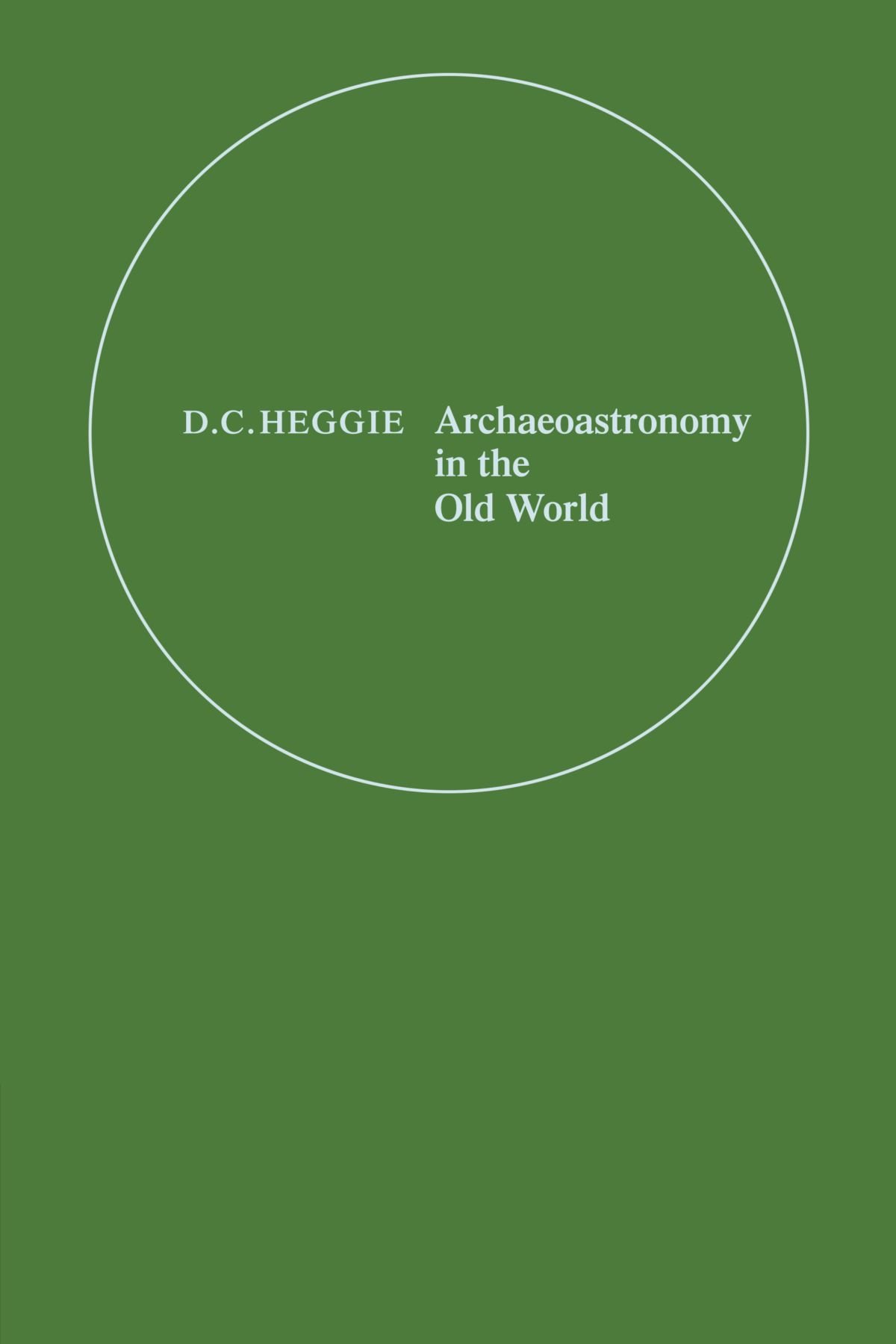
Archaeoastronomy in the Old World: Ancient Astronomy in Neolithic and Bronze Age Europe by D. C. Heggie
Inclusive of all applicable taxes. FREE shipping on all orders.
Available Offers
- 🚚Free Delivery — Free shipping on all orders
- 💵Cash on Delivery — Pay when your order arrives
- ↩️15-Day Easy Returns — Hassle-free return policy
- 🔒Cash on Delivery — Pay safely when your order arrives
Check Delivery
Product Description
Introduction
Archaeoastronomy in the Old World, edited by D. C. Heggie and published by Cambridge University Press, is a seminal work that bridges the gap between astronomy, archaeology, and ancient history. This hardcover volume presents a comprehensive overview of the research presented at a landmark conference held at the University of Oxford in 1981, under the auspices of the International Astronomical Union and the International Union for the History and Philosophy of Science. For Indian readers and students fascinated by how ancient civilizations understood the cosmos, this book offers a rigorous yet accessible exploration of the astronomical practices of prehistoric Europe, particularly in north-west Europe during the late Neolithic and Bronze Ages.
Book Overview
This volume is a collection of scholarly papers that delve into one of the most intriguing questions in European prehistory: did ancient peoples in the Old World practice astronomy, and if so, for what purpose? The book critically examines the evidence for astronomical alignments in megalithic structures, stone circles, and other ancient monuments. It brings together perspectives from statisticians, astronomers, and prehistorians, offering a multidisciplinary approach that is both thorough and thought-provoking. The work is especially valuable for its balanced treatment of controversial claims, presenting both supporting data and skeptical analyses.
Key Highlights
- Multidisciplinary Collaboration: Features contributions from leading astronomers, statisticians, and archaeologists, ensuring a well-rounded scientific perspective.
- Focus on European Prehistory: Concentrates on the Neolithic and Bronze Age cultures of north-west Europe, including the British Isles and Brittany.
- Critical Evaluation: Provides a rigorous assessment of statistical methods used to identify ancient astronomical alignments, a topic of enduring interest.
- Historical Context: Situates the debate within the broader history of science and archaeology, making it relevant for students of both fields.
- Enduring Relevance: Despite its origins in the early 1980s, the methodological discussions remain foundational for contemporary archaeoastronomy.
Inside the Book
The book is structured around a series of papers presented at the 1981 Oxford conference. Early chapters introduce the fundamental concepts of archaeoastronomy and the challenges of interpreting ancient monuments. Subsequent sections present detailed case studies of specific sites, such as Stonehenge and other megalithic complexes, examining their potential alignments with solstices, equinoxes, and lunar standstills. A significant portion of the volume is dedicated to statistical techniques for testing the significance of these alignments, addressing the skepticism of mainstream archaeologists. The final chapters explore the social and cultural implications of astronomical knowledge in prehistoric societies, questioning whether astronomy served ritual, calendrical, or practical purposes.
Key Topics
- Megalithic Astronomy: Analysis of stone circles, standing stones, and passage tombs for solar and lunar alignments.
- Statistical Methods in Archaeology: How probability and statistics are used to evaluate claims of ancient astronomical knowledge.
- Neolithic and Bronze Age Chronology: The cultural and temporal context of the monuments under study.
- Interdisciplinary Debates: The friction between scientific and humanistic approaches to prehistory.
- Calendrical Systems: Evidence for ancient timekeeping and seasonal markers.
Reader Benefits
Readers will gain a deep understanding of how ancient peoples may have observed the sky and integrated that knowledge into their built environment. The book equips students and enthusiasts with the critical tools to evaluate archaeological claims, fostering a healthy skepticism while appreciating the ingenuity of prehistoric cultures. It also serves as a model for interdisciplinary research, demonstrating how astronomy, statistics, and archaeology can inform one another. For Indian readers, the methodologies discussed are transferable to the study of India's own ancient astronomical traditions, such as those seen in the Indus Valley and Vedic periods.
Learning Outcomes
- Understand the fundamental principles of archaeoastronomy and its historical development.
- Evaluate the evidence for astronomical alignments in European megalithic structures.
- Apply basic statistical reasoning to archaeological data and interpret significance tests.
- Appreciate the cultural and social contexts in which ancient astronomy was practiced.
- Critically assess popular claims about prehistoric science and technology.
Who Should Read
This book is ideal for undergraduate and postgraduate students in archaeology, astronomy, history of science, and anthropology. It is also highly recommended for amateur astronomers, history enthusiasts, and anyone curious about the roots of scientific thought in the ancient world. Indian readers with an interest in global archaeoastronomy will find the comparative perspectives valuable for understanding their own heritage.
About the Author
D. C. Heggie is a distinguished mathematician and astronomer who has made significant contributions to the field of celestial mechanics and the history of astronomy. His editorial work on this volume reflects his commitment to rigorous scientific inquiry and interdisciplinary dialogue. Heggie's expertise ensures that the statistical and astronomical content is both accurate and accessible to non-specialists.
About the Publisher
Cambridge University Press is one of the world's oldest and most respected academic publishers, with a history dating back to 1534. Known for its high standards of scholarship, the Press has published countless works that have shaped modern science, mathematics, and the humanities. This volume exemplifies their commitment to producing authoritative, well-edited collections that advance knowledge across disciplines.
Conclusion
Archaeoastronomy in the Old World remains a cornerstone text for anyone serious about understanding the astronomical achievements of prehistoric Europe. Its balanced approach, rich interdisciplinary content, and critical methodology make it an essential addition to the library of any student or scholar of ancient science. By exploring how our ancestors engaged with the heavens, this book not only illuminates the past but also inspires a deeper appreciation for the universal human quest to comprehend the cosmos.
Quick Summary
Archaeoastronomy in the Old World, edited by D. C. Heggie, is a seminal academic work that compiles papers from a 1981 Oxford conference co-hosted by the International Astronomical Union and the International Union for the History and Philosophy of Science. The book investigates a controversial question: did Neolithic and Bronze Age peoples in north-west Europe practice astronomy, and if so, for what purpose? It examines megalithic monuments, stone circles, and alignments as potential evidence of ancient sky watching, calendar systems, and ritual practices. This volume is essential for students and researchers in archaeology, astronomy, and history of science, offering a rigorous interdisciplinary approach. Readers will gain insights into the methods used to study prehistoric astronomical knowledge and the cultural significance of celestial observations. Published by Cambridge University Press, this hardcover edition is a durable reference for academic libraries and personal collections. By purchasing from Bookshops.in, Indian readers receive a genuine copy with prompt service, making it a valuable addition to any scholarly library.
Book Highlights
Book Specifications
| ISBN-13 | 9780521125307 |
| ISBN-10 | 0521125308 |
| Publisher | Cambridge University Press |
| Language | English |
| Dimensions | 15.24 x 1.68 x 22.86 cm |
| Weight | 400 g |
| Country | India |
| Category | Science & Mathematics › Astronomy & Astrophysics |
| Genre | Science & Mathematics |
| Original Language | English |
Frequently Asked Questions
What is Archaeoastronomy in the Old World about?
Who edited Archaeoastronomy in the Old World?
What time period does the book cover?
Is this book suitable for beginners in archaeoastronomy?
Does the book discuss Stonehenge?
What is the ISBN of this book?
What language is the book in?
Is this a digital or physical book?
What topics are covered in the book?
Can I use this book for academic research?
Does the book include illustrations or diagrams?
Why buy this book from Bookshops.in?
Readers Also Search For
Customers Also Bought
Mathematics
Stereotype Spaces and Algebras: 73 (De Gruyter Expositions in Mathematics, 73)

Chemistry
Concise Encyclopedia of Biochemistry

Chemistry
Proceedings of the Third USSR - FRG Symposium, Makhachkala (USSR), October 2–6, 1980: 001
Physics
Quantum Theory at the Crossroads by Guido Bacciagaluppi – Quantum Mechanics History
Physics
The Quantum and Cosmic Codes of the Universe
Mathematics
Mathematical Theory of Optimal Processes (Classics of Soviet Mathematics)
Related Products
View All
Science & Mathematics
Squid - Superconducting Quantum Interference Devices and Their Applications: Proceedings of the International Conference on Superconducting Quantum Devices, Berlin-west, October 4-8, 1976
Science & Mathematics
Thermodynamics and Pattern Formation in Biology
Science & Mathematics
The Nature of Mathematics and the Mathematics of Nature by S. Andersson – Mathematics & Science

Science & Mathematics
Linear Algebra | by Stephen Friedberg | Arnold Insel | Lawrence Spence | Pearson | by Stephen Friedberg | Arnold Insel | Lawrence Spence | Pearson | by Stephen Friedberg | Arnold Insel | Lawrence Spence | Pearson | by Stephen Friedberg | Arnold Insel | Lawrence Spence | Pearson | by Stephen Friedberg | Arnold Insel | Lawrence Spence | Pearson | by Stephen Friedberg | Arnold Insel | Lawrence Spence | Pearson | by Stephen Friedberg | Arnold Insel | Lawrence Spence | Pearson | by Stephen Friedberg
Science & Mathematics
University Calculus | by Joel Hass | Christopher Heil | Maurice Weir | Pearson | by Joel Hass | Christopher Heil | Maurice Weir | Pearson | by Joel Hass | Christopher Heil | Maurice Weir | Pearson | by Joel Hass | Christopher Heil | Maurice Weir | Pearson | by Joel Hass | Christopher Heil | Maurice Weir | Pearson | by Joel Hass | Christopher Heil | Maurice Weir | Pearson | by Joel Hass | Christopher Heil | Maurice Weir | Pearson | by Joel Hass | Christopher Heil | Maurice Weir | Pearson | by Joe

Science & Mathematics