
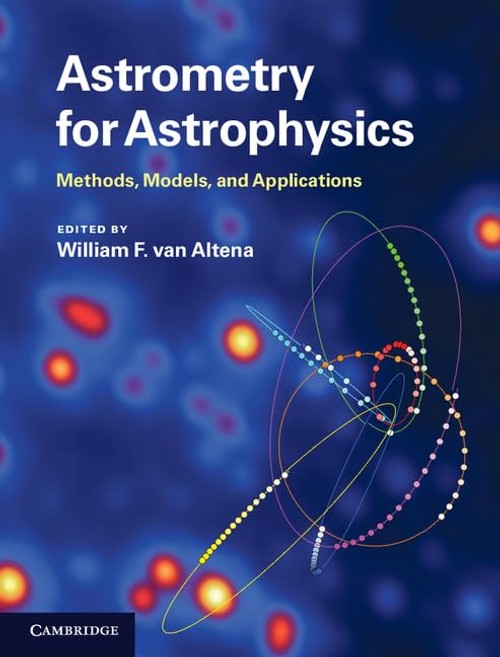
Astrometry for Astrophysics: Methods, Models, and Applications by William F. Van Altena – A Definitive Reference for Pre
Inclusive of all applicable taxes. FREE shipping on all orders.
Available Offers
- 🚚Free Delivery — Free shipping on all orders
- 💵Cash on Delivery — Pay when your order arrives
- ↩️15-Day Easy Returns — Hassle-free return policy
- 🔒Cash on Delivery — Pay safely when your order arrives
Check Delivery
Product Description
Introduction
Astrometry—the science of precisely measuring the positions, distances, and motions of celestial objects—has entered a transformative era. With space missions like Gaia and advanced ground-based observatories delivering micro-arcsecond accuracy, astrometry now underpins breakthroughs in exoplanet detection, Galactic archaeology, and fundamental physics. Astrometry for Astrophysics: Methods, Models, and Applications, edited by renowned expert William F. Van Altena, offers a comprehensive guide to this rapidly evolving field. Published by Cambridge University Press, this hardbound volume is an essential resource for graduate students, researchers, and professionals seeking a deep understanding of modern astrometric techniques and their cosmological implications.
Book Overview
This edited textbook brings together contributions from leading international specialists, providing a unified treatment of astrometry from first principles to cutting-edge applications. The book is structured in four logical parts: it begins by surveying the opportunities and challenges in 21st-century astrometry—both from space and the ground. It then introduces the relativistic frameworks necessary for micro-arcsecond precision. The third section guides readers through the fundamental steps of transforming raw photon counts into accurate celestial coordinates. The final part demonstrates how astrometric methods solve real-world problems in stellar dynamics, Galactic structure, and cosmology. With its blend of theory, practical methodology, and case studies, the book serves as both a graduate-level textbook and a reference for practicing astronomers.
Key Highlights
- Comprehensive coverage of observational astrometry, from basic principles to advanced relativistic corrections.
- Edited by William F. Van Altena, a distinguished authority in astrometry and stellar astronomy.
- Contributions from global experts ensuring diverse perspectives and up-to-date content.
- Focus on high-precision challenges of the Gaia era and next-generation facilities.
- Practical guidance on data reduction, error analysis, and coordinate transformations.
- Real-world applications including exoplanet detection, Galactic dynamics, and cosmological distance scales.
Inside the Book
The book opens with an exploration of the current landscape of astrometry, highlighting how space missions like Hipparcos and Gaia have revolutionized our view of the Milky Way. Readers then delve into the formalisms of general and special relativity that underpin micro-arcsecond measurements—essential for understanding light deflection, parallax, and proper motions. Subsequent chapters cover the entire data pipeline: from detector calibration and image processing to astrometric reduction and catalog cross-matching. The final section presents detailed case studies, such as using astrometry to detect exoplanets via reflex motion, mapping the Galactic bar, and testing theories of gravity. Each chapter includes mathematical derivations, illustrative figures, and references to primary literature.
Key Topics
- Space-based astrometry: Gaia, Hipparcos, and future missions
- Ground-based astrometry: interferometry, adaptive optics, and wide-field surveys
- Relativistic astrometry: light bending, reference frames, and time scales
- Data reduction techniques: CCD calibration, centroiding, and astrometric solutions
- Error propagation and statistical methods in astrometry
- Galactic kinematics and stellar streams
- Astrometric exoplanet detection and characterization
- Cosmological applications: parallax distances, standard candles, and dark matter
- Asteroid and near-Earth object astrometry
Reader Benefits
- Master the fundamentals of astrometric measurement and calibration.
- Understand relativistic effects crucial for high-precision astronomy.
- Learn practical data analysis methods applicable to real observations.
- Gain insights into cutting-edge research from leading scientists.
- Bridge theory and application through worked examples and case studies.
- Stay current with the latest developments in the Gaia era.
Learning Outcomes
By studying this book, readers will be able to: explain the principles of modern astrometry and its role in astrophysics; apply relativistic corrections to astrometric data; reduce and analyze raw astronomical images to extract precise positions; use astrometric catalogs for scientific investigations; design observational programs for astrometric studies; and interpret astrometric results in the context of stellar, Galactic, and cosmological phenomena. The book equips students with both theoretical knowledge and practical skills, preparing them for research in this dynamic field.
Who Should Read
- Graduate students in astronomy, astrophysics, and physics seeking a thorough grounding in astrometry.
- Early-career researchers transitioning into observational or computational astrometry.
- Professional astronomers needing a reference for advanced astrometric techniques.
- Instructors designing courses on astrometry or Galactic astronomy.
- Space scientists and engineers involved in mission planning or data analysis.
- Amateur astronomers with a strong technical background wanting to understand professional methods.
About the Author
William F. Van Altena is Professor Emeritus of Astronomy at Yale University and a leading figure in astrometry. He has served as director of the Yale Southern Observatory and has contributed to numerous international projects, including the Hipparcos mission. His research spans stellar positions, proper motions, and the structure of the Milky Way. With decades of teaching and mentorship, he brings unparalleled expertise to this edited volume.
About the Publisher
Cambridge University Press is a world-renowned academic publisher with a rich history of producing authoritative texts in science and mathematics. Their astronomy and astrophysics list includes seminal works by Nobel laureates and leading researchers, making this book a trusted addition to any serious library.
Conclusion
Astrometry for Astrophysics: Methods, Models, and Applications is an indispensable guide for anyone entering the field of high-precision astrometry. Whether you are a graduate student learning the ropes or a seasoned researcher seeking a comprehensive reference, this book delivers the depth, clarity, and practical insight needed to navigate the modern astrometric landscape. With its strong pedagogical structure and world-class contributors, it deserves a place on the shelf of every astronomy department and research institute. Order your hardcover copy today from Bookshops.in and embark on a journey to the frontiers of celestial measurement.
Quick Summary
Astrometry for Astrophysics: Methods, Models, and Applications, edited by William F. Van Altena, is a definitive reference work that captures the transformative advances in precision astronomical measurement. The book is structured to guide readers from the fundamental challenges and opportunities facing 21st-century astrometry—both from space and ground—to the sophisticated relativistic formalisms required for micro-arcsecond accuracy. It systematically explains how raw photon detections are transformed into precise celestial coordinates, covering data reduction, reference frames, and error analysis. The final sections demonstrate how astrometric methods solve real problems in stellar kinematics, Galactic structure, and cosmology. This volume is ideal for graduate students, researchers, and academics in astronomy, astrophysics, and physics who seek a rigorous yet accessible treatment of modern astrometry. By purchasing from Bookshops.in, Indian readers receive a genuine hardcover edition with reliable delivery and customer support, making it a valuable addition to any scientific library.
Book Highlights
Book Specifications
| ISBN-13 | 9780521519205 |
| ISBN-10 | 0521519209 |
| Publisher | Cambridge University Press |
| Language | English |
| Dimensions | 20.32 x 2.54 x 25.4 cm |
| Weight | 1 kg 90 g |
| Country | India |
| Category | Science & Mathematics › Astronomy & Astrophysics |
| Genre | Science & Mathematics |
| Original Language | English |
Frequently Asked Questions
What is astrometry?
Who is the author of Astrometry for Astrophysics?
Is this book suitable for beginners?
Does the book cover the Gaia mission?
What topics are included in the book?
Is this book used in Indian universities?
Does the book include mathematical derivations?
Can this book help with research in cosmology?
Is the book available in hardcover?
What is the price in Indian rupees?
Does the book have practical examples?
Who is the publisher?
Is this book only for professional astronomers?
Readers Also Search For
Customers Also Bought
Mathematics
Stereotype Spaces and Algebras: 73 (De Gruyter Expositions in Mathematics, 73)
Mathematics
Semigroups in Algebra, Geometry and Analysis: 20 (De Gruyter Expositions in Mathematics, 20)
Mathematics
Geometry from the Pacific Rim: Proceedings of the Pacific Rim Geometry Conference held at National University of Singapore, Republic of Singapore, ... 1994 (De Gruyter Proceedings in Mathematics)
Mathematics
First International Tainan-Moscow Algebra Workshop: Proceedings of the International Conference held at National Cheng Kung University Tainan, Taiwan, ... 1994 (De Gruyter Proceedings in Mathematics)
Mathematics
Differential Geometry - Proceedings of the VIII International Colloquium (English, Jesus A. Alvarez Lopez | Eduardo Garcia-Rio)
Mathematics
Mathematical Theory of Optimal Processes (Classics of Soviet Mathematics)
Related Products
View All
Science & Mathematics
Elements of Pelagos Biology: With Focus on the Mediterranean Sea
Science & Mathematics
Squid - Superconducting Quantum Interference Devices and Their Applications: Proceedings of the International Conference on Superconducting Quantum Devices, Berlin-west, October 4-8, 1976
Science & Mathematics
Thermodynamics and Pattern Formation in Biology
Science & Mathematics
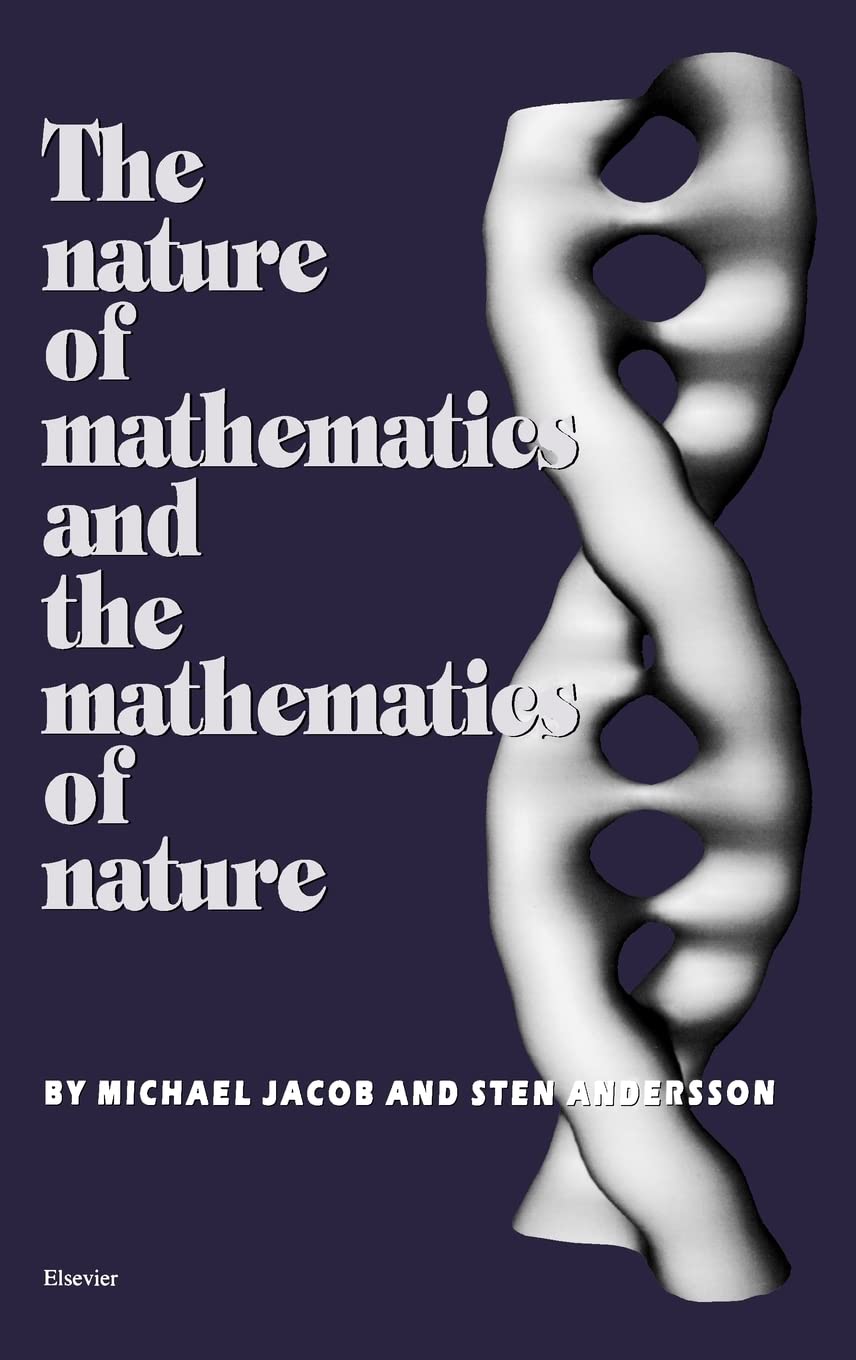
The Nature of Mathematics and the Mathematics of Nature by S. Andersson – Mathematics & Science

Science & Mathematics
Linear Algebra | by Stephen Friedberg | Arnold Insel | Lawrence Spence | Pearson | by Stephen Friedberg | Arnold Insel | Lawrence Spence | Pearson | by Stephen Friedberg | Arnold Insel | Lawrence Spence | Pearson | by Stephen Friedberg | Arnold Insel | Lawrence Spence | Pearson | by Stephen Friedberg | Arnold Insel | Lawrence Spence | Pearson | by Stephen Friedberg | Arnold Insel | Lawrence Spence | Pearson | by Stephen Friedberg | Arnold Insel | Lawrence Spence | Pearson | by Stephen Friedberg
Science & Mathematics