
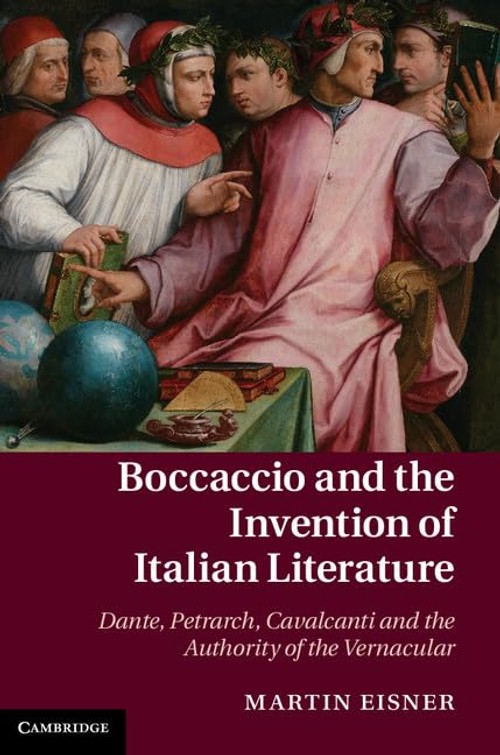
Boccaccio and the Invention of Italian Literature: Dante, Petrarch, Cavalcanti, and the Authority of the Vernacular by M
Inclusive of all applicable taxes. FREE shipping on all orders.
Available Offers
- 🚚Free Delivery — Free shipping on all orders
- 💵Cash on Delivery — Pay when your order arrives
- ↩️15-Day Easy Returns — Hassle-free return policy
- 🔒Cash on Delivery — Pay safely when your order arrives
Check Delivery
Product Description
Introduction
In the vast landscape of Italian literary history, few figures stand as tall as Giovanni Boccaccio. Yet, beyond his celebrated masterpiece, the Decameron, lies a lesser-known but equally transformative role: that of a scribe, editor, and canon-maker. Martin Eisner’s Boccaccio and the Invention of Italian Literature: Dante, Petrarch, Cavalcanti, and the Authority of the Vernacular offers a groundbreaking exploration of how Boccaccio single-handedly shaped the Italian literary tradition. This meticulously researched volume from Cambridge University Press is an essential read for students of medieval literature, Renaissance studies, and anyone fascinated by the birth of vernacular writing. Through a single manuscript written entirely in Boccaccio’s hand, Eisner uncovers the strategies—biographical, editorial, and material—that Boccaccio used to elevate writers like Dante, Petrarch, and Cavalcanti into a lasting canon. For Indian readers who appreciate the power of language and cultural identity, this book resonates deeply, offering parallels to our own literary heritage.
Book Overview
Boccaccio and the Invention of Italian Literature bridges the gap between philology and literary criticism. At its core is a unique codex—a manuscript copied entirely by Boccaccio himself—which contains works by Dante Alighieri, Francesco Petrarch, and Guido Cavalcanti. Eisner argues that Boccaccio was not merely a passive copyist but an active architect of literary authority. By selecting, arranging, and even altering these texts, Boccaccio created a vernacular canon that could stand alongside Latin classics. The book examines how Boccaccio’s own writings, including the Decameron and the Genealogy of the Gentile Gods, reflect his deep engagement with the idea of poetic legitimacy. This is not a dry academic tome but a vivid detective story of how one man’s scribal labour shaped the future of Italian letters.
Key Highlights
- Manuscript as Evidence: The book centres on a single, autograph codex—Boccaccio’s own handwritten collection—offering a rare material window into medieval literary culture.
- Four Literary Giants: Explores Boccaccio’s relationships with Dante, Petrarch, and Cavalcanti, showing how he positioned them (and himself) within a new vernacular tradition.
- Philology Meets History: Combines close reading of texts with analysis of physical manuscripts, revealing how layout, marginalia, and corrections carried ideological weight.
- Biographical Innovation: Boccaccio’s life-writing, including his biography of Dante, is reinterpreted as a deliberate act of canon-formation.
- Latin and Vernacular Unity: Challenges the traditional divide between Boccaccio’s Latin works and his Italian writings, showing them as complementary projects.
- Authority of the Vernacular: Traces how Boccaccio argued for the dignity of the Italian language against the dominance of Latin, a theme that resonates with postcolonial language debates in India.
Story Themes
At its heart, this book is about invention—not of stories alone, but of a whole literary tradition. One central theme is authority: how does a writer in a ‘lesser’ language gain legitimacy? Boccaccio’s answer lay in careful editing, biographical framing, and material presentation. Another theme is community: Boccaccio saw himself as part of a lineage of poets, and his codex created a virtual fellowship of Dante, Petrarch, and Cavalcanti. The book also explores memory and preservation, showing how scribal acts were acts of cultural survival. Finally, the power of the vernacular emerges as a political and aesthetic force, much like the debates around Hindi, Tamil, or Bengali in India’s own literary history. Eisner’s narrative reminds us that canons are not born—they are made, often by the hands of a single, determined individual.
Reader Benefits
- Deepen Your Understanding of Boccaccio: Move beyond the Decameron to see Boccaccio as a literary activist and canon-builder.
- Learn Manuscript Studies: Gain insights into how medieval books were made, read, and used—a fascinating world of parchment, ink, and marginal notes.
- Connect Literature and History: See how textual choices reflect political and cultural shifts, offering a model for studying any literary tradition.
- Appreciate Vernacular Literature: Understand the struggle for linguistic respect that parallels the rise of regional literatures in India.
- Enhance Academic Research: For students and scholars, this book provides a methodological toolkit combining philology, biography, and material culture.
- Enjoy a Scholarly Thriller: Eisner’s detective work on Boccaccio’s handwriting and editorial interventions reads like a literary mystery.
Who Should Read
This book is ideal for students of Italian literature seeking a fresh perspective on the trecento. Scholars of medieval and Renaissance studies will find cutting-edge philological analysis. Indian academics working on vernacular literatures, translation studies, or canon formation will discover rich comparative material. Book historians and bibliophiles will delight in the focus on a single, extraordinary manuscript. General readers with a passion for Dante or the Decameron will gain a deeper appreciation for the cultural forces that shaped these works. If you are a postgraduate or researcher in English, comparative literature, or cultural studies, this volume is an indispensable addition to your library.
About the Author
Martin Eisner is a distinguished scholar of Italian literature and a professor at Duke University. His research spans medieval and Renaissance poetry, manuscript culture, and the history of the book. Eisner’s work is known for its meticulous attention to material evidence and its ability to connect philological details to broad literary-historical questions. He has published widely on Dante, Petrarch, and Boccaccio, and his scholarship has been recognized with fellowships from the American Council of Learned Societies and the National Endowment for the Humanities. In Boccaccio and the Invention of Italian Literature, Eisner brings together decades of archival research and critical insight to produce a transformative study of one of Italy’s greatest writers.
About the Publisher
Cambridge University Press is one of the world’s oldest and most prestigious academic publishers, with a history dating back to 1534. Renowned for its rigorous peer-review process and high-quality scholarship, Cambridge publishes works that define their fields. This hardcover edition reflects the Press’s commitment to durable, beautifully produced books that serve both scholars and serious readers. For Indian academics and institutions, Cambridge University Press titles are a trusted benchmark of excellence in the humanities and social sciences.
Conclusion
Boccaccio and the Invention of Italian Literature is more than a study of a single author—it is a meditation on how literary traditions are born, nurtured, and transmitted. Martin Eisner’s lucid prose and rigorous scholarship illuminate Boccaccio’s genius as a cultural architect, showing that the scribe’s hand can be as powerful as the poet’s pen. For anyone interested in the roots of European literature, the politics of language, or the material life of books, this volume is a treasure. Order your hardcover copy today from Bookshops.in and add a foundational work to your collection—one that will inspire new ways of thinking about the written word and its enduring authority.
Quick Summary
Boccaccio and the Invention of Italian Literature by Martin Eisner is a scholarly work that reexamines Giovanni Boccaccio's foundational role in shaping the Italian literary canon. While Boccaccio is famous as the author of the Decameron, Eisner shows that he was also a meticulous scribe and editor who copied and curated the works of Dante, Petrarch, and Cavalcanti. By focusing on a single autograph codex, the book reveals how Boccaccio used material and textual strategies to authorize vernacular poetry and construct a literary tradition. Readers will learn about the intersection of manuscript culture, biography, and canon formation in fourteenth-century Italy. This book is ideal for Indian students and scholars of medieval literature, philology, and Italian studies. It offers a unique blend of close reading and archival research, making complex ideas accessible. Purchasing from Bookshops.in ensures you receive a genuine hardcover edition with reliable delivery across India.
Book Highlights
Book Specifications
| ISBN-13 | 9781107041660 |
| ISBN-10 | 110704166X |
| Publisher | Cambridge University Press |
| Language | English |
| Dimensions | 15.24 x 1.91 x 22.86 cm |
| Weight | 520 g |
| Category | Foreign Languages › Italian |
| Genre | Literary Criticism |
| Original Language | Italian |
Frequently Asked Questions
What is the main argument of Boccaccio and the Invention of Italian Literature?
Who is Martin Eisner?
Is this book suitable for undergraduate students?
What specific manuscript does the book focus on?
Does the book discuss the Decameron?
How does this book differ from other studies on Boccaccio?
What is the significance of the vernacular in this study?
Are there illustrations or manuscript facsimiles in the book?
Can this book help me understand Dante better?
Is this book part of a series?
What is the price of this book in India?
Where can I buy this book in India?
Is the book written in English?
Readers Also Search For
Customers Also Bought
Contemporary Fiction
Stepladder Junction and Other Stories

Contemporary Fiction
Fabrications by Pamela Painter – Short Story Collection

Contemporary Fiction
The Double Life of an Alaskan Sled Dog (English, Andrea Finney Aufder Heyde)

Contemporary Fiction
The Alabaster Girl by Zan Perrion

Contemporary Fiction
Grimm and Grimmer: Classic Fairy Tales Rebooted by Mark Russell
Classic Literature
The Prose Works of Andrew Marvell: 1676-1678 by Andrew Marvell – Restoration Literature
Related Products
View All
Literature & Fiction
Shakespeare, Madness, and Music: Scoring Insanity in Cinematic Adaptations
Literature & Fiction
Literary Research and Canadian Literature: Strategies and Sources: 10 (Literary Research: Strategies and Sources, 10)

Literature & Fiction
Crime Fiction and National Identities in the Global Age | by Julie H. Kim | McFarland & Company | by Julie H. Kim | McFarland & Company | by Julie H. Kim | McFarland & Company | by Julie H. Kim | McFarland & Company | by Julie H. Kim | McFarland & Company | by Julie H. Kim | McFarland & Company | by Julie H. Kim | McFarland & Company | by Julie H. Kim | McFarland & Company | by Julie H. Kim | McFarland & Company | by Julie H. Kim | McFarland & Company | by
Literature & Fiction
Greek Literature in the Classical Period: The Poetics of Drama in Athens: 4 (Greek Literature Vol. 4)
Literature & Fiction
Greek Literature and Philosophy (Greek Literature, Volume 6)
Literature & Fiction