
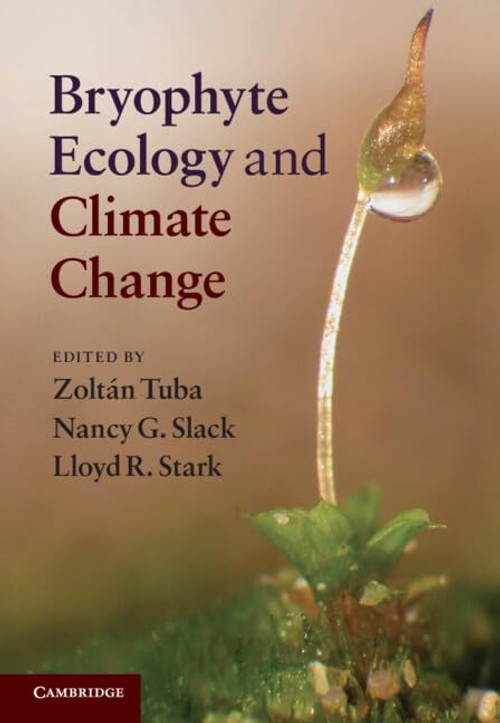
Bryophyte Ecology and Climate Change: A Comprehensive Study on Moss Ecology and Climate Impact by Zoltán Tuba
Inclusive of all applicable taxes. FREE shipping on all orders.
Available Offers
- 🚚Free Delivery — Free shipping on all orders
- 💵Cash on Delivery — Pay when your order arrives
- ↩️15-Day Easy Returns — Hassle-free return policy
- 🔒Cash on Delivery — Pay safely when your order arrives
Check Delivery
Product Description
Introduction
In an era where climate change is reshaping ecosystems across the globe, understanding the subtle indicators of environmental stress has never been more critical. Bryophyte Ecology and Climate Change, authored by Zoltán Tuba and published by Cambridge University Press, offers a pioneering exploration into the world of mosses, liverworts, and hornworts—often called the 'canaries in the coal mine' of our planet. This hardcover volume is an essential resource for Indian students, researchers, and environmental scientists seeking to decode the silent signals of climate change through the lens of bryophyte biology.
Book Overview
This comprehensive work is the first of its kind to synthesize a wide spectrum of bryophyte research under the unifying theme of climate change. Spanning physiology, desiccation tolerance, photosynthesis, and responses to temperature and UV radiation, the book examines how these ancient, resilient plants serve as living monitors of environmental shifts. With contributions from leading global experts, it provides a holistic view of bryophyte ecology across diverse ecosystems—from tropical forests and alpine peaks to Sphagnum-dominated wetlands and Antarctic landscapes. The text also delves into computer modeling of future distribution patterns, making it a forward-looking guide for conservation and climate science.
Key Highlights
- First-of-its-kind compilation: Unites bryophyte ecology and climate change research in a single authoritative volume.
- Global ecosystem coverage: Examines bryophyte roles in aquatic, desert, tropical, boreal, alpine, Antarctic, and wetland habitats.
- Cutting-edge topics: Includes desiccation tolerance, UV response, photosynthesis under stress, and predictive modeling.
- Practical relevance: Highlights bryophytes as bioindicators for monitoring climate impacts in real time.
- Academic rigor: Published by Cambridge University Press, ensuring high-quality, peer-reviewed content.
Inside the Book
Readers will journey through chapters that dissect the intricate life strategies of bryophytes, from their remarkable ability to survive extreme dryness to their sensitivity to temperature spikes. The book features detailed case studies on rare and common species, offering insights into how climate change alters distribution patterns. It also includes data-driven models that project future scenarios, helping researchers anticipate ecological transformations. Each chapter is richly supported with diagrams, tables, and references, making it an invaluable reference for both field and lab work.
Key Topics
- Bryophyte physiology and climate stress responses
- Desiccation tolerance and water relations
- Photosynthetic adaptations in changing environments
- Temperature and UV radiation effects on growth
- Distribution modeling and conservation planning
- Role of Sphagnum in carbon cycling and wetland ecology
- Bryophyte communities in tropical, boreal, and polar ecosystems
- Implications for biodiversity and ecosystem services
Reader Benefits
By engaging with this book, readers gain a deep understanding of how bryophytes can act as early warning systems for climate change. It equips you with the knowledge to interpret ecological data, design field studies, and apply modeling techniques to real-world conservation challenges. For Indian researchers, the insights on tropical and alpine bryophytes are particularly relevant, offering parallels to the Western Ghats, Himalayas, and other biodiverse regions. The book also serves as a bridge between pure botany and climate science, fostering interdisciplinary thinking.
Learning Outcomes
- Understand the physiological mechanisms that enable bryophytes to survive extreme conditions.
- Analyze how climate change influences bryophyte distribution and ecosystem function.
- Evaluate the use of bryophytes as bioindicators for environmental monitoring.
- Apply computer modeling techniques to predict future ecological shifts.
- Develop strategies for conserving bryophyte diversity in a warming world.
Who Should Read
This book is ideal for postgraduate students and researchers in botany, ecology, environmental science, and climate studies. It is also a valuable resource for conservation biologists, forest managers, and policy makers working on climate adaptation. Indian undergraduate students with a keen interest in plant sciences will find it a challenging yet rewarding read, especially those focusing on cryptogams or ecosystem monitoring. Libraries and research institutions aiming to build a robust climate change collection will benefit from this definitive text.
About the Author
Zoltán Tuba is a distinguished Hungarian botanist and ecologist known for his extensive work on bryophyte physiology and climate interactions. With decades of research experience, he has contributed significantly to understanding how non-vascular plants respond to environmental stress. His editorial leadership brings together a global team of experts, ensuring the book's depth and credibility.
About the Publisher
Cambridge University Press is one of the world's oldest and most respected academic publishers. With a legacy of excellence spanning over four centuries, it continues to produce authoritative works in science, technology, and humanities. This hardcover edition reflects the press's commitment to high-quality scholarship and rigorous peer review.
Conclusion
Bryophyte Ecology and Climate Change is more than a textbook—it is a call to pay attention to the quiet voices of the natural world. As climate change accelerates, the humble bryophyte offers profound lessons in resilience and adaptation. Whether you are a student, a scientist, or a conservation advocate, this book will deepen your appreciation for the tiny plants that hold big clues about our planet's future. Order your copy today from Bookshops.in and join the global effort to understand and protect our changing environment.
Quick Summary
Bryophyte Ecology and Climate Change by Zoltán Tuba is a seminal work that delves into the intricate relationships between non-vascular plants and a warming planet. The book systematically explores how mosses, liverworts, and hornworts respond to climate stressors such as rising temperatures, altered precipitation, and increased UV radiation. It covers a wide range of ecosystems—from tropical rainforests to Antarctic tundra—highlighting the unique physiological adaptations like desiccation tolerance that enable bryophytes to survive. Readers will learn about the role of Sphagnum in wetland carbon dynamics and how bryophyte distribution shifts can signal broader ecological changes. This book is ideal for postgraduate students, ecologists, climate scientists, and conservationists in India who study Himalayan, Western Ghats, or wetland ecosystems. By purchasing from Bookshops.in, customers receive a high-quality hardcover edition from Cambridge University Press, ensuring durable reference material. The book combines field observations with laboratory studies and computer modeling, offering a holistic understanding. It stands out as the first comprehensive synthesis of bryophyte ecology under climate change, making it an indispensable resource for anyone serious about plant ecology and environmental monitoring in the Indian context.
Book Highlights
Book Specifications
| ISBN-13 | 9780521767637 |
| ISBN-10 | 0521767636 |
| Publisher | Cambridge University Press |
| Language | English |
| Dimensions | 18.42 x 2.54 x 26.04 cm |
| Weight | 1 kg 180 g |
| Country | India |
| Category | Biology & Life Sciences › Botany |
| Genre | Science & Mathematics |
| Original Language | English |
Frequently Asked Questions
What is this book about?
Who is the author?
Which ecosystems are covered?
Is this book suitable for Indian students?
What topics in physiology are discussed?
Does it include rare species?
Is this a research-level book?
What is the ISBN?
What format is available?
Does it cover computer modeling?
Why are bryophytes important for climate studies?
Can this book help in conservation?
Is the language accessible?
Where can I buy this book in India?
Readers Also Search For
Customers Also Bought

Mathematics
Stereotype Spaces and Algebras: 73 (De Gruyter Expositions in Mathematics, 73)

Mathematics
Semigroups in Algebra, Geometry and Analysis: 20 (De Gruyter Expositions in Mathematics, 20)

Mathematics
Geometry from the Pacific Rim: Proceedings of the Pacific Rim Geometry Conference held at National University of Singapore, Republic of Singapore, ... 1994 (De Gruyter Proceedings in Mathematics)

Mathematics
First International Tainan-Moscow Algebra Workshop: Proceedings of the International Conference held at National Cheng Kung University Tainan, Taiwan, ... 1994 (De Gruyter Proceedings in Mathematics)

Mathematics
Differential Geometry - Proceedings of the VIII International Colloquium (English, Jesus A. Alvarez Lopez | Eduardo Garcia-Rio)

Mathematics
Mathematical Theory of Optimal Processes (Classics of Soviet Mathematics)
Related Products
View All
Science & Mathematics
Elements of Pelagos Biology: With Focus on the Mediterranean Sea

Science & Mathematics
Squid - Superconducting Quantum Interference Devices and Their Applications: Proceedings of the International Conference on Superconducting Quantum Devices, Berlin-west, October 4-8, 1976

Science & Mathematics
Thermodynamics and Pattern Formation in Biology

Science & Mathematics
The Nature of Mathematics and the Mathematics of Nature by S. Andersson – Mathematics & Science

Science & Mathematics
Linear Algebra | by Stephen Friedberg | Arnold Insel | Lawrence Spence | Pearson | by Stephen Friedberg | Arnold Insel | Lawrence Spence | Pearson | by Stephen Friedberg | Arnold Insel | Lawrence Spence | Pearson | by Stephen Friedberg | Arnold Insel | Lawrence Spence | Pearson | by Stephen Friedberg | Arnold Insel | Lawrence Spence | Pearson | by Stephen Friedberg | Arnold Insel | Lawrence Spence | Pearson | by Stephen Friedberg | Arnold Insel | Lawrence Spence | Pearson | by Stephen Friedberg

Science & Mathematics