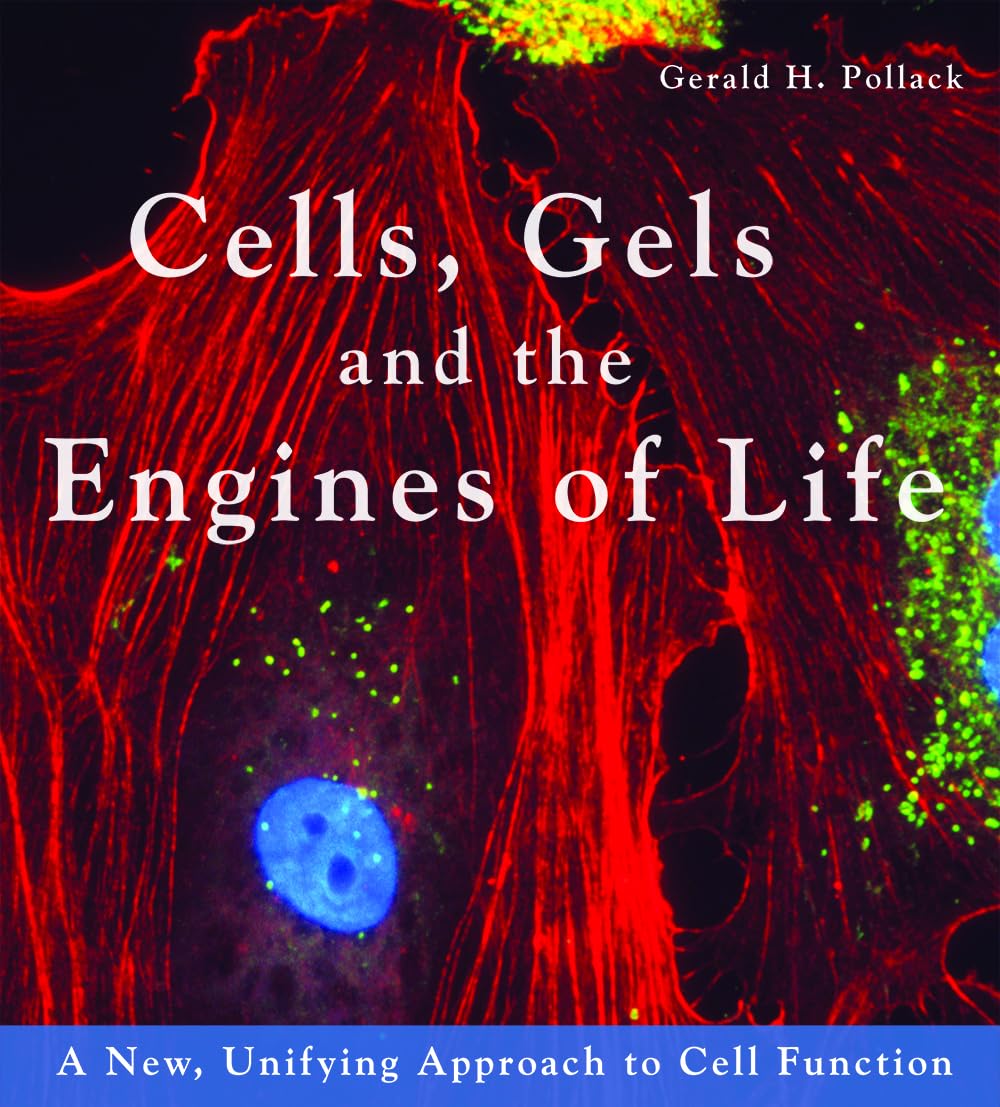
Cells, Gels and the Engines of Life: A New, Unifying Approach to Cell Function by Gerald H. Pollack – A Paradigm-Shiftin
Inclusive of all applicable taxes. FREE shipping on all orders.
Available Offers
- 🚚Free Delivery — Free shipping on all orders
- 💵Cash on Delivery — Pay when your order arrives
- ↩️15-Day Easy Returns — Hassle-free return policy
- 🔒Cash on Delivery — Pay safely when your order arrives
Check Delivery
Product Description
Introduction
Have you ever wondered how a single cell knows exactly what to do—how it moves, divides, and communicates without a brain or a central command? For decades, biology textbooks have told us that cells are like tiny factories run by molecular machines. But what if that picture is incomplete? In Cells, Gels and the Engines of Life: A New, Unifying Approach to Cell Function, Gerald H. Pollack offers a bold and refreshing perspective that turns conventional wisdom on its head. Written in an engaging, often humorous style, this hardcover edition from Ebner and Sons Publishers is a must-read for curious minds in India—from undergraduate students to seasoned researchers—who want to understand life at its most fundamental level.
Book Overview
This book is not just another biology text; it is a paradigm-shifting exploration of how cells really work. Pollack challenges the long-held belief that cells are primarily powered by protein-based molecular motors and pumps. Instead, he proposes a simpler, more elegant model rooted in the physical chemistry of water, gels, and electrical charges. The core idea is that the cell is essentially a gel—a semi-solid, water-rich material—whose behavior is governed by principles like phase transitions, ion gradients, and the structuring of water near surfaces. From movement and transport to division and communication, Pollack shows how these processes can be explained without invoking complex, energy-consuming machinery. The book is profusely illustrated with full-color diagrams that make even the trickiest concepts accessible.
Key Highlights
- Revolutionary Thesis: Pollack argues that most cellular functions arise from the physical properties of the cytoplasm as a gel, not from isolated molecular machines.
- Water-Centric View: A major focus is on the role of structured water (exclusion zone water) near hydrophilic surfaces, which acts as a battery and drives many cellular processes.
- Unified Framework: The book provides a single, coherent explanation for seemingly unrelated phenomena like cell division, muscle contraction, nerve impulses, and cytoplasmic streaming.
- Accessible Language: Written for the non-specialist, the text avoids unnecessary jargon and includes witty analogies that make learning enjoyable.
- Stunning Visuals: Over 200 full-color figures and illustrations help readers visualize gel behaviour, charge patterns, and water structures.
Inside the Book
Pollack takes readers on a journey from the basics of gel physics to the complexities of living cells. Early chapters introduce the concept of the cell as a gel and explain how water molecules arrange themselves into ordered layers near surfaces—a phenomenon often overlooked in mainstream biology. Later chapters apply this framework to specific cellular functions: how cells move using gel swelling and contraction, how they divide through phase transitions, and how they communicate via electrical signals generated by water layers. The book also tackles long-standing puzzles, such as how muscles contract without sliding filaments and how nerves transmit signals without ion channels. Each chapter ends with a summary and thought-provoking questions that encourage readers to test the ideas themselves.
Key Topics
- The cell as a gel: cytoplasm, cytoskeleton, and extracellular matrix
- Exclusion zone (EZ) water: structure, properties, and biological significance
- Phase transitions in gels: swelling, shrinking, and critical phenomena
- Donnan equilibrium and ion partitioning in charged gels
- Mechanisms of cell motility: amoeboid movement, ciliary beating, and muscle contraction
- Cell division: how gels separate chromosomes without a spindle
- Nerve conduction: a gel-based model for action potentials
- Cell communication: intercellular signals through gel hydration changes
- Energy transduction: how light, heat, and mechanical forces couple to gel behaviour
Reader Benefits
- Deepen Your Understanding: Move beyond rote memorisation of pathways and learn the underlying physical principles that govern life.
- Think Critically: The book encourages you to question established dogmas and explore alternative explanations.
- Bridge Disciplines: Perfect for students of biology, physics, chemistry, and engineering who want a cross-disciplinary perspective.
- Prepare for Exams: Gain insights that complement standard curricula in cell biology, biophysics, and physiology.
- Enjoy Learning: Pollack’s witty and conversational tone makes complex ideas feel like a friendly chat.
Learning Outcomes
By reading this book, you will be able to: (1) describe the gel-like nature of the cytoplasm and its implications for cell function; (2) explain how structured water contributes to cellular energy and signalling; (3) critically evaluate the strengths and limitations of the traditional molecular machine model; (4) apply gel physics concepts to interpret experimental observations in cell biology; and (5) discuss how a unifying physical approach can simplify our understanding of life’s core processes.
Who Should Read
This book is ideal for Indian students pursuing undergraduate or postgraduate degrees in life sciences, biotechnology, biochemistry, or biophysics. It is also highly valuable for teachers and professors who want to introduce fresh perspectives in their classrooms. Researchers in cell biology, physiology, or biomedical engineering will find the alternative framework stimulating. Finally, curious general readers with a background in basic science will appreciate the clear explanations and thought-provoking ideas.
About the Author
Gerald H. Pollack is a professor of bioengineering at the University of Washington, Seattle. He is a leading authority on the role of water in biological systems and has spent decades challenging mainstream views. His discovery of the exclusion zone—a layer of water near hydrophilic surfaces that excludes solutes—has opened new avenues in biophysics. Pollack is also the founder of the Annual Conference on the Physics, Chemistry and Biology of Water. He writes with a rare blend of scientific rigour and playful curiosity, making him a beloved figure among students and colleagues worldwide.
About the Publisher
Ebner and Sons Publishers is a niche academic press based in the United States, known for publishing bold and unconventional works in science. Their catalogue focuses on books that challenge established paradigms, especially in biophysics, water science, and cell biology. They are committed to producing high-quality hardcover editions with full-colour illustrations, ensuring that complex ideas are presented with clarity and beauty. This title is a cornerstone of their mission to advance new, unifying approaches in biology.
Conclusion
Cells, Gels and the Engines of Life is more than a book—it is an invitation to see life through a new lens. Gerald Pollack’s gel-based model offers a simpler, more elegant explanation for how cells work, and it has the potential to reshape biology as we know it. Whether you are a student struggling to make sense of cellular processes or a seasoned scientist looking for fresh inspiration, this hardcover volume deserves a place on your shelf. Order your copy from Bookshops.in today and join the growing number of thinkers who are reimagining the very engines of life.
Quick Summary
Cells, Gels and the Engines of Life by Gerald H. Pollack is a groundbreaking book that reimagines how cells function. Instead of relying on complex molecular machinery, Pollack proposes a simpler, unifying model based on the physical properties of gels and water within cells. Written in an engaging and humorous style, the book explains fundamental processes like movement, transport, division, and communication through the lens of phase transitions and gel behavior. It is richly illustrated with color figures, making it accessible to non-experts while still offering deep insights for biologists and researchers. This book is perfect for Indian students, teachers, and science enthusiasts who want to understand life at the cellular level from a fresh perspective. By challenging long-held assumptions, it encourages critical thinking and opens new avenues for research. Purchasing from Bookshops.in ensures you receive a high-quality hardcover edition, delivered across India, of this thought-provoking work that has inspired a generation of biologists to think differently about the engines of life.
Book Highlights
Book Specifications
| ISBN-13 | 9780962689529 |
| ISBN-10 | 0962689521 |
| Publisher | Ebner and Sons Publishers |
| Language | English |
| Dimensions | 23.37 x 1.78 x 21.59 cm |
| Weight | 862 g |
| Category | Medicine › Biotechnology |
| Genre | Science |
| Original Language | English |
Frequently Asked Questions
What is Cells, Gels and the Engines of Life about?
Who is the author of this book?
Is this book suitable for beginners?
Does the book contain illustrations?
What topics does the book cover?
Is this a textbook?
What is the ISBN-13?
What is the binding type?
What is the price in India?
What is the rating of this book?
How is this book different from other cell biology books?
Can I buy this book from Bookshops.in?
Readers Also Search For
Customers Also Bought
Research
Mathematical Modeling of Biological Systems, Volume I (English, Andreas Deutsch | Lutz Brusch | Helen Byrne)
Research
Intermediate Statistics (English, James P. Stevens)
Research
Statistics Explained by Steve McKillup – Life Science Statistics Guide

Research
Data Analysis and Graphics Using R by John Maindonald – Statistical Computing

Research
Applied Longitudinal Data Analysis (English, Judith D. Singer | John B. Willett)
Research