
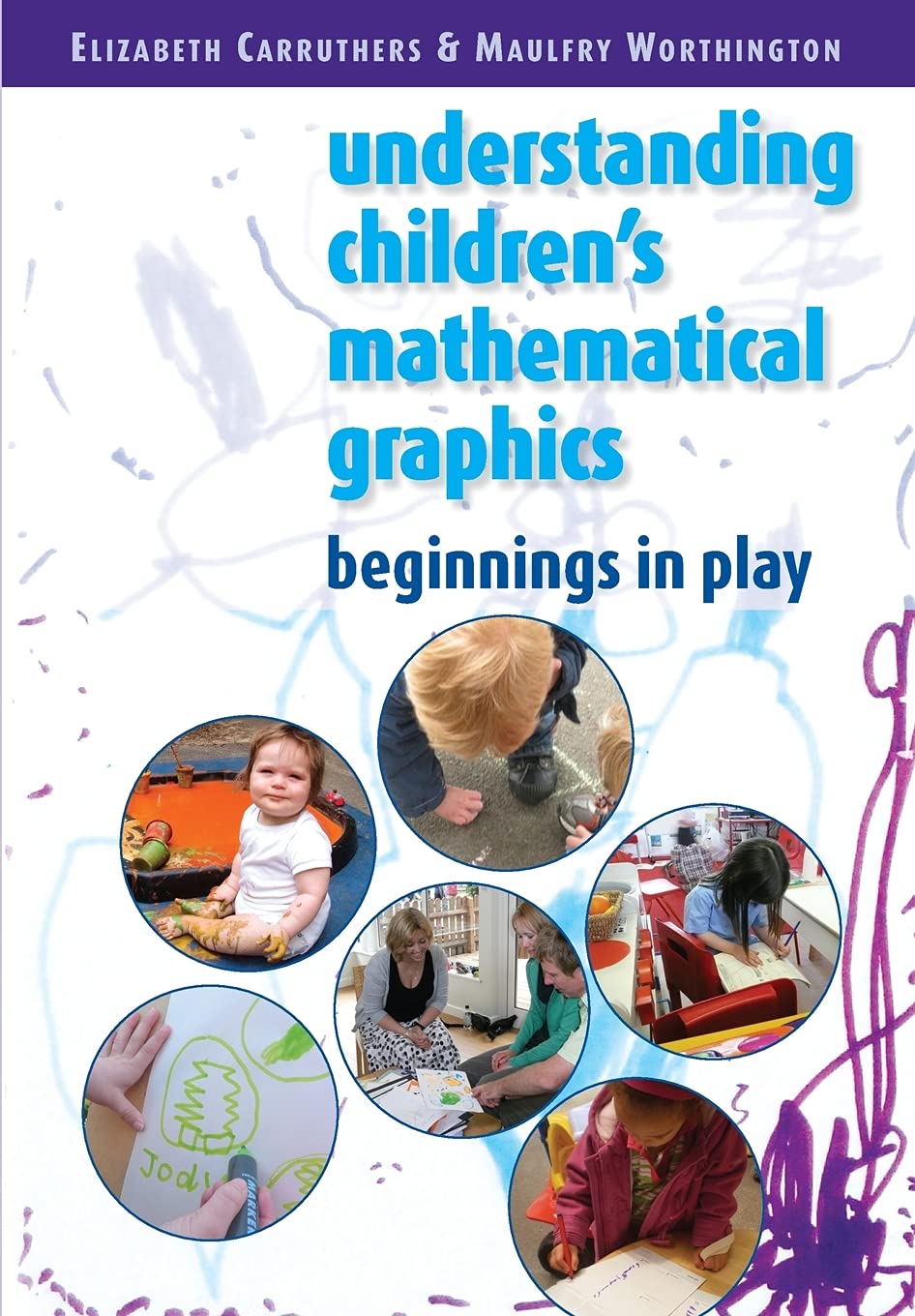
Understanding Childrens Mathematical Graphics: Beginnings in Play by Carruthers Elizabeth – A Complete Guide to Early Ma
Inclusive of all applicable taxes. FREE shipping on all orders.
Available Offers
- 🚚Free Delivery — Free shipping on all orders
- 💵Cash on Delivery — Pay when your order arrives
- ↩️15-Day Easy Returns — Hassle-free return policy
- 🔒Cash on Delivery — Pay safely when your order arrives
Check Delivery
Product Description
Introduction
In the vibrant world of early childhood education, every scribble, dot, and line drawn by a child carries meaning. Understanding Children's Mathematical Graphics: Beginnings in Play by Elizabeth Carruthers is a groundbreaking resource that invites educators, parents, and caregivers to look beyond the surface and recognise children's early marks as the foundation of mathematical thinking. Published by Open University Press, this hardcover edition is an essential guide for anyone passionate about nurturing young minds through play and creativity. It bridges the gap between spontaneous drawing and structured mathematical concepts, offering a fresh perspective on how children naturally explore numbers, patterns, and shapes.
Book Overview
This book delves deep into the concept of 'mathematical graphics'—the marks, symbols, and drawings that children create during play. Elizabeth Carruthers argues that these are not random scribbles but purposeful expressions of mathematical thought. The book provides a comprehensive framework for understanding how children develop mathematical ideas from the earliest stages. It combines theoretical insights with practical strategies, making it an invaluable tool for teachers, early years practitioners, and parents. The author draws on extensive research and real-life examples to show how play-based learning can foster a strong mathematical foundation. This is not just a textbook; it is a celebration of children's innate curiosity and their unique way of making sense of the world.
Key Highlights
- Innovative Perspective: Challenges traditional views by positioning children's scribbles as legitimate mathematical expressions.
- Play-Based Learning: Emphasises the role of unstructured play in developing mathematical concepts like counting, sorting, and spatial awareness.
- Practical Guidance: Offers clear, actionable strategies for observing, interpreting, and extending children's mathematical graphics.
- Research-Backed: Grounded in decades of classroom observation and academic study, ensuring credibility and depth.
- CPD Resource: Includes a comprehensive Continuing Professional Development framework with 38 session outlines for training educators.
- CD-ROM Included: Comes with a CD containing examples, activities, and materials for PowerPoint presentations to support professional development sessions.
Inside the Book
The book is structured to guide readers from theory to practice. Early chapters explore the origins of mathematical graphics in infancy and toddlerhood, showing how babies and young children use marks to communicate. Later sections focus on the progression of these graphics as children grow, linking them to formal mathematical symbols like numerals and operators. The author provides detailed case studies and annotated examples of children's work, helping readers decode the meaning behind each drawing. The CPD booklet offers ready-to-use session plans that encourage group discussions, reflective practice, and hands-on activities. The accompanying CD enriches the learning experience with visual aids and printable resources. Every page is designed to deepen your understanding of how children think mathematically through play.
Key Topics
- The origins of mathematical graphics in early play
- Recognising and interpreting children's marks as mathematical thinking
- Linking scribbles to number sense, pattern recognition, and spatial reasoning
- The role of the educator in scaffolding mathematical development
- Using everyday materials to encourage mathematical mark-making
- Assessing and documenting children's mathematical progress
- Designing a play-rich environment that fosters mathematical exploration
- Integrating mathematical graphics across the curriculum
- Collaborating with parents to support mathematical learning at home
- Continuing professional development strategies for early years teams
Reader Benefits
By engaging with this book, readers will gain a transformative understanding of early mathematical development. Educators will learn to see mathematical potential in every child's drawing, turning everyday moments into teachable opportunities. Parents will discover how to encourage mathematical thinking through simple play activities at home. The book provides practical tools for observing and recording children's progress, making assessment a natural part of daily interactions. It also equips readers with a vocabulary to discuss mathematical graphics with colleagues and families. Ultimately, this book empowers adults to become more responsive, thoughtful, and effective in supporting children's mathematical journeys from the very beginning.
Learning Outcomes
- Appreciate early mark-making as the beginning of mathematical development
- Recognise and interpret children's mathematical graphics with confidence
- Develop pedagogical approaches that honour children's own mathematical thinking
- Use play-based activities to enhance number sense, pattern recognition, and spatial awareness
- Design learning environments that invite mathematical exploration through drawing and writing
- Implement effective observation and documentation techniques for mathematical learning
- Facilitate professional development sessions using the provided CPD framework
- Build stronger partnerships with parents around mathematical learning
Who Should Read
This book is ideal for early years educators, nursery teachers, kindergarten facilitators, and primary school teachers working with children aged 0–7. It is also highly relevant for child development students, teacher trainees, and lecturers in early childhood education. Childcare providers, playgroup leaders, and home-schooling parents will find the insights equally valuable. Additionally, educational policymakers, curriculum developers, and anyone involved in designing early learning programmes will benefit from the research-based approach. The book speaks to all who believe in the power of play and want to nurture mathematical thinking from the very first scribble.
About the Author
Elizabeth Carruthers is a respected educator and researcher with decades of experience in early years education. She has worked as a teacher, headteacher, and local authority advisor, and is known for her pioneering work on children's mathematical graphics. Carruthers has co-authored several influential books on early mathematics and is a sought-after speaker at conferences worldwide. Her passion for understanding how children learn through play shines through in every chapter. She brings a rare combination of academic rigour and practical wisdom, making complex ideas accessible to all readers. Her work has inspired countless educators to rethink how they support young children's mathematical development.
About the Publisher
Open University Press is a leading academic publisher known for its high-quality resources in education, social sciences, and professional development. With a strong focus on research-informed practice, the press publishes works that bridge theory and classroom reality. Their titles are widely used in teacher training programmes and continuing professional development across the United Kingdom and beyond. Open University Press is committed to producing books that empower educators and improve outcomes for learners. This hardcover edition reflects their dedication to durable, well-crafted educational materials that stand the test of time.
Conclusion
Understanding Children's Mathematical Graphics: Beginnings in Play is more than a book—it is a doorway into the rich, imaginative world of children's thinking. By honouring their scribbles, lines, and drawings, we unlock a powerful path to mathematical understanding. Elizabeth Carruthers offers a compassionate, insightful, and practical guide that will change how you see children's play forever. Whether you are a teacher, a parent, or a student of child development, this book will inspire you to look closer, listen harder, and celebrate every mark as a step towards mathematical fluency. Add this essential resource to your library today and begin a journey of discovery with the young learners in your life.
Quick Summary
Understanding Childrens Mathematical Graphics: Beginnings in Play by Carruthers Elizabeth is a groundbreaking resource that reveals how young children's scribbles, drawings, and marks are actually early forms of mathematical thinking. Designed for educators, parents, and early years professionals, this book provides a comprehensive framework to recognize, interpret, and nurture mathematical concepts that emerge naturally during play. The accompanying CPD booklet offers 38 ready-to-use training sessions, making it an ideal tool for schools, preschools, and teacher training programs in India. Readers will learn to see mathematics in children's everyday mark-making, understand the developmental progression of mathematical graphics, and apply this knowledge to support deeper learning. By purchasing from Bookshops.in, you get a high-quality physical copy delivered to your doorstep, along with the assurance of India's trusted online bookstore for academic and educational titles.
Book Highlights
Book Specifications
| ISBN-13 | 9780335237760 |
| ISBN-10 | 0335237762 |
| Publisher | Open Univ Pr |
| Language | English |
| Dimensions | 16.99 x 1.35 x 24 cm |
| Weight | 431 g |
| Country | India |
| Category | Medicine › Education & Training |
| Genre | Education |
| Original Language | English |
Frequently Asked Questions
What is this book about?
Who is the author?
Is this book suitable for Indian educators?
Does the book include training materials?
What age group does this book focus on?
Can parents use this book?
Is this book research-based?
What is the format of the book?
What is the price in India?
Does the book include activities for children?
Is this book part of a series?
What is the ISBN?
Can I use this book for teacher training workshops?
How is this book different from other early math books?
Readers Also Search For
Customers Also Bought

Anatomy
Ultrastructure of the Digestive Tract: 4 (Electron Microscopy in Biology and Medicine)

Anatomy
Ultrastructure of the Connective Tissue Matrix: 3 (Electron Microscopy in Biology and Medicine)

Anatomy
Reproductive Genetics (Royal College of Obstetricians and Gynaecologists Study Group)

Anatomy
Human Gross Anatomy: An Outline Text by Robert J. Leonard – Medical Anatomy

Pharmacology
Mathematical Modeling and Simulation in Enteric Neurobiology

Anatomy
Nature’s Patterns and the Fractional Calculus: 2 (Fractional Calculus in Applied Sciences and Engineering, 2)
Related Products
View All
Medicine & Health Sciences
Pediatrics on Call | by Charles A. Pohl | Kathleen Bradford | Clara Callahan | McGraw Hill / Medical | by Charles A. Pohl | Kathleen Bradford | Clara Callahan | McGraw Hill / Medical | by Charles A. Pohl | Kathleen Bradford | Clara Callahan | McGraw Hill / Medical | by Charles A. Pohl | Kathleen Bradford | Clara Callahan | McGraw Hill / Medical | by Charles A. Pohl | Kathleen Bradford | Clara Callahan | McGraw Hill / Medical | by Charles A. Pohl | Kathleen Bradford | Clara Callahan | McGraw Hill

Medicine & Health Sciences
The Physician's Guide to Depression and Bipolar Disorders | by Dwight L. Evans | Dennis S. Charney | Lydia Lewis | McGraw Hill / Medical | by Dwight L. Evans | Dennis S. Charney | Lydia Lewis | McGraw Hill / Medical | by Dwight L. Evans | Dennis S. Charney | Lydia Lewis | McGraw Hill / Medical | by Dwight L. Evans | Dennis S. Charney | Lydia Lewis | McGraw Hill / Medical | by Dwight L. Evans | Dennis S. Charney | Lydia Lewis | McGraw Hill / Medical | by Dwight L. Evans | Dennis S. Charney | Lydi

Medicine & Health Sciences
First Exposure to Internal Medicine | by Andrew R. Hoellein | Charles H. Griffith | McGraw Hill / Medical | by Andrew R. Hoellein | Charles H. Griffith | McGraw Hill / Medical | by Andrew R. Hoellein | Charles H. Griffith | McGraw Hill / Medical | by Andrew R. Hoellein | Charles H. Griffith | McGraw Hill / Medical | by Andrew R. Hoellein | Charles H. Griffith | McGraw Hill / Medical | by Andrew R. Hoellein | Charles H. Griffith | McGraw Hill / Medical | by Andrew R. Hoellein | Charles H. Griffit

Medicine & Health Sciences
First Exposure to Internal Medicine | by Charles H. Griffith | Andrew R. Hoellein | McGraw Hill / Medical | by Charles H. Griffith | Andrew R. Hoellein | McGraw Hill / Medical | by Charles H. Griffith | Andrew R. Hoellein | McGraw Hill / Medical | by Charles H. Griffith | Andrew R. Hoellein | McGraw Hill / Medical | by Charles H. Griffith | Andrew R. Hoellein | McGraw Hill / Medical | by Charles H. Griffith | Andrew R. Hoellein | McGraw Hill / Medical | by Charles H. Griffith | Andrew R. Hoellei

Medicine & Health Sciences
Internal Medicine | by Paul G. Schmitz | Kevin J. Martin | McGraw Hill / Medical | by Paul G. Schmitz | Kevin J. Martin | McGraw Hill / Medical | by Paul G. Schmitz | Kevin J. Martin | McGraw Hill / Medical | by Paul G. Schmitz | Kevin J. Martin | McGraw Hill / Medical | by Paul G. Schmitz | Kevin J. Martin | McGraw Hill / Medical | by Paul G. Schmitz | Kevin J. Martin | McGraw Hill / Medical | by Paul G. Schmitz | Kevin J. Martin | McGraw Hill / Medical | by Paul G. Schmitz | Kevin J. Martin |

Medicine & Health Sciences