
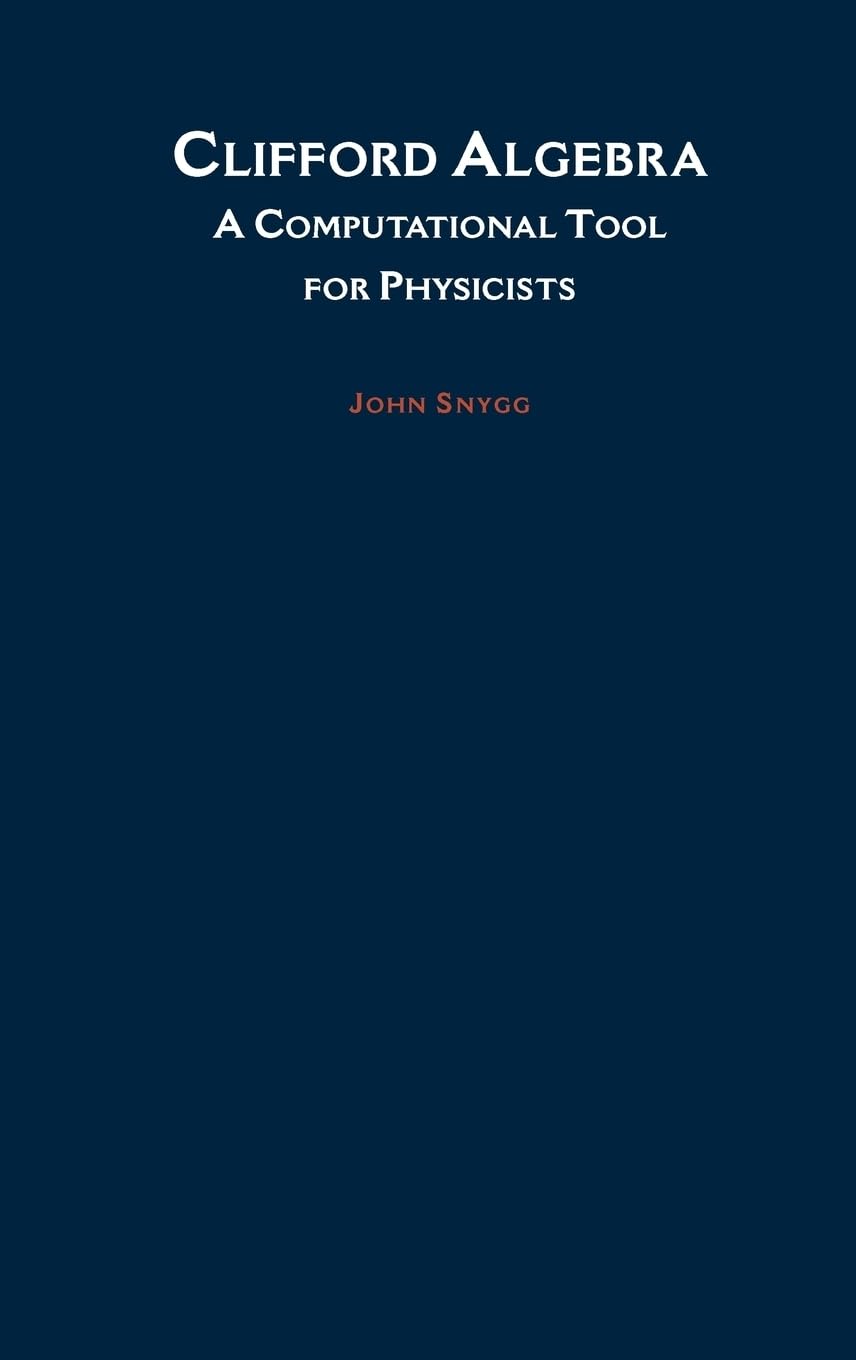
Clifford Algebras: A Computational Tool for Physicists by John Snygg – A Graduate-Level Guide to Algebraic Methods in Re
Inclusive of all applicable taxes. FREE shipping on all orders.
Available Offers
- 🚚Free Delivery — Free shipping on all orders
- 💵Cash on Delivery — Pay when your order arrives
- ↩️15-Day Easy Returns — Hassle-free return policy
- 🔒Cash on Delivery — Pay safely when your order arrives
Check Delivery
Product Description
Introduction
For physicists and mathematicians navigating the frontiers of modern theoretical physics, Clifford algebras have emerged as an essential computational framework. Whether you are delving into the geometric underpinnings of special relativity, exploring the intricate structure of Dirac's equation, or venturing into the realms of superstring theory, a solid grasp of Clifford algebras is no longer optional—it is a necessity. John Snygg's Clifford Algebras: A Computational Tool for Physicists, published by Oxford University Press, offers a rigorous yet accessible gateway into this powerful mathematical language. This hardbound volume is designed specifically for beginning graduate students in physics and mathematics, as well as researchers who wish to harness the computational elegance of Clifford algebras in their work.
Book Overview
This book is a carefully crafted exposition that bridges the gap between abstract algebraic theory and practical application in physics. Snygg begins with the foundational concepts of Clifford algebras and systematically builds toward advanced topics, ensuring that readers develop both conceptual understanding and computational proficiency. The text is rich with worked examples, exercises, and applications drawn from classical and quantum physics, making it an ideal companion for courses in mathematical physics, relativity, and quantum theory. Unlike many texts that treat Clifford algebras as a purely formal subject, Snygg emphasizes their role as a computational tool, showing how they simplify and unify diverse physical phenomena.
Key Highlights
- Computational Focus: The book prioritizes hands-on manipulation of Clifford algebras, with numerous step-by-step derivations and problem sets.
- Physics-Driven Approach: Every algebraic concept is motivated by a concrete physical problem, from rotating tops to spacetime geometry.
- Graduate-Level Rigour: Written for students with a background in linear algebra and basic physics, the text progresses to advanced topics suitable for researchers.
- Comprehensive Coverage: Includes applications in special and general relativity, Dirac theory, Kaluza-Klein theories, dimensional renormalization, and superstrings.
- Indian Context: The clear exposition and self-contained nature make it particularly valuable for Indian students preparing for competitive exams or pursuing research in theoretical physics.
Inside the Book
The book is structured into well-organized chapters that guide the reader from elementary definitions to sophisticated applications. Early chapters introduce the algebraic foundations, including the definition of Clifford algebras, their representation theory, and the crucial concept of spinors. Subsequent chapters delve into geometric interpretations, showing how Clifford algebras encode rotations, reflections, and Lorentz transformations in a natural and computationally efficient manner. The latter part of the book explores advanced topics such as the Dirac equation in curved spacetime, the use of Clifford algebras in gauge theories, and their role in the formulation of superstring theory. Each chapter concludes with a summary and a set of exercises that reinforce the material and encourage independent exploration.
Key Topics
- Definition and basic properties of Clifford algebras
- Representation theory and spinors
- Clifford algebras and the geometry of spacetime
- Applications to special relativity and the Lorentz group
- Dirac matrices and the Dirac equation
- Clifford algebras in general relativity and curved spacetime
- Kaluza-Klein theories and dimensional renormalization
- Superstring theory and beyond
- Algebraic manipulation techniques for physicists
Reader Benefits
By working through this book, readers will gain a deep and practical command of Clifford algebras, enabling them to approach complex physical theories with confidence. The computational emphasis means that students will not only understand the mathematics but will also be able to apply it directly to problems in quantum mechanics, field theory, and relativity. The book's clear structure and extensive examples make it suitable for self-study, while its rigorous treatment ensures that it serves as a reliable reference for years to come. Indian students will particularly appreciate the logical progression from basics to cutting-edge topics, which mirrors the curriculum of advanced physics programmes at leading Indian institutes.
Learning Outcomes
- Master the algebraic structure and representations of Clifford algebras.
- Apply Clifford algebras to solve problems in special and general relativity.
- Derive and manipulate the Dirac equation using Clifford algebraic methods.
- Understand the role of Clifford algebras in modern gauge theories and string theory.
- Develop computational skills for handling spinors and Lorentz transformations.
- Gain the ability to read and engage with current research literature that employs Clifford algebras.
Who Should Read
This book is ideally suited for beginning graduate students in physics and mathematics who are taking courses in mathematical physics, relativity, quantum physics, or applied mathematics. It is also highly recommended for advanced undergraduate students with a strong background in linear algebra and classical mechanics. Researchers in theoretical physics, especially those working in areas such as quantum field theory, general relativity, and string theory, will find the book a valuable resource for refreshing and deepening their understanding of Clifford algebras. Additionally, faculty members teaching mathematical physics or advanced quantum mechanics will appreciate the book's pedagogical clarity and wealth of examples.
About the Author
John Snygg is a respected physicist and mathematician with decades of experience in teaching and research. He has contributed significantly to the application of Clifford algebras in physics, and his work reflects a deep commitment to making advanced mathematical tools accessible to students. Snygg's writing style is clear, methodical, and focused on the needs of the learner, making him an ideal guide through this challenging subject.
About the Publisher
Oxford University Press (OUP) is a globally renowned academic publisher with a distinguished history of producing authoritative texts in science and mathematics. OUP's commitment to excellence ensures that this book meets the highest standards of accuracy, clarity, and production quality. The hardcover edition is durable and designed for frequent use, making it a lasting addition to any student's or researcher's library.
Conclusion
Clifford Algebras: A Computational Tool for Physicists is more than just a textbook—it is a practical guide that empowers physicists to wield one of the most elegant and powerful mathematical frameworks available today. With its focus on computation, its deep connection to physical theory, and its accessible presentation, this book is an indispensable resource for anyone serious about understanding the mathematical foundations of modern physics. Whether you are a graduate student in India embarking on your research journey or a seasoned physicist seeking to expand your toolkit, John Snygg's masterful exposition will serve as a trusted companion. Order your copy from Bookshops.in today and take a decisive step toward mastering the algebra that underpins our universe.
Quick Summary
Clifford Algebras: A Computational Tool for Physicists by John Snygg is a comprehensive graduate-level textbook that bridges abstract algebra with practical physics. The book introduces Clifford algebras as a unified computational framework for tackling problems in special relativity, general relativity, quantum mechanics, and beyond. Readers will learn to manipulate Dirac matrices, handle spinors, and apply algebraic methods to the rotating top, Kaluza-Klein theories, and superstring theory. Designed for beginning graduate students in physics and mathematics, the book offers clear, step-by-step explanations and computational exercises that build confidence and skill. Whether you are exploring relativistic dynamics or the foundations of quantum field theory, this Oxford University Press hardcover is an essential resource. By purchasing from Bookshops.in, you support a trusted Indian bookstore offering fast delivery and genuine editions.
Book Highlights
Book Specifications
| ISBN-13 | 9780195098242 |
| ISBN-10 | 0195098242 |
| Publisher | OUP USA |
| Language | English |
| Dimensions | 23.39 x 15.6 x 2.06 cm |
| Weight | 658 g |
| Category | Non-Core Engineering › Mathematics & Statistics |
| Genre | Science & Mathematics |
| Reading Age | Graduate level |
| Original Language | English |
Frequently Asked Questions
What is Clifford Algebras: A Computational Tool for Physicists about?
Who is the author of this book?
Is this book suitable for beginners?
What topics are covered in this book?
Does this book include exercises?
Can this book be used for self-study?
What is the ISBN of this book?
What is the price of this book in India?
Is this book relevant for quantum field theory?
Does the book cover geometric algebra?
What is the reading level of this book?
Where can I buy this book in India?
Readers Also Search For
Customers Also Bought
Mathematics
Stereotype Spaces and Algebras: 73 (De Gruyter Expositions in Mathematics, 73)
Mathematics
Semigroups in Algebra, Geometry and Analysis: 20 (De Gruyter Expositions in Mathematics, 20)
Mathematics
Geometry from the Pacific Rim: Proceedings of the Pacific Rim Geometry Conference held at National University of Singapore, Republic of Singapore, ... 1994 (De Gruyter Proceedings in Mathematics)
Mathematics
First International Tainan-Moscow Algebra Workshop: Proceedings of the International Conference held at National Cheng Kung University Tainan, Taiwan, ... 1994 (De Gruyter Proceedings in Mathematics)
Mathematics
Differential Geometry - Proceedings of the VIII International Colloquium (English, Jesus A. Alvarez Lopez | Eduardo Garcia-Rio)
Mathematics
Mathematical Theory of Optimal Processes (Classics of Soviet Mathematics)
Related Products
View All
Science & Mathematics
Elements of Pelagos Biology: With Focus on the Mediterranean Sea
Science & Mathematics
Squid - Superconducting Quantum Interference Devices and Their Applications: Proceedings of the International Conference on Superconducting Quantum Devices, Berlin-west, October 4-8, 1976
Science & Mathematics
Thermodynamics and Pattern Formation in Biology
Science & Mathematics
The Nature of Mathematics and the Mathematics of Nature by S. Andersson – Mathematics & Science

Science & Mathematics
Linear Algebra | by Stephen Friedberg | Arnold Insel | Lawrence Spence | Pearson | by Stephen Friedberg | Arnold Insel | Lawrence Spence | Pearson | by Stephen Friedberg | Arnold Insel | Lawrence Spence | Pearson | by Stephen Friedberg | Arnold Insel | Lawrence Spence | Pearson | by Stephen Friedberg | Arnold Insel | Lawrence Spence | Pearson | by Stephen Friedberg | Arnold Insel | Lawrence Spence | Pearson | by Stephen Friedberg | Arnold Insel | Lawrence Spence | Pearson | by Stephen Friedberg
Science & Mathematics